10 Best Portable Generator with 50 Amp Outlet for 2026: Full Power Without Adapters
The best portable generator with 50 amp outlet is the Westinghouse WGen12000DF, with a 14-50R receptacle and 12,000 running watts on gasoline. We compared 10 portable generators, scoring each on 50-amp usability, power and runtime, and ease of use. Most models look identical on paper but fall short on running watts, cord fit, or safe home connection. Whether you need RV power, home backup, or jobsite power, this guide gives you one clear answer.
This is a specification comparison based on published outlet and wattage information, not a hands-on test. That distinction matters here, because a 50-amp receptacle alone does not guarantee 50 amps of continuous power.
Quick Comparison: All 10 Products Ranked
| # | Product | Best For | Rating | Badge | |
|---|---|---|---|---|---|
| 1 | Westinghouse WGen12000DF Dual Fuel Portable Generator | Full home backup and large RVs | 4.9/5 | Best Overall | Buy → |
| 2 | DuroMax XP13000EH Dual Fuel Portable Generator | Home backup with dual-fuel flexibility | 4.8/5 | Best Dual-Fuel Power | Buy → |
| 3 | Westinghouse WGen9500DF Dual Fuel Portable Generator | 50-amp RVs and managed home loads | 4.8/5 | Best for RVs | Buy → |
| 4 | Champion 100891 Dual Fuel Portable Generator | Value buyers with a 50-amp RV | 4.7/5 | Best Value | Buy → |
| 5 | Champion 201438 Tri-Fuel Portable Generator | Homes with natural gas available | 4.7/5 | Best Tri-Fuel | Buy → |
| 6 | DuroMax XP12000EH Dual Fuel Portable Generator | Large loads on gasoline or propane | 4.6/5 | Best Large Dual-Fuel | Buy → |
| 7 | Westinghouse WGen11500TFc Tri-Fuel Portable Generator | Large tri-fuel home backup | 4.6/5 | Best Large Tri-Fuel | Buy → |
| 8 | Champion 201543 Portable Generator | High gasoline output without dual fuel | 4.5/5 | Best High-Output Gas | Buy → |
| 9 | DuroMax XP10000E Portable Generator | Mid-size home and jobsite power | 4.5/5 | Best Mid-Size 50-Amp | Buy → |
| 10 | Champion 201175 Dual Fuel Inverter Portable Generator | Quieter inverter power with 50-amp outlet | 4.4/5 | Best Inverter Option | Buy → |
How We Chose These Generators
What we checked
Published outlet listings for 10 models, with a 14-50R receptacle required for inclusion.
Our 3 scoring criteria
50-Amp Usability, Power and Runtime, and Ease of Use, applied to every model.
Expert consulted
No outside expert was consulted; this is a specification comparison, not hands-on testing.
What we cut — and why
Models without a confirmed 14-50R outlet, and models where only a 30-amp outlet was confirmed.
What to Look for When Buying a Portable Generator with a 50 Amp Outlet
Start with the load, not the outlet. The receptacle tells you how to connect, but running watts tell you what can actually run at the same time.
1. Running watts, not just the receptacle rating
A 120/240V 50-amp receptacle needs 12,000 running watts to deliver 50 amps continuously at 240V. Many models in this list have the outlet but a lower running-watt rating, so they are still useful, just not full 50-amp machines. Add running watts first, then add starting watts for motors. If you are buying mainly for an RV, compare 50-amp RV generator options before you assume any 14-50R model will run two air conditioners.
2. Fuel type and runtime for the fuel you will use
Dual-fuel and tri-fuel models sound flexible, but their ratings change by fuel. Check the running watts for gasoline, propane, and natural gas separately, and plan for the fuel you will use most. A load plan built on gasoline may fail on propane. Also check tank size, propane connection, and whether a second fuel is practical to store safely at your home.
3. Safe home and RV connection
A 14-50R outlet can feed an RV cord or a home inlet, but the connection method must be safe and code-compliant. For a home, use a transfer switch, interlock, or inlet installed by a qualified electrician, and never backfeed through a household outlet. For an RV, confirm the cord type, plug fit, and clearance around the panel. The wider choice of portable generators with 240-volt outlets shows why the 240V panel, not just one socket, matters.
4. Noise, weight, and placement
Most high-output models here are large open-frame units, not quiet inverter suitcases. Check published noise, weight, wheel kit, and handle design, and plan a level outdoor spot away from windows, doors, and air intakes. Carbon monoxide safety is not optional: run the generator outdoors, follow the manual, and use working CO alarms indoors. A powerful generator that cannot be placed safely is the wrong generator.

Westinghouse WGen12000DF Dual Fuel Portable Generator
For a buyer who wants the 50-amp outlet to do real work, this Westinghouse is the clearest fit. Its 14-50R receptacle is matched by 12,000 running watts on gasoline, so the outlet is not just a connector on a smaller machine. Dual-fuel operation adds flexibility when gasoline is hard to find, although propane running watts fall to 10,800. The panel also includes a transfer-switch-ready L14-30R outlet and household GFCI outlets. Its main trade-off is size and weight: this large open-frame generator needs a clear, level spot and a sensible moving plan. Check total running load before ordering.
- 14-50R plus 50A at 240V on gasoline
- 12,000 running watts on gasoline
- Dual-fuel flexibility for longer outages
- Heavy open-frame unit to move
- Propane output lower than gasoline
4.9/5
4.9/5
4.8/5

DuroMax XP13000EH Dual Fuel Portable Generator
This DuroMax is a strong choice when home backup is the priority and fuel choice matters. It offers a 14-50R outlet for a transfer-switch or inlet connection, plus 10,500 running watts on gasoline and 10,000 running watts on propane in published specifications. That power covers many essential circuits, but buyers should note the running current at 240V is 43.75 amps on gasoline, not a continuous 50 amps. Push-button electric start keeps starting simple, and the panel includes useful 30-amp and household outlets. Its limitation is regulatory: published listings say it is not CARB certified, so buyers in California should check local sale and use rules before ordering.
- 14-50R for transfer-switch connection
- 10,500 running watts on gasoline
- Dual fuel with push-button start
- Running current below 50A at 240V
- Not CARB certified for California sale
4.8/5
4.8/5
4.7/5

Westinghouse WGen9500DF Dual Fuel Portable Generator
For a 50-amp RV, this Westinghouse removes the need for a step-down adapter. Its 14-50R outlet accepts a standard 50-amp RV cord, while 9,500 running watts on gasoline and 8,500 on propane cover many managed RV loads. Remote start is a practical benefit at a campsite or in poor weather, because the generator can be started without walking to the panel. The panel also includes a 30-amp locking outlet and household GFCI outlets. The honest limit is continuous current: at 240V, 9,500 running watts is below a full 50 amps, so two large air conditioners and other heavy loads still need careful load management.
- Direct 14-50R RV connection
- 9,500 running watts on gasoline
- Remote start for easier operation
- Below 50A continuous at 240V
- Heavy for frequent solo moves
4.8/5
4.7/5
4.8/5

Champion 100891 Dual Fuel Portable Generator
This Champion is the value route into a true 14-50R connection. It provides 7,500 running watts on gasoline and 6,750 on propane, which suits a single air conditioner, lights, charging, and other managed loads better than a whole-house plan. Four GFCI household outlets and a 30-amp locking outlet add flexibility for smaller tools and appliances. Dual-fuel operation is useful when gasoline storage is limited or propane is already on hand. The trade-off is headroom: buyers who want two RV air conditioners, an electric water heater, and other heavy loads at once should move up to a higher-running-watt model rather than expecting this unit to carry everything.
- 14-50R at a lower output class
- Dual-fuel operation included
- Four GFCI household outlets
- Limited for two large RV air conditioners
- Running watts below larger models
4.7/5
4.6/5
4.8/5
Champion 201438 Tri-Fuel Portable Generator
This Champion suits a buyer who wants fuel options beyond gasoline and propane. Tri-fuel operation allows natural gas where a suitable connection is available, which can simplify long outages, although natural-gas running watts are lower than the gasoline rating. On gasoline it offers 10,000 running watts and a 14-50R outlet, plus a transfer-switch-ready 30-amp locking outlet. That combination works for managed home backup and for larger RV use. The important limitation is installation: a natural-gas connection is not a casual plug-in job, and a qualified installer should confirm the connection, hose, and local rules before the generator is used that way.
- Three fuel options included
- 10,000 running watts on gasoline
- 14-50R plus transfer-switch outlet
- Natural-gas output lower than gasoline
- Professional connection still recommended
4.7/5
4.8/5
4.6/5

DuroMax XP12000EH Dual Fuel Portable Generator
This DuroMax pairs a direct 14-50R outlet with 9,500 running watts on gasoline, making it a practical middle step between value models and the largest home-backup frames. It also offers 8,075 running watts on propane in published figures, so fuel choice changes the available headroom. The panel includes 30-amp locking and twist-lock outlets plus household GFCI outlets, which helps when different cords and tools are in use. Buyers should still plan loads carefully, because 9,500 running watts at 240V is below a continuous 50 amps. Its other trade-off is physical size: measure the storage spot and the path to the operating position before ordering.
- 14-50R and broad outlet panel
- 9,500 running watts on gasoline
- Dual-fuel flexibility included
- Running current below 50A at 240V
- Large frame needs storage space
4.6/5
4.7/5
4.6/5
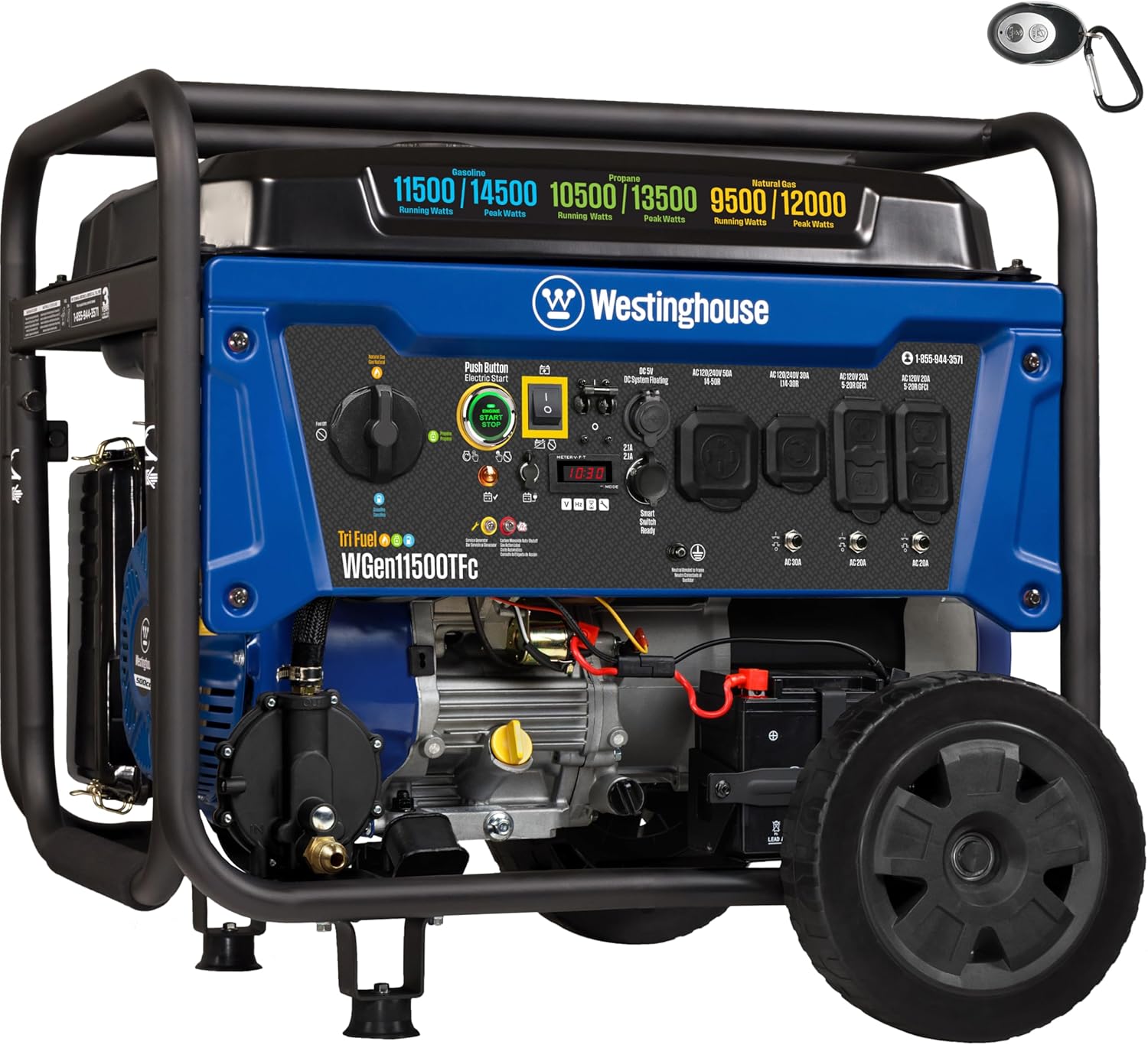
Westinghouse WGen11500TFc Tri-Fuel Portable Generator
This Westinghouse is for buyers who want both high gasoline output and tri-fuel flexibility. It offers 11,500 running watts on gasoline, with lower ratings on propane and natural gas, and a 14-50R outlet for a high-capacity connection. That makes it useful for larger managed home loads, provided the buyer adds up running watts and starting watts before relying on it. The panel also supports transfer-switch-style connections through its locking outlet. The trade-off is not just size: fuel ratings differ, so a load plan that works on gasoline may not work unchanged on propane or natural gas. Confirm the rating for the fuel you will actually use most.
- 11,500 running watts on gasoline
- Tri-fuel flexibility included
- 14-50R for high-capacity connection
- Output falls on propane and natural gas
- Large unit with higher handling needs
4.6/5
4.7/5
4.5/5

Champion 201543 Portable Generator
This Champion is a straightforward high-output gasoline model with a 14-50R outlet. With 11,000 running watts and 14,000 starting watts on gasoline, it has more headroom than many dual-fuel value models for starting motors and running several large loads. Remote start adds convenience, and the transfer-switch-ready locking outlet supports a planned home connection. The clear trade-off is fuel: there is no propane or natural-gas option, so buyers who want a second fuel for long outages should choose a dual-fuel or tri-fuel model instead. It is also a large open-frame unit, so storage, ventilation, and safe placement need planning.
- 11,000 running watts on gasoline
- 14-50R plus remote start
- Transfer-switch-ready locking outlet
- Gasoline only, no propane option
- Large open-frame handling required
4.5/5
4.7/5
4.6/5

DuroMax XP10000E Portable Generator
This DuroMax shows that a 50-amp outlet does not always mean the largest frame. It offers a 120/240V 50-amp outlet alongside 8,000 running watts and 10,000 starting watts on gasoline, which suits managed home backup, RV use, and jobsite tools. The panel includes 30-amp outlets and household outlets, so different cords can be used without relying on one receptacle. The limitation is the same as for most models in this list: the receptacle rating is not the same as continuous output, because 8,000 running watts at 240V is well below 50 amps. It is also gasoline only, so buyers wanting propane should look higher in this list.
- 50-amp outlet at mid-size output
- 8,000 running watts on gasoline
- Multiple outlet types included
- Gasoline only, no dual fuel
- Below 50A continuous at 240V
4.5/5
4.5/5
4.6/5

Champion 201175 Dual Fuel Inverter Portable Generator
This Champion is the inverter choice in a list dominated by open-frame models. It offers a 14-50R outlet, dual-fuel operation, and inverter output that is better suited to sensitive electronics than a conventional open-frame generator. On gasoline it provides 7,000 running watts and 8,500 starting watts, with 6,300 running watts on propane. That makes it a good fit for a smaller RV, managed essentials, and quieter operation, but not for whole-house ambitions. Buyers must be especially careful here: the 50-amp receptacle does not mean 50 amps of continuous power, because 7,000 running watts at 240V is about 29 amps.
- Inverter output for sensitive electronics
- 14-50R plus dual-fuel operation
- More portable inverter design
- Lowest running watts in this list
- 50A receptacle, not 50A continuous output
4.4/5
4.3/5
4.7/5
Top 3 Head-to-Head: WGen12000DF vs XP13000EH vs WGen9500DF
These three are the common final choices because each offers a direct 14-50R outlet, dual fuel, and electric or remote start, but their running watts differ in a way that changes what they can carry.
| Feature | #1 WGen12000DF | #2 XP13000EH | #3 WGen9500DF |
|---|---|---|---|
| 50-Amp Usability | 14-50R, 50A at 240V on gas — Best | 14-50R, 43.75A at 240V on gas | 14-50R, below 50A at 240V |
| Power and Runtime | 12,000 running watts on gas — Best | 10,500 running watts on gas | 9,500 running watts on gas |
| Ease of Use | Remote and electric start | Push-button electric start | Remote and electric start — Best |
| Choose if… | You want full 50-amp capability on gasoline | You want strong dual-fuel home backup | You want a direct 50-amp RV connection |
Who These Generators Are NOT For
A 50-amp outlet does not make every model a whole-house generator, a quiet campsite generator, or a lightweight portable unit.
If you need automatic whole-house backup, a portable generator is also the wrong category. A permanently installed standby system, installed by a professional, is designed for that job. If you only need a few essentials, a smaller generator will be easier to store, move, and fuel.
Common Mistakes to Avoid
These mistakes are common because the outlet rating looks like a promise, but the load plan decides whether it works.
Frequently Asked Questions About Portable Generators with a 50 Amp Outlet
What does a 50 amp outlet on a portable generator mean?
It means the generator has a 120/240V 14-50R receptacle rated for up to 50 amps. It does not guarantee the generator can deliver 50 amps continuously, because that depends on running watts. At 240V, a continuous 50 amps requires 12,000 running watts. Always check both the receptacle type and the running-watt rating before buying.
How many watts do I need for a 50 amp RV?
It depends on what runs at the same time. A single air conditioner, lights, and charging may work well on 7,500 running watts, while two air conditioners need much more headroom. List every load, add running watts, and add starting watts for motors. Manage large loads by staggering them, rather than starting everything at once.
Can I plug a 50 amp generator into my house?
Only through a safe, code-compliant connection, such as a transfer switch, interlock, or home inlet installed by a qualified electrician. Never plug a generator into a household outlet, because that can backfeed power lines and create a serious safety risk. The electrician should confirm the inlet, cord, breaker, and load plan for your home.
Is a 50 amp outlet the same as a 30 amp RV outlet?
No. A 50-amp RV service uses a 14-50R receptacle with 120/240V power, while a 30-amp RV service uses a TT-30R receptacle with 120V power. The plugs, cords, and available power are different. If your RV has a 50-amp inlet, a direct 14-50R connection avoids adapters, but you still need enough running watts for your loads. For a smaller RV, compare 30-amp RV generator options first.
Do I need an inverter generator for a 50 amp outlet?
Not necessarily. Inverter output is useful for sensitive electronics and often runs quieter, but most high-output 50-amp models are conventional open-frame generators. Choose an inverter model if clean power and lower noise matter more than maximum watts. Choose an open-frame model if you need higher running watts for large home or RV loads.
What cord do I need for a 50 amp generator outlet?
You need a cord that matches the generator outlet, the RV inlet or home inlet, the length, and the load. For an RV, that is usually a 50-amp RV cord with a 14-50 plug. For a home, use the inlet and cord specified by your transfer-switch or interlock installer. Check plug shape, gauge, length, and outdoor rating, and never use a damaged cord.
Our Final Verdict
The key trade-off is receptacle versus continuous power: most 14-50R models offer a convenient connection, but only the top pick matches it with 12,000 running watts on gasoline. Choose by running watts for your real loads, not by outlet alone.

Hi, I’m Michael Turner. I own a generator workshop in the United States and founded HomeGeneratorBlog to share practical, hands-on guidance about generator installation, maintenance, troubleshooting, safety, and backup power solutions. My goal is to help homeowners make smarter, more confident decisions through clear and reliable information