Can a 5000W Generator Run a House? What You Can Power
Quick Answer
Yes, a 5,000-watt generator can run the essential loads in many homes, but it usually won’t power an entire house normally. A true 5,000-running-watt generator can often handle a refrigerator, gas-furnace blower, lights, electronics, and selected pumps when you manage loads carefully; see my complete house generator sizing guide if you need broader whole-home coverage.
What a 5,000W generator can usually handle
- Refrigeration: A refrigerator or freezer normally leaves plenty of capacity for other essential loads.
- Gas heating: A gas or oil furnace blower can often run if its startup surge fits the generator.
- Pumps: Many sump pumps and smaller well-pump systems are possible, but starting watts matter.
- Lights and electronics: LED lights, routers, televisions, laptops, and chargers are comparatively light loads.
- Occasional appliances: A microwave or similar appliance may work if heavier loads are temporarily switched off.
- Not everything: Electric dryers, electric water heaters, large central AC systems, and several big appliances together are usually beyond this size.
Check this before deciding
- Make sure “5,000W” means 5,000 continuous or running watts rather than only 5,000 starting watts.
A 5,000-watt generator sits in an interesting middle ground. It’s large enough for a useful emergency-power setup, yet small enough that careless load management can overload it quickly.
Can a 5000W generator really run a house?
Yes, if “run a house” means keeping important circuits and appliances operating during an outage. It usually isn’t enough if you expect every breaker, heating appliance, air conditioner, and kitchen appliance to operate as though utility power never failed.
I treat a 5,000-running-watt machine as an essential-load generator. That means choosing the loads that protect food, heat, water, communication, and basic comfort first.
Definition: A 5,000W generator is a generator capable of supplying about 5,000 watts of electrical output, but you must confirm whether that figure refers to continuous running output or brief starting output.
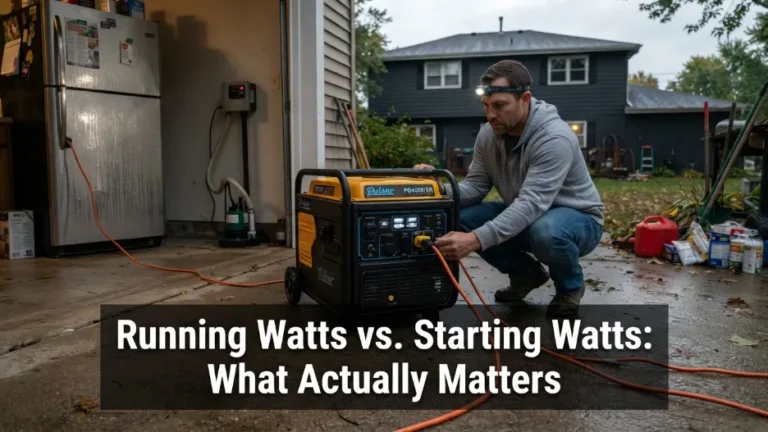
The distinction matters because manufacturers normally publish both numbers. You can review the difference in more detail in my guide to running watts vs. starting watts.
What household appliances can a 5000W generator run?
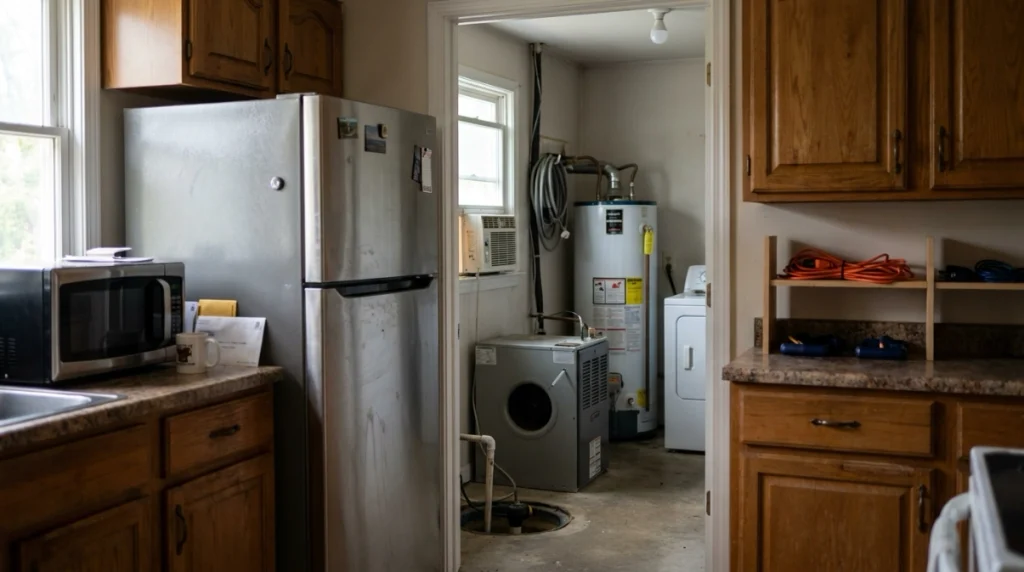
A genuine 5,000-running-watt generator can support a surprisingly useful combination of household essentials. The exact result depends on the appliance nameplates and which motors start at the same time.
The figures below use approximate planning values published in the Honda generator wattage guide. Your own appliance labels should always take priority.
| Household load | Approx. running watts | Approx. starting watts | 5,000W fit? |
|---|---|---|---|
| Energy Star refrigerator/freezer | 132–192W | 1,200W | Easy essential load |
| 1/4 hp furnace fan | 600W | 1,000W | Usually practical |
| 1/3 hp sump pump | 800W | 1,300W | Usually practical |
| 10,000 BTU window AC | 1,500W | 2,200W | Possible with load management |
| 1,000W microwave | 1,500W | 1,500W | Use selectively |
| Electric water heater | 4,500W | 4,500W | Consumes nearly all capacity |
| Electric clothes dryer | 5,400W | 6,750W | No |
What does a realistic 5,000W outage load look like?
Consider a house using a refrigerator, furnace blower, sump pump, LED lighting, Wi-Fi equipment, and a television. Using the approximate figures above, the steady load remains well below 5,000 watts.
- Refrigerator: about 192 running watts
- Furnace blower: about 600 running watts
- Sump pump: about 800 running watts
- LED lighting allowance: about 100 watts
- Router and modem: about 20 watts as a planning example
- Television: about 190 watts for Honda’s listed 46-inch flat screen example
That combination is roughly 1,900 running watts before appliance-specific variations. Even when the sump pump or refrigerator starts, a 5,000W generator has useful headroom.
A microwave changes the picture. Add roughly 1,500 watts, and you’ll want to avoid starting another major motor at that exact moment.
Why do starting watts matter so much?
Motor-driven appliances briefly need more power when they start than when they run. Refrigerators, furnace blowers, pumps, and air conditioners are common examples.
This is why simply adding the running watts can give you the wrong generator size. My basic sizing method is:
- Add the running watts of everything you plan to operate simultaneously.
- Identify the largest startup requirement among those loads.
- Make sure the generator’s surge capacity can absorb that startup event.
- Stagger large loads instead of deliberately starting several motors together.
- Keep some capacity in reserve rather than operating at the limit continuously.
Honda demonstrates the same principle in its power-management guidance. Starting appliances separately can let a smaller generator support a collection of loads that would appear too large if every startup watt were added together.
For the full calculation process, see my generator power capacity guide.
Does “5000 watt generator” mean 5000 running watts?
Not necessarily. This is one of the first specifications I check because the large wattage printed in a product name can represent peak output instead of continuous output.
For example, some generators advertised around the 5,000W class provide only about 4,000 continuous watts. A true 5,000-running-watt model gives you significantly more usable household capacity.
- Running watts: Power the generator can supply continuously.
- Starting watts: Higher output available briefly for startup surges.
- Peak watts: Usually another term for short-duration maximum output.
- Rated watts: Usually the continuous-output figure.
As of 2026, for example, Champion’s model 201602 is rated for 5,000 running watts and 6,250 starting watts on gasoline. Honda’s EM5000SX is a 5,000-watt 120/240V model that can provide additional short-duration starting power.
Can a 5000W generator run an air conditioner?
It can run many window air conditioners, but central air is a different problem. Compressor startup demand determines whether the system will start reliably.
Honda lists about 1,500 running watts and 2,200 starting watts for its 10,000 BTU window-unit example. That leaves room for selected essentials on a true 5,000-running-watt generator.
A large central system can exceed this generator class, especially during compressor startup. I break those loads down separately in my guide to choosing a generator for an air conditioner.
Practical tip: If cooling matters during an outage, a single efficient window unit is often much easier for a 5,000W generator to support than a central HVAC compressor.
What can’t a 5000W generator run comfortably?
High-wattage electric heating and large motor loads are the biggest limitations. A 5,000W unit works best when your home uses gas or another fuel for major heating duties.
- Electric clothes dryer: Honda’s example requires about 5,400 running watts, already beyond a 5,000W generator.
- Electric water heater: Around 4,500 watts can consume almost the generator’s entire continuous capacity.
- Multiple electric range elements: One 8-inch element can use about 2,100 watts.
- Large central air conditioner: Compressor startup can exceed available surge capacity.
- Several pumps together: Overlapping motor starts may trip the generator even when steady wattage appears acceptable.
This is why fuel type inside the house matters. A home with a gas furnace, gas water heater, and gas range is much easier to support with 5,000 watts than an all-electric home.
Do you need 120V or 240V output to run a house?
A 120/240V generator is usually more useful for residential backup because some pumps and hardwired circuits require 240 volts. Wattage alone does not guarantee that the generator can supply the voltage and receptacle your equipment needs.
At 240 volts, 5,000 watts equals roughly 20.8 amps of total power. The generator’s individual receptacles and breakers may impose their own limits.
- Check whether your generator produces 120V only or 120/240V.
- Check whether your required appliance is 120V or 240V.
- Check the generator receptacle and breaker rating.
- Match any inlet, cord, transfer equipment, and household circuit correctly.
How should a 5000W generator be connected to a house?
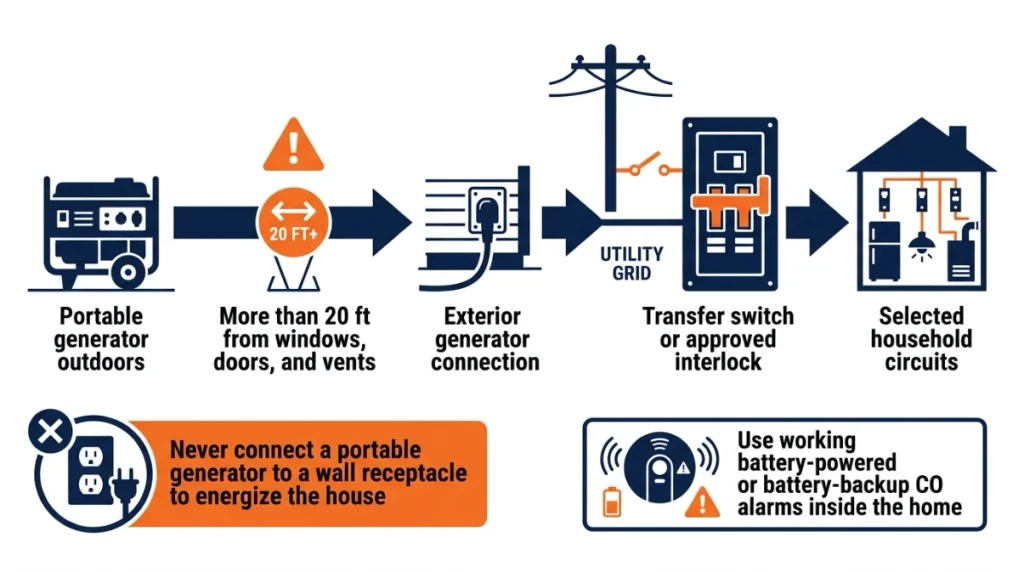
Use properly installed transfer equipment when supplying permanent household wiring. Never connect a portable generator to a wall receptacle to energize the house.
A transfer switch or approved interlock arrangement isolates generator power from utility power. See my portable generator transfer switch guide for the home-side setup.
The U.S. Consumer Product Safety Commission warns that backfeeding through a wall outlet can create an electrocution hazard. Have a qualified electrician handle permanent connections and confirm local code requirements.
Where should you operate the generator?
A portable fuel-burning generator belongs outside, far from occupied buildings. Carbon monoxide is odorless and can become deadly before occupants realize anything is wrong.
The CDC’s current carbon monoxide guidance says to operate a portable generator outdoors more than 20 feet from windows, doors, and vents. Use working battery-powered or battery-backup CO alarms inside the home.
The FEMA generator safety guidance also recommends keeping generators outside and using qualified electrical installation for equipment that connects to household wiring.
How do you calculate whether your own house fits within 5000 watts?
Build the load from your actual appliance labels instead of relying on house size. Two houses with the same square footage can have completely different electrical requirements.
- Choose essential loads. List only the equipment you genuinely need during an outage.
- Record running watts. Read each nameplate or owner’s manual.
- Record starting demand. Pay special attention to compressors, pumps, and fans.
- Add simultaneous loads. Decide which appliances must operate together.
- Compare both generator ratings. Running output must cover steady demand, while surge output must handle motor startup.
If the nameplate lists volts and amps instead of watts, you can estimate a simple load with watts = volts × amps. Motor and compressor sizing can be more complicated, so use manufacturer data whenever possible.
For a second check, an established manufacturer’s generator sizing tool can help compare basic-load and broader whole-home scenarios.
When should you buy a generator larger than 5000W?
Move up in capacity when you want less load management or need several large appliances simultaneously. A 7,500- to 10,000-watt portable generator often provides a more forgiving essentials-plus setup.
I would consider a larger generator when several of these conditions apply:
- You have a well pump plus a sump pump.
- You want air conditioning during the outage.
- Your house uses electric water heating.
- You want to use cooking appliances without switching other loads off.
- You need several 240V circuits.
- You don’t want family members constantly managing the load.
- Your calculated requirement already approaches the generator’s continuous rating.
A larger unit isn’t automatically better. It usually costs more, consumes more fuel, weighs more, and may be noisier.
The goal is enough capacity for the outage plan you will actually use. Don’t size for appliances you have no intention of powering.
5000W generators I’d consider for home essentials
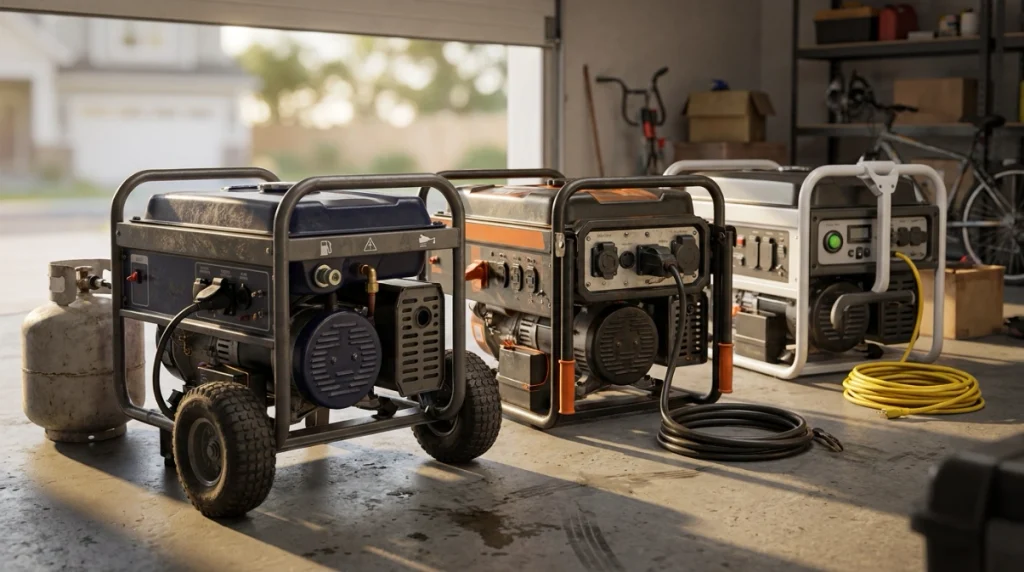
If you’re ready to pick a generator around this capacity, these are three established models I’d put on the comparison list. Confirm your exact outlet, voltage, fuel, and load requirements before buying.
🏆 Best Overall
Champion 201602 5000W Tri-Fuel Generator
★★★★½ 4.7/5
On gasoline, this model delivers 5,000 running watts and 6,250 starting watts, plus 120/240V output and gasoline, propane, or natural-gas operation. I like it for emergency planning because the three fuel choices give homeowners more options when gasoline supply becomes difficult.
⚡ Best Transfer-Switch Ready Pick
Westinghouse WGen5300DFc
★★★★½ 4.6/5
The WGen5300DFc provides 5,300 running and 6,600 peak watts on gasoline, with lower output on propane. Its L14-30R connection, 120/240V capability, dual-fuel operation, and CO sensor make it a practical match for a professionally planned essential-circuit backup system.
🔧 Premium Pick
Honda EM5000SX
★★★★½ 4.6/5
Honda rates the EM5000SX at 5,000 watts with 120/240V output and up to 7,000 watts for 10 seconds to help start larger equipment. I see this as the premium choice when stable output, strong startup capability, electric start, and long-term home-backup use matter more than purchase price.
Frequently Asked Questions
Will a 5000W generator run a refrigerator and freezer?
Yes. A 5,000-running-watt generator normally has ample capacity for a refrigerator and freezer, assuming their starting surges fit within the generator’s peak rating. Check each appliance label because compressor size, age, and design can change the actual demand.
Will a 5000W generator run a furnace?
It can often run the blower on a gas or oil furnace. Honda’s example lists a 1/4 hp furnace fan at about 600 running watts and 1,000 starting watts, but your furnace may differ and hardwired systems require a safe, code-compliant connection.
Can a 5000W generator run a well pump?
Possibly, especially if the generator provides 120/240V output and enough starting capacity. Well-pump requirements vary substantially by horsepower, voltage, depth, and pump design, so verify the motor nameplate before including it in your outage load.
How many appliances can a 5000W generator run at once?
There is no fixed appliance count. Ten small loads may use less power than one electric water heater, so add actual running wattage and account for the largest motor-starting requirement instead of counting devices.
Is 5000 watts enough for whole-house backup?
Usually not in the normal meaning of whole-house backup. Five thousand watts works better for selected essential circuits, while homes needing central air, electric heating loads, pumps, and broad circuit coverage generally require considerably more capacity.
Final Takeaway
A 5,000W generator can run a house during an outage when you define the job as powering essential loads rather than everything at once. Refrigeration, a furnace blower, lights, communications equipment, and selected pumps can make a practical emergency setup.
The deciding factors are your actual running watts, motor-starting surge, voltage requirements, and willingness to manage loads. Check those numbers before buying, and a properly sized 5,000W generator can provide far more useful home backup than its size might suggest.

Hi, I’m Michael Turner. I own a generator workshop in the United States and founded HomeGeneratorBlog to share practical, hands-on guidance about generator installation, maintenance, troubleshooting, safety, and backup power solutions. My goal is to help homeowners make smarter, more confident decisions through clear and reliable information