Is It Legal to Run a Generator All Night? 2026 Guide
Quick Answer
In the United States, running a generator all night is not automatically illegal. However, state or local noise ordinances, neighborhood rules, rental agreements, fire codes, and nuisance laws can restrict nighttime generator operation. Even when overnight use is permitted, follow CDC generator safety guidance and your generator manufacturer’s instructions.
What to check before running it overnight
- Local noise rules: Your city or county may limit nighttime noise or set residential quiet hours.
- HOA or lease rules: Private property rules may be stricter than local law.
- Safe placement: Portable generators should stay outdoors and at least 20 feet from doors, windows, and vents.
- CO protection: Use working battery-powered or battery-backup carbon monoxide alarms inside your home.
- Electrical safety: Never backfeed household wiring through a wall outlet.
- Manufacturer limits: Check runtime, oil, load, maintenance, and refueling requirements for your exact model.
My practical approach
- Before an overnight run, I would check the local noise ordinance, reduce unnecessary electrical loads, test every CO alarm, and confirm the generator can operate for the required period without unsafe refueling.
A generator can feel essential during a long blackout, especially when you need a refrigerator, sump pump, furnace blower, or medical device running overnight.
The legal question is more complicated than a simple yes or no. In 2026, your location, generator type, noise level, property rules, and emergency conditions can all change the answer.
Is It Against the Law to Run a Generator All Night?
There is no single nationwide U.S. rule that simply makes residential generator use illegal after a certain hour. Nighttime restrictions are more likely to come from state laws, city or county ordinances, nuisance rules, zoning provisions, or private community restrictions.
The federal Noise Control Act recognizes that primary responsibility for controlling environmental noise rests with state and local governments.
- City ordinances: May establish nighttime quiet hours or maximum sound levels.
- County rules: Can apply when you live outside incorporated city limits.
- HOA rules: May regulate generator placement, noise, or operating hours.
- Rental agreements: Landlords may prohibit certain fuel-burning equipment.
- Nuisance rules: Excessive or unreasonable noise can sometimes create a violation even without a generator-specific rule.
You can review the federal framework through the Noise Control Act provisions published by Cornell’s Legal Information Institute.
For your exact situation, search your city or county code for terms such as noise ordinance, quiet hours, residential equipment, and emergency generator.
What Rules Can Make Overnight Generator Use Illegal?
Noise is usually the first legal issue to investigate. A generator that is perfectly acceptable during an afternoon outage might violate a nighttime noise standard in the same neighborhood.
Don’t assume every city uses the same hours or decibel limit. Local regulations vary considerably.
| Rule or Requirement | What It May Control | Why It Matters at Night | What to Check |
|---|---|---|---|
| Local noise ordinance | Sound levels, hours, equipment | Nighttime limits may be stricter | City or county code |
| HOA rules | Noise, placement, permanent installations | Private rules can exceed city requirements | CC&Rs and community policies |
| Electrical requirements | Transfer equipment and connections | Improper backfeeding creates serious hazards | Local electrical code and electrician |
| Fire requirements | Fuel storage and equipment location | Fuel and hot-engine risks remain overnight | Local fire authority |
| Manufacturer instructions | Runtime, maintenance, load and clearance | Long operation may require inspection or shutdown | Owner’s manual |
Emergency conditions can also affect enforcement or exemptions. Never assume a storm or utility outage automatically suspends your local noise rules.
Do Noise Ordinances Apply to Generators During a Power Outage?
They can. Whether an emergency generator receives an exemption depends on the wording of the applicable local ordinance.
Some rules distinguish emergency equipment from routine machinery. Other jurisdictions may still require residents to minimize unnecessary disturbance.
- Search the ordinance for an explicit emergency-equipment exemption.
- Check whether the exemption covers portable generators or only permanently installed systems.
- Confirm whether the exemption applies during any outage or only declared emergencies.
- Check whether separate nuisance provisions still apply.
When the rule is unclear, your local code-enforcement office or non-emergency municipal information service is a better source than relying on a neighbor’s interpretation.
How Far Should a Generator Be From the House Overnight?
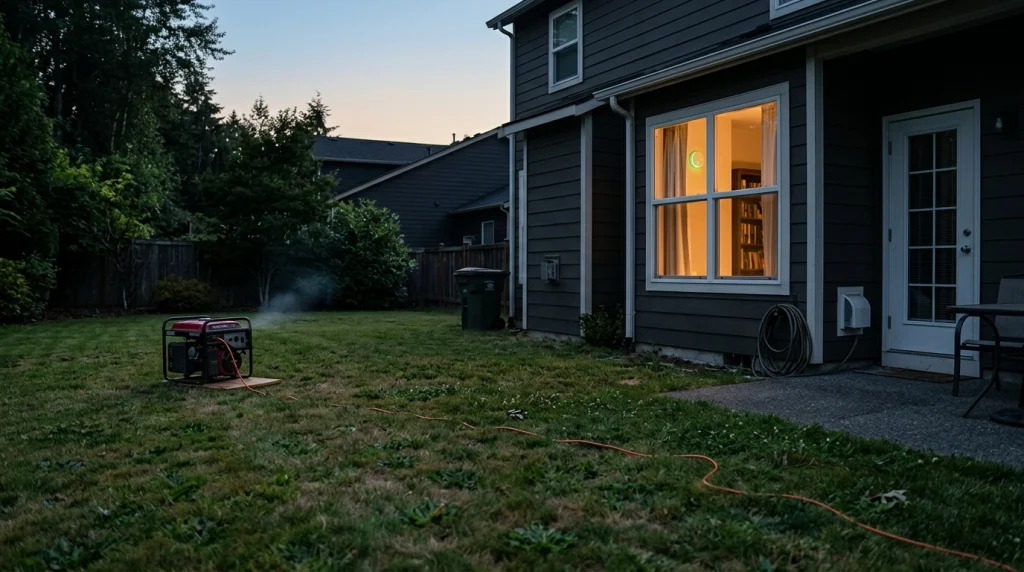
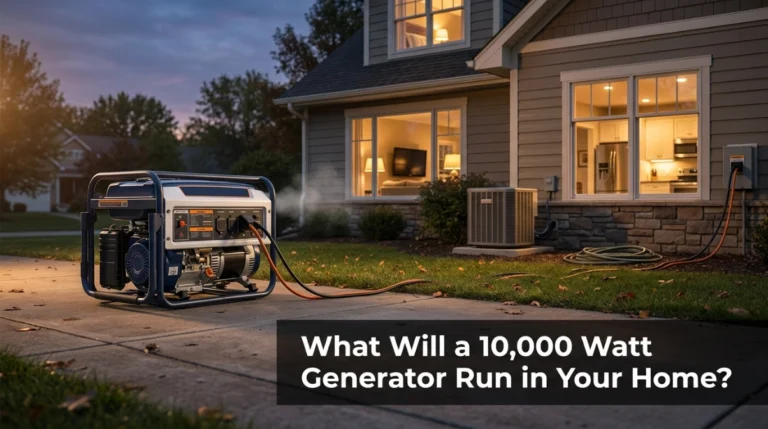
A portable fuel-burning generator should operate outdoors, more than 20 feet from windows, doors, and vents. Its exhaust should face away from the home.
The CDC specifically warns against running a portable generator inside a house or garage, even when doors and windows are open.
- Distance: Keep the generator more than 20 feet from openings into occupied buildings.
- Exhaust direction: Point exhaust away from your home and nearby occupied structures.
- CO alarms: Use battery-powered or battery-backup detectors indoors.
- Ventilation: Never surround the generator with an improvised enclosure that traps exhaust.
- Clearance: Follow the ventilation and cooling clearances in the owner’s manual.
The U.S. Consumer Product Safety Commission also advises keeping portable generators outdoors and at least 20 feet from the home, with exhaust directed away.
That distance is especially important while people are sleeping. Carbon monoxide is colorless and odorless, so you cannot rely on smell to warn you.
Can I Run a Generator in the Garage With the Door Open?
No. An open garage door does not make a garage a safe location for a portable fuel-burning generator.
Carbon monoxide can accumulate inside the garage or move into the home through doors, cracks, attic spaces, and other openings.
- Don’t run it in an attached garage.
- Don’t run it in a detached garage.
- Don’t run it in a basement.
- Don’t run it in a shed.
- Don’t place it on an enclosed porch or carport.
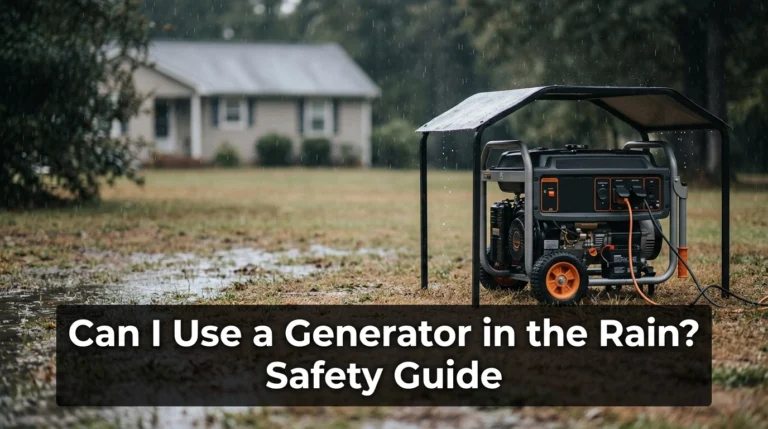
Outdoor placement remains necessary even during rain or cold weather. Use a generator-specific weather solution approved for operation rather than moving the machine into an enclosed area.
Is It Safe to Sleep While a Generator Is Running?
A portable generator shouldn’t be treated like a normal household appliance that you start and forget. Overnight operation adds risk because fewer people are awake to notice changing weather, unusual engine behavior, damaged cords, alarms, or fuel problems.
If continuous power is essential, prepare the entire setup before bedtime.
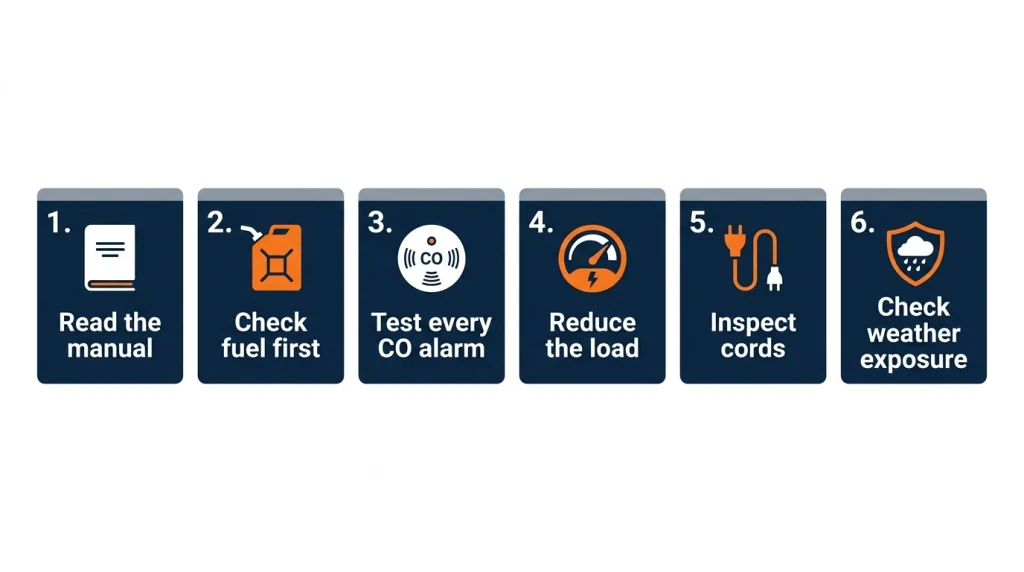
- Read the manual. Confirm your model’s runtime, oil-check schedule, load limits, and maintenance requirements.
- Check fuel first. Avoid planning a middle-of-the-night gasoline refill.
- Test every CO alarm. Backup batteries matter during an outage.
- Reduce the load. Run only equipment you genuinely need overnight.
- Inspect cords. Use grounded, outdoor-rated cords sized for their electrical load.
- Check weather exposure. Keep electrical components dry without trapping exhaust or engine heat.
My practical rule is simple: tank capacity doesn’t decide whether an overnight run is acceptable. The full setup does.
Can You Refuel a Generator During the Night?
Never add gasoline while the generator is running or while the engine is still hot. Shut it down and allow it to cool according to the manufacturer’s instructions.
Spilled gasoline can ignite on hot engine or exhaust components.
The Electrical Safety Foundation International generator guidance also recommends keeping generators dry, avoiding overloads, using appropriate cords, and preventing unsafe household backfeeding.
Can I Plug a Generator Into a Wall Outlet?
No. Connecting a portable generator to a household receptacle to energize your home’s wiring is commonly called backfeeding.
It can energize wiring outside your home and endanger utility workers, neighbors, and anyone handling electrical equipment.
- Plug individual equipment directly into properly rated generator cords when appropriate.
- Use outdoor-rated grounded extension cords for temporary outdoor connections.
- Use an approved transfer system when powering household circuits.
- Have transfer equipment installed by a qualified electrician where required.
A transfer switch separates generator power from utility power. This prevents the two sources from being connected incorrectly.
Portable Generator vs Standby Generator at Night
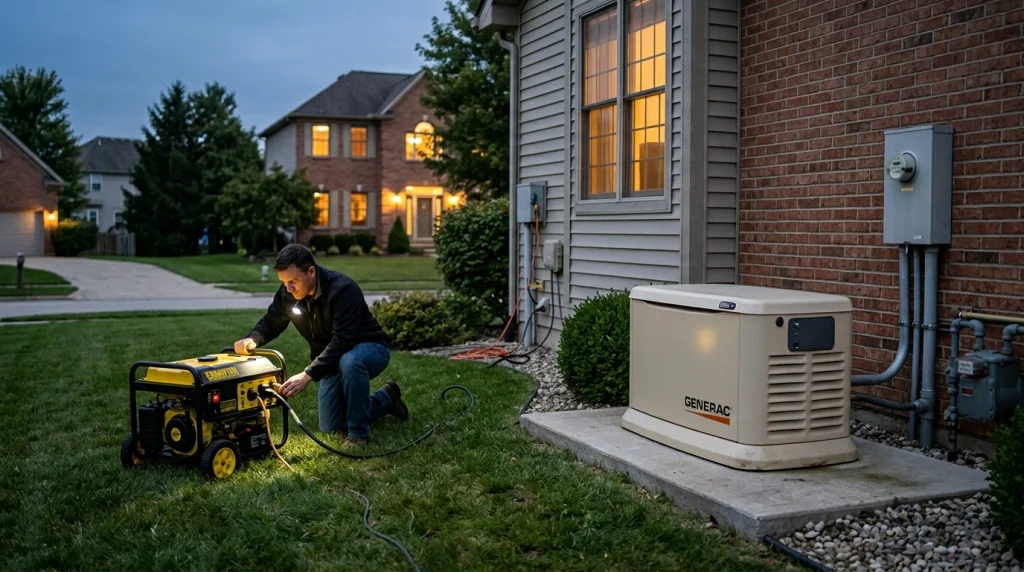
A permanently installed standby generator is fundamentally different from a portable generator. Standby systems are designed around fixed installation, automatic transfer equipment, permanent fuel connections, and manufacturer-required clearances.
Portable generators usually need much more hands-on management.
| Feature | Portable Generator | Standby Generator |
|---|---|---|
| Typical starting | Manual or electric start | Usually automatic |
| Fuel supply | Tank, cylinder, or portable supply | Usually fixed propane or natural gas supply |
| Electrical connection | Cords or approved transfer equipment | Installed transfer system |
| Overnight management | Requires active planning | Designed for automatic outage response |
Neither type is automatically exempt from local noise, installation, zoning, or permit requirements.
How Can You Reduce Generator Noise at Night?
Start by reducing unnecessary electrical load and using the quietest suitable generator. An enclosed inverter generator is often quieter than a large open-frame design.
Don’t solve a noise problem by creating a carbon monoxide problem.
- Never move the generator into a garage or shed to make it quieter.
- Never move it closer to the house so neighbors hear less noise.
- Keep exhaust and cooling airflow unobstructed.
- Use manufacturer-approved weather or sound-management accessories.
- Position the generator farther from neighboring sleeping areas when safe placement allows.
- Reduce nonessential electrical loads overnight.
Before building any sound barrier, check your generator manual. A poorly designed enclosure can trap heat or exhaust.
A Simple Overnight Generator Checklist
Before I would consider an overnight run, I would want every item below checked. Missing one of the safety basics is a reason to correct the setup first.
- Local nighttime generator and noise rules checked
- HOA or lease restrictions checked
- Generator outdoors and more than 20 feet from openings
- Exhaust pointed away from occupied buildings
- Working CO alarms with battery backup
- Dry, stable generator location
- Correct outdoor-rated electrical cords
- No backfeeding through a household outlet
- Electrical load below the generator’s continuous rating
- Enough fuel for the planned runtime
- No need for unsafe hot refueling
- Oil and maintenance requirements checked
If you’re setting up emergency power, a few pieces of safety equipment can make the system easier to manage.
🏆 Best for Power Outages
Kidde COP Plug-In Carbon Monoxide Alarm
★★★★★
This model plugs into an outlet and uses AA batteries for backup power during an outage. I like battery backup for generator situations because CO monitoring shouldn’t disappear when utility electricity does.
🔋 Best Battery Option
Kidde COBD10 Carbon Monoxide Alarm
★★★★☆
The COBD10 uses a 10-year battery and includes a digital display. A battery-powered design is practical during extended outages because it does not depend on a powered wall receptacle.
🔌 Best Heavy-Duty Cord
Southwire 10/3 SJTW 50-Foot Outdoor Extension Cord
★★★★☆
Southwire lists 10/3 SJTW 50-foot outdoor cords rated for 125 volts and 15 amps in its current cord range. I prefer a properly sized outdoor cord over trying to stretch a lightweight indoor cord to a safely positioned generator.
Frequently Asked Questions
Can my neighbor legally run a generator all night?
Your neighbor may be allowed to operate a generator overnight, but local noise ordinances, nuisance rules, HOA requirements, and emergency exemptions can affect the answer. Check the city or county code that applies to the property rather than assuming all nighttime generator use is legal or illegal.
Can I run a generator from 10 p.m. to 6 a.m.?
Possibly, but the exact hours matter only in relation to your local rules. Some communities use nighttime noise limits or quiet-hour provisions. Check the applicable ordinance and any HOA or rental restrictions before planning routine overnight operation.
Can I run a generator all night during an emergency?
An outage or emergency does not automatically cancel every local rule. Some jurisdictions provide exceptions for emergency equipment, while others use narrower definitions. You still need safe outdoor placement, working CO alarms, proper electrical connections, and compliance with the generator manufacturer’s instructions.
Is it safe to run a generator outside my bedroom window?
No. A portable generator should not sit next to a bedroom window. CDC guidance says to operate portable generators outside and more than 20 feet from windows, doors, and vents, with exhaust directed away from the building.
Can a quiet generator be used all night?
Lower noise can reduce disturbance, but a quiet generator is not automatically legal or safe for unrestricted overnight use. Local rules still apply, and fuel-burning generators still require correct placement, CO protection, electrical safety, weather protection, and manufacturer-approved operating practices.
Bottom Line: Is It Legal to Run a Generator All Night?
Running a generator all night can be legal, but legality depends heavily on where you live. Your city, county, HOA, lease, and local nuisance rules may regulate nighttime noise or generator operation.
Legal permission also doesn’t replace safe operation. Keep portable generators outdoors, more than 20 feet from doors, windows, and vents, point exhaust away, use working CO alarms, avoid backfeeding, and follow the exact instructions for your generator.
Before the next outage, check your local rules while the lights are still on. A few minutes of preparation can prevent a noise complaint, unsafe midnight refueling, or a far more serious carbon monoxide or electrical emergency.

Hi, I’m Michael Turner. I own a generator workshop in the United States and founded HomeGeneratorBlog to share practical, hands-on guidance about generator installation, maintenance, troubleshooting, safety, and backup power solutions. My goal is to help homeowners make smarter, more confident decisions through clear and reliable information