What Size Generator Will Run a House? 2026 Sizing Guide
Quick Answer
Most homes need a 5,000- to 8,500-watt generator to keep essential appliances running during an outage. A larger home that needs central air, pumps, electric water heating, or many circuits may need 10,000 to 20,000+ watts, so calculate your actual generator power capacity before buying.
Typical generator sizes for a house
- 3,000-4,500 watts: Refrigerator, lights, internet equipment, chargers, and a few small appliances.
- 5,000-7,500 watts: Typical emergency essentials including a refrigerator, furnace blower, sump pump, and lighting.
- 7,500-10,000 watts: More household circuits, a well pump, window air conditioner, or occasional kitchen loads.
- 10,000-14,000 watts: Higher-demand homes with several large loads and carefully managed air conditioning.
- 14,000-22,000+ watts: Typical territory for whole-house standby backup with central air and fewer compromises.
Before choosing a size
- Check the nameplates: Your appliances’ real wattage matters more than home square footage.
- Allow for startup: Pumps, refrigerators, and air conditioners briefly draw extra power when their motors start.
If you’re trying to figure out what size generator will run a house, don’t start with square footage. Start with the appliances and circuits you can’t afford to lose during an outage.
I’ve seen homeowners buy oversized generators they barely load and smaller units that trip as soon as a pump starts. This guide shows you a practical way to land between those two mistakes.
What Size Generator Will Run a Typical House?
A typical house can often run its outage essentials on 5,000 to 8,500 running watts. Full-home comfort requires considerably more power, especially when central air conditioning or electric heating enters the calculation.
The important word is simultaneously. You don’t need enough generator capacity for every appliance you own unless you truly intend to run everything together.
A homeowner willing to rotate a microwave, coffee maker, and window air conditioner can use far less generator than someone expecting the house to operate normally.
| Backup goal | Useful generator range | Typical loads |
|---|---|---|
| Basic essentials | 3,000-4,500 W | Fridge, lights, router, TV, chargers |
| Standard home outage | 5,000-7,500 W | Above plus furnace blower and sump pump |
| Higher-demand backup | 7,500-10,000 W | Well pump, more circuits, window AC, limited kitchen use |
| Large portable setup | 10,000-14,000 W | Multiple large loads with active load management |
| Whole-house standby | 14,000-22,000+ W | Central AC plus broad panel coverage |
These ranges are planning guides, not substitutes for appliance specifications. A house with gas heat can have dramatically lower electrical demand than the same-sized house with electric resistance heat.
How Do I Calculate What Size Generator I Need?
Add the running watts for everything you want operating together. Then account for the largest additional startup surge from any motor-driven appliance.
This is easier once you understand running watts versus starting watts. Running watts are continuous demand, while starting watts cover a short motor-starting spike.
- List your essential loads. Include refrigerators, pumps, heating equipment, lighting, communication gear, and cooling equipment you expect to use.
- Find each running wattage. Check the appliance label, manual, or manufacturer’s specifications.
- Add simultaneous running loads. Don’t include appliances you plan to keep switched off.
- Find the largest startup requirement. Focus on compressors and motors such as refrigerators, pumps, and air conditioners.
- Add only the extra surge. If an appliance uses 400 running watts and 1,200 starting watts, its additional startup demand is 800 watts.
- Leave reasonable headroom. Avoid selecting a unit that must sit at its maximum continuous rating whenever your normal outage loads are operating.
A realistic sizing example
Suppose I want to run a refrigerator, furnace blower, sump pump, lights, Wi-Fi equipment, and a television. Using planning estimates, my simultaneous running load might total about 2,500 watts.
If the largest motor adds roughly 1,500 watts above its normal running draw during startup, I need approximately 4,000 watts of short-term capacity. Moving into the 5,000-watt class gives me much better breathing room.
How Many Watts Do Common Household Appliances Use?
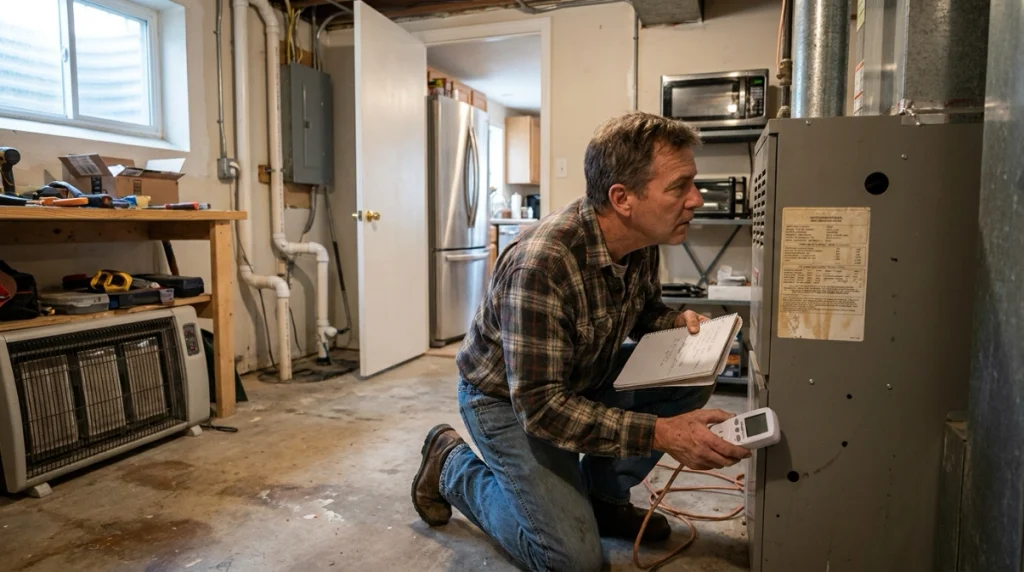
Household wattage varies by model, age, efficiency, and motor size. The figures below are useful planning ranges, but always check your specific equipment before buying a generator.
| Appliance | Typical running watts | Possible starting demand |
|---|---|---|
| Refrigerator/freezer | 150-400 W | 800-1,200 W |
| 1/3 HP sump pump | 800-1,050 W | 1,300-2,150+ W |
| 1/2 HP well pump | 1,000-1,500 W | 2,000-3,500+ W |
| Gas-furnace blower | 300-800 W | 1,000-2,350 W |
| Window air conditioner | 700-1,500 W | 1,800-3,600+ W |
| Microwave | 600-1,500 W | Usually limited extra surge |
| Portable space heater | About 1,500 W | Minimal startup surge |
Resistive electric heat is one of the fastest ways to consume generator capacity. An electric water heater, range, clothes dryer, or several space heaters can push a seemingly modest home into a much larger generator class.
What Size Generator Do I Need to Run Central Air?
Central air conditioning can become the largest electrical load in the house. Compressor startup demand is why a generator that handles the rest of the home may still fail when the AC tries to start.
Don’t size central air from tonnage alone. Check the condenser data plate and use the manufacturer information, especially when locked-rotor or starting-current data is available.
- Window AC: Often practical with a 3,000- to 5,000-watt generator when other loads are controlled.
- Mini-split: Many efficient systems have manageable running demand, but model-specific startup behavior still matters.
- Central AC: Frequently pushes the overall backup requirement into the 10,000-watt-and-up range.
- Large central systems: May be better matched with a professionally sized standby generator or approved load-management system.
If cooling is a priority, use my more detailed guide to generator sizing for an air conditioner before selecting a unit.
Is a Portable or Standby Generator Better for a House?
A portable generator usually makes sense when you want to keep essential circuits alive at a lower upfront cost. A standby generator makes more sense when you want automatic operation and broad whole-home coverage.
| Feature | Portable generator | Standby generator |
|---|---|---|
| Typical role | Essential or managed loads | Automatic home backup |
| Starting | Manual or electric start | Automatic |
| Fuel | Gasoline, propane, or multi-fuel | Usually natural gas or propane |
| Connection | Cords or properly installed transfer equipment | Permanent transfer system |
If you’re connecting a portable generator to household circuits, read the guide to choosing a portable generator transfer switch. A qualified electrician should handle equipment connected to your electrical panel.
How Do You Use a House Generator Safely?
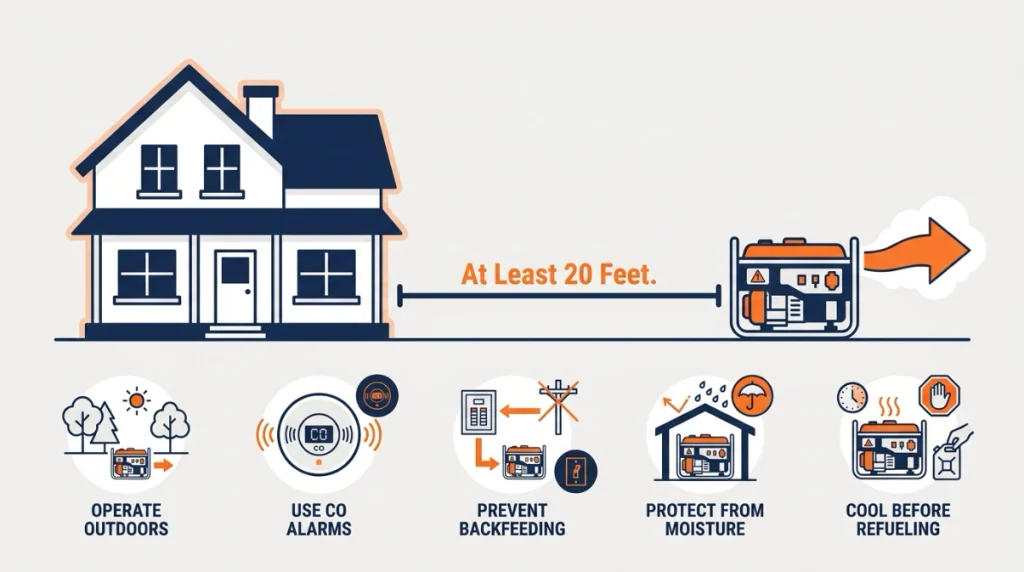
Correct sizing doesn’t make an unsafe installation safe. Fuel-powered portable generators create carbon monoxide, electrical, fire, and backfeeding hazards when used incorrectly.
The U.S. Consumer Product Safety Commission says portable generators should be operated outside, at least 20 feet from the home, with exhaust directed away from the building.
- Keep it outdoors: Never operate a fuel-burning generator in a garage, basement, shed, crawlspace, or other enclosed area.
- Use CO alarms: Install and maintain carbon monoxide alarms in the home.
- Prevent backfeeding: Never improvise a connection from a generator into a household wall outlet.
- Protect against moisture: Follow the generator manufacturer’s wet-weather instructions.
- Let it cool: Shut the generator off and allow it to cool before refueling.
OSHA’s portable generator safety guidance warns against connecting a generator directly to a building’s electrical system without a properly installed transfer switch.
The EPA’s power-outage guidance also emphasizes outdoor generator use and carbon monoxide protection. FEMA provides additional generator safety guidance for homes.
For practical setup distances and placement examples, see my guide on where to place a portable generator.
What Size Generator Should I Buy in 2026?
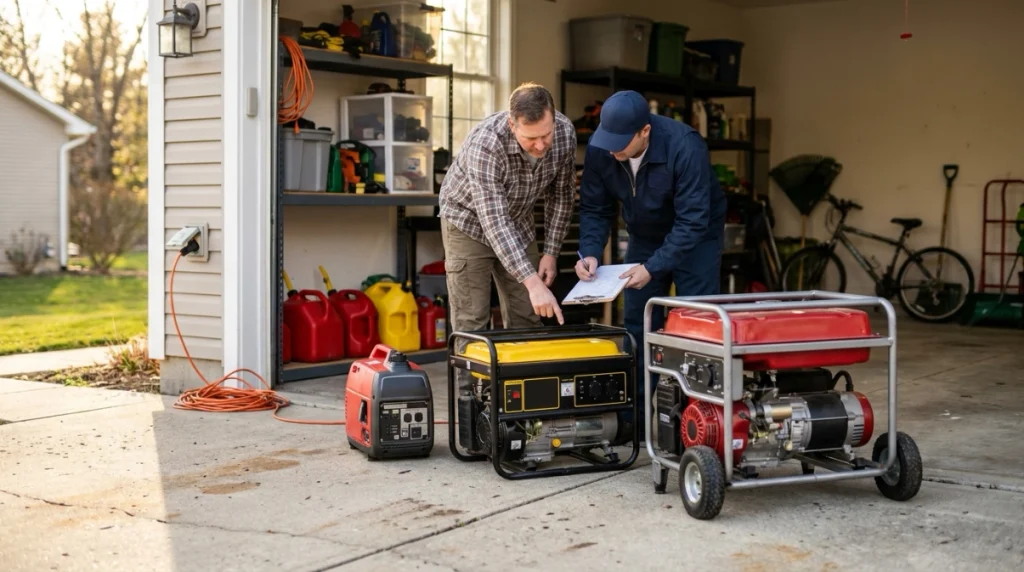
For most homeowners who only want dependable emergency power, I would start by calculating the fridge, heating blower, pumps, lighting, communications, and one comfort load. That usually produces a more sensible answer than trying to back up every circuit.
If you’re ready to shop after doing that calculation, these three generator classes cover useful points on the home-backup spectrum.
🔌 Best for essentials
Westinghouse iGen4500DF
★★★★☆ My fit rating: 4.4/5
It provides 3,700 running and 4,500 peak watts on gasoline, with lower output on propane. I like this class for refrigerators, electronics, lighting, and modest 120-volt backup rather than 240-volt whole-panel loads.
🏆 Best for most homes
Champion 201121 Tri-Fuel
★★★★★ My fit rating: 4.7/5
On gasoline it supplies 8,000 running and 10,000 starting watts, while also supporting propane and natural gas. The 120/240-volt output and fuel flexibility make this the class I’d look at first for a serious essentials-focused home backup setup.
⚡ Best for higher demand
DuroMax XP13000HXT
★★★★☆ My fit rating: 4.5/5
This tri-fuel model is rated at 10,500 running and 13,000 peak watts on gasoline, with 120/240-volt output. I see it as a better fit when pumps, more household circuits, and larger intermittent loads push you beyond the normal 7,500- to 8,500-watt class.
Frequently Asked Questions
Will a 5,000-watt generator run a house?
A 5,000-watt generator can run essential loads in many homes, including a refrigerator, lights, electronics, and some heating or pumping equipment. It usually won’t support central air, electric water heating, an electric range, and other large loads simultaneously.
Will a 7,500-watt generator run a whole house?
A 7,500-watt generator can provide substantial emergency backup if you manage your loads. It can often support a refrigerator, furnace blower, sump or well pump, lights, and selected appliances, but calling it true whole-house power would be misleading for many homes.
What size generator do I need for a 2,000-square-foot house?
Square footage doesn’t determine generator size by itself. A 2,000-square-foot home may need 5,000-8,500 watts for essentials, while the same-sized house could need much more if it has central air, electric water heating, large pumps, or electric space heating.
Is a 10,000-watt generator enough for a house?
A 10,000-watt generator gives many homeowners enough capacity for extensive emergency backup and selective large loads. You still need to calculate startup demand and avoid operating too many high-wattage appliances at once, particularly central AC, electric dryers, ranges, and water heaters.
Can I plug a generator directly into my house?
Don’t connect a portable generator to household wiring through a normal wall receptacle. If you want to power circuits through your electrical panel, use properly approved transfer or interlock equipment installed according to applicable codes and manufacturer requirements.
Final Takeaway
For most houses, 5,000 to 8,500 watts is the practical starting range for emergency essentials. Homes expecting central air and broad whole-house coverage commonly move into 10,000- to 22,000-watt territory or beyond.
Make your appliance list first, calculate simultaneous running demand, account for the largest extra motor-starting surge, and then choose reasonable headroom. That simple worksheet is far more reliable than buying a generator based on house size alone.
Once you know your number, match the generator’s voltage, outlets, fuel type, connection method, and safety features to the way you actually plan to use it. You’ll spend less money and have a backup system that’s much easier to live with when the power goes out.

Hi, I’m Michael Turner. I own a generator workshop in the United States and founded HomeGeneratorBlog to share practical, hands-on guidance about generator installation, maintenance, troubleshooting, safety, and backup power solutions. My goal is to help homeowners make smarter, more confident decisions through clear and reliable information