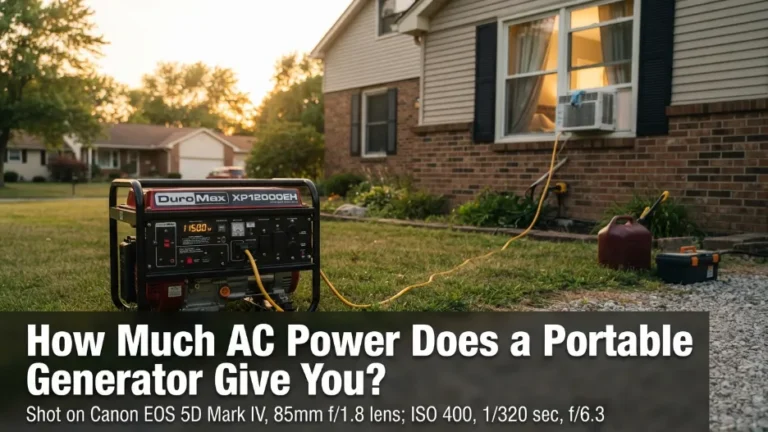
10 Best Predator Portable Generators for 2026: Quiet, Capable Power
The best Predator portable generator is the Predator 3500 Watt Super Quiet Inverter Generator, with 3,000 running watts at a listed 56 dBA. We compared 10 Predator portable generators on Power and Runtime, Quiet Operation, and Value for Money. Most portable generators look similar on paper but fail on starting watts, noise, or fuel runtime in real use. Whether you need home backup, RV power, or job-site power, this guide gives you one clear answer.
Quick Comparison: All 10 Products Ranked
| # | Product | Best For | Rating | Badge | |
|---|---|---|---|---|---|
| 1 | Predator 3500 Watt Super Quiet Inverter Generator | RV and home essentials | 4.9/5 | Best Overall | Buy → |
| 2 | Predator 5000 Watt Dual-Fuel Super Quiet Inverter Generator | Gas or propane backup | 4.8/5 | Best Dual-Fuel | Buy → |
| 3 | Predator 2000 Watt Super Quiet Inverter Generator | Light camping and electronics | 4.7/5 | Best Lightweight | Buy → |
| 4 | Predator 9500 Watt Super Quiet Inverter Generator | Large home backup | 4.7/5 | Best Whole-Home Inverter | Buy → |
| 5 | Predator 13000 Watt Tri-Fuel Portable Generator with Remote Start | Maximum fuel flexibility | 4.6/5 | Best Tri-Fuel | Buy → |
| 6 | Predator 9000 Watt Portable Generator | Job sites and outages | 4.6/5 | Best Job Site | Buy → |
| 7 | Predator 6500 Watt Portable Generator | Straightforward home backup | 4.5/5 | Best Value Backup | Buy → |
| 8 | Predator 4550 Watt Open-Frame Inverter Generator | Lighter inverter power | 4.5/5 | Best Open-Frame Inverter | Buy → |
| 9 | Predator 2500 Watt Super Quiet Inverter Generator | Compact camping power | 4.5/5 | Best Compact Inverter | Buy → |
| 10 | Predator 4375 Watt Portable Generator | Simple outage backup | 4.4/5 | Best Budget Conventional | Buy → |
How We Chose These Generators
What we compared
Listed starting and running watts, fuel type, listed noise, weight, outlets, and runtime claims for 10 Predator models.
Our 3 scoring criteria
Power and Runtime, Quiet Operation, and Value for Money, applied identically to every model.
What we did not do
No hands-on testing, no test duration, and no expert consultation are claimed in this guide.
What we cut — and why
Discontinued or duplicate wattage variants were cut to keep the list to 10 distinct, current-style Predator options.
What to Look for When Buying a Predator Portable Generator
Start with the loads you must run, not the biggest number on the box. Starting watts matter for motors, running watts matter for everything else, and both must fit your plan.
1. Running watts versus starting watts
Add the running watts of every item you will run at once, then add the largest single starting surge. If that total exceeds the generator rating, something will trip or fail to start. A fridge, a freezer, lights, and a phone charger are a very different load from a well pump or a large air conditioner, so check nameplates rather than guessing.
This matters most for home essential generator planning, where rotating loads is often the practical answer.
2. Inverter versus conventional power
Inverter models produce cleaner power for laptops, phones, and modern electronics, and they usually run quieter because the engine speed follows the load. Conventional open-frame models are often simpler and stronger for the wattage, but they are louder and less suited to sensitive electronics. Choose the inverter route when electronics and noise matter most.
For a broader comparison, see these inverter generator buying guides before deciding on a closed-frame model.
3. Fuel type and runtime
Gasoline is widely available, propane stores longer and runs cleaner, and tri-fuel adds natural gas for a fixed home connection. Runtime figures are usually quoted at a stated load, often 25 percent or 50 percent, so compare them at the same load. A larger tank helps, but only if you can safely store and handle that fuel.
4. Noise, weight, and portability
Listed decibels are measured under specific conditions, so use them to compare models, not as a promise for your campsite or yard. Weight matters just as much: a 250-plus-pound unit needs a ramp, a second person, or a fixed spot, while a sub-50-pound inverter can be carried by one person. Wheels and handles help on flat ground, not on stairs or soft soil.
5. Outlets, start type, and safety
Check for the outlets you actually need, including 120-volt household outlets, a 240-volt outlet for larger loads, USB charging, and a transfer-switch-ready connection where relevant. Electric and remote start help in cold weather and for larger engines, while recoil start keeps smaller units simpler. Never run a generator indoors, in a garage, or near open windows, even with a carbon monoxide shutoff.
Safety features are covered in more detail in guides to portable generators with CO shutoff.

Predator 3500 Watt Super Quiet Inverter Generator — Quiet RV-ready balance
Best for: RV and home essentials
For most RV owners and outage planners, the 3500 hits a practical middle ground. It offers enough running power for a small RV air conditioner plus lights and charging, without moving into the heavy, louder class above it. Its closed-frame inverter design keeps listed noise low, its electric start avoids repeated pulls in cold weather, and its clean inverter output suits phones, laptops, and televisions. The trade-off is clear: it will not run a whole house at once, so larger loads must be rotated. Still, for one versatile unit, this is the easiest Predator to recommend first.
- 3,000 running watts, 3,500 starting watts
- Listed 56 dBA, closed-frame quiet design
- Electric start with recoil backup
- Clean inverter power for sensitive electronics
- Cannot run a whole house simultaneously
- 102 pounds needs wheels and planning
- Gasoline only, no dual-fuel option
4.8/5
4.9/5
4.9/5

Predator 5000 Watt Dual-Fuel Super Quiet Inverter Generator — Flexible fuel backup
Best for: Gas or propane backup
When fuel choice matters as much as wattage, this dual-fuel inverter is the stronger step up from the 3500. On gasoline it offers 3,900 running watts, enough for a fridge, freezer, lights, and selected tools with careful load management. On propane it trades a little power for longer storage life and cleaner handling, which suits outage kits kept ready for months. Its closed-frame design keeps noise moderate for its size, and remote start adds convenience during bad weather. The cost is weight and size: at about 110 pounds, it is a two-person lift onto a truck bed.
- Dual-fuel gasoline and propane operation
- 3,900 running watts on gasoline
- Remote start for bad-weather convenience
- Clean inverter power for electronics
- Lower output on propane than gasoline
- About 110 pounds, less truly portable
- No natural gas connection option
4.9/5
4.7/5
4.8/5
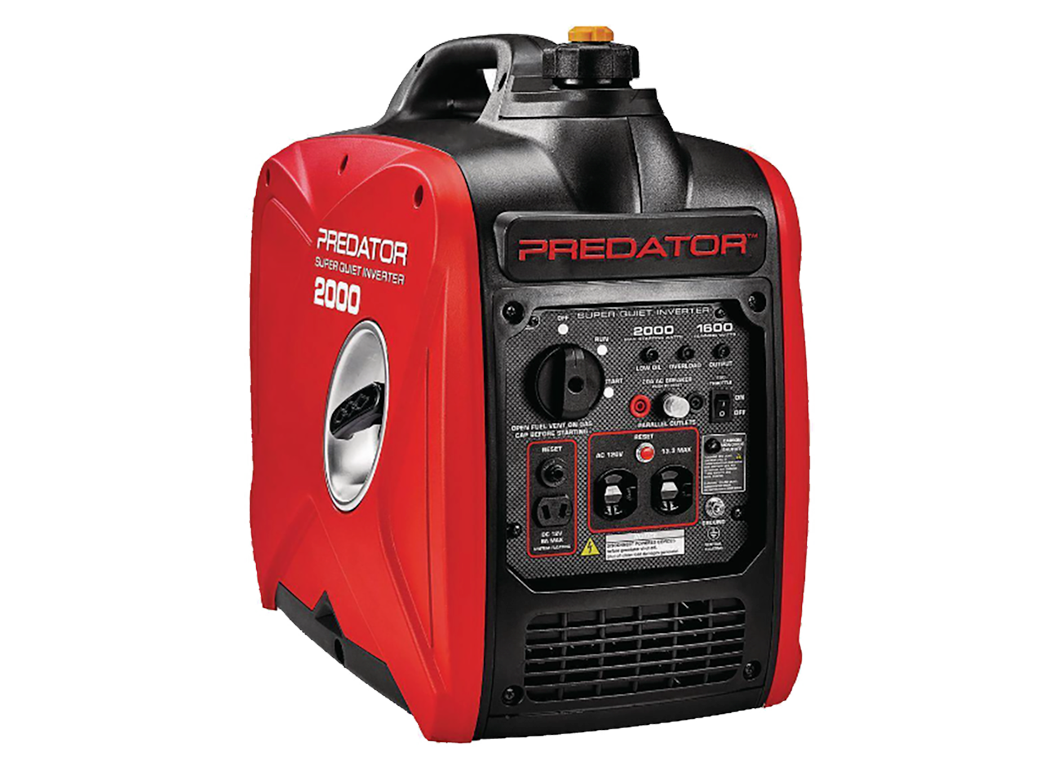
Predator 2000 Watt Super Quiet Inverter Generator — Carry-it-anywhere power
Best for: Light camping and electronics
If your loads are small, this is the Predator that disappears into a trip rather than dominating it. At about 49 pounds, it is easy to carry to a campsite, tailgate, or cabin, and its inverter output safely charges phones, laptops, cameras, and small fans. Its economy mode stretches fuel by slowing the engine under light loads, which matters on a quiet night. The limit is obvious: with 1,600 running watts, it cannot start a large air conditioner or run a full kitchen. Pairing two units with a parallel kit is the honest upgrade path, not overloading one.
- About 49 pounds, truly carryable
- Clean inverter power for electronics
- Economy mode extends light-load runtime
- Parallel capable for doubling power
- Only 1,600 running watts
- No electric start on base model
- Parallel kit sold separately
4.3/5
4.9/5
4.8/5
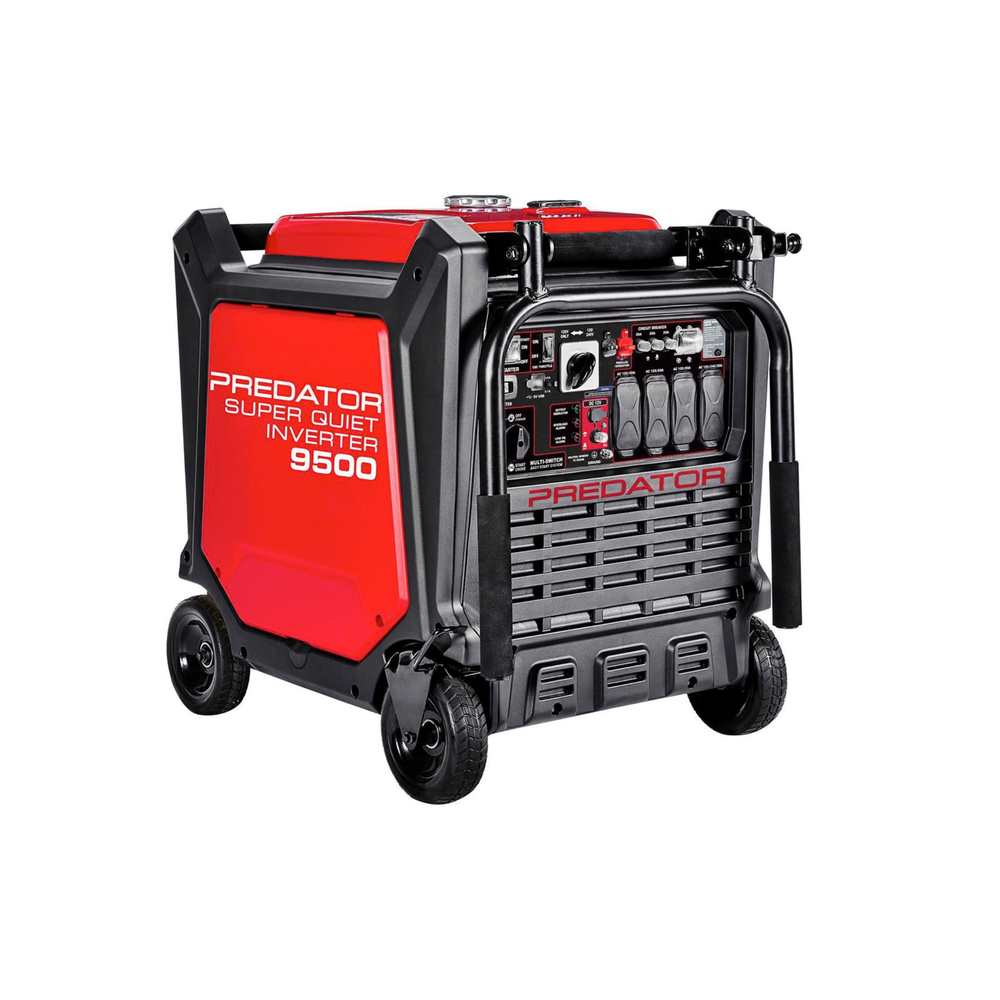
Predator 9500 Watt Super Quiet Inverter Generator — Big inverter power
Best for: Large home backup
For a home that needs more than essentials, the 9500 is the Predator inverter that changes the conversation. With 7,600 running watts, it can hold a fridge, freezer, well pump, lights, and selected heating or cooling loads with proper planning and a safe connection method. Its closed-frame design is far quieter than a conventional generator of similar output, and its inverter power suits electronics. The drawback is physical: at about 257 pounds, it is not a camping generator, and moving it needs planning, a ramp, and help. Buy it for backup, not for carrying.
- 7,600 running watts, 9,500 starting watts
- Closed-frame, quieter than open-frame rivals
- Electric start with recoil backup
- Clean inverter power for electronics
- About 257 pounds, very heavy
- Gasoline only, no dual-fuel option
- Not suitable for light camping trips
5.0/5
4.3/5
4.7/5

Predator 13000 Watt Tri-Fuel Portable Generator with Remote Start — Maximum flexibility
Best for: Maximum fuel flexibility
When one fuel cannot be trusted, this tri-fuel model is the Predator to consider first. It runs on gasoline, propane, or natural gas, with 10,000 running watts on gasoline, 9,100 on propane, and 7,800 on natural gas. Remote start means you can start or stop it without walking out in a storm, and its 458cc engine is built for heavy home loads. That flexibility comes with size, noise, and installation planning: natural gas connection needs a qualified installer, and the unit is far from a portable camping choice. For a serious backup plan, though, fuel choice is real insurance.
For comparison, see other remote-start portable generator options.
- Gas, propane, and natural gas
- 10,000 running watts on gasoline
- Remote start with push-button stop
- CO SECURE shutdown technology included
- Lower output on propane and gas
- Natural gas needs professional installation
- Large, loud, and not camping-friendly
5.0/5
4.0/5
4.7/5

Predator 9000 Watt Portable Generator — Strong conventional backup
Best for: Job sites and outages
For tools and a house during an outage, the 9000 offers a straightforward conventional formula: a large 420cc engine, 7,250 running watts, and up to 13 hours at half load. It can run multiple corded tools, a fridge, a water pump, and lights without the complexity of inverter electronics. Its 240-volt outlet suits larger loads and transfer-switch setups, while CO SECURE adds a safety layer outdoors. The trade-offs are noise, weight, and power quality: it is louder than inverter models, heavier to move, and not the first choice for sensitive electronics alone.
- 7,250 running watts, 9,000 starting watts
- Up to 13 hours at half load
- 420cc engine for tools and backup
- CO SECURE shutdown technology included
- Louder than inverter models
- Not ideal for sensitive electronics alone
- Heavy open-frame unit to move
4.8/5
4.2/5
4.8/5
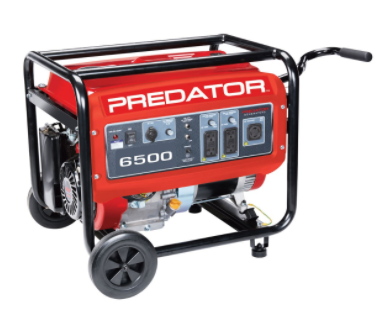
Predator 6500 Watt Portable Generator — Simple, long-running backup
Best for: Straightforward home backup
If you want backup without inverter complexity, the 6500 is a clear, honest choice. Its 5,500 running watts cover a fridge, freezer, lights, a water pump, and selected tools, and its large tank supports over 14 hours at half load. A 301cc engine keeps the design simple, and its 240-volt outlet helps with larger household loads. It is louder than inverter models and not designed primarily for sensitive electronics, so plan its use around essentials and tools. For a garage-ready outage unit that starts, runs, and refuels simply, it earns its place.
- 5,500 running watts, 6,500 starting watts
- Over 14 hours at half load
- Simple 301cc conventional design
- 240-volt outlet for larger loads
- Louder than inverter models
- Recoil start only on listed model
- Not for sensitive electronics alone
4.6/5
4.2/5
4.8/5

Predator 4550 Watt Open-Frame Inverter Generator — Lighter inverter choice
Best for: Lighter inverter power
If you want inverter power without closed-frame weight, the 4550 is a useful middle path. Its open frame keeps weight near 77 pounds while still delivering 3,650 running watts, enough for a fridge, lights, charging, and selected tools. It is louder than the closed-frame 3500, and it lacks electric start, so buyers must accept recoil starting and more noise for the weight saving. For a truck, workshop, or cabin where clean power matters but a closed case is not essential, that trade is reasonable and easy to understand.
- 3,650 running watts, 4,550 starting watts
- About 77 pounds, lighter than 3500
- Clean inverter power for electronics
- Open frame aids cooling and access
- Louder than closed-frame 3500 model
- No electric start listed
- Open frame offers less noise shielding
4.5/5
4.4/5
4.7/5

Predator 2500 Watt Super Quiet Inverter Generator — Small step up
Best for: Compact camping power
For buyers who find the 2000 slightly too small but still want a compact inverter, the 2500 fills that gap well. It adds headroom for a small fridge, a fan, lights, and charging without jumping to the heavier 3500 class. Its closed-frame design keeps noise low for campsites, and its size still suits a car, a small RV, or a cabin trip. The limit remains the same in principle: it is not a whole-house or large air-conditioner solution, and heavy motor loads still need careful planning. Choose it when portability is the priority and loads are modest.
- More headroom than 2000 model
- Closed-frame quiet inverter design
- Clean power for small electronics
- Still compact for camping trips
- Not for large air conditioners
- Limited whole-house backup ability
- Check exact variant before ordering
4.4/5
4.8/5
4.3/5

Predator 4375 Watt Portable Generator — Simple outage starter
Best for: Simple outage backup
For a first backup generator, the 4375 keeps the decision simple. It offers enough power for a fridge, lights, a fan, and charging during a short outage, without the size, weight, or complexity of the larger Predator models. Its conventional design is easy to understand and maintain, and its 240-volt capability helps with selected household loads. It is louder than inverter models, it is not built for sensitive electronics alone, and larger motor loads still need rotation. For a modest, budget-minded outage plan, it is a sensible starting point, not a whole-house answer.
- Simple conventional backup design
- Enough for fridge and lights
- 240-volt outlet for selected loads
- Smaller than large backup models
- Louder than inverter models
- Not for sensitive electronics alone
- Limited for large motor loads
4.3/5
4.1/5
4.7/5
Top 3 Head-to-Head: Predator 3500 vs Predator 5000 Dual-Fuel vs Predator 2000
These three are the common final choices because they cover the three real decisions: usable power, fuel flexibility, and portability. One is not simply better than the others; each wins a different priority.
| Feature | #1 Predator 3500 | #2 Predator 5000 | #3 Predator 2000 |
|---|---|---|---|
| Running watts | 3,000 watts | 3,900 watts, gasoline — Best | 1,600 watts |
| Listed noise | 56 dBA — Best | 61.7 dBA | About 58 dBA |
| Weight and portability | About 102 pounds, wheeled | About 110 pounds, wheeled | About 49 pounds — Best |
| Choose if… | You want the best balance for RV and essentials | You want propane as a backup fuel | You want the lightest, simplest unit |
Who These Predator Generators Are NOT For
Predator portable generators are a strong value choice, but they are not the right answer for every buyer.
They are also not for indoor use, for running a central air conditioner and a full house at once on a small model, or for buyers who need a dealer network and long on-site service. If quiet operation at a strict campground is the priority, check the site rules and choose a closed-frame inverter, not an open-frame model.
Common Mistakes to Avoid
Most generator regret comes from sizing, fuel, or placement, not from the brand.
Frequently Asked Questions About Predator Portable Generators
What size Predator generator do I need?
Add the running watts of everything you will run together, then add the largest starting surge. A 2,000-watt inverter suits light camping, a 3,500-watt inverter suits an RV and home essentials, and a 9,000-watt or larger model suits heavier backup and tools. When in doubt, list your loads by nameplate wattage before choosing.
Are Predator generators good for RVs?
Yes, the closed-frame inverter models are the best Predator choice for RV use. The 3500 is a common RV pick because it can run a small air conditioner plus lights and charging, while the 2000 and 2500 suit lighter loads. Check your air conditioner size and starting watts, since larger units may need a bigger generator or a soft-start device.
Can a Predator generator power a house?
A larger Predator can power selected house circuits, but not usually a whole house at once. Use a transfer switch, inlet, or interlock installed by a qualified electrician, and rotate large loads such as a water heater or central air conditioner. Small models are best for essentials only, such as a fridge, freezer, lights, and charging.
How loud is a Predator generator?
Noise varies widely by model and load. Closed-frame inverters are the quietest, with the 3500 listed at 56 dBA, while open-frame conventional models are noticeably louder. Listed figures are measured under specific conditions, so compare models at the same load and distance, and check campground or neighbourhood rules before buying for quiet use.
Do Predator generators have electric start?
Many larger Predator models have electric start, and some also offer remote start, while smaller inverters are usually recoil start only. Check the exact variant before ordering, since start type can differ within a wattage class. For a broader comparison, see other portable generators with electric start.
Can I run a Predator generator on propane?
Only dual-fuel and tri-fuel Predator models run on propane; gasoline-only models do not. Propane usually gives slightly lower running watts than gasoline, but it stores longer and is easier to keep ready for outages. If propane matters to you, filter the list to dual-fuel or tri-fuel models first, then compare their propane running watts specifically.
Our Final Verdict
Predator’s range rewards a simple choice: pick the 3500 for RV and essentials, step up to dual-fuel or tri-fuel for outage flexibility, and only buy the largest models if you have the space, help, and safe connection to use them. For most buyers, quiet, usable power beats maximum wattage.

Hi, I’m Michael Turner. I own a generator workshop in the United States and founded HomeGeneratorBlog to share practical, hands-on guidance about generator installation, maintenance, troubleshooting, safety, and backup power solutions. My goal is to help homeowners make smarter, more confident decisions through clear and reliable information