Should I Get a Power Station or a Generator? 2026 Guide
Quick Answer
Get a power station if you need quiet, indoor-friendly backup for a refrigerator, electronics, lights, internet equipment, or occasional outages. Choose a fuel generator when you need much more power or expect outages lasting several days, especially if you need pumps, large air conditioners, or many household circuits. Before buying either, calculate how many watts you actually need.
The simplest way to choose
- Choose a power station: You value quiet operation, easy setup, indoor use, and clean power for electronics.
- Choose a generator: You need several thousand watts for long periods and can safely operate it outdoors.
- Short outages: Battery power is usually simpler because there’s no fuel, oil, starting procedure, or engine maintenance.
- Long outages: A generator can keep producing electricity as long as you have fuel.
- Heavy appliances: A conventional generator normally gives you more running and starting wattage for the money.
My practical rule
- For basic emergency loads, I lean toward a 2kWh-class power station. For pumps, central cooling, or multi-day outages, I lean toward a properly sized generator.
If you’re asking whether you should get a power station or a generator, the decision isn’t just about wattage. Runtime, noise, safety, fuel availability, maintenance, and the appliances you want to run matter just as much.
I find the easiest way to make the choice is to start with your outage plan instead of the equipment. Decide what absolutely needs electricity, then choose the power source that handles that load with reasonable headroom.
What Is the Difference Between a Power Station and a Generator?
A portable power station stores electricity in a rechargeable battery and uses an inverter to supply AC power to your appliances. You recharge it from a wall outlet, vehicle, solar panels, or another supported charging source.
A portable generator creates electricity while an engine is running. Most portable models burn gasoline, propane, natural gas, or a combination of those fuels.
That single difference changes almost everything about ownership.
- Power stations store energy: Their runtime is limited by battery capacity.
- Generators produce energy: Their runtime can continue when you add more fuel.
- Power stations have no combustion exhaust: They don’t produce carbon monoxide through normal battery operation.
- Generators have engines: They create exhaust, noise, heat, and require maintenance.
- Generators usually offer more raw output: Large portable units can deliver well over 7,000 running watts.
If terms such as rated, running, surge, and peak watts are confusing, my guide to running watts versus starting watts explains the difference before you size your setup.
Power Station vs Generator: How Do They Compare?
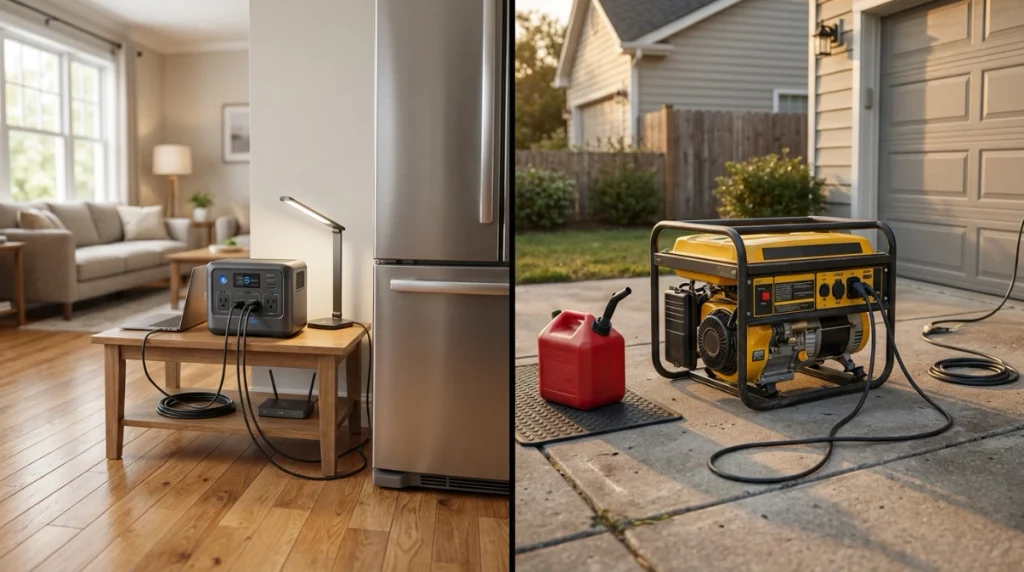
Here’s the comparison I would use before spending money. The exact numbers vary by model, but these differences stay consistent across most products.
| Feature | Portable Power Station | Fuel Generator |
|---|---|---|
| Energy source | Rechargeable battery | Gasoline, propane, natural gas, or diesel |
| Typical use | Electronics, fridge, lights, internet, small appliances | Pumps, refrigerators, HVAC loads, tools, multiple circuits |
| Representative output | EcoFlow DELTA 2 Max: 2,400W continuous, 4,800W surge | Westinghouse WGen9500DFc: 9,500W running, 12,500W peak on gasoline |
| Stored energy | Often measured in watt-hours, such as 2,048Wh | Determined by available fuel |
| Indoor operation | Generally designed for indoor use when manufacturer instructions are followed | No — combustion generators must run outdoors |
| Noise | Usually quiet except for cooling fans | Engine noise while operating |
| Maintenance | Low | Oil, fuel, spark plug, battery, filters, and periodic exercise |
| Refueling | Requires recharging time | Add fuel after safely shutting down and cooling |
Should I Get a Power Station or Generator for a Home Outage?
For a short outage where your priorities are refrigeration, phones, Wi-Fi, lighting, and a television, a power station is often the easier solution. There’s no engine to start and no fuel to store.
For a long outage involving a well pump, sump pump, furnace blower, large air conditioner, or several household circuits, a fuel generator often makes more sense. It gives you much greater continuous output without buying a huge battery bank.
Choose a power station when you need:
- Refrigerator or freezer backup
- Phones, tablets, and laptops
- Wi-Fi modem and router
- LED lights
- Television
- CPAP or other compatible low-watt equipment
- Small cooking appliances used selectively
- Quiet overnight operation
Choose a generator when you need:
- A well or sump pump
- A furnace blower
- Large power tools
- Window or central air conditioning
- Several high-demand appliances
- Extended multi-day backup
- More than several thousand watts continuously
If your goal is broader home coverage, work through my home generator sizing guide before assuming a certain wattage will be enough.
How Long Will a Power Station Run Compared With a Generator?
A power station’s runtime depends on its battery capacity and your average load. A 2,048Wh battery theoretically contains enough energy for a 100-watt constant load for about 20.5 hours, although inverter losses and standby consumption reduce real runtime.
High-power appliances drain batteries much faster. A 1,500-watt heater, kettle, or cooking appliance can consume the usable energy of a 2kWh battery surprisingly quickly.
You can estimate battery runtime with this simple formula:
Battery capacity in Wh ÷ average appliance watts = theoretical runtime in hours.
Generators work differently because you aren’t limited to energy stored inside a battery. You can operate them again after refueling, assuming you have a safe fuel supply and follow the manufacturer’s shutdown and refueling instructions.
For example, Westinghouse lists up to 12 hours of runtime at 25% load for its WGen9500DFc on a 6.6-gallon gasoline tank. Actual runtime changes with load, fuel, weather, and operating conditions.
Which One Is Safer During a Power Outage?
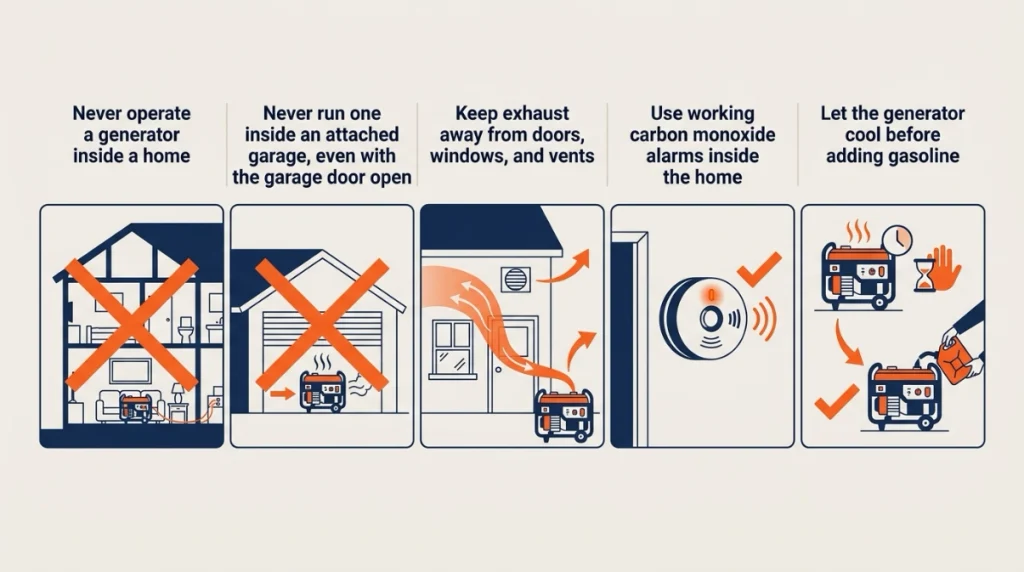
A battery power station avoids the carbon monoxide hazard created by combustion engines. That’s a major advantage when you want backup electricity inside your living space.
Battery equipment still needs sensible handling. Keep ventilation openings clear, use approved charging equipment, avoid damaged batteries, and follow the manufacturer’s temperature and storage limits.
Fuel generators need much stricter placement rules.
- Never operate a generator inside a home.
- Never run one inside an attached garage, even with the garage door open.
- Keep exhaust away from doors, windows, and vents.
- Use working carbon monoxide alarms inside the home.
- Let the generator cool before adding gasoline.
The CDC recommends operating portable generators outdoors more than 20 feet from windows, doors, and vents. This isn’t a rule I would shorten because of rain, theft concerns, or extension-cord inconvenience.
The Consumer Product Safety Commission also warns about portable-generator carbon monoxide hazards. Treat engine exhaust as a serious safety issue every time the generator runs.
Can I Connect Either One to My House?
Potentially, but the connection method matters. Never improvise a connection that sends electricity backward through your home’s wiring or utility lines.
A suitable transfer switch or other approved equipment isolates backup power from the utility supply. Have a qualified electrician handle permanent or panel-connected installations.
FEMA generator guidance also emphasizes appropriate transfer equipment when connecting backup power to building electrical systems. Backfeeding can endanger utility workers and damage equipment.
Some larger power stations support transfer-switch or home-backup configurations, but compatibility varies. Check the power station’s output voltage, connector, neutral arrangement, and manufacturer-approved installation method first.
What About Noise and Everyday Convenience?
This is where power stations are hard to beat. You press a button, plug in the appliance, and get electricity without pulling a starter cord, checking engine oil, or handling gasoline.
Cooling fans may turn on under load or while charging, but they’re usually far less intrusive than a combustion engine. That matters at night, in apartments, at campsites, and around neighbors.
Modern inverter generators narrow the noise gap while retaining fuel-powered runtime. If you want engine-driven backup without a traditional open-frame machine, see my inverter portable generator buying guide.
Which Costs Less: A Power Station or a Generator?
A conventional generator usually gives you more output wattage per dollar. That’s why large portable generators remain attractive for homeowners who need pumps, HVAC equipment, and multiple circuits.
A power station can cost more for the amount of energy it stores. However, it has no gasoline consumption during use and much less routine maintenance.
Think about ownership costs in these categories:
- Purchase price: Compare equipment with enough output for your actual load.
- Battery expansion: Extra batteries can increase a power station’s cost substantially.
- Fuel: Generators need a continuing supply during extended outages.
- Maintenance: Engine oil, spark plugs, filters, batteries, and storage preparation add ongoing work.
- Solar panels: Solar charging adds upfront cost but can extend battery usefulness during long outages.
The U.S. Department of Energy notes that battery storage can provide backup power during electrical disruptions. Solar can help replenish that stored energy, but charging speed still depends on panel capacity and sunlight.
Can a Power Station Replace a Generator Completely?
For some households, yes. A sufficiently large power station can cover essential electronics, refrigeration, lighting, and selected appliances without needing a fuel generator.
For heavy loads or multi-day outages, replacement becomes harder. You may need several kilowatt-hours of battery storage, expansion batteries, substantial solar input, or load management.
I wouldn’t compare only the inverter’s maximum watts. Check both output wattage and battery capacity in watt-hours.
- Watts tell you what it can run.
- Watt-hours tell you roughly how long it can run it.
A 3,000-watt inverter with a 2,000Wh battery may start a demanding appliance but still have limited runtime. A lower-powered device running continuously can sometimes be the bigger energy concern.
Should You Own Both a Power Station and a Generator?
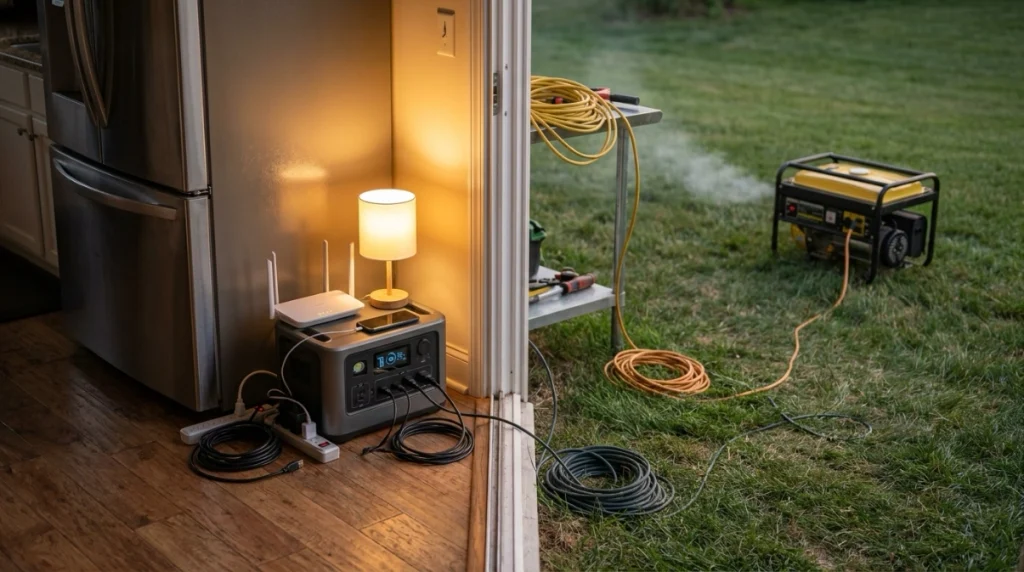
For serious outage preparation, a hybrid setup can be more flexible than choosing only one. The power station handles quiet overnight loads while the generator handles heavy loads and recharging when necessary.
A practical setup could look like this:
- Run refrigerators, router, lights, and electronics from the power station overnight.
- Start the generator outdoors during the day when larger loads need power.
- Recharge the power station while the generator is already operating, if both manufacturers permit that setup.
- Shut down the generator when heavy loads are finished.
- Return to quiet battery power for low-demand evening and overnight use.
This approach reduces unnecessary generator runtime without forcing a battery system to handle every high-watt appliance. It also gives you two different backup options if one energy source becomes unavailable.
If you’re ready to pick one, here are the three models I’d put on the shortlist for different priorities:
🏆 Best indoor backup
EcoFlow DELTA 2 Max
★★★★★
It combines a 2,048Wh LFP battery with 2,400W continuous AC output and 4,800W surge capability. I like this size for refrigeration, internet, electronics, lights, and selected household appliances without running an engine.
⚡ Best high-output battery
Jackery Explorer 2000 Plus
★★★★☆
The Explorer 2000 Plus provides about 2,042.8Wh of battery capacity, 3,000W AC output, and up to 6,000W surge output. I would consider it when appliance starting wattage is the main reason a smaller power station won’t work.
⛽ Best for long outages
Westinghouse WGen9500DFc
★★★★☆
This dual-fuel generator produces 9,500 running and 12,500 peak watts on gasoline, or 8,500 running and 11,200 peak watts on propane. I prefer this type of machine when pumps, household circuits, and extended runtime matter more than silence.
Frequently Asked Questions
Is a power station better than a generator?
A power station is better for quiet, low-maintenance backup of electronics, refrigeration, lighting, and modest household loads. A generator is usually better when you need higher wattage, longer runtime, large motor loads, or the ability to keep producing electricity by adding fuel.
Can a power station run a refrigerator?
Yes, many medium and large power stations can run a refrigerator. Check both the refrigerator’s normal running wattage and its compressor starting surge, then make sure the power station’s continuous and surge ratings exceed those requirements.
Can a power station run an air conditioner?
Some large power stations can operate smaller window or portable air conditioners if their inverter handles the starting surge. Central air conditioning can require substantially more power, so verify the unit’s actual electrical specifications before assuming a portable battery can run it.
Is a generator better for a multi-day blackout?
A fuel generator usually has an advantage during a multi-day outage because you can continue operating it as long as fuel remains available. A power station needs grid, solar, vehicle, generator, or another compatible charging source once its stored battery energy is depleted.
Do I need a generator if I already have a power station?
Not necessarily. If your power station comfortably handles every essential load for the duration of your typical outage, it may be enough. A generator becomes useful when you need more wattage, longer runtime, or a second backup source during extended emergencies.
Final Takeaway: Power Station or Generator?
Choose a power station if your priority is quiet, convenient backup for essential devices and moderate household loads. It’s especially attractive for shorter outages, apartments, overnight use, electronics, and people who don’t want to manage an engine.
Choose a generator if you need high output and long runtime for pumps, HVAC equipment, tools, or multiple circuits. You’ll trade quiet operation for considerably more sustained power.
For many homes, the strongest emergency setup isn’t one or the other. A power station for quiet essential loads combined with a properly sized generator for heavy work gives you flexibility when the grid stays down longer than expected.

Hi, I’m Michael Turner. I own a generator workshop in the United States and founded HomeGeneratorBlog to share practical, hands-on guidance about generator installation, maintenance, troubleshooting, safety, and backup power solutions. My goal is to help homeowners make smarter, more confident decisions through clear and reliable information