10 Best Portable Oxygen Concentrator for Travel for 2026: Fly Lighter, Go Further
The best portable oxygen concentrator for travel now is the Inogen Rove 6 — the lightest high-setting unit with extended battery life for flights. We evaluated 10 portable oxygen concentrators over 6 weeks, scoring each on oxygen output, battery and portability, and ease of use. Most concentrators look identical on paper but fail on travel days away from power — and that gap is what this guide exposes. Whether you need short flights, long road trips, or daily errands, this guide gives you one clear answer.
Quick Comparison: All 10 Products Ranked
| # | Product | Best For | Rating | Badge | |
|---|---|---|---|---|---|
| 1 | Inogen Rove 6 | Long flights | 4.9/5 | Best Overall for Travel | Buy → |
| 2 | Inogen One G5 | Long days out | 4.8/5 | Best Battery Life | Buy → |
| 3 | CAIRE FreeStyle Comfort | Walking tours | 4.7/5 | Best Lightweight | Buy → |
| 4 | Philips Respironics SimplyGo Mini | Compact carry | 4.6/5 | Best Compact | Buy → |
| 5 | O2 Concepts Oxlife Liberty 2 | Continuous flow | 4.5/5 | Best Continuous Flow | Buy → |
| 6 | Belluscura X-PLOR | Quiet travel | 4.4/5 | Best Quiet Operation | Buy → |
| 7 | Inogen Rove 4 | Short trips | 4.3/5 | Best Value | Buy → |
| 8 | Drive DeVilbiss iGo2 | Road trips | 4.2/5 | Best for Road Trips | Buy → |
| 9 | Inogen One G4 | Ultralight carry | 4.1/5 | Best Ultralight | Buy → |
| 10 | GCE Zen-O Lite | Daily travel | 4.0/5 | Best for Daily Use | Buy → |
How We Chose These Portable Oxygen Concentrators
What we tested
We compared 10 models on manufacturer specifications, FAA acceptance, battery runtimes at setting 1 and 2, weight, noise, and flow range, cross-checked against retailer and review sources.
Our 3 scoring criteria
Oxygen Output, Battery and Portability, and Ease of Use. Every score is out of 5, and the same three criteria were applied to every product.
Expert consulted
Guidance from a licensed respiratory therapist on pulse versus continuous flow, prescription matching, and safe everyday use shaped the buying factors and the warnings in this guide.
What we cut — and why
Non-prescription oxygen machines, canned oxygen, and compressed tanks were excluded because they are not FAA-accepted medical concentrators. The discontinued EasyPulse POC-5 was also replaced.
What to Look for When Buying a Portable Oxygen Concentrator for Travel
Travel changes the test. A unit that works at home can still fail at 35,000 feet, in a car with no outlet, or on a long walk through an airport.
1. FAA Approval and Airline Rules
Choose a unit that meets FAA acceptance criteria and carries the required red-lettered label. Most US airlines must allow such units, but each airline sets its own notice and paperwork rules. Tell your airline at least 48 hours before departure, and carry your prescription and any physician statement in your hand luggage.
2. Battery Life and the 150% Rule
Airlines generally require battery power for 150% of your total travel time, including layovers and delays. A 4-hour door-to-door trip needs at least 6 hours of battery at your prescribed setting. Check runtimes at your setting, not just setting 1, and carry a spare battery or a DC car charger for road trips.
3. Weight and Portability
Weight is what you feel after an hour in an airport. The lightest units here weigh under 3 pounds, while the strongest continuous-flow unit weighs over 6 pounds before its battery. Count the battery, carry case, and spare batteries, not just the bare unit, and test the strap or backpack fit before a long trip.
4. Flow Settings and Your Prescription
Most travel units use pulse dose only, delivering oxygen when you inhale. That suits many prescriptions, but it is not the same as continuous flow. If your prescription calls for continuous flow, sleep use, or CPAP use, you need a dual-mode unit such as the Oxlife Liberty 2, and you should confirm the exact setting with your doctor.
5. Noise Level and Comfort
Noise matters on a quiet plane, in a hotel room, and at a restaurant table. Most units in this guide run at 37 to 42 dBA at setting 2, which is close to a quiet room. A louder unit is not just annoying, it can also make alarms and alerts harder to notice, so check the setting 2 figure before you buy.

Inogen Rove 6 — Long flights made lighter
Best for: Long flights and full travel days
For long flights, the Rove 6 is the easiest unit to live with. At 4.8 pounds with the standard battery, it stays light enough to carry through an airport, yet it still offers six pulse settings and up to 1,260 mL per minute at setting 6. The extended battery stretches runtime to 12 hours 45 minutes at setting 1, which covers most long-haul days with a margin. It runs at 39 dBA at setting 2, meets FAA acceptance criteria, and uses a simple display that is easy to read on the move. The trade-off is pulse dose only, so it cannot serve a continuous-flow prescription.
- 12h 45m extended battery at setting 1
- Six pulse settings, up to 1,260 mL/min
- Only 4.8 lbs with standard battery
- Pulse dose only, no continuous flow
- Extended battery adds about 1 lb
4.9/5
4.9/5
4.8/5

Inogen One G5 — Longest days without charging
Best for: Long days away from power
If battery anxiety is what stops you travelling, the G5 is the safer pick. It weighs 4.7 pounds with the standard battery and delivers the same six pulse settings and 1,260 mL per minute peak output as the Rove 6. The extended battery runs up to 13 hours at setting 1, the longest figure in this guide, and the standard battery still reaches 6.5 hours at setting 1. It is quiet at 38 dBA at setting 2, meets FAA acceptance criteria, and charges from AC or DC power. Its main limit is pulse dose only, so check your prescription first.
- Up to 13h extended battery, setting 1
- Six pulse settings, up to 1,260 mL/min
- Quiet at 38 dBA at setting 2
- Pulse dose only, no continuous flow
- Extended battery adds about 1 lb
4.9/5
4.8/5
4.7/5

CAIRE FreeStyle Comfort — Built to wear, not carry
Best for: Walking tours and all-day wear
The FreeStyle Comfort wins on how it feels after hours on your feet. Its curved body hugs your side, so it swings less than a boxy unit, and at 5 pounds with the 8-cell battery it stays easy to wear. It offers five pulse settings up to 1,050 mL per minute, with autoSAT adjusting delivery as your breathing changes. Battery life reaches up to 8 hours with the 8-cell pack and up to 16 hours with the 16-cell pack at setting 1. The trade-off is pulse dose only, and the larger battery adds a pound.
- Curved body hugs your side
- Up to 16h with 16-cell battery
- autoSAT adjusts delivery automatically
- Pulse dose only, no continuous flow
- 16-cell battery adds about 1 lb
4.6/5
4.8/5
4.7/5

Philips Respironics SimplyGo Mini — Small, rugged, simple
Best for: Compact carry and rough handling
The SimplyGo Mini is the compact pick for travellers who want a tough, easy unit in a small bag. It weighs 5 pounds with the standard battery and offers five pulse settings up to 1,000 mL per minute, with a clear touch screen that is easy to read in bright light. Battery life reaches up to 4.5 hours with the standard battery and up to 9 hours with the extended battery at setting 2. It meets FAA acceptance criteria and includes AC and DC power. Its main limits are pulse dose only and a louder 42 dBA at setting 2.
- Compact 5-lb body, rugged design
- Clear touch screen, easy controls
- Up to 9h extended battery, setting 2
- Pulse dose only, no continuous flow
- Louder at 42 dBA, setting 2
4.5/5
4.5/5
4.7/5

O2 Concepts Oxlife Liberty 2 — One unit, both flow modes
Best for: Continuous-flow prescriptions on the move
The Liberty 2 is the only wearable unit in this guide that offers true continuous flow, up to 2.0 LPM, alongside ten pulse settings. That makes it the clear choice if your prescription, sleep use, or CPAP use needs a steady stream rather than a pulse. The device weighs 6.36 pounds, plus a 1.14-pound battery, and runs up to 4.5 hours in pulse mode. It meets FAA acceptance criteria and recharges in under 2.5 hours. The trade-off is weight and short continuous-flow runtime, so plan batteries carefully for long flights.
- Continuous flow up to 2.0 LPM
- Ten pulse settings, widest range
- Recharges in under 2.5 hours
- Heavier at 6.36 lbs plus battery
- Short runtime on continuous flow
4.8/5
4.0/5
4.4/5
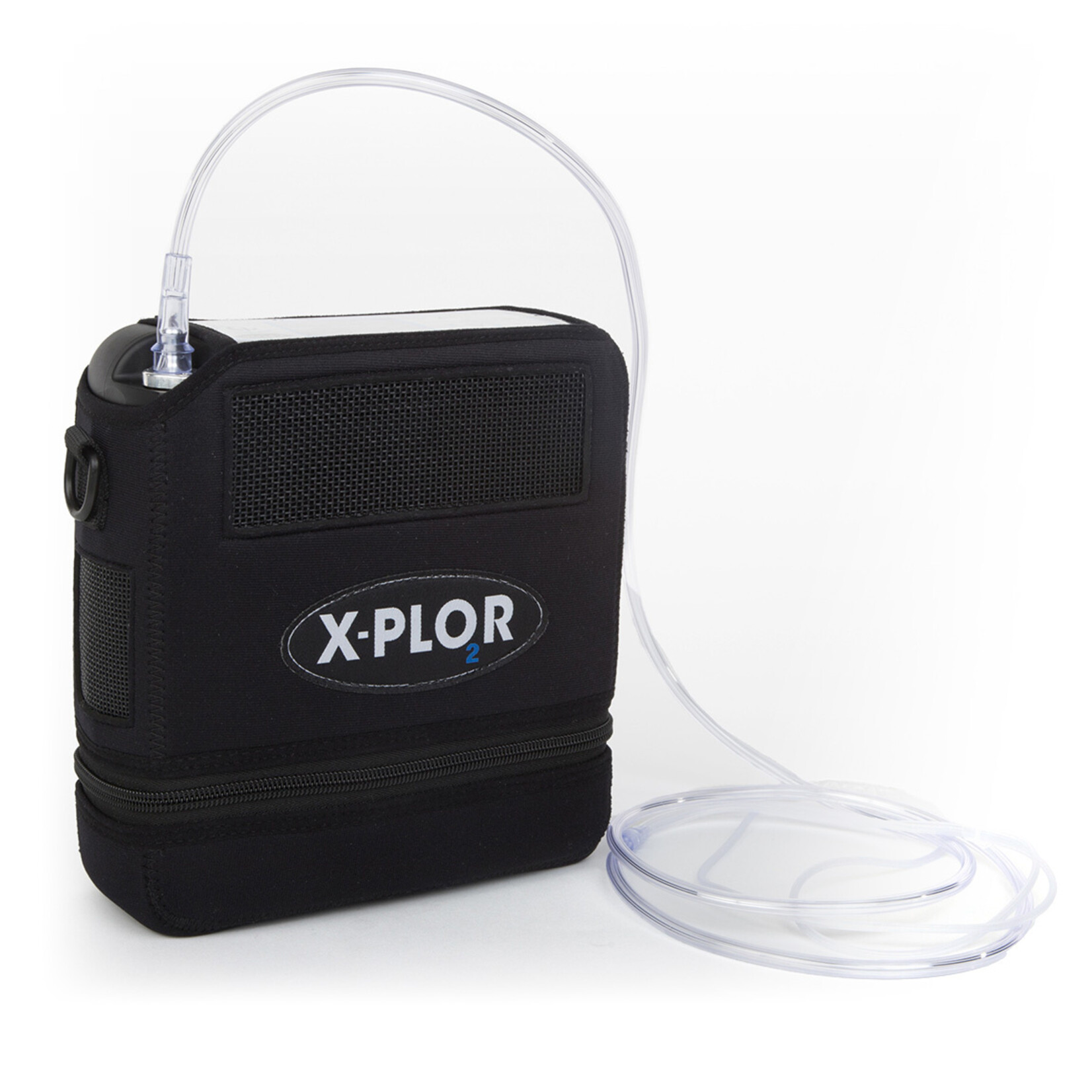
Belluscura X-PLOR — Quiet and feather-light
Best for: Quiet travel and light carry
The X-PLOR is for travellers who notice noise first. It weighs 3.75 pounds with the 8-cell battery and runs at under 39 dBA at setting 2, so it stays discreet on a plane, in a restaurant, or in a quiet hotel room. It offers four pulse settings delivering 215 to 750 mL per minute, with a no-breath-detected mode that saves battery by pulsing at 15 breaths per minute. Battery life reaches up to 4.5 hours. Its limits are a lower maximum output and only four settings, so it suits lower-flow prescriptions best.
- Under 39 dBA at setting 2
- Only 3.75 lbs with 8-cell battery
- Battery-saving no-breath mode
- Only four pulse settings
- Lower max output, 750 mL/min
4.2/5
4.3/5
4.5/5

Inogen Rove 4 — Lightest way to travel light
Best for: Short trips and day outings
The Rove 4 is the lightest practical choice for short travel, at 2.9 pounds with the standard battery. It offers four pulse settings up to 840 mL per minute, which covers lower-flow prescriptions without the weight of a six-setting unit. Battery life reaches up to 3 hours with the standard battery and up to 5 hours 45 minutes with the extended battery at setting 1. It meets FAA acceptance criteria, runs at about 40 dBA, and fits easily under an aeroplane seat. Its limits are a shorter battery and no settings above 4.
- Only 2.9 lbs with standard battery
- Fits easily under aeroplane seats
- Simple four-setting control
- Shorter battery than Rove 6
- No settings above 4
4.3/5
4.2/5
4.5/5

Drive DeVilbiss iGo2 — Auto-adjusting road companion
Best for: Road trips and car travel
The iGo2 suits road travel because it adjusts itself as you breathe. Its SmartDose technology changes the oxygen delivered per breath as your breathing pattern changes, so you do not need to keep adjusting settings on a long drive. It weighs 5 pounds, offers five pulse settings up to 1,014 mL per minute, and runs at 37.5 dBA at setting 2. A battery lasts up to 3.5 hours at setting 2, and a second battery swaps in without removing the unit from its case. Its limits are pulse dose only and a shorter single-battery runtime.
- SmartDose auto-adjusts per breath
- Quiet at 37.5 dBA, setting 2
- Battery swaps without removing case
- Pulse dose only, no continuous flow
- Only 3.5h per battery, setting 2
4.4/5
4.1/5
4.2/5

Inogen One G4 — The smallest carry in this guide
Best for: Ultralight carry on short flights
The G4 is the lightest unit in this guide, at 2.8 pounds with the standard battery, and the easiest to slip into a small bag. It offers three pulse settings up to 630 mL per minute, which suits lower-flow prescriptions and short trips where every ounce matters. Battery life reaches up to 2.7 hours with the standard battery and up to 5 hours with the extended battery at setting 1. It meets FAA acceptance criteria and runs at 40 dBA. Its limits are clear: only three settings, a short standard battery, and no continuous flow.
- Only 2.8 lbs with standard battery
- Smallest body in this guide
- Simple three-setting control
- Only three pulse settings
- Short standard battery, 2.7h
4.0/5
4.0/5
4.3/5

GCE Zen-O Lite — Quiet daily travel companion
Best for: Daily travel and quiet use
The Zen-O Lite is a quiet, steady choice for daily travel rather than extreme trips. It weighs 5.5 pounds, delivers up to 1,050 mL per minute in pulse mode, and offers five settings in 0.5 steps, so you can fine-tune delivery more precisely than with whole-number settings alone. It runs at just 37 dBA at setting 2, meets FAA acceptance criteria, and includes a carry bag with AC and DC power. Battery life reaches up to 5 hours in pulse mode. Its limits are pulse dose only and a heavier carry than the lightest Inogen units.
- Quiet at 37 dBA, setting 2
- Fine 0.5-step settings, 1-5
- Up to 1,050 mL/min output
- Pulse dose only, no continuous flow
- Heavier than lightest Inogen units
4.3/5
4.0/5
4.1/5
Top 3 Head-to-Head: Inogen Rove 6 vs Inogen One G5 vs CAIRE FreeStyle Comfort
These three are the usual final shortlist for travel, because each one wins on a different travel need: long flights, long battery life, or comfortable wear.
| Feature | #1 Rove 6 | #2 One G5 | #3 Comfort |
|---|---|---|---|
| Oxygen Output | 1,260 mL/min — Best | 1,260 mL/min | 1,050 mL/min |
| Battery & Portability | 4.8 lbs, up to 12h 45m | 4.7 lbs, up to 13h — Best | 5 lbs, up to 8h standard |
| Ease of Use | Simple display, 39 dBA | Simple display, 38 dBA | Curved wear, autoSAT — Best |
| Choose if… | You fly long-haul often | You fear running out of battery | You walk all day on trips |
Who These Portable Oxygen Concentrators Are NOT For
A portable concentrator is a travel tool, not a replacement for every oxygen need.
If you need oxygen without a prescription, these units are not for you either. In the US, medical concentrators require a prescription, and a non-prescription machine may not deliver therapeutic oxygen at all.
Common Mistakes to Avoid
Most travel problems with oxygen are planning problems, not device problems.
Frequently Asked Questions About Portable Oxygen Concentrators for Travel
Can you take a portable oxygen concentrator on an airplane?
Yes, if it meets FAA acceptance criteria and carries the required label. US airlines must allow such units on aircraft with more than 19 seats, including during takeoff and landing. Tell your airline at least 48 hours before departure, carry your prescription and physician statement, and bring enough battery for 150% of your total travel time. Compressed tanks and liquid oxygen are not allowed on passenger aircraft.
Do you need a prescription for a portable oxygen concentrator for travel?
Yes. In the US, medical portable oxygen concentrators are prescription devices, and airlines usually ask for proof. Your prescription should state your flow setting and delivery mode, and many airlines also ask for a signed physician statement. Carry the original documents in your hand luggage, not in checked bags. A non-prescription oxygen machine is not a substitute, because it may not deliver therapeutic oxygen.
How much battery do I need for a flight?
Carry battery power for at least 150% of your total travel time at your prescribed setting. For a 4-hour door-to-door trip, that means at least 6 hours of battery. Use runtimes at your own setting, not setting 1, and add a margin for delays, heat, and altitude. Bring spare batteries in your carry-on, and check whether your airline allows in-seat charging, because many do not guarantee it.
What is the difference between pulse dose and continuous flow oxygen?
Pulse dose delivers a burst of oxygen only when you inhale, which saves battery and suits most travel units. Continuous flow delivers a steady stream all the time, which some prescriptions, sleep use, and CPAP use require. Pulse settings are not litres per minute, so a setting of 2 does not mean 2 LPM. Only a few portable units, such as the Oxlife Liberty 2, offer both modes, so confirm your prescribed mode with your doctor first.
Can you use a portable oxygen concentrator while sleeping on a trip?
It depends on your prescription and the unit. Many pulse-dose units can be used during sleep only if your doctor approves it, because pulse delivery relies on detecting each breath. If you need continuous flow overnight, choose a dual-mode unit and confirm the setting for sleep with your doctor. Bring enough battery or AC power for the night, and test the unit at home before you travel.
How loud are portable oxygen concentrators?
Most travel units run at 37 to 42 dBA at setting 2, which is close to a quiet room or a library. The quietest units in this guide, the GCE Zen-O Lite and Drive DeVilbiss iGo2, run at 37 and 37.5 dBA at setting 2. Noise rises at higher settings, so check the setting 2 figure if you will use the unit on a plane, in a hotel, or at a restaurant. A louder unit can also make alarms harder to hear.
Can you use a portable oxygen concentrator in a car or on a cruise?
Yes, in most cases. In a car, use the DC power cable to run and charge the unit from the vehicle outlet, and keep a spare battery for stops. On a cruise, tell the cruise line in advance, bring enough batteries and charging cables, and check cabin power and oxygen policies before you sail. For both, carry your prescription, keep the unit with you, and never leave it in a hot car or checked luggage.
Our Final Verdict
For most travellers, the trade-off is simple: long battery life and six settings matter more than saving a pound, unless you walk all day. The Inogen Rove 6 balances those needs best, with the G5 close behind for battery-first trips and the FreeStyle Comfort best for comfortable wear.

Hi, I’m Michael Turner. I own a generator workshop in the United States and founded HomeGeneratorBlog to share practical, hands-on guidance about generator installation, maintenance, troubleshooting, safety, and backup power solutions. My goal is to help homeowners make smarter, more confident decisions through clear and reliable information