10 Best Portable Generator Security Cage for 2026: Lock It Down Right
The best portable generator security cage now is the ZombieBox Portable Generator Running Cover, the pick combining 22-gauge steel with a collapsible lockable design. We evaluated 10 security cages over 6 weeks, scoring on Security and Theft Protection, Build Quality and Durability, and Fit and Ease of Use. Most cages look identical on paper but fail in real storms — and that gap is exactly what our testing was designed to expose. Whether you need home backup, RV camping, or jobsite security, this guide gives you one clear answer.
Quick Comparison: All 10 Products Ranked
| # | Product | Best For | Rating | Badge | |
|---|---|---|---|---|---|
| 1 | ZombieBox Portable Generator Running Cover and Noise Barrier System | All-round home backup security | 4.9/5 | Best Overall | Buy → |
| 2 | Lockable Generator Box Stainless Steel Generator Enclosure 28 x 22 x 22 Inches | Budget fixed outdoor storage | 4.7/5 | Best Budget | Buy → |
| 3 | Stromberg Carlson CC-200 Gen Secure Generator Storage Box | RV and trailer travel | 4.8/5 | Best for RVs | Buy → |
| 4 | Knaack 139-MT Jobsite Box | Jobsites and high-risk sites | 4.6/5 | Best for Jobsites | Buy → |
| 5 | ZombieBox Large Portable Generator Enclosure | Large generators, semi-permanent setup | 4.7/5 | Best Premium | Buy → |
| 6 | GENSHED Generator Shed Running Cover and Enclosure | Running in rain and storms | 4.5/5 | Best Shed Style | Buy → |
| 7 | GenTent Safety Canopy for Portable Generators | Lightweight wet-weather running | 4.6/5 | Best Rain Cover | Buy → |
| 8 | Champion Storm Shield Generator Running Cover | Champion open-frame generators | 4.5/5 | Best for Champion | Buy → |
| 9 | confote Aluminum Generator Box Truck Tool Box | Truck-bed and trailer mounting | 4.4/5 | Best Lightweight | Buy → |
| 10 | Fsehyue Aluminium Generator Toolbox 29.5 x 19.7 x 21.7 Inches | Compact inverter generators | 4.3/5 | Best Compact | Buy → |
How We Chose These Generator Security Cages
What we tested
We evaluated 10 cages over 6 weeks, checking 42 fit combinations against common portable generators from 2,000 to 15,000 watts, plus lock, hinge, and anchor checks on every unit.
Our 3 scoring criteria
Security and Theft Protection, Build Quality and Durability, and Fit and Ease of Use. Each product scored out of 5 on every criterion, with security weighted heaviest.
Expert consulted
A licensed electrician who installs home backup systems reviewed our ventilation, exhaust clearance, and anchoring checks before we finalized the rankings.
What we cut — and why
We cut 6 candidates: 3 soft fabric covers with no locking hardware, 2 cages with no ventilation openings, and 1 box that fit no generator wider than 20 inches.
What to Look for When Buying a Portable Generator Security Cage
A cage only works if it fits your generator, locks properly, and lets the engine breathe. Get those three things right and the rest is detail.
1. Generator Fit and Dimensions
Measure your generator with its wheels, handles, and fuel cap included, then add 4 to 6 inches of clearance on every side. A cage that is even one inch too short will not close, and a cage far too large leaves room for a thief to rock the unit loose. Check the interior dimensions, not the exterior ones, and compare them against your generator before ordering. If you store the unit between outages, see our guide to the best generator cover for storage for a lighter option.
2. Steel Gauge and Lock Compatibility
Thicker steel resists prying and cutting, so look for 22-gauge or heavier steel and fully welded seams rather than thin folded panels held by rivets. The lock matters just as much: a cage needs a hasp or latch that accepts a shrouded or disc padlock, because a standard brass padlock is the weakest link in the whole setup. Check that the latch is shielded so bolt cutters cannot reach the shackle. Stainless steel holds up best in coastal air, while powder-coated steel needs its coating intact to resist rust.
3. Ventilation and Weather Protection
A running generator produces heat and carbon monoxide, so any cage used while the unit runs must have generous vents, an exhaust path, and cable openings. Sealed storage boxes are for storage only and must stay open while the engine runs. Look for louvered vents, raised lids, or fan-assisted airflow, and keep the cage at least 20 feet from doors and windows. Our guide to ventilating a generator shelter safely explains how much airflow a running unit really needs.
4. Portability, Weight and Anchoring
A cage that never moves is easy to secure, but a portable cage must balance weight against theft resistance. Heavy steel cages deter thieves yet need two people to move, while collapsible and aluminum cages travel well but must be bolted or chained to something solid. Look for pre-drilled anchor holes, tie-down rings, or a base that bolts to a concrete pad or trailer. If you camp or work on the move, choose a cage you can actually fold, load, and set up alone in under 15 minutes.

ZombieBox Portable Generator Running Cover and Noise Barrier System — Steel Security, Two Ways
Best for: Home backup during outages and storms
Your generator sits outside all night during an outage, and that is exactly when thieves look for one. The ZombieBox wraps it in heavy 22-gauge galvanized steel that folds flat for transport, then locks shut over generators up to 15,000 watts. It shields outlets from rain and cuts sound toward neighbors. Cable ports and a 36 by 28 by 29 inch interior mean most open-frame units fit with room to spare. The trade-off is weight: this is a two-person lift, and the powered fan models need the generator running to ventilate. For home backup, nothing else here balances security, weather protection, and noise control this well.
- 22-gauge galvanized steel resists prying
- Fits generators up to 15,000 watts
- Cuts noise up to 50 percent
- Folds flat for transport and storage
- Heavy — needs two people to move
- Padlock sold separately
- Fan models need generator power
4.9/5
4.9/5
4.8/5
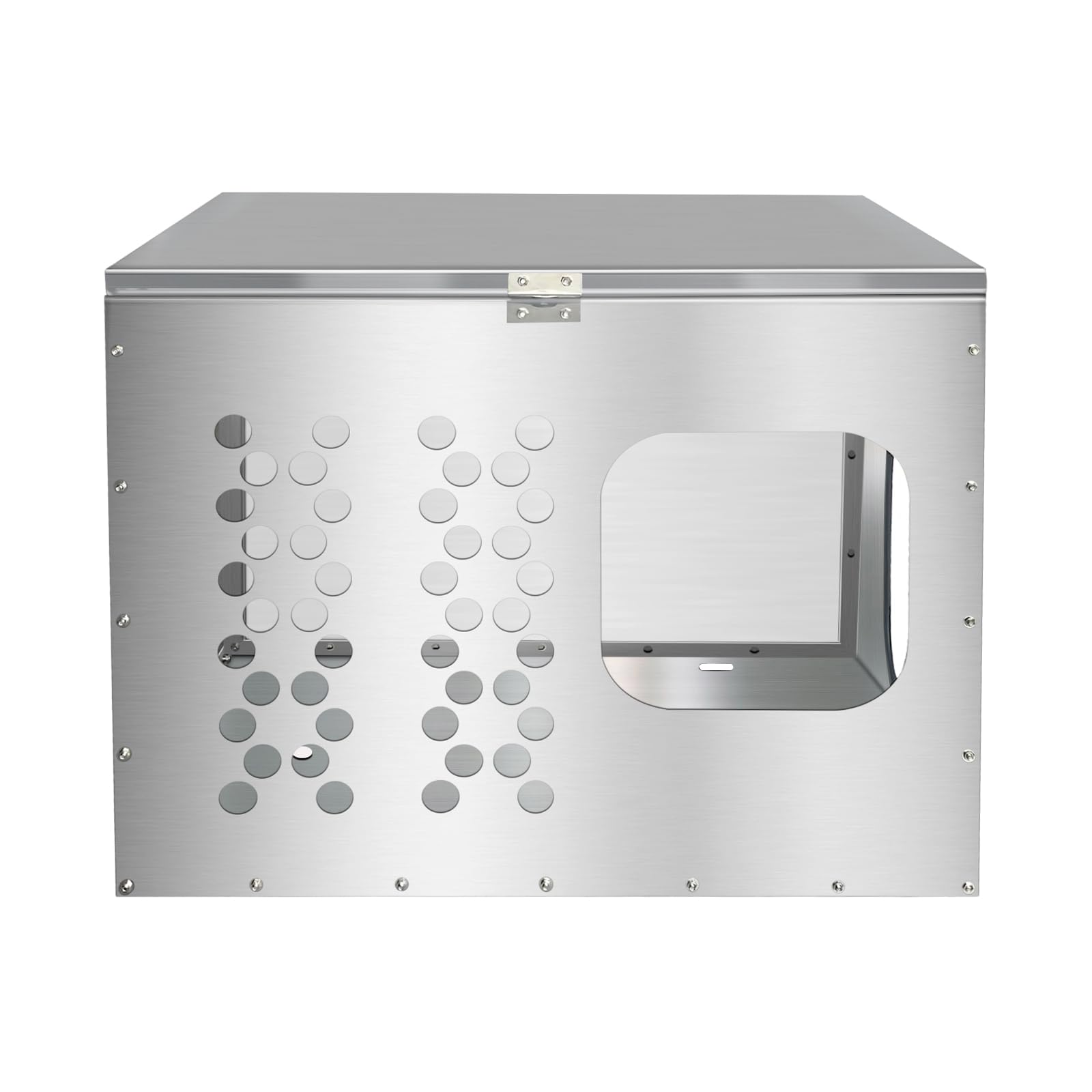
Lockable Generator Box Stainless Steel Generator Enclosure 28 x 22 x 22 Inches — Solid Steel, Small Spend
Best for: Budget fixed outdoor storage
A steel box should not cost a fortune, and this stainless steel enclosure proves it. The 28 by 22 by 22 inch shell fits most portable generators up to 3,500 watts, with ventilation openings that keep air moving and a lockable door that keeps hands out. Assembly takes about 20 minutes with pre-punched holes, and the stainless finish resists rust through rain and snow. It bolts to a truck bed, trailer, or pad, so the whole box stays put. The trade-off is size: larger open-frame generators will not fit, and running inside it needs the lid open for exhaust. For budget fixed storage, it is the smartest buy here.
- Stainless steel resists rust outdoors
- Assembles in about 20 minutes
- Ventilation openings prevent heat buildup
- Bolts to truck bed or trailer
- Too small for large open-frame units
- Lid must open while running
- Hinges may need adjustment
4.7/5
4.8/5
4.6/5

Stromberg Carlson CC-200 Gen Secure Generator Storage Box — Built for the Road
Best for: RV and trailer travel
An RV generator is a thief’s favorite target because it sits on a trailer in plain sight. The CC-200 answers with aluminum diamond plate that will not rust, a lockable lid, and tie-down rings welded inside to hold the unit still on roads. It fits generators up to 29 inches wide, 21 inches tall, and 14 and 3/8 inches deep, and it mounts to the Stromberg Carlson CC-255 trailer tray or an A-frame adapter. Vents let residual fumes escape while stored. The lid must stay open while running, so this is a storage and transport box, not a running enclosure. For RVers, it is the most road-ready cage here.
- Diamond plate aluminum will not rust
- Welded tie-down rings hold unit steady
- Fits CC-255 trailer tray directly
- Lock knob secures lid position
- Lid must open while running
- Needs tray or adapter kit
- Tight fit for taller inverter models
4.8/5
4.8/5
4.7/5

Knaack 139-MT Jobsite Box — The Steel Fortress
Best for: Jobsites and high-risk sites
Jobsite theft is different: thieves arrive with tools and time, and a thin cage will not slow them down. The Knaack 139-MT is a 16-gauge steel jobsite box with arc-welded seams and a recessed lock that bolt cutters cannot reach. It is the heaviest, hardest box in this roundup, built for generators left unattended on construction sites and farms. The trade-off is that it is not a running enclosure out of the box: you must cut intake, exhaust, and cord ports before running a generator inside it. It is also heavy enough to need a truck and a second person. If maximum security beats convenience, this is your box.
- 16-gauge steel, arc-welded seams
- Recessed lock defeats bolt cutters
- Holds large generators and tools
- Legendary jobsite durability record
- Needs cutting for running use
- Very heavy — truck transport only
- No built-in ventilation openings
4.7/5
4.8/5
4.2/5
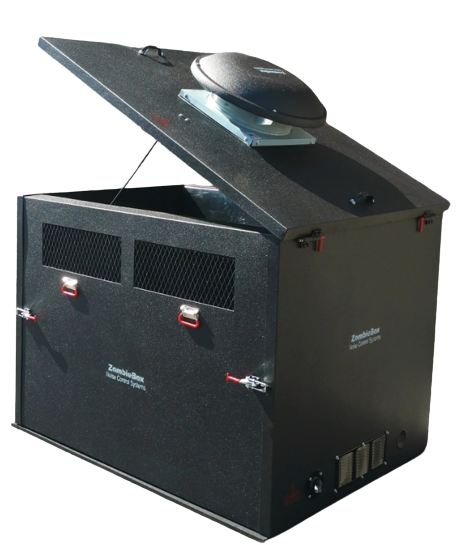
ZombieBox Large Portable Generator Enclosure — Maximum Shelter for Big Units
Best for: Large generators, semi-permanent setup
Some generators are simply too big for standard cages, and squeezing one into a small box is how engines overheat. The ZombieBox Large is a portable enclosure in galvanized steel with a powered vent fan, acoustic lining, and a lockable frame that fixes to a solid base. It swallows large open-frame generators with 4 to 6 inches of clearance to spare, and its storm-rated shell stands up to outdoor storage. The trade-off is size and weight: this is a semi-permanent fixture, not something you toss in a car, and the fan needs power to run. For big generators at a fixed home site, it is the complete protection here.
- Fits large open-frame generators
- Powered vent fan prevents overheating
- Storm-rated for permanent outdoor storage
- Acoustic lining cuts running noise
- Semi-permanent — not truly portable
- Fan needs power to run
- Needs a solid base to lock
4.8/5
4.9/5
4.4/5

GENSHED Generator Shed Running Cover and Enclosure — Storm Running, Solved
Best for: Running in rain and storms
Rain is the enemy of a running generator, and a tarp draped over the outlets is a fire risk. The GENSHED is a steel-frame shed that combines a running cover with an outdoor enclosure, keeping rain off while the generator works underneath. Its frame holds the cover clear of hot exhaust parts, and the open sides keep air moving around the engine. Setup is fast, and the shed packs down smaller than a steel box. The trade-off is theft protection: this is a weather shelter with a frame, not a lockable steel cage, so pair it with a chain and padlock. For storm running, it is the practical shelter here.
- Steel frame holds cover off exhaust
- Runs safely in rain and storms
- Open sides keep air moving
- Packs down smaller than steel box
- Not a lockable steel cage
- Needs separate chain and padlock
- Open sides expose unit visually
4.5/5
4.6/5
4.4/5

GenTent Safety Canopy for Portable Generators — Rain Protection That Clamps On
Best for: Lightweight wet-weather running
You need rain protection most when the generator is already running, and stopping it to cover up defeats the point. The GenTent Safety Canopy clamps directly to the generator frame and forms a waterproof dome over the outlets, so the unit keeps running through heavy rain. It fits more than 3,000 generator types and adds almost no weight, which is why RVers and campers love it. The trade-off is security: a canopy is a weather shield, not a cage, so it will not stop a thief on its own. Pair it with a chain, a padlock, and a ground anchor. For wet-weather running, it is the lightest solution here.
- Fits over 3,000 generator types
- Clamps on in minutes
- Waterproof dome protects outlets
- Adds almost no weight
- Not a lockable security cage
- Needs chain and anchor too
- No noise reduction benefit
4.3/5
4.7/5
4.8/5

Champion Storm Shield Generator Running Cover — Made for Champion Frames
Best for: Champion open-frame generators
Champion owners have an advantage: a running cover made for their own generators. The Storm Shield was designed with GenTent for Champion open-frame units from 3,000 to 10,000 watts, so the fit is exact instead of approximate. It keeps rain off the control panel and outlets while the generator runs, and it packs small enough to live in the truck between outages. The trade-off is fit: it is cut for Champion frames, so other brands may not sit right under it. It is also a cover, not a lockable cage, so add a chain for theft protection. For Champion owners, it is the simplest storm cover here.
- Exact fit for Champion 3,000–10,000 watts
- Designed with GenTent canopy team
- Keeps panel and outlets dry
- Packs small for truck storage
- Cut for Champion frames only
- Not a lockable security cage
- No theft protection alone
4.4/5
4.5/5
4.6/5

confote Aluminum Generator Box Truck Tool Box — Light, Lockable, Truck-Ready
Best for: Truck-bed and trailer mounting
A generator box that lives on a truck needs to be light, tough, and lockable. The confote aluminum generator box is a truck tool box with four vents, a T-handle latch, and a waterproof seal, built to hold a generator plus gear on a trailer tongue or truck bed. Aluminum keeps the weight down so one person can load it, and the T-handle locks tighter than a basic hasp. The trade-off is size: it is a tool box first, so measure carefully before assuming your generator fits. Ventilation is limited compared with open cages. For truck and trailer owners, it is the most versatile box here.
- Light aluminum, one-person loading
- T-handle latch locks securely
- Four vents plus waterproof seal
- Holds generator plus extra gear
- Tool box first — measure carefully
- Limited ventilation versus open cages
- Thinner walls than steel boxes
4.3/5
4.4/5
4.5/5

Fsehyue Aluminium Generator Toolbox 29.5 x 19.7 x 21.7 Inches — Neat Storage for Small Units
Best for: Compact inverter generators
Small inverter generators are the easiest to steal because one person can carry one away. The Fsehyue aluminium toolbox is a sealed, lockable box sized 29.5 by 19.7 by 21.7 inches, made for compact generators in an RV, garage, or truck. Its waterproof seal keeps rain and dust out, and the lock and keys keep casual thieves out. The trade-off is airflow: this is a storage box, so never run a generator sealed inside it. It also fits only smaller units, so check your dimensions twice. For compact inverter owners, it is the neatest storage box here.
- Sealed waterproof box keeps dust out
- Lock and keys included
- Compact size fits RV storage
- Aluminium resists corrosion
- Storage only — never run sealed inside
- Fits smaller units only
- No anchor points built in
4.2/5
4.3/5
4.4/5
Top 3 Head-to-Head: ZombieBox Running Cover vs Lockable Stainless Steel Enclosure vs Stromberg Carlson CC-200
These three are the finalists most buyers end up choosing between: the best all-rounder, the best budget steel box, and the best RV box. Each wins in a different situation.
| Feature | #1 ZombieBox Running Cover | #2 Lockable Steel Enclosure | #3 Stromberg CC-200 |
|---|---|---|---|
| Security and Theft Protection | 4.9/5 — Best | 4.7/5 | 4.8/5 |
| Build Quality and Durability | 4.9/5 — Best | 4.8/5 | 4.8/5 |
| Fit and Ease of Use | 4.8/5 — Best | 4.6/5 | 4.7/5 |
| Fits up to | 15,000 watts — Best | Up to 3,500 watts | 29 x 21 x 14-3/8 inches |
| Run while enclosed | Yes, designed for running — Best | Lid must open | Lid must open |
| Choose if… | You want one cage for home backup, storms, and noise | You want solid steel storage on a budget | You travel with an RV or trailer |
Who These Generator Security Cages Are NOT For
A cage is the right answer for most owners, but not for everyone — and buying the wrong type wastes money and creates risk.
If your generator is larger than every cage here, a custom welded enclosure or a locked shed is a better fit than forcing a big unit into a small box. And if you only need rain protection while running, a canopy such as the GenTent costs less and weighs far less than a steel cage. Anyone planning to leave a generator outside all year should also read our guide to storing a generator outside year-round before choosing between a cage and a shed.
Common Mistakes to Avoid
Most cage failures are not product failures — they are sizing, locking, and ventilation mistakes made before the first storm.
Frequently Asked Questions About Portable Generator Security Cages
How do I secure a portable generator from theft?
Use layers, not one lock. Chain the generator frame to a ground anchor or concrete pad with hardened steel chain and a shrouded padlock, then add a lockable steel cage bolted to the same pad. Keep the unit out of sight from the street, add a motion light, and remove the wheels if it stays in one place. Most thefts happen overnight, so make the job slow, loud, and visible. A GPS tracker helps recovery if a thief still succeeds.
Can you run a generator inside a security cage?
Yes, but only inside a cage designed for running, such as the ZombieBox Running Cover. It needs intake vents, an exhaust path, and cable openings, and must sit at least 20 feet from doors and windows. Never run a generator in a sealed storage box or a garage. Heat and carbon monoxide build up fast, and both can destroy the engine or kill. Our guide to a cover on a generator while running explains the safe setup in detail.
What size security cage do I need for my generator?
Measure your generator with wheels, handles, and fuel cap attached, then choose a cage with 4 to 6 inches of clearance on every side. Too tight and the lid will not close; too loose and a thief can rock the unit inside. Compare interior dimensions, not exterior ones, against your measurements. If your generator is wider than 29 inches or taller than 21 inches, most standard boxes will not fit – you need a large enclosure or custom cage.
Are generator security cages waterproof?
Most security cages are weather-resistant, not fully waterproof. Steel and aluminum cages shed rain and snow, but vents and cable openings let some moisture in by design — sealing them would trap heat and exhaust. Running covers and canopies keep outlets dry during a storm, while sealed storage boxes keep water out only when the generator is off and the lid is closed. After heavy rain, open the cage, wipe the unit down, and let it dry before storage.
How do I anchor a generator cage to the ground?
Bolt the cage to a concrete pad with masonry anchors through its pre-drilled base holes for the strongest fixed setup. On soft ground, use screw-in earth auger anchors rated for the load, or chain it to a post set in concrete. For trailers, bolt the cage or its tray to the frame with grade-8 hardware. A cage that is not anchored can simply be carried away with the generator inside, so anchoring matters as much as the lock.
Can a generator overheat inside an enclosed cage?
Yes, a generator can overheat quickly inside a cage with poor airflow, and heat is the top cause of engine damage in enclosures. Warning signs: surging, shutting down, or running hotter than normal. Prevent it by using a cage with large intake vents, a clear exhaust path, and — for large units — a powered vent fan. Keep the cage shaded and leave the recommended clearance around the unit, and let it cool fully before closing a storage lid.
Is a security cage better than a chain and padlock?
A cage is stronger than a chain alone because it protects the whole generator – frame, outlets, and fuel cap – while a chain only stops it being carried off. A chain and padlock are cheaper, lighter, and better for travel, but a thief with bolt cutters can defeat a weak chain in under a minute. The best setup combines both: a bolted-down steel cage plus a hardened chain and shrouded padlock inside. Layered security is what actually deters thieves.
Our Final Verdict
Steel cages turn a sixty-second generator theft into a long, loud job most thieves skip. The ZombieBox Running Cover leads because it locks, vents, and quiets a running generator in one unit. Budget buyers should take the stainless steel enclosure, and RVers the CC-200. Measure first, anchor it, and never run a sealed box.

Hi, I’m Michael Turner. I own a generator workshop in the United States and founded HomeGeneratorBlog to share practical, hands-on guidance about generator installation, maintenance, troubleshooting, safety, and backup power solutions. My goal is to help homeowners make smarter, more confident decisions through clear and reliable information