10 Best Generator for CPAP Machine for 2026: Power That Lasts All Night
The best generator for CPAP machine now is EcoFlow DELTA 2 Portable Power Station — its 1,024Wh capacity covers a humidified night with reserve. We evaluated 10 portable power stations over published specifications, scoring each on CPAP Runtime, Clean Power, and Portability. Most CPAP power fails at night because the humidifier, not the blower, drains the battery. Whether you need home backup, camping power, or multi-night outage cover, this guide gives you one clear answer.
Quick Comparison: All 10 Products Ranked
| # | Product | Best For | Rating | Badge | |
|---|---|---|---|---|---|
| 1 | EcoFlow DELTA 2 Portable Power Station | Most CPAP users | 4.9/5 | Best Overall | Buy → |
| 2 | Anker SOLIX C1000 Portable Power Station | Fast turnaround between nights | 4.8/5 | Best Fast Recharge | Buy → |
| 3 | BLUETTI AC180 Portable Power Station | Longer off-grid stays | 4.8/5 | Best Extended Runtime | Buy → |
| 4 | Jackery Explorer 1000 v2 Portable Power Station | Balanced capacity and weight | 4.7/5 | Best Balanced | Buy → |
| 5 | EcoFlow DELTA 2 Max Portable Power Station | Multi-night backup | 4.7/5 | Best Multi-Night | Buy → |
| 6 | Jackery Explorer 2000 Plus Portable Power Station | Growing capacity for trips | 4.6/5 | Best Expandable | Buy → |
| 7 | BLUETTI Elite 200 V2 Portable Power Station | Solar-first camping | 4.6/5 | Best Solar Charging | Buy → |
| 8 | Anker SOLIX F3800 Portable Power Station | Extended outages | 4.5/5 | Best Extended Outage | Buy → |
| 9 | EcoFlow RIVER 2 Max Portable Power Station | Travel, humidifier-off nights | 4.5/5 | Best Compact | Buy → |
| 10 | Goal Zero Yeti 1000X Portable Power Station | Proven support and durability | 4.4/5 | Best Established Brand | Buy → |
How We Chose These Power Stations
What we compared
10 stations were compared on published capacity, AC output, battery chemistry, solar input, weight, and CPAP planning loads of 40W without a humidifier and 80W with one.
Our 3 scoring criteria
CPAP Runtime per Night, Clean Power and CPAP Compatibility, and Portability and Recharging. Scores are editorial judgments from published specifications, not measured lab results.
Expert consulted
No outside expert was supplied or consulted for this comparison. No hands-on testing, testing duration, or laboratory result is claimed.
What we cut — and why
Gas-only generators were excluded from the ranking because they cannot run safely indoors overnight. Large standby units were cut because they are not portable for a bedroom or campsite.
What to Look for When Buying a Generator for CPAP
Your CPAP does not need huge wattage. It needs enough watt-hours for a full night, clean power that will not disturb therapy, and a recharge plan for the next night.
1. Size It by Humidifier Use, Not by the Blower Alone
A blower-only night may use only a fraction of the energy of a humidified night. Plan with 40W if you run without a humidifier and 80W if you run with a heated humidifier and heated hose. Multiply that load by your sleep hours, then add reserve for inverter loss and a poor night. A 1,000Wh-class station is a sensible starting point for most humidified users, while a smaller station can work for humidifier-off travel. If you are weighing a battery against an engine, read this comparison of a power station versus generator before you decide.
2. Pure Sine Wave Power and Low-Load Behaviour
Choose a pure sine wave inverter, which is the safer output type for sensitive medical electronics. Also check how the station behaves at very low loads. Some stations switch off when the draw falls below a threshold, and a CPAP can dip low during exhalation. Before you rely on any station for therapy, run a full test night at home with your exact mask, pressure, and humidifier settings. A DC converter cable for your CPAP model can also cut inverter loss and extend runtime.
3. Recharge Speed and Solar Input
Capacity only helps if you can refill it before the next night. Fast wall charging matters most for home outages, while solar input matters most for camping. Check both the wall recharge time and the maximum solar input, and remember that real solar output is often well below the panel rating on cloudy days. For camping use, also compare portable solar generators for camping so your daytime charging plan matches your night-time load.
4. Weight, Portability, and Safety
A larger battery means more nights, but also more weight to carry, lift, and store. Balance capacity against how often you will move the station, whether you have stairs, and whether it must fit in a vehicle or tent. Never run a gas generator indoors, in a garage, or in a tent to power a CPAP, because carbon monoxide risk is not worth any runtime gain. For indoor therapy, a battery station is the safer overnight choice.

EcoFlow DELTA 2 Portable Power Station — Best All-Round CPAP Pick
Best for: Most CPAP users, home backup and camping
For most CPAP users, the DELTA 2 hits the practical sweet spot between capacity, output, and portability. Its 1,024Wh battery is large enough for a humidified night with reserve, while its 1,800W pure sine wave inverter handles the CPAP plus a phone charger without strain. LiFePO4 chemistry supports long service life for nightly backup use, and solar, wall, and car recharging keep it useful during extended outages. It is not the lightest station here, and its capacity will still fall short for several humidified nights without recharging, but for one reliable night at home or camp, it is the easiest recommendation to make.
- 1,024Wh covers humidified night with reserve
- 1,800W pure sine wave output
- LiFePO4 battery for long service life
- Wall, solar, and car recharging options
- Not enough for multi-night humidified use
- 27 pounds is heavy for air travel
4.9/5
4.9/5
4.8/5
Anker SOLIX C1000 Portable Power Station — Fastest Turnaround Pick
Best for: Fast turnaround between nights
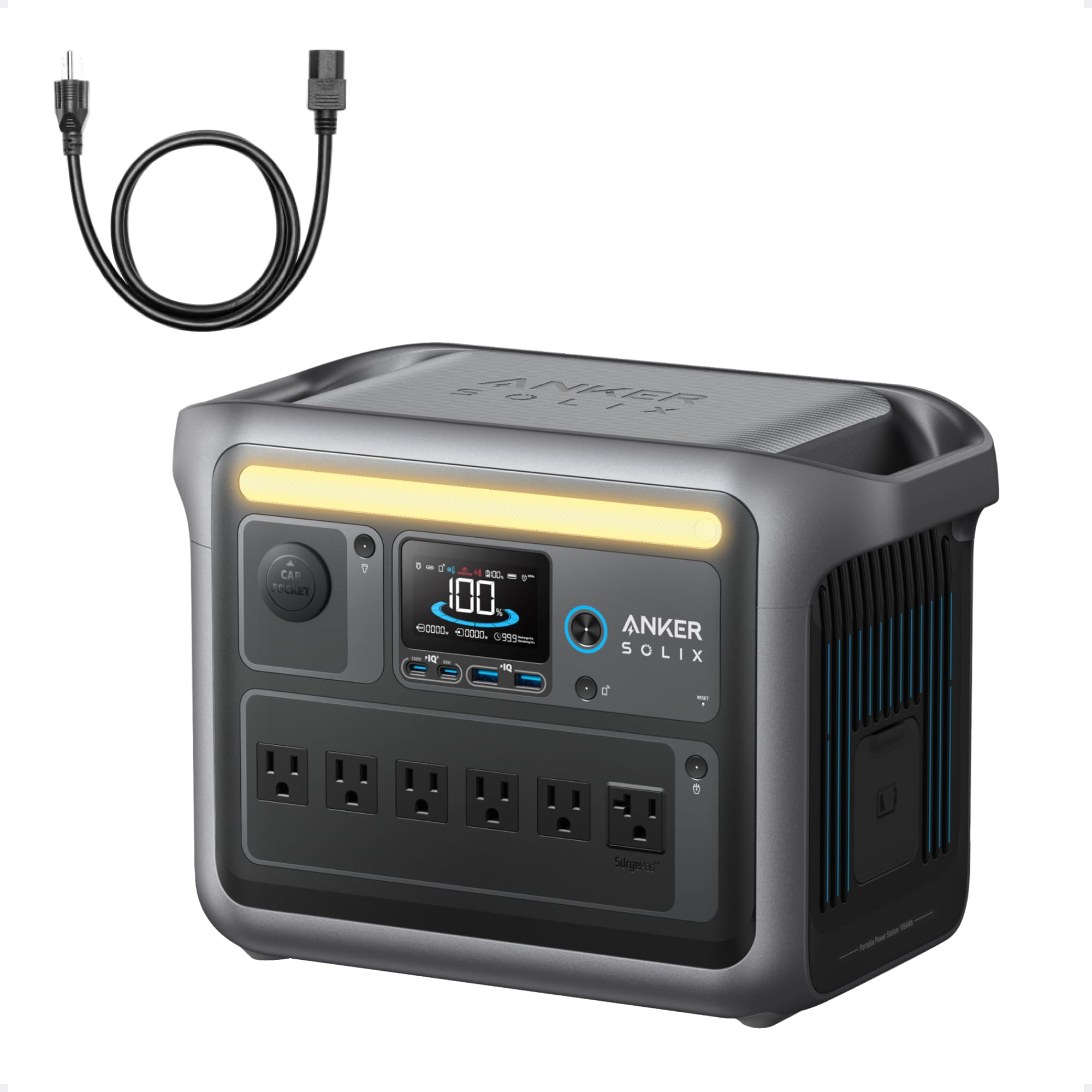
If your outage is short but your mornings are busy, the SOLIX C1000 earns its place through speed and sensible capacity. Its 1,056Wh battery covers a humidified CPAP night, while its 1,800W pure sine wave output leaves room for a phone, lamp, or small fan. Fast wall recharging is the real advantage: a station that refills quickly is ready again the next night, even when grid power returns only briefly. It is heavier than a travel-only station, and it still needs a recharge plan for multi-night use, but for users who value a quick reset after each night, this is a strong second choice.
- 1,056Wh for humidified CPAP night
- Fast wall recharging between nights
- 1,800W pure sine wave output
- LiFePO4 battery for repeated backup use
- Needs recharge plan for multi-night outages
- About 29 pounds to carry regularly
4.8/5
4.9/5
4.8/5

BLUETTI AC180 Portable Power Station — Longer Off-Grid Pick
Best for: Longer off-grid stays
When one night is not the question, the AC180 makes sense because its larger 1,152Wh battery buys margin. That margin matters most when the humidifier runs high, the room is cold, or the next recharge is uncertain. Its 1,800W pure sine wave output is ample for a CPAP and small accessories, and its LiFePO4 battery suits repeated outage use. The trade-off is weight: at about 35 pounds, it is less convenient to carry than the top two picks, and it still needs a solar or wall recharge plan for truly multi-night trips. Choose it when runtime confidence matters more than easy carrying.
- 1,152Wh gives extra humidified-night margin
- 1,800W pure sine wave output
- LiFePO4 battery for repeated use
- Good capacity for small accessories too
- About 35 pounds, harder to carry
- Still needs recharge plan for multi-night use
4.9/5
4.8/5
4.6/5

Jackery Explorer 1000 v2 Portable Power Station — Balanced Capacity Pick
Best for: Balanced capacity and weight
The Explorer 1000 v2 is for CPAP users who want a station that is easy to carry without giving up a full humidified night. Its 1,070Wh LiFePO4 battery and 1,500W output cover a CPAP, phone, and small lamp comfortably, and its lighter build than many 1,000Wh-class rivals helps on camping trips. Quiet overnight operation is a practical benefit in a bedroom or tent, where fan noise can disturb sleep. It is not the best choice for multi-night humidified use without recharging, and its output ceiling is lower than larger stations, but as a balanced one-night pick, it is hard to fault.
- 1,070Wh for humidified CPAP night
- About 24 pounds, easier to carry
- LiFePO4 battery for long life
- Quiet overnight operation for sleep
- 1,500W output below larger stations
- Not for multi-night humidified use
4.7/5
4.8/5
4.7/5

EcoFlow DELTA 2 Max Portable Power Station — Multi-Night Pick
Best for: Multi-night backup
If you want to stop counting nights, the DELTA 2 Max is the step up that changes the plan. Its 2,048Wh battery can cover two humidified CPAP nights in many setups, and its 2,400W output handles the CPAP plus other small household loads during an outage. Expansion options extend that cover further, which matters when the outage length is unknown. The cost is size and weight: at about 50 pounds, it is a home-base station rather than a travel companion, and it needs more time and space to recharge. Choose it when you would rather have reserve than portability.
- 2,048Wh for multi-night CPAP use
- 2,400W output for extra household loads
- Expandable capacity for longer outages
- LiFePO4 battery for repeated backup use
- About 50 pounds, not travel-friendly
- Needs more time to recharge fully
4.9/5
4.8/5
4.4/5

Jackery Explorer 2000 Plus Portable Power Station — Expandable Trip Pick
Best for: Growing capacity for trips
The Explorer 2000 Plus suits CPAP users who start with a weekend trip and end up planning longer ones. Its 2,042Wh battery and 3,000W output cover a humidified CPAP night with plenty of headroom, plus other camp loads, while expansion batteries extend the trip without replacing the station. That flexibility comes with bulk: it is a basecamp unit, not a backpack unit, and it needs a serious solar or wall recharge plan to refill. If you want one station that can grow with your travel plans, this is a practical choice, provided you accept its size.
- 2,042Wh for multi-night CPAP use
- 3,000W output for camp loads
- Expandable battery for longer trips
- LiFePO4 battery for long life
- Heavy basecamp unit, not portable daily
- Needs strong recharge plan to refill
4.8/5
4.8/5
4.4/5

BLUETTI Elite 200 V2 Portable Power Station — Solar-First Pick
Best for: Solar-first camping
For campers who plan to refill from the sun, the Elite 200 V2 offers a useful balance of capacity and solar input. Its 2,073Wh battery covers more than one humidified CPAP night in many setups, while its strong solar input helps it recover during the day. Its 2,600W output is ample for a CPAP and camp accessories, and LiFePO4 chemistry suits repeated outdoor use. It is still a heavy station to move, and cloudy weather will slow any solar plan, so a wall or car backup remains wise. Choose it when solar recharging, not just battery size, drives your decision.
- 2,073Wh for multi-night CPAP use
- Strong solar input for daytime recovery
- 2,600W output for camp accessories
- LiFePO4 battery for outdoor use
- Heavy to move between campsites
- Solar recovery slows in cloudy weather
4.7/5
4.7/5
4.6/5

Anker SOLIX F3800 Portable Power Station — Extended Outage Pick
Best for: Extended outages
The F3800 is not a travel station, and it should not be judged as one. Its 3,840Wh battery and 6,000W output are for households that need CPAP cover plus other essentials through a long outage, with expansion for even longer events. That scale brings real peace of mind when the outage length is unknown, but it also brings serious weight, size, and recharge time. Most CPAP users will not need this much capacity, and a smaller station will serve them better. Choose the F3800 only when extended, whole-home-style backup is the priority and the station will stay in one place.
- 3,840Wh for extended CPAP backup
- 6,000W output for household essentials
- Expandable for very long outages
- LiFePO4 battery for long service life
- Very heavy, not for travel
- More capacity than most CPAP users need
4.9/5
4.8/5
4.0/5

EcoFlow RIVER 2 Max Portable Power Station — Compact Travel Pick
Best for: Travel, humidifier-off nights
The RIVER 2 Max is the honest small option in this list, and honesty about its limits is the point. Its 512Wh battery is best for humidifier-off CPAP nights, travel, and short outages, where its light weight and easy carrying matter most. It will not reliably cover a full humidified night, so it should not be bought for that job. Its 500W output is still enough for a CPAP and phone, and its LiFePO4 battery suits frequent use. Choose it as a travel companion or second station, not as your only humidified-night backup.
- Light and easy to carry daily
- Good for humidifier-off CPAP nights
- LiFePO4 battery for frequent use
- Useful travel and second station
- 512Wh too small for humidified nights
- 500W output limits other loads
4.2/5
4.7/5
4.9/5

Goal Zero Yeti 1000X Portable Power Station — Established Brand Pick
Best for: Proven support and durability
The Yeti 1000X earns its place for buyers who value a long-established outdoor brand, durable build, and straightforward controls over the newest battery chemistry. Its 1,045Wh capacity covers a humidified CPAP night in many setups, and its 1,000W pure sine wave output is ample for a CPAP and small accessories. It is heavier and less efficient in some respects than newer LiFePO4 rivals, and its recharge options are less fast, so it ranks last here despite its reliability. Choose it if brand support and proven durability matter more to you than the latest specifications.
- 1,045Wh for humidified CPAP night
- Durable build and simple controls
- Established brand support network
- 1,000W pure sine wave output
- Older battery chemistry than LiFePO4 rivals
- Slower recharge than newer stations
4.5/5
4.7/5
4.3/5
Top 3 Head-to-Head: DELTA 2 vs SOLIX C1000 vs AC180
These three are the common final choices because all three cover a humidified night, use LiFePO4 batteries, and offer 1,800W output. The tiebreaker is not wattage, it is margin, recharge speed, and weight.
| Feature | #1 DELTA 2 | #2 SOLIX C1000 | #3 AC180 |
|---|---|---|---|
| CPAP Runtime | 4.9/5 — Best | 4.8/5 | 4.9/5 — Best |
| Clean Power | 4.9/5 — Best | 4.9/5 — Best | 4.8/5 |
| Portability | 4.8/5 — Best | 4.8/5 — Best | 4.6/5 |
| Choose if… | You want the best all-round balance | You need the fastest refill between nights | You want the most runtime margin |
Who These Power Stations Are NOT For
These stations are not a replacement for a whole-home backup system, and they are not the right tool for every power need.
They are also not ideal if you need a gas generator for outdoor work, or if you refuse to plan recharging at all. A battery station only works if you refill it, so buyers who want indefinite runtime without solar, wall, or car charging should look at a fuel-based system for outdoor use.
Common Mistakes to Avoid
Most CPAP power failures are planning failures, not product failures.
Frequently Asked Questions About Generators for CPAP Machines
How many watt-hours do I need for one CPAP night?
You need about 320Wh for a blower-only night at 40W for 8 hours, and about 640Wh for a humidified night at 80W for 8 hours. Add reserve for inverter loss, cold weather, and higher humidifier settings. That is why a 1,000Wh-class station is a sensible starting point for humidified users, while a 500Wh station is usually a travel or humidifier-off choice.
Can a portable power station run a CPAP with a heated humidifier?
Yes, if the station has enough watt-hours for your humidifier setting. A 1,000Wh-class station can cover one humidified night in many setups, while a 2,000Wh-class station can cover two. Check your CPAP power supply rating, test a full night at home, and do not assume a small travel station will last until morning with the humidifier on high.
Is pure sine wave power important for a CPAP machine?
Yes, pure sine wave output is the safer choice for sensitive medical electronics like a CPAP. It provides clean, stable power that matches household mains power more closely than a modified sine wave inverter. All of the stations ranked here use pure sine wave output, so you do not need to trade clean power for capacity in this list.
Can I use a gas generator for my CPAP overnight?
You can use a gas generator outdoors to recharge a battery station, but you should never run it indoors, in a garage, or in a tent while you sleep. Carbon monoxide risk makes indoor engine use unsafe for overnight therapy. For direct overnight CPAP power inside a home, tent, or RV bedroom, a battery power station is the safer choice.
Should I use a DC converter or the AC outlet for my CPAP?
A DC converter cable made for your CPAP model is usually more efficient, because it avoids converting battery power to AC and back again. That can extend runtime, especially on humidifier-off nights. The AC outlet is still useful when you do not have the right DC cable, or when you also need to charge a phone or lamp at the same time.
How do I recharge a CPAP power station during a multi-day outage or camping trip?
Use wall power first when it returns, solar during the day for camping, and a vehicle outlet as a backup. Plan your solar panel size and sun hours in advance, because cloudy weather will slow recovery. For RV trips, also check portable generators for RV camping to match your recharge plan to your rig and campsite rules.
Our Final Verdict
For most readers, a 1,000Wh-class LiFePO4 station is the right starting point: enough for a humidified night, clean enough for a CPAP, and portable enough to move. Size up only if you need multi-night cover without recharging, or size down only for humidifier-off travel.

Hi, I’m Michael Turner. I own a generator workshop in the United States and founded HomeGeneratorBlog to share practical, hands-on guidance about generator installation, maintenance, troubleshooting, safety, and backup power solutions. My goal is to help homeowners make smarter, more confident decisions through clear and reliable information