10 Best 1000 Watt Portable Generators for 2026: Quiet, Reliable Power
The best 1000 watt portable generator right now is the Honda EU1000i — the quietest gas model we compared at 42 dBA at quarter load. We evaluated 10 models against manufacturer specs and published run-time data, scoring each on power, portability, and value. Most 1000-watt units look identical on paper but fail on surge power, noise, or runtime in real use. Whether you need quiet camping power, outage backup, or fast solar recharging, this guide gives you one clear answer.
Quick Comparison: All 10 Products Ranked
| # | Product | Best For | Rating | Badge | |
|---|---|---|---|---|---|
| 1 | Honda EU1000i | Quiet camping and light home backup | 4.6/5 | Best Overall | Buy → |
| 2 | Jackery Explorer 1000 v2 | Short outages and indoor-safe power | 4.5/5 | Best Power Station | Buy → |
| 3 | Yamaha EF1000iS | Weight-conscious campers who want long runtime | 4.4/5 | Longest Run Time | Buy → |
| 4 | GENMAX GM1200i | Budget-friendly inverter power for camping | 4.4/5 | Best Budget | Buy → |
| 5 | Westinghouse iGen1500c | Safety-minded buyers needing motor-start headroom | 4.3/5 | Best CO Protection | Buy → |
| 6 | Anker SOLIX C1000 Gen 2 | Fast recharging and solar top-ups | 4.3/5 | Fastest Recharge | Buy → |
| 7 | EcoFlow DELTA 2 | Buyers whose power needs may grow | 4.2/5 | Best Expandable | Buy → |
| 8 | BLUETTI AC70 | Compact true-1,000W backup power | 4.2/5 | Best Compact Station | Buy → |
| 9 | GRECELL T-1000 | Lightweight car camping and light backup | 4.1/5 | Lightest Station | Buy → |
| 10 | Sportsman 1000 Watt Generator | Basic emergency lighting and small loads | 3.8/5 | Simplest Backup | Buy → |
How We Chose These Generators
What we compared
5 gas generators and 5 battery power stations in the 1,000-watt class. We checked rated and surge watts, weight (about 17 to 33 lb), noise in dBA, and run time per tank or charge.
Our 3 scoring criteria
Power Delivery (output, surge, power quality), Portability (weight and carry design), and Value for Money (capability against each model’s market tier). Each is scored out of 5 and averaged.
Sources behind the specs
Manufacturer spec sheets, retailer listings, and independent reviews from TechRadar, StorageReview, and CleanTechnica. Where sources disagreed, such as the Westinghouse weight, we say so in the review.
What we cut, and why
Models without published running and surge watts, run-time ratings, or manufacturer support. We also skipped 1,500W-plus gas units that stray from the 1,000-watt class.
What to Look for When Buying a 1000 Watt Portable Generator
A 1,000-watt generator is a small power source with big limits, so the right pick depends on what you plug in and how you plan to refuel. These four factors separate a smart purchase from a frustrating one.
1. Running Watts vs. Starting Watts
Every gas model here lists a running figure and a higher starting figure, such as the Honda’s 900 rated and 1,000 max watts. Motors in refrigerators, pumps, and fans draw a short surge on startup, so your biggest starting load must fit under the surge number. Our guide to running watts versus starting watts shows how to add up your own loads in a minute. Stations like the Jackery sidestep the problem with 3,000W of surge headroom.
2. Gas Inverter or Battery Power Station
Gas inverter generators such as the Honda EU1000i refuel in minutes and run as long as you have gasoline, but they make noise and exhaust and must stay outdoors. Battery stations like the Anker SOLIX C1000 Gen 2 are silent and indoor-safe, yet they stop when the battery is empty and must be recharged. Pick gas for multi-day outages and long camping trips, and a station for short outages, vehicles, and apartments.
3. Run Time and Noise
Gas run time depends heavily on load: the Honda lasts 3.2 hours at rated load but 7.1 hours at quarter load. The Yamaha stretches to 12 hours at quarter load, and the GENMAX reaches 6.5 hours at half load. Noise follows the same pattern, with the Honda at 42 to 50 dBA and the GENMAX near 57 to 58 dBA. Compare figures at the same load, because makers quote the most flattering number.
4. Safety and Long-Term Durability
Never run a gas generator indoors or in a garage, because carbon monoxide builds up fast. CO detection, found on the Westinghouse iGen1500c and newer Hondas, shuts the engine down when levels rise. For stations, check cycle life: the Jackery and Anker cells are rated for 4,000 cycles, versus 3,000-plus for EcoFlow and Bluetti. Warranty length is the easiest durability clue, from one year on the GENMAX to five years on the Jackery when bought direct.

Honda EU1000i 1000 Watt Inverter Generator — Quiet, clean, proven gas power
Best for: Quiet camping and light home backup
If you want a small gas generator you can carry in one hand, the EU1000i is the benchmark. It puts out 900 rated watts (1,000 max) from a 49.4 cc Honda engine and runs at just 42 to 50 dBA depending on load. Eco-Throttle trims fuel burn, so a 0.6-gallon tank lasts 7.1 hours at quarter load. That drops to 3.2 hours at rated load, which is the real trade-off. Newer units add Honda’s CO-Minder carbon monoxide detection. It suits campers, tailgaters, and light outage backup, though a second unit is the only way to scale up.
- 42 dBA at quarter load, 50 dBA rated
- Weighs only 28.7 lb with handle
- 7.1 hours at quarter load per tank
- Backed by a 2-year residential warranty
- Only 3.2 hours at rated load
- Rated output is 900 watts, not 1,000
4.8/5
4.8/5
4.2/5

Jackery Explorer 1000 v2 Portable Power Station — Silent power with real surge headroom
Best for: Short outages and indoor-safe power
Most 1,000-watt gas generators struggle to start a fridge, but the Explorer 1000 v2 has headroom: 1,500W continuous AC output and 3,000W surge from a 1,070Wh LiFePO4 battery. It weighs 23.8 pounds, supports pass-through charging, and switches over as a UPS in under 20 milliseconds. Emergency mode recharges it in about an hour through the app, while the default is 1.7 hours for battery health. The limit is capacity: at a 1,000W load it lasts roughly an hour, so it fits short outages, camping, and indoor use better than multi-day backup.
- 1,500W continuous, 3,000W surge output
- Full recharge in about 1 hour
- LiFePO4 battery rated for 4,000 cycles
- No fumes, safe for indoor use
- About 1 hour at a 1,000W load
- Emergency fast charge needs the app
4.7/5
4.4/5
4.4/5

Yamaha EF1000iS 1000 Watt Inverter Generator — Stretches a tiny tank to 12 hours
Best for: Weight-conscious campers who want long runtime
Yamaha’s EF1000iS is built for anyone who counts every pound and every hour of runtime. Its 50 cc OHV engine delivers 900 rated and 1,000 maximum watts, and Economy Control lets it run up to 12 hours at quarter load. It weighs 27.9 pounds in the U.S. spec and runs at 47 to 57 dBA with Economy on. A fuel petcock lets you run the carburetor dry before storage. The catch is availability: many online listings are for international 230V models, so confirm the 120V U.S. version before you order, and expect more noise than the Honda at full load.
- Up to 12 hours at quarter load
- 27.9 lb dry weight
- 47 to 57 dBA with Economy on
- Fuel petcock simplifies storage
- Many listings are 230V international models
- Louder than the Honda at full load
4.6/5
4.8/5
3.8/5

GENMAX GM1200i 1200W Inverter Generator — Budget-friendly inverter power, light weight
Best for: Budget-friendly inverter power for camping
The GM1200i is the most budget-friendly route to a true inverter generator in this roundup. It delivers 1,000 running and 1,200 starting watts from a 57 cc engine, weighs just 25.3 pounds, and is parallel ready if you later add a second unit. Run time reaches 6.5 hours at half load on a roughly 0.7-gallon tank, at about 57 to 58 dBA. Two 120V outlets, USB ports, and a CO alert round out the package. The compromises are a one-year warranty, louder operation than Honda or Yamaha, and mixed owner reports on long-term reliability.
- 1,000W running, 1,200W starting watts
- Lightest gas model here at 25.3 lb
- 6.5 hours at half load
- Parallel ready with a second GM1200i
- Only a 1-year factory warranty
- Some owner reports of stalling
- Not CARB compliant; check state rules
4.0/5
4.7/5
4.6/5
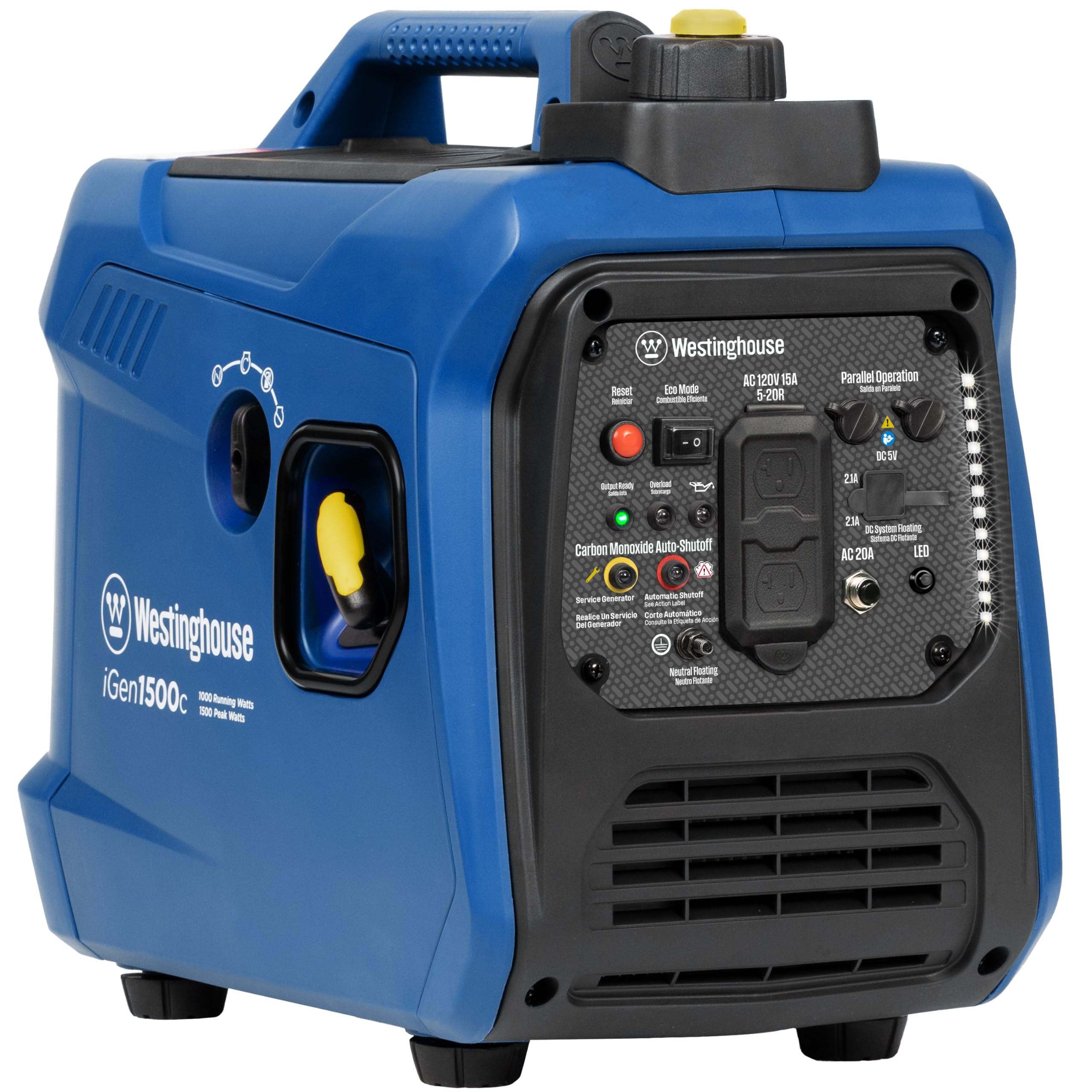
Westinghouse iGen1500c Inverter Generator with CO Sensor — Built-in CO shutdown plus motor headroom
Best for: Safety-minded buyers needing motor-start headroom
Safety-minded buyers will like the iGen1500c because it adds carbon monoxide detection and automatic shutdown to a compact 1,000-running-watt inverter generator. Peak output is 1,500 watts, which gives extra headroom for starting small motors, and the 56 cc engine runs as low as 52 dBA. Westinghouse rates it for up to 12 hours at 25 percent load on a 0.79-gallon tank, and it is parallel capable. Weight figures vary by listing, from about 20 to 33 pounds, so check the spec sheet. Some retailers also list it as discontinued, so confirm availability before you plan around it.
- CO detection with automatic shutdown
- 1,500 starting watts for motor loads
- Up to 12 hours at 25% load
- 3-year limited warranty
- Some retailers list it as discontinued
- Weight claims vary from 20 to 33 lb
4.4/5
4.3/5
4.2/5
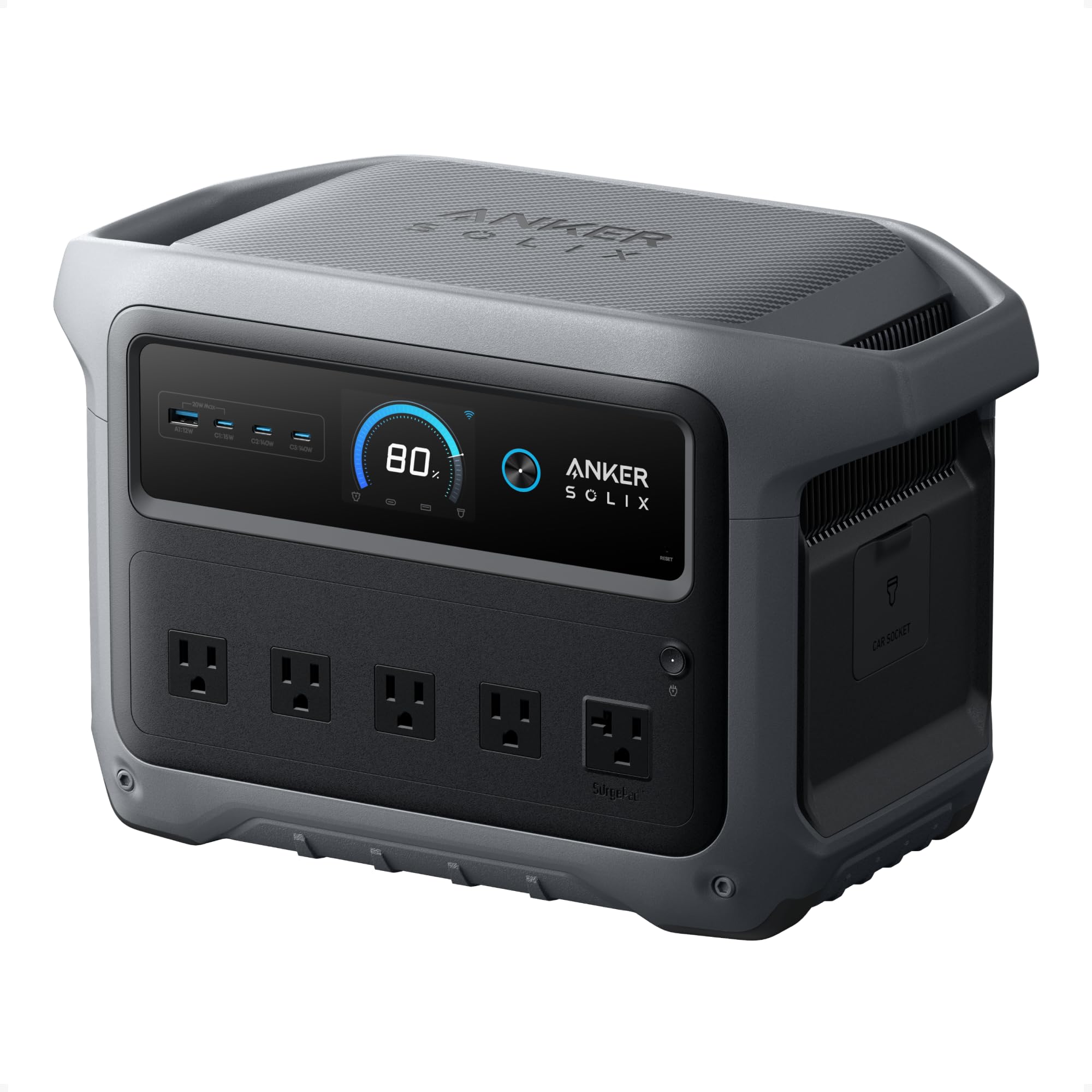
Anker SOLIX C1000 Gen 2 Portable Power Station — Refills in under an hour
Best for: Fast recharging and solar top-ups
Anker’s C1000 Gen 2 is the pick when waiting on a recharge is your biggest frustration. UltraFast mode refills the 1,024Wh LiFePO4 battery in 49 minutes at 1,600W, and up to 600W of solar can do it in 1.8 hours. It delivers 2,000W continuous and 3,000W peak across nine to ten ports while weighing 24.9 pounds. Anker rates the battery for 4,000 cycles to at least 80 percent capacity. UltraFast charging must be enabled in the app and requires the supplied Anker AC cable, and the cooling fans get loud while charging at full speed.
- 49-minute recharge in UltraFast mode
- 2,000W continuous, 3,000W peak output
- Accepts up to 600W of solar
- 4,000 cycles to 80% capacity
- Fans loud during fastest charging
- UltraFast needs the app and Anker cable
4.5/5
4.5/5
4.0/5

EcoFlow DELTA 2 Portable Power Station 1024Wh — Room to grow past 1,000 watts
Best for: Buyers whose power needs may grow
EcoFlow’s DELTA 2 is the best fit when you suspect 1,000 watts will not stay enough. It stores 1,024Wh, outputs 1,800W with 2,700W surge, and X-Boost can run some resistive appliances rated up to 2,200W. Capacity expands to 2,048Wh with an extra battery. X-Stream charging reaches 80 percent in 50 minutes, and solar input tops out at 500W. The unit weighs about 27 pounds, roughly three pounds more than the Jackery and Anker. EcoFlow lists 3,000-plus cycles for its LiFePO4 cells, which trails the 4,000-cycle claims from those two rivals.
- 1,800W output with 2,700W surge
- Expandable to 2,048Wh with extra battery
- 80% charge in about 50 minutes
- Wi-Fi and app control
- 27 lb, heavier than Jackery or Anker
- 3,000-cycle rating trails some rivals
4.8/5
4.0/5
3.8/5

BLUETTI AC70 Portable Power Station 768Wh 1000W — True 1,000W output in a small box
Best for: Compact true-1,000W backup power
The AC70 is a compact power station with a true 1,000W output rating, which makes it the closest match to the generator class this guide covers. Its 768Wh LiFePO4 battery weighs 22.5 pounds, and Power Lifting mode lets it run resistive loads up to 2,000W, such as a kettle or hair dryer. Solar input reaches 500W, filling the battery in about two hours. A B80 expansion battery lifts capacity to 1,574Wh. TechRadar’s reviewer found it handled devices within the 1,000W range without trouble. The smaller 768Wh battery means shorter runtimes than the 1,000Wh-class stations above.
- 1,000W continuous, 2,000W Power Lifting mode
- 22.5 lb with LiFePO4 battery
- Up to 500W solar input
- Expandable with the B80 battery
- 768Wh runs out sooner than rivals
- Power Lifting suits resistive loads only
4.0/5
4.5/5
4.2/5

GRECELL T-1000 1000W Portable Power Station 999Wh — Lightweight 999Wh for car camping
Best for: Lightweight car camping and light backup
The GRECELL T-1000 is the lightest 999Wh station in this guide at about 17 pounds, with 1,000W of pure sine wave output and a 2,000W surge. It suits car campers and light outage backup where weight matters more than app features. StorageReview notes its NCM lithium-ion cells pack more energy into less weight than LiFePO4, though at the cost of longevity. The display is basic with no app control, and maximum AC input is 155W, so refills take far longer than the Jackery or Anker. It only powers appliances rated up to 1,000W.
- About 17 lb for 999Wh
- 1,000W pure sine wave, 2,000W surge
- Pass-through charging supported
- Dual-fan cooling guards against overheating
- NCM cells trade lifespan for weight
- 155W max input means slow recharges
- No app control
3.8/5
4.6/5
4.0/5

Sportsman 1000 Surge Watt Portable Generator — No-frills gas backup for basics
Best for: Basic emergency lighting and small loads
For readers who want the simplest possible backup generator, the Sportsman 1000 Surge Watt model covers the basics: 900 running watts, 1,000 surge watts, one 120V outlet, and recoil starting. A 1.1-gallon tank runs about five hours at 50 percent load, according to the listing, which is enough for lights, a radio, and a small TV. It is sold to hunters, campers, and tailgaters and stows easily in a car trunk. Expect fewer features than the inverter models above: one outlet, no parallel capability listed, and no published noise rating, so read the manual before buying.
- 900 running, 1,000 surge watts
- About 5 hours at 50% load
- Simple recoil start, 1.1-gallon tank
- Stows easily in a car trunk
- Single 120V outlet only
- No noise rating on the listing
- Basic features versus inverter models
3.4/5
3.8/5
4.1/5
Top 3 Head-to-Head: Honda EU1000i vs Jackery Explorer 1000 v2 vs Yamaha EF1000iS
These three are the usual final choices: two premium gas inverters and the station with the most surge headroom. Each wins a different part of the comparison.
| Feature | #1 Honda EU1000i | #2 Jackery 1000 v2 | #3 Yamaha EF1000iS |
|---|---|---|---|
| Continuous output | 900W rated (1,000W max) | 1,500W AC — Best | 900W rated (1,000W max) |
| Weight | 28.7 lb | 23.8 lb — Best | 27.9 lb |
| Noise | 42 to 50 dBA | No engine noise — Best | 47 to 57 dBA |
| Run time | 7.1 hr at 1/4 load | About 1 hr at 1,000W | 12 hr at 1/4 load — Best |
| Choose if… | You want quiet, refuelable gas power | You want silent output with surge headroom | You want maximum gas runtime per tank |
Who These Generators Are NOT For
These units are built for lights, electronics, and small appliances, not for heavy equipment.
Not sure whether a battery or a gas unit suits you? Our power station versus generator comparison walks through the trade-offs. Also skip these if you need a microwave above 650 watts, an electric kettle, or a space heater, since each draws more than 1,000 watts.
Common Mistakes to Avoid
Four errors cause most small-generator problems, and every one is easy to prevent.
Frequently Asked Questions About 1000 Watt Portable Generators
What can a 1000 watt generator run?
A 1000 watt generator can run lights, phone and laptop chargers, a TV, a fan, a CPAP, and a small or mini refrigerator, as long as the combined running watts stay under the rating. Add up every device you plan to run at once, and remember that motors need extra starting watts. Anything with a heating element, such as a kettle, space heater, or hair dryer, usually exceeds 1000 watts.
Can a 1000 watt generator run a refrigerator?
Sometimes. An efficient fridge may run on 100 to 200 watts, but its compressor can briefly need two to three times that on startup, so check the starting watts on the label. A small or mini fridge is usually fine. Older full-size models with surges near or above 1,000 watts can overload a gas unit, while a station with a 3,000W surge rating handles them more comfortably.
Can a 1000 watt generator run a microwave?
Only a small one. A microwave labeled 1,000 watts typically pulls about 1,500 watts from the wall, which exceeds a 1000 watt generator. Models rated 650 watts or lower can run, but they use nearly the entire capacity, so unplug everything else first. Check the input wattage on the nameplate rather than the cooking wattage before you try it.
How long will a 1000 watt generator run on a tank of gas?
Run time depends on load. The Honda EU1000i lasts 3.2 hours at rated load and 7.1 hours at quarter load on 0.6 gallons, while the GENMAX GM1200i reaches 6.5 hours at half load. Lower loads and Eco mode stretch a tank, so lights and chargers last far longer than a heater would. For fuel math, see how long a generator runs per gallon.
Is an inverter generator better than a conventional 1000 watt generator?
For most buyers, yes. Inverter models produce cleaner power that is safer for laptops, phones, and medical devices, run quieter, and adjust engine speed to the load to save fuel. Conventional open-frame units are simpler and more budget-friendly, but they are usually louder. Choose an inverter for sensitive electronics, camping, and nearby neighbors, and a basic model only for simple lighting and small loads.
Is a portable power station better than a 1000 watt gas generator?
It depends on how long you need power. A station such as the Jackery Explorer 1000 v2 is silent, emission-free, and safe indoors, but it runs dry after roughly an hour at full load and then needs recharging. A gas generator keeps going as long as you add fuel. Choose a station for short outages and camping, and gas for multi-day outages.
Can a 1000 watt generator run a whole house?
No. A 1000 watt generator can keep a few essentials running during an outage, such as lights, a phone charger, a router, and perhaps a small fridge, but it cannot power central air, an electric range, a water heater, or a well pump. Whole-house backup typically needs several thousand watts and a properly installed transfer switch.
Our Final Verdict
Gas inverter models like the Honda EU1000i still win for refuel-anywhere reliability, while battery stations like the Jackery Explorer 1000 v2 win on silence and output. Decide by how you will recharge: gasoline for multi-day use, battery for quiet, short-term backup and camping.

Hi, I’m Michael Turner. I own a generator workshop in the United States and founded HomeGeneratorBlog to share practical, hands-on guidance about generator installation, maintenance, troubleshooting, safety, and backup power solutions. My goal is to help homeowners make smarter, more confident decisions through clear and reliable information