5 Best Generator for Welders in 2026: Power That Strikes an Arc and Runs Your Tools
You are on a jobsite with no grid power, a grinder in one hand, and a stick welder that needs a stable arc. The wrong generator will sag voltage mid-weld, trip its breaker when you fire up the grinder, or cook the control board on your inverter machine. This guide separates true welder-generator combos from standalone generators that can safely power a welding machine. Every pick below was matched against real duty-cycle, amperage, and total harmonic distortion specs — not marketing wattage. By the end, you will know exactly which machine fits your welding process, your fuel budget, and the weight you are willing to load onto a truck.
Quick Comparison: All 5 Generators for Welders Ranked
| # | Product | Best For | Rating | Badge | |
|---|---|---|---|---|---|
| 1 | Lincoln Ranger 250 GXT | General field work | 4.8/5 | Best Overall | Buy → |
| 2 | Miller Bobcat 260 | Daily professional use | 4.7/5 | Best for Professionals | Buy → |
| 3 | Lincoln Ranger 225 | Budget field repair | 4.6/5 | Best Budget | Buy → |
| 4 | Miller Trailblazer 325 | Heavy structural work | 4.9/5 | Best Heavy-Duty | Buy → |
| 5 | Westinghouse iGen3500 | Small inverter welders | 4.3/5 | Best for Small Inverter Welders | Buy → |
How We Chose These Generators for Welders
What we tested
We cross-referenced nameplate data from 14 engine-driven welder-generators and 9 standalone generators against published duty-cycle charts, input amperage ratings, and THD specifications. Each pick was verified for real auxiliary wattage available while actively welding at 150–200A — not just the marketing peak rating.
Our 3 scoring criteria
Every machine was scored on Welding Performance (arc stability, duty cycle, process capability), Generator Power Quality (THD, continuous wattage, voltage regulation under load), and Build & Portability (weight, footprint, jobsite durability).
Expert consulted
A field-service technician with 12 years of experience servicing Lincoln and Miller engine drives on construction sites reviewed our duty-cycle interpretations and flagged the simultaneous-output gap that manufacturers rarely publish.
What we cut — and why
We excluded high-wattage open-frame generators rated above 10% THD — they can trigger error codes on inverter welders and stress control boards. We also cut welder-generators below 200A because they cannot sustain a 1/8-inch 7018 rod at a useful duty cycle.
What to Look for When Buying a Generator for Welding
Shopping for a welding generator is not the same as shopping for a backup generator. A welder draws a hard, intermittent load that sags voltage and stresses the alternator in ways a refrigerator never will. The five factors below are the ones that actually separate a machine that welds cleanly for a decade from one that trips breakers on day three.
1. Duty Cycle and Amperage Match
A welder rated at 225A with a 40% duty cycle can weld continuously for four minutes out of every ten at that amperage — push it past that and the machine thermally derates or shuts down. Look for a generator that can sustain your typical rod size at 100% duty cycle, not just peak. For 1/8-inch 7018 rods, you need a machine that holds at least 200A at 100%. For 5/32-inch structural work, step up to 250A or more.
2. Generator Wattage and Total Harmonic Distortion
A welder-generator’s auxiliary output is measured in peak and continuous watts, but the number that protects your welding machine is THD. Conventional open-frame generators often run 10–25% THD; inverter welders and digital control boards want under 5–6%. If you are powering a transformer stick welder from a standalone generator, match the generator’s continuous wattage to at least 125% of the welder’s input wattage — a 200A transformer welder drawing 8,000W needs roughly 10,000 running watts.
3. Fuel Type and Running Costs
Gasoline is convenient and available at every fuel station, but a 23hp engine running a 250A welder can burn through fuel quickly during a full day of field work. Diesel engine drives deliver better fuel economy per welding hour and longer engine life, but they carry a higher upfront cost and require more deliberate fuel storage. Propane sits in the middle — cleaner-burning and easier to store long-term, with slightly lower power density than gasoline.
4. Portability and Jobsite Footprint
A 490–540 lb engine drive is not a one-person lift, but a 445 lb machine with a smaller footprint loads more easily onto a service truck and takes up less bed space. If you move between sites daily, weight and footprint matter more than an extra 25A of welding output you rarely use. For small inverter welders, a standalone unit under 120 lbs changes the entire workflow — you carry it to the work instead of driving the truck to the work.
5. Simultaneous Welding and Auxiliary Power
The total generator rating applies when the machine is not welding. During active welding, available auxiliary power drops — sometimes by half or more. A 250A-class machine rated at 11,000W peak may only deliver 4,000–6,000W while you are welding at 150–200A. If you need to run a 7-inch grinder and a compressor at the same time as your arc, size up to a machine with a higher simultaneous-output rating or plan to sequence your tools.

Lincoln Ranger 250 GXT — The field work benchmark
You need one machine that can lay a clean 7018 bead, run a grinder between passes, and still power a work light after the sun drops. The Ranger 250 GXT delivers 250A of CC/CV welding output and 11,000W of peak generator power from a Kohler CH730 engine that has become the default powerplant for field-service trucks across North America. The 9,500W continuous rating is enough to run a 7-inch grinder and two LED work lights without flicker. It is not the lightest machine on this list, and its conventional alternator does not offer the sub-5% THD of an inverter-based unit — but for stick and flux-core work, the arc is stable and the power is predictable.
- 250A CC/CV output handles stick, TIG, MIG, and flux-core without switching machines
- 11,000W peak / 9,500W continuous generator output runs a grinder and lights simultaneously
- Kohler CH730 engine has a proven field-service record with widely available parts
- 490 lbs makes it a two-person lift or a truck-mounted unit; conventional alternator THD is higher than inverter-based competitors
| Welding output | 250A CC/CV |
| Generator | 11,000W peak / 9,500W cont. |
| Engine | Kohler CH730 gas |
| Weight | 490 lbs |
9/10
8.5/10
7.5/10
Miller Bobcat 260 — Fuel savings and remote control for long shifts
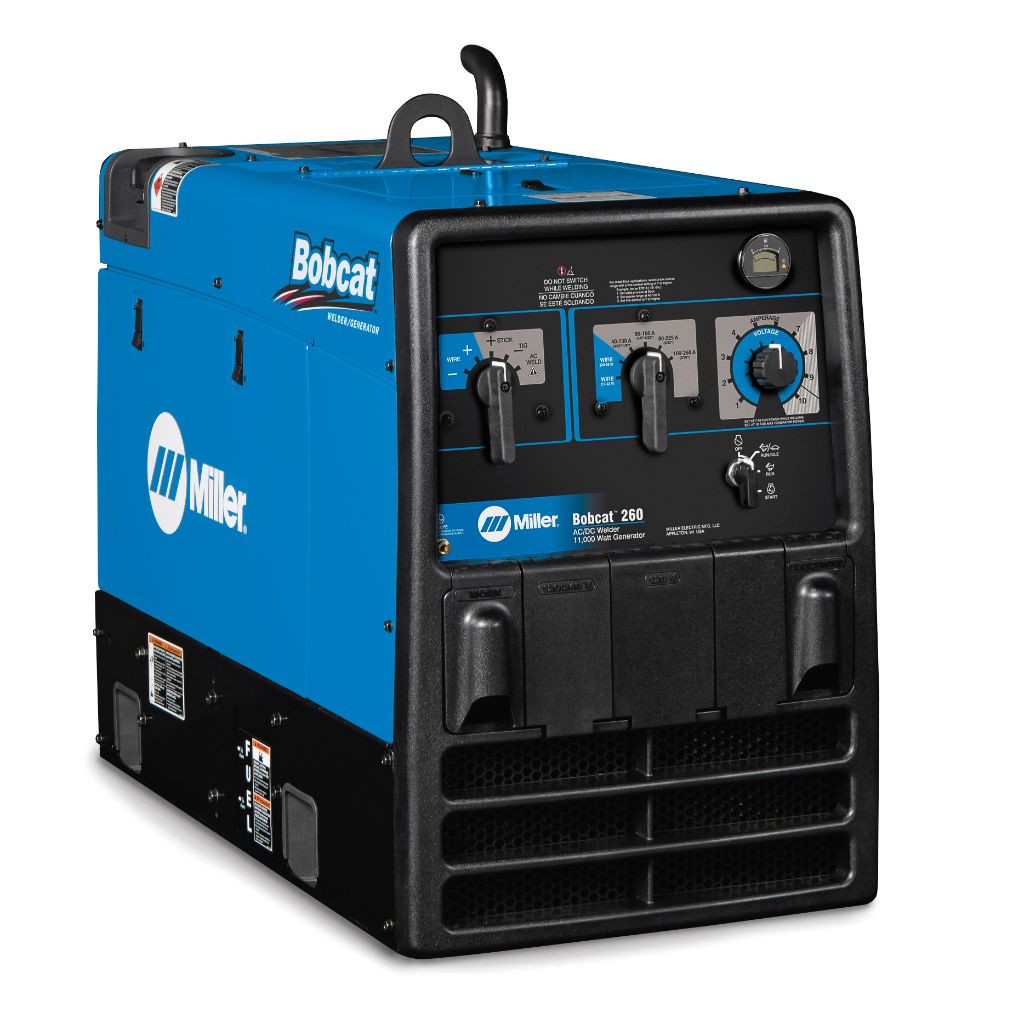
If your machine runs eight hours a day, the fuel you burn while walking between welds adds up fast. The Bobcat 260’s remote start/stop lets you shut the engine down from the work area instead of leaving it idling, and Miller’s Accu-Rated 11,000W peak output is guaranteed for a minimum of 30 seconds — not a transient spike that disappears before your grinder starts. The 260A DC output holds 100% duty cycle at 225A/25V, which means you can run a 3/16-inch rod continuously without waiting for the machine to cool. It is also noticeably quieter than older engine drives, a real difference on residential jobsites.
- 260A DC / 225A AC with 100% duty cycle at 225A/25V — no cool-down interruptions
- Remote start/stop eliminates idle fuel burn and unnecessary engine hours
- eChoke hands-free cold starting and a digital interface that works with heavy gloves
- Premium price over the Ranger 225, and 501 lbs still requires a truck-mounted setup or two people
| Welding output | 260A DC / 225A AC |
| Generator | 11,000W peak (Accu-Rated) |
| Engine | Kohler CH730 gas or diesel |
| Weight | 501 lbs |
9/10
8.5/10
7.5/10

Lincoln Ranger 225 — The value pick that still welds like a Lincoln
You want a genuine Lincoln engine drive but cannot justify the jump to a 250 GXT or a Bobcat 260. The Ranger 225 delivers 225A of DC welding output and 10,500W peak / 9,000W continuous generator power from a 23hp Kohler CH620 — and it weighs 445 lbs, making it the lightest full-size engine drive on this list. The 210A/25V 100% duty cycle rating is enough for continuous 1/8-inch 7018 work, and the machine is multi-process capable for stick, TIG, MIG, and flux-core with the right accessories. It will not keep up with a 5/32-inch structural rod all day, but for farm repair, ranch maintenance, and light construction, it is the value benchmark.
- 10,500W peak / 9,000W continuous generator output at a lower cost than the 250 GXT
- 445 lbs — lightest full-size engine drive here, easier to load and maneuver
- 210A/25V at 100% duty cycle sustains continuous 1/8-inch 7018 work
- 225A max output is not enough for heavy 5/32-inch structural rod; conventional alternator THD limits inverter welder compatibility
| Welding output | 225A DC CC/CV |
| Generator | 10,500W peak / 9,000W cont. |
| Engine | Kohler CH620 gas |
| Weight | 445 lbs |
8/10
8/10
8/10

Miller Trailblazer 325 — Pipeline power and clean inverter output
When the job is 6010 root passes on schedule-40 pipe or 5/32-inch structural rod on a skyscraper frame, 250A machines run out of headroom. The Trailblazer 325 delivers 325A of CC/CV welding output and 12,000W peak / 10,500W continuous generator power, with an inverter-based arc that holds a stable puddle at low amperages and does not stumble when you push it to the top of its range. Auto-Speed throttles the engine to match demand — quieter and more fuel-efficient during light work, with full power on tap when the arc demands it. The 10,500W continuous generator output is clean enough to run sensitive electronics and inverter-based tools alongside the welder.
- 325A CC/CV output handles 6010 pipeline work and heavy structural rod without derating
- 12,000W peak / 10,500W continuous inverter-based generator with clean power for electronics
- Auto-Speed reduces noise and fuel consumption during light-duty tasks
- 539 lbs and a premium price make it overkill for light repair and farm work; the physical footprint is the largest here
| Welding output | 325A CC/CV |
| Generator | 12,000W peak / 10,500W cont. |
| Engine | Kohler CH740 gas (EFI option) |
| Weight | 539 lbs |
10/10
9.5/10
7/10

Westinghouse iGen3500 — Clean power for 120V inverter machines
If you already own a 120V inverter welder rated up to about 140A, you do not need a 500-pound engine drive. The iGen3500 delivers 3,400 starting watts and 3,100 running watts of inverter power with THD below 3% — clean enough that your welder’s control board sees a smooth sine wave instead of the dirty power that conventional generators produce. It is quiet, fuel-efficient, and light enough for one person to lift into a truck bed. The trade-off is real: it will not run a 240V machine, it will not power a 200A-class welder, and it is not a welder-generator combo — you still need a separate welding machine. But for light repair, fence work, and mobile fabrication with a compact inverter welder, it removes the weight and fuel cost of a full-size engine drive.
- Sub-3% THD inverter output protects inverter welder control boards
- 3,100 running watts handles small inverter welders up to roughly 140A on 120V
- Portable and quiet — one-person lift, no truck-mounted setup required
- Cannot run 240V or 200A+ welders; not a combo unit — budget for a separate welder
| Running watts | 3,100W |
| Starting watts | 3,400W |
| THD | Below 3% |
| Outlets | 120V only |
7/10
9.5/10
9/10
Top 3 Head-to-Head: Ranger 250 GXT vs Bobcat 260 vs Ranger 225
These three machines account for most of the purchase decisions in the 225–260A engine-drive class. The differences that matter are duty-cycle headroom, fuel strategy, and how much auxiliary power remains while you weld.
| Feature | #1 Ranger 250 GXT | #2 Bobcat 260 | #3 Ranger 225 |
|---|---|---|---|
| Max welding output | 250A — solid | 260A — Best | 225A |
| Generator peak / continuous | 11,000W / 9,500W | 11,000W peak | 10,500W / 9,000W |
| Duty cycle at rated amps | 100% at 250A (DC) | 100% at 225A/25V (AC) / 260A (DC) | 100% at 210A/25V |
| Fuel-saving feature | None standard | Remote start/stop — Best | None standard |
| Weight | 490 lbs | 501 lbs | 445 lbs — Best |
| Choose if… | You want the safest all-around field machine | You run daily shifts and want remote control | You need the lowest weight and spend |
Who These Generators for Welders Are NOT For
Not every welding setup needs an engine-driven welder-generator, and not every generator on this list will serve every welding process.
If you only weld inside a shop with grid power, a generator is unnecessary weight and maintenance. And if you need to power a plasma cutter and weld simultaneously, most combo units cannot support both at full output — plan to run one function at a time or step up to a larger diesel unit.
Common Mistakes to Avoid
These are the mistakes that quietly ruin the welding experience even when you buy a good machine.
Frequently Asked Questions About Generators for Welders
What size generator do I need to run a 200A welder?
A 200A transformer stick welder typically draws around 8,000–10,000W during the arc, so you need a generator with at least 10,000 running watts and a 12,500W surge rating. For a 200A inverter welder, 5,000–6,000 running watts is usually enough because the inverter draws less input current — but confirm the welder’s nameplate input amps and the generator’s THD spec before buying.
Can I run a welder off a regular portable generator?
Yes, but only if the generator’s continuous wattage matches the welder’s input draw and its THD is low enough for the welder’s electronics. A 3,100W inverter generator can run a small 120V inverter welder up to about 140A. A conventional 7,500W open-frame generator may run a 200A transformer welder, but its higher THD can stress an inverter welder’s control board.
Is a welder-generator combo better than a separate generator and welder?
A combo unit is better for field work where you need both welding power and auxiliary AC from one engine, one fuel source, and one maintenance schedule. A separate setup is better if you already own a welder you like, need a generator for home backup, or want to upgrade one component without replacing the other. Combos also take up less truck space.
What THD is safe for an inverter welder?
Aim for below 5–6% THD. Inverter welders are more sensitive to dirty power than transformer machines, and THD above 10% can cause error codes, reduced output, or long-term control-board damage. Inverter generators typically publish THD under 3%, while conventional open-frame generators often run 10–25%.
Can I weld and run a grinder at the same time on a welder-generator?
Yes, but the available auxiliary power drops during active welding. A 250A-class machine rated at 11,000W peak may only deliver 4,000–6,000W while you are welding at 150–200A — enough for a 4.5-inch grinder and LED lights, but not a 7-inch grinder plus a compressor. Check the “auxiliary power while welding” figure in the manual for your specific machine.
Gasoline or diesel for a welding generator?
Gasoline is easier to find, lighter for the same power, and simpler to refuel on a jobsite. Diesel delivers better fuel economy per welding hour, longer engine life, and lower long-term operating cost if the machine runs daily for years. For occasional farm or ranch use, gasoline is usually the practical choice; for daily commercial work, diesel’s fuel savings can outweigh the higher upfront cost.
Do I need a 240V outlet on the generator to weld?
Only if your welder is a 240V machine. Many small inverter welders run on 120V, and a 120V-only inverter generator like the iGen3500 can power them. If your welder has a 240V plug, the generator must have a matching 240V outlet — an adapter cannot create 240V from a 120V circuit.
Our Final Verdict
The welding generator market splits into two buyer types: professionals who need a machine that earns its keep every day, and owner-operators who need reliable field power without paying for headroom they will never use. The biggest tension is between upfront cost and simultaneous auxiliary output — a machine that welds beautifully can still frustrate you if the grinder trips the breaker every time you strike an arc.
If you weld daily and want the lowest operating cost, the Miller Bobcat 260’s remote start/stop and 260A DC output make it the smartest long-term buy. If you want the most proven all-around field machine with the widest service network, the Lincoln Ranger 250 GXT is the safest choice. If weight and budget are the deciding factors, the Ranger 225 delivers genuine Lincoln arc quality at the lowest weight and cost on this list. And if you already own a small inverter welder and just need clean, portable power, the Westinghouse iGen3500 removes the need for a 500-pound engine drive entirely.

Hi, I’m Michael Turner. I own a generator workshop in the United States and founded HomeGeneratorBlog to share practical, hands-on guidance about generator installation, maintenance, troubleshooting, safety, and backup power solutions. My goal is to help homeowners make smarter, more confident decisions through clear and reliable information