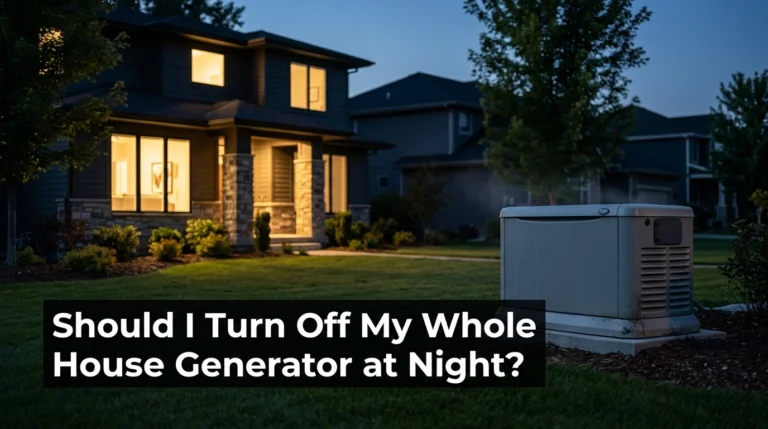
Will a 20,000 Watt Generator Power a House?
Quick Answer
Yes, a 20,000-watt generator can power many houses, including central air conditioning and several major appliances. However, an all-electric home or a house running several high-wattage loads at once may exceed 20 kW, so calculate your actual generator power capacity before choosing a unit.
What a 20,000-watt generator can usually handle
- Refrigeration: A refrigerator and separate freezer are small loads compared with a 20 kW generator.
- Heating equipment: A gas furnace blower is usually manageable without consuming much of the available capacity.
- Central air: Many systems can run, but compressor starting demand must be included in the calculation.
- Household circuits: Lights, televisions, computers, outlets, and internet equipment generally leave substantial capacity available.
- Major appliances: Pumps, microwaves, washing machines, and selected kitchen appliances can often run with sensible load management.
- Heavy electric loads: Electric heat, dryers, water heaters, ranges, and EV charging can push total demand past 20,000 watts.
Before buying
- Check continuous watts, starting watts, fuel-specific output, and the loads you expect to operate simultaneously.
A 20,000-watt generator sounds enormous until you start adding electric heating, air conditioning, water heating, and cooking equipment. The important question isn’t simply whether 20 kW can run a house.
The better question is whether it can run your house under the conditions you expect during an outage. Here’s how I work that out without relying on square footage alone.
What Does a 20,000-Watt Generator Mean?
A 20,000-watt generator is a generator capable of supplying up to 20 kilowatts, or 20 kW, under its specified rating conditions. At 240 volts, 20,000 watts represents about 83 amps of available current.
Definition: Generator wattage is the amount of electrical power a generator can supply. Running watts describe continuous output, while starting or surge capacity describes the short extra power available when motors and compressors start.
Those two ratings matter because a central air conditioner, well pump, refrigerator, and other motor-driven equipment can draw extra power for a few seconds during startup.
A generator can therefore have enough continuous capacity for your appliances yet still struggle when a large compressor starts.
- 20 kW: 20,000 watts.
- At 240 volts: approximately 83.3 amps.
- At 120 volts: the mathematical equivalent is about 166.7 amps, although residential generator systems normally distribute power across 120/240-volt circuits.
- Starting loads: motors and compressors may temporarily require more than their normal running demand.
Will a 20,000 Watt Generator Run a Whole House?
For many homes, yes. A 20,000-watt generator sits firmly in whole-house standby territory and can support substantially more than emergency essentials.
It isn’t a guarantee that every breaker can stay on simultaneously. If you’re comparing other capacities, my guide to choosing a generator size for a house explains why household electrical load matters more than floor area.
| Home Setup | 20 kW Outlook | Main Concern |
|---|---|---|
| Gas heat, gas water heater, gas cooking | Usually plenty of capacity | Central AC starting load |
| Gas heat with several electric appliances | Often a strong fit | Avoid stacking large loads |
| Electric water heater and electric dryer | Possible with load management | Both appliances draw several kilowatts |
| All-electric home | May be insufficient | Heat, water heating, cooking, and HVAC |
| Large home with multiple HVAC systems | Needs individual sizing | Multiple compressor starting loads |
I don’t treat “whole house” as meaning every appliance gets unlimited power. I treat it as keeping the home comfortable while preventing unnecessary large loads from piling on simultaneously.
What Appliances Can a 20,000-Watt Generator Run?
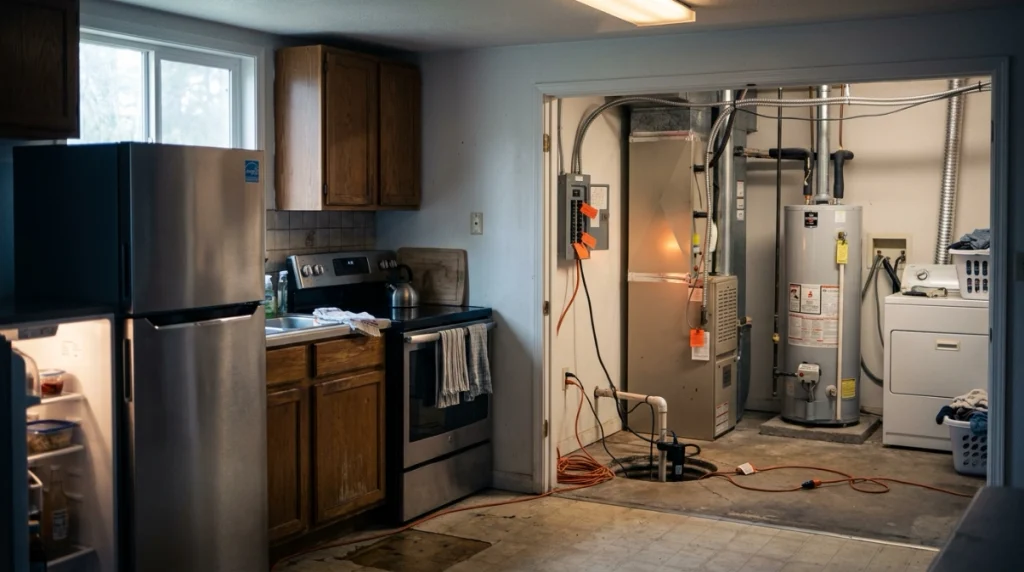
A 20 kW generator can usually support a long list of normal household equipment. Smaller electronics and lighting barely make a dent compared with electric resistance heating or a clothes dryer.
The Honda generator wattage guide illustrates the difference well. Its planning figures list an electric water heater around 4,500 running watts and an electric dryer around 5,400 running watts.
| Example Appliance | Approx. Running Watts | Why It Matters |
|---|---|---|
| Energy Star refrigerator | 132–192 W | Low running draw but has startup demand |
| 1/2 HP furnace fan | 875 W | Common with gas or oil heat |
| 1/3 HP sump pump | 800 W | Motor requires extra startup power |
| Electric range element | 2,100 W | Multiple elements increase demand |
| Electric water heater | 4,500 W | Large continuous resistive load |
| Electric clothes dryer | 5,400 W | Can consume more than one-quarter of 20 kW |
These numbers are planning figures, not substitutes for equipment data. I always use the appliance nameplate, HVAC specifications, or manufacturer documentation before making a final sizing decision.
Can a 20 kW Generator Run Central Air Conditioning?
Yes, many 20 kW generators can operate central air conditioning. The bigger challenge is starting the compressor while other large loads are already running.
This is why motor-starting capability matters alongside the generator’s continuous watt rating. Some standby systems also use load-management modules to delay selected appliances during a heavy startup event.
- Keep continuous loads counted: Refrigerator, lighting, pumps, furnace controls, and electronics still consume power while the AC runs.
- Allow for startup: Compressor demand can briefly rise well above normal running consumption.
- Avoid simultaneous heating loads: An electric dryer or water heater can consume thousands of watts while the AC operates.
- Consider a soft starter: A compatible professionally installed soft-start device may reduce compressor starting demand.
When I see a house with central air plus electric water heating, the first thing I check is whether both need to run simultaneously. Simple load scheduling can change the generator requirement significantly.
Why Can an All-Electric House Overload a 20,000-Watt Generator?
Electric resistance heating turns electricity directly into heat and can consume large amounts of generator capacity. Add an electric water heater, dryer, range, and central HVAC, and 20 kW disappears quickly.
The problem isn’t usually lights, televisions, or phone chargers. It’s stacking several high-draw 240-volt appliances at the same time.
- Electric furnace heat strips
- Electric water heater
- Electric clothes dryer
- Electric range or oven
- Large central air conditioner or heat pump
- Well or pool pumps
- EV charging equipment
A larger home can therefore run comfortably on 20 kW when heating and cooking use gas, while a smaller all-electric home may require more capacity.
Does a 200-Amp House Need More Than a 20 kW Generator?
Not automatically. A 200-amp electrical service describes the maximum capacity available from the utility system, not the amount your house consumes every minute.
A 200-amp, 240-volt service has a much larger theoretical capacity than a 20 kW generator. Your generator only needs to support the loads you intend to operate during an outage.
Practical rule: Don’t size a generator by the number printed on the main breaker. Size it from the appliances and circuits expected to operate at the same time.
Load management is especially useful in a 200-amp home. It can temporarily prevent lower-priority equipment from starting when the generator is already carrying a heavy load.
Does a 20 kW Generator Produce 20,000 Watts on Natural Gas?
Not necessarily. Fuel-specific output is one of the easiest generator specifications to overlook.
For example, the current KOHLER 20RCA is rated at 20 kW on liquid propane but 18 kW on natural gas. That difference is enough to matter when your calculated load already sits close to the generator’s limit.
| Current Standby Model | LP Output | Natural Gas Output | Motor Starting |
|---|---|---|---|
| KOHLER 20RCA | 20 kW | 18 kW | 41 kVA peak |
| Briggs & Stratton PowerProtect 22 kW | 22 kW | 22 kW | 45 kVA |
| Generac Guardian 24 kW | 24 kW | 21 kW | Check matched installation specifications |
As of 2026, I would compare the natural-gas rating first if that’s the fuel you plan to use. The larger number printed in marketing material may reflect propane operation.
How Do I Calculate Whether 20,000 Watts Is Enough?
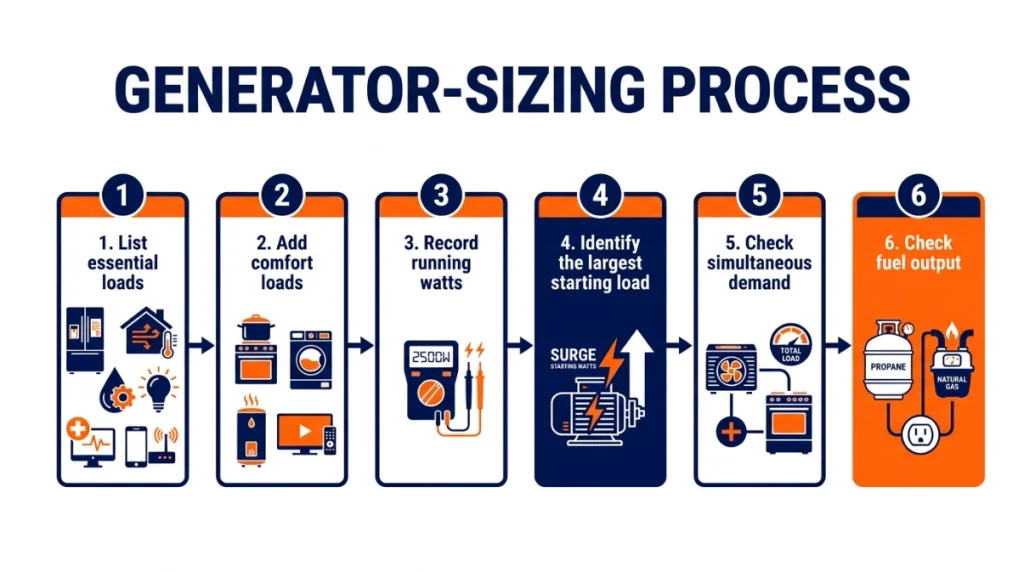
Add the running watts of everything you expect to operate together, then account for the largest motor-starting demand. Leave reasonable headroom instead of designing the system to live at its absolute limit.
- List essential loads. Start with refrigeration, HVAC, pumps, lights, medical needs, and communications.
- Add comfort loads. Include cooking, laundry, hot water, entertainment, and other equipment you want available.
- Record running watts. Use equipment labels or manufacturer documentation whenever possible.
- Identify the largest starting load. Central AC, pumps, and other motors deserve special attention.
- Check simultaneous demand. Decide which high-draw appliances can be prevented from operating together.
- Check fuel output. Use the generator’s rating for the fuel you will actually burn.
If you’re sizing a larger property, my guide to generator sizing for a 3,000-square-foot house shows how backup goals can change the answer even when floor area stays the same.
Do I Need a Transfer Switch With a 20,000-Watt Generator?
Yes, approved transfer equipment is essential when a generator supplies permanent household wiring. It prevents utility power and generator power from being improperly connected together.
The OSHA generator safety guidance warns against directly attaching a generator to a building electrical system unless a qualified electrician has installed appropriate transfer equipment.
- Standby generator: Usually paired with an automatic transfer switch.
- Large portable generator: Commonly uses an approved manual transfer switch or compatible interlock arrangement.
- Direct extension-cord loads: Do not energize the home’s permanent wiring.
For more detail, see my portable generator transfer switch guide. The switch, inlet, breaker, conductors, voltage, neutral arrangement, and generator all need to match.
How Do I Use a Large Generator Safely?
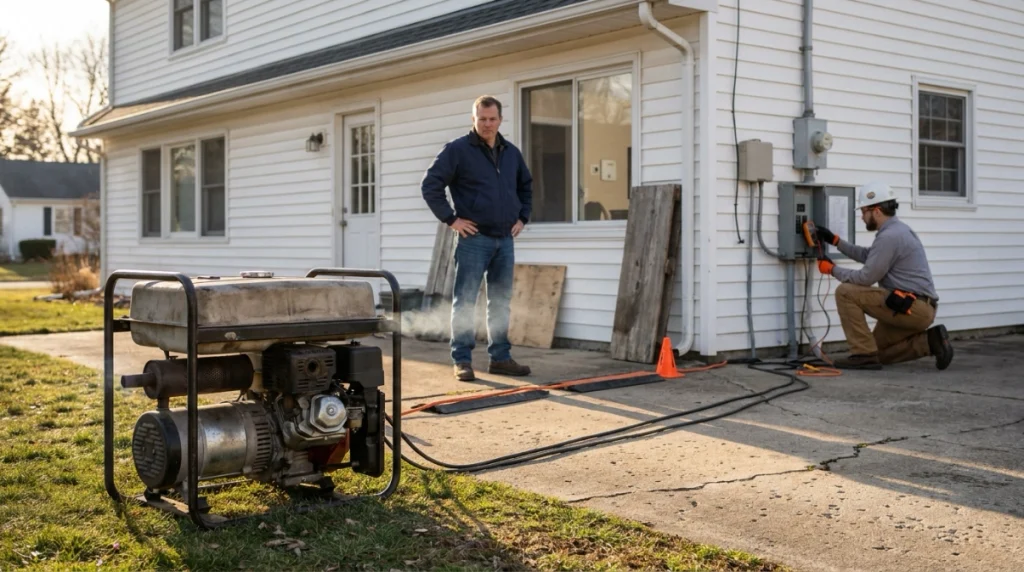
Generator capacity means nothing if the installation creates a carbon monoxide or electrical hazard. Portable generators must stay outdoors and away from occupied buildings.
The U.S. Consumer Product Safety Commission recommends placing portable generators at least 20 feet from the home with exhaust directed away from doors, windows, and vents.
- Never run a portable generator inside a house, garage, basement, shed, or crawlspace.
- Keep working carbon monoxide alarms on every level and outside sleeping areas.
- Never backfeed a house through a wall receptacle.
- Use a qualified electrician for permanent transfer equipment and household wiring connections.
- Follow the generator manufacturer’s placement, fuel, grounding, and weather-protection instructions.
Is 20 kW Too Much Generator for a House?
It can be. Buying more capacity than your home needs increases equipment cost and may give you little practical benefit.
On the other hand, modest headroom can make the system easier to live with. The goal is adequate capacity, not the largest generator available.
- Choose less capacity if you only need refrigeration, lights, a furnace blower, pumps, and selected outlets.
- Stay near 20 kW when you want broad whole-home backup with central air and manageable major loads.
- Consider more than 20 kW for electric-heavy homes, multiple HVAC systems, large pumps, or minimal load management.
If you’re ready to compare actual equipment, these are three models I would put on the shortlist for different 20 kW-class situations.
🏆 Best Direct Match
KOHLER 20RCA 20 kW
★★★★☆ 4.7/5
Rated at 20 kW on LP and 18 kW on natural gas, with 41 kVA peak motor-starting capability. I’d start here when the load calculation truly points to the 20 kW class rather than buying extra capacity automatically.
🔥 Best for Natural Gas
Briggs & Stratton PowerProtect 22 kW
★★★★★ 4.8/5
This model is rated for 22 kW on both liquid propane and natural gas, with 45 kVA motor-starting capability. I like the specification for homes where natural-gas output would otherwise reduce the usable capacity of a competing unit.
⚡ Best for Extra Headroom
Generac Guardian 24 kW Model 7210
★★★★☆ 4.7/5
This Guardian model provides up to 24 kW on LP and 21 kW on natural gas and is sold with a whole-house switch configuration. I’d compare it when a 20 kW calculation feels tight and a few extra kilowatts would reduce load-management compromises.
Frequently Asked Questions
Will a 20,000-watt generator run a 2,000-square-foot house?
It can run many 2,000-square-foot houses, but square footage alone doesn’t determine generator size. A home with gas heat and gas water heating may have modest electrical demand, while an all-electric 2,000-square-foot house can require substantially more power during heating or cooling.
Can a 20 kW generator run two air conditioners?
Possibly, but the answer depends on each unit’s running and compressor-starting requirements. Two central AC compressors starting close together can create a large temporary load, so professional sizing or load-management controls may be needed.
Will a 20 kW generator run an electric water heater?
Yes, a 20 kW generator can usually supply a standard electric water heater by itself along with many smaller household loads. The problem arises when the water heater operates at the same time as electric cooking, clothes drying, HVAC, or other heavy loads.
Is a 20 kW generator enough for a 200-amp service?
A 20 kW generator can be enough for a home with 200-amp utility service because generator sizing is based on expected backup load rather than the main breaker’s maximum rating. Homes expecting nearly every large electric appliance to run simultaneously may require greater capacity.
Is a 20 kW generator considered a whole-house generator?
Yes, 20 kW falls within common residential whole-house standby-generator territory. Whether it provides true no-compromise whole-house operation depends on HVAC, fuel type, electric heating, pumps, kitchen appliances, laundry equipment, EV charging, and how those loads are managed.
Final Takeaway
So, will a 20,000-watt generator power a house? For many homes, the answer is yes, and 20 kW can provide comfortable whole-house backup rather than an essentials-only setup.
Don’t buy from the wattage number alone. Add your actual running loads, account for motor startup, check the generator’s output on your chosen fuel, and have the electrical connection professionally sized.
If your home uses gas for heating, water heating, or cooking, 20 kW may provide generous capacity. If the house is heavily electric, calculate each major 240-volt load before assuming 20,000 watts will cover everything at once.

Hi, I’m Michael Turner. I own a generator workshop in the United States and founded HomeGeneratorBlog to share practical, hands-on guidance about generator installation, maintenance, troubleshooting, safety, and backup power solutions. My goal is to help homeowners make smarter, more confident decisions through clear and reliable information