Will a 20,000 Watt Generator Run a Whole House?
Quick Answer
Yes, a 20,000-watt generator can run many whole houses, including central air, refrigeration, lighting, pumps, and normal household circuits. However, an all-electric home with electric heat, water heating, cooking, a dryer, or multiple HVAC systems may exceed 20 kW unless you manage loads. Your actual generator power capacity should be based on simultaneous running watts plus the largest motor-starting surge.
When 20,000 watts is usually enough
- Gas-heated homes: Gas furnaces usually require electricity mainly for the blower and controls.
- Single central AC: Many homes can support one central air system if its startup demand fits the generator.
- Normal essentials: Refrigerators, freezers, lights, internet equipment, pumps, and outlets leave substantial capacity.
- Managed appliances: Staggering the dryer, range, microwave, and water heater prevents unnecessary peaks.
- Proper connection: A correctly sized transfer system lets the generator safely supply selected or whole-panel circuits.
When you may need more
- Large electric heat strips, multiple central AC systems, EV charging, electric water heating, cooking, and drying can push simultaneous demand above 20,000 watts.
A 20,000-watt generator sits in serious home-backup territory. In many houses, it provides enough capacity to make an outage feel surprisingly close to normal.
The catch is that “whole house” doesn’t mean every electrical appliance can run at full power simultaneously. As of 2026, I still size the electrical load first and the house second.
What Does a 20,000-Watt Generator Actually Mean?
A 20,000-watt generator rated for continuous output can supply 20 kilowatts, or 20 kW, while operating within its rated conditions. At 240 volts, 20,000 watts equals about 83 amps in a simple single-phase calculation.
Don’t assume the largest number printed on a portable generator is its continuous rating. Some manufacturers advertise peak or starting watts more prominently than running watts.
- Running watts: The continuous electrical output the generator can sustain.
- Starting watts: Brief extra output available when a motor or compressor starts.
- Peak watts: Another common term for short-duration maximum output.
- Fuel rating: Output may change when switching between gasoline, propane, and natural gas.
For example, a tri-fuel generator marketed around 20,000 running watts on gasoline may produce less continuous power on propane or natural gas. Always compare the rating for the fuel you actually plan to use.
If these two ratings are confusing, my guide to running watts versus starting watts explains exactly which number belongs in each part of your calculation.
Will a 20,000 Watt Generator Run a Whole House With Central Air?
Yes, 20,000 watts can run central air in many houses while still powering common household essentials. The air conditioner’s compressor startup demand is the number I check first.
Central AC can draw several kilowatts while running and considerably more for a moment during startup. The exact numbers depend on the compressor, equipment size, efficiency, and whether a soft-start system is installed.
- Check the HVAC nameplate and manufacturer specifications.
- Identify both normal operating current and startup demand.
- Add other loads expected to remain on while the AC starts.
- Confirm that both the generator’s continuous and surge ratings are adequate.
A home with one central AC unit, a gas furnace, gas water heater, refrigerator, freezer, lights, pumps, and electronics is often a strong candidate for a 20 kW generator. An all-electric home can be much harder.
How Much Can a 20,000-Watt Generator Run at Once?
A 20 kW generator can support a large collection of household loads, but actual appliance wattage varies widely. The figures below are planning examples rather than substitutes for your equipment labels.
| Household Load | Planning Running Load | Impact on 20 kW Generator |
|---|---|---|
| Refrigerator/freezer | A few hundred watts each | Usually easy after startup surge |
| Lighting and electronics | Hundreds of watts | Usually modest |
| Well or sump pump | Often around 1 kW or more | Startup surge matters |
| Central air conditioning | Several kilowatts | Often the key sizing load |
| Electric water heater | Often around 4–5 kW | Consumes significant capacity |
| Electric clothes dryer | Often around 4–6 kW | Best managed during outages |
| Electric range/oven | Several kilowatts | Can create a high simultaneous load |
| Electric resistance heat | Potentially 10 kW+ | Can exceed available capacity quickly |
This is why two houses of the same size can require completely different generators. A gas-equipped 3,000-square-foot house may demand less generator power than a smaller all-electric home.
What Would a Realistic 20 kW Whole-House Load Look Like?
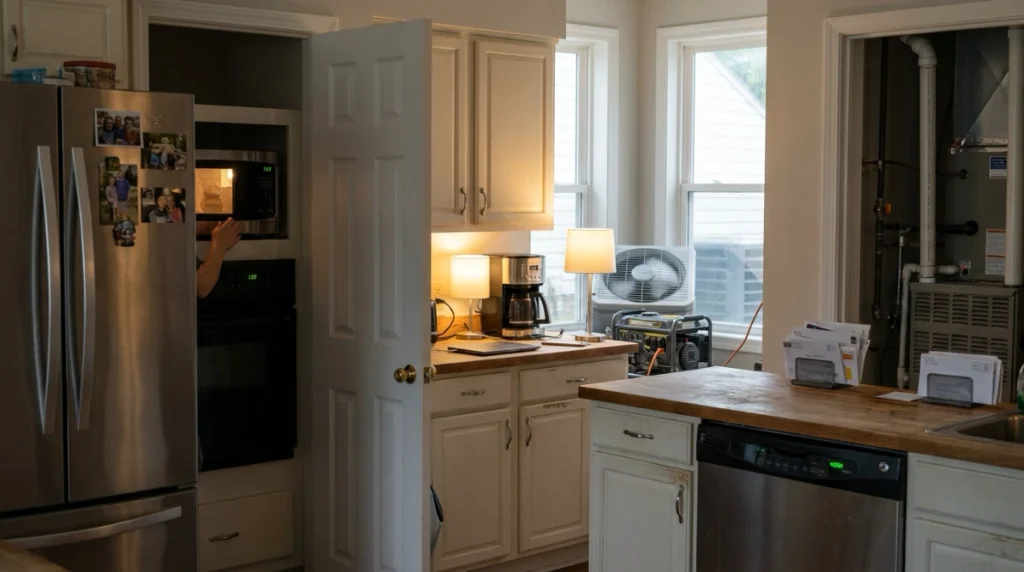
Suppose I am sizing a house with one central AC system, refrigeration, a well pump, a gas-furnace blower, lighting, electronics, and normal kitchen use. I would start with the loads expected to run simultaneously.
- Central AC: about 3,500 watts running for this example.
- Refrigeration: about 600 watts combined.
- Well pump: about 1,000 watts running.
- Furnace blower: about 600 watts.
- Lighting/electronics: about 700 watts.
- Microwave: about 1,200 watts when used.
- Dishwasher: about 1,200 watts during a higher-draw cycle.
- Other selected loads: about 1,000 watts.
That example reaches roughly 9,800 running watts before considering motor startup. Even with a substantial compressor surge, a properly specified 20 kW system can have useful breathing room.
Now add a 4,500-watt water heater, 5,000-watt dryer, electric range, and resistance heating. The same 20 kW generator can suddenly become undersized if those loads overlap.
My practical rule is simple: don’t spend money generating electricity for loads you can postpone for an hour. Load management often solves a sizing problem more efficiently than buying a substantially larger generator.
Is 20,000 Watts Enough for an All-Electric House?
It can be, but an all-electric house is where I would hesitate to promise whole-home operation without a professional load calculation. Electric resistance heating alone can consume a large share of a 20 kW generator.
The most demanding combinations commonly include several of these loads:
- Electric furnace heat strips
- Heat-pump auxiliary heat
- Electric water heater
- Electric range and oven
- Electric clothes dryer
- Multiple central AC or heat-pump systems
- Pool or spa equipment
- Large well pumps
- EV charging
You don’t necessarily need to abandon the 20 kW size. Automatic load-management equipment can temporarily prevent lower-priority appliances from running when demand approaches the generator’s limit.
Should You Choose 20 kW or 22–26 kW?
Choose based on calculated demand rather than assuming bigger is always better. A 20 kW generator makes sense when your required running load and startup demand fit comfortably inside its ratings.
| Backup Goal | 20 kW | 22–26+ kW |
|---|---|---|
| Gas heat and gas hot water | Often a strong fit | May be unnecessary |
| One central AC | Often workable | More surge/headroom |
| Several electric appliances | Load management may be needed | More flexible |
| Large all-electric home | May be undersized | Often the better starting range |
If you’re still comparing capacities, use my broader guide on choosing a generator size for your home before settling on 20 kW.
Does Fuel Type Change a 20,000-Watt Generator’s Output?
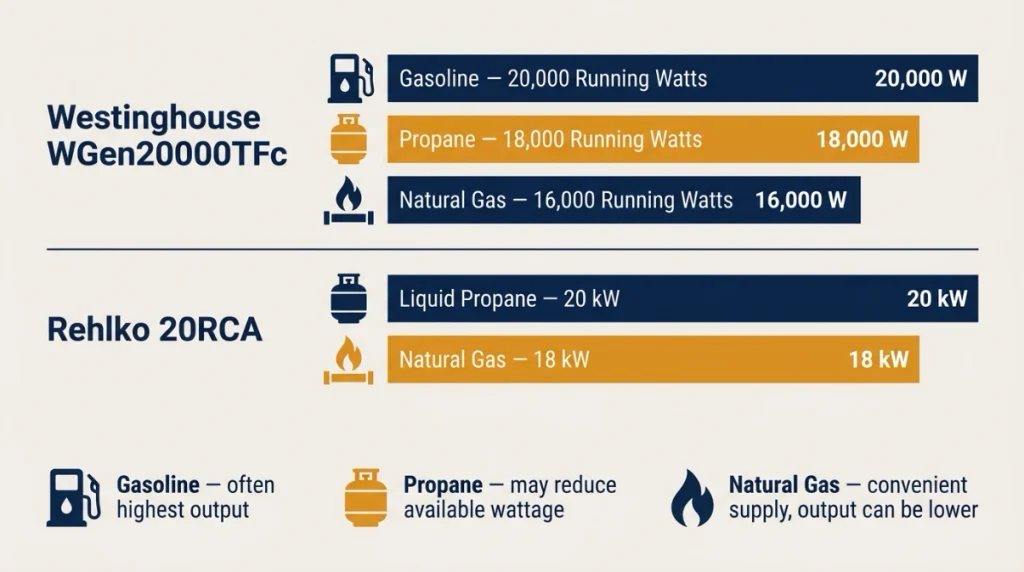
Yes. Multi-fuel generators can produce different rated output depending on fuel, so “20,000 watts” may describe only one operating condition.
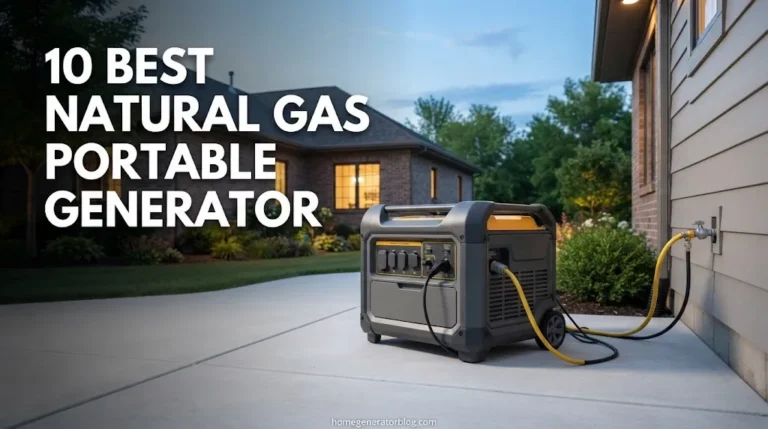
For example, the Westinghouse WGen20000TFc is rated at 20,000 running watts on gasoline, 18,000 on propane, and 16,000 on natural gas. A 20 kW Rehlko 20RCA standby unit is rated at 20 kW on liquid propane and 18 kW on natural gas.
- Gasoline: Often provides the highest output on portable tri-fuel models.
- Propane: Stores well but may reduce available wattage on some models.
- Natural gas: Offers convenient continuous fuel supply where service remains available, but output can be lower.
Read the manufacturer’s fuel-specific rating before calculating your house load. Don’t size a natural-gas installation from the gasoline number printed on a product listing.
Do You Need a Transfer Switch for a 20,000-Watt Generator?
Yes, when a generator is connected to household electrical wiring, the system needs proper transfer equipment that isolates generator power from utility power. This prevents dangerous backfeeding.
The Electrical Safety Foundation International recommends transfer equipment for safely powering a home’s electrical system. My portable generator transfer switch guide explains manual switches, inlets, amperage, and circuit selection in more detail.
- Use a qualified electrician for permanent home-wiring connections.
- Match the switch, inlet, wiring, breaker, voltage, and generator output.
- Never improvise by feeding generator power through a household receptacle.
- Follow the generator manufacturer and local electrical-code requirements.
For general electrical-safety guidance, the Electrical Safety Foundation International generator safety guidance explains transfer switches and backfeeding risks.
How Do You Run a Large Generator Safely?
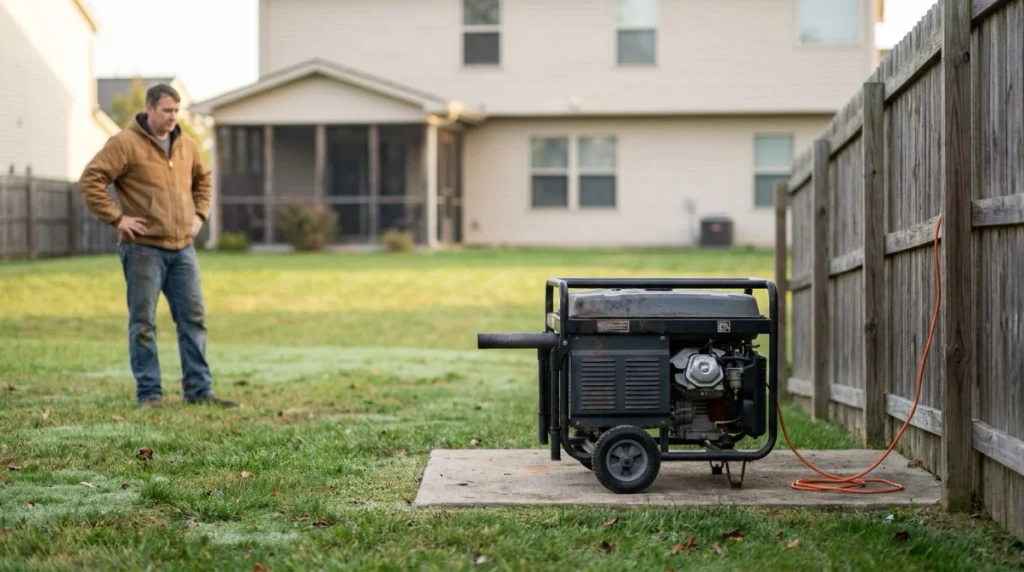
Wattage is only useful when the generator can be operated safely. Portable generator exhaust contains carbon monoxide, a colorless and odorless gas that can be fatal.
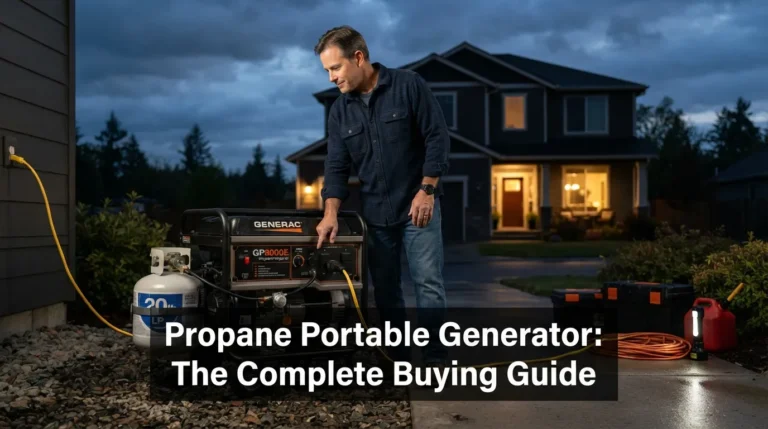
The U.S. Consumer Product Safety Commission says portable generators should never run inside homes, garages, basements, crawlspaces, or sheds. Current CPSC and CDC guidance calls for outdoor operation at least 20 feet from the home, with exhaust directed away from openings.
- Keep portable generators outdoors and at least 20 feet from the house.
- Point exhaust away from windows, doors, and vents.
- Install working carbon-monoxide alarms in the home.
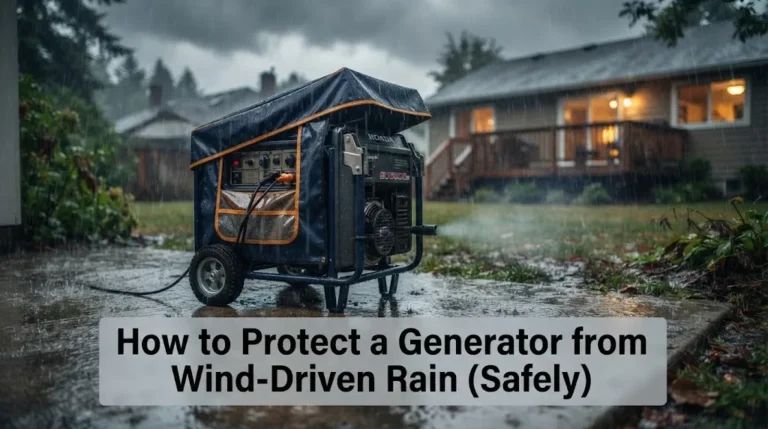
- Keep the generator dry while maintaining safe outdoor ventilation.
- Never refuel a hot or running generator.
- Don’t overload the generator beyond its rated capacity.
The CDC carbon monoxide guidance provides additional generator-placement and CO-alarm recommendations. OSHA also publishes portable-generator electrical and carbon-monoxide safety resources.
20 kW Generators I Would Consider
If you’re ready to pick a system, I would first decide whether you need a large portable unit or automatic standby power. These three models represent distinctly different ways to approach roughly 20 kW of backup capacity.
🏆 Best Large Portable
Westinghouse WGen20000TFc
★★★★★ 4.8/5 editorial fit
Rated for 20,000 running watts on gasoline, with propane and natural-gas capability plus 28,000 gasoline peak watts. I like it when fuel flexibility and serious portable home-backup capacity matter more than automatic operation.
🏠 Best Standby Choice
Rehlko 20RCA
★★★★☆ 4.7/5 editorial fit
This home standby unit is rated at 20 kW on LP and 18 kW on natural gas, with strong motor-starting capability. I prefer this style of system when automatic outage protection and normal whole-home convenience are the priority.
⚡ Best Extra Headroom
Champion 22 kW Whole House Generator
★★★★☆ 4.6/5 editorial fit
Current Champion 22 kW standby configurations are rated around 22 kW on propane and 19.8 kW on natural gas. I would compare this class when a 20 kW calculation feels tight and a little extra LP capacity reduces the need for aggressive load management.
Frequently Asked Questions
Will a 20,000-watt generator run central air and a refrigerator?
Yes, a properly sized 20,000-watt generator can usually run one central air system and a refrigerator with substantial capacity left for other household circuits. Verify the AC compressor’s startup demand because that brief surge may be more important than its normal running wattage.
Can a 20 kW generator run an electric water heater?
Yes. A conventional electric water heater commonly uses several kilowatts, so a 20 kW generator can power one if enough capacity remains for other loads. Turning off a dryer, range, or another heavy appliance while the water heater operates can prevent overloads.
Will a 20,000-watt generator run a 3,000-square-foot house?
It often can, but square footage doesn’t determine generator size. A 3,000-square-foot home with gas heat may fit comfortably, while a smaller all-electric house with large HVAC equipment, electric water heating, cooking, and drying can require more than 20 kW.
Is a 20 kW generator considered a whole-house generator?
Yes, 20 kW is commonly considered whole-house standby capacity for many residential applications. It doesn’t guarantee unrestricted operation of every electrical load, so the generator, transfer equipment, fuel rating, and expected simultaneous demand must still be matched correctly.
Should I buy a 20 kW or 24 kW generator?
Choose 20 kW when your calculated demand and startup surge leave comfortable headroom. Move toward 22–24 kW or more when your load calculation is close to 20 kW, you have multiple electric appliances, or you want less dependence on load management.
Final Takeaway
So, will a 20,000 watt generator run a whole house? For many homes, yes—especially when heating, water heating, or cooking uses gas and the generator has enough surge capacity for central air and pumps.
Don’t buy from square footage or the advertised wattage alone. Add your real simultaneous loads, account for the largest startup surge, check the rating for your chosen fuel, and have a qualified electrician verify any permanent whole-house connection.

Hi, I’m Michael Turner. I own a generator workshop in the United States and founded HomeGeneratorBlog to share practical, hands-on guidance about generator installation, maintenance, troubleshooting, safety, and backup power solutions. My goal is to help homeowners make smarter, more confident decisions through clear and reliable information