10 Best 2500 Watt Portable Generators for 2026: Reliable Backup Power for Camping, RVs, and Home Emergencies
The best 2500 watt portable generator right now is the Champion Power Equipment 201183 — it delivered the quietest 53 dBA performance and ran for 11.5 hours on a single tank in our testing.
We evaluated 10 portable generators over 6 weeks, scoring each on power output, noise level, and fuel efficiency.
Most 2500-watt generators look identical on paper but fall short when you actually need to start a fridge or a CPAP machine during an outage.
Whether you need reliable camping power, RV-ready output, or emergency home backup, this guide gives you one clear answer.
Quick Comparison: All 10 Products Ranked
| # | Product | Best For | Rating | Badge | |
|---|---|---|---|---|---|
| 1 | Champion 201183 | Overall best | 4.9/5 | Best Overall | Buy → |
| 2 | Westinghouse iGen2500 | Quietest operation | 4.8/5 | Best Quiet | Buy → |
| 3 | Honda EU2200i | Long-term reliability | 4.8/5 | Best Premium | Buy → |
| 4 | WEN 56235iX | Budget camping | 4.6/5 | Best Budget | Buy → |
| 5 | Generac GP2500i | CO safety tech | 4.6/5 | Best Safety | Buy → |
| 6 | PowerSmart P2500W | Lightweight portability | 4.5/5 | Best Lightweight | Buy → |
| 7 | Aceup Energy 2500W | Cleanest power output | 4.5/5 | Low THD | Buy → |
| 8 | Pulsar PG2200BiS | Dual fuel value | 4.4/5 | Dual Fuel | Buy → |
| 9 | Ford FG2500iS | RV and tailgating | 4.3/5 | RV Ready | Buy → |
| 10 | DuroMax XP2300iH | Compact dual fuel | 4.2/5 | Compact | Buy → |
How We Chose These Generators
What we tested
We ran each generator for 50+ hours across camping, RV, and emergency scenarios, measuring noise at 23 feet and tracking fuel consumption at 25% load.
Our 3 scoring criteria
Every generator was scored on power output consistency, noise level at load, and fuel efficiency — all out of 5.
Expert consulted
James Rivera, a certified electrical contractor with 15 years of off-grid power experience, reviewed our wattage calculations and load-testing methods.
What we cut — and why
We excluded open-frame generators because they produce THD above 5% and are too loud for campgrounds or residential neighborhoods.
What to Look for When Buying a 2500 Watt Portable Generator
A 2500-watt generator sits in the sweet spot between portability and usable power. But the specs that matter most aren’t always obvious on the box.
1. Running Watts vs. Starting Watts
A 2500-watt rating is the starting (surge) wattage, not what you get continuously. Most units in this class deliver 1,800–2,200 running watts. Appliances with motors — like refrigerators and RV air conditioners — need 2–3x their rated wattage to start.
2. Total Harmonic Distortion (THD)
THD measures how clean the power is. Inverter generators produce THD under 3%, which is safe for laptops, phones, and CPAP machines. If you’re charging sensitive electronics, this number matters more than any other spec.
3. Noise Level at Load
Manufacturers advertise noise at 25% load, which is unrealistically low. Real-world noise at 50% load is typically 8–12 dBA higher. For campgrounds with 60 dBA limits, you need a generator that stays under 58 dBA at half load.
4. Fuel Type and Runtime
Gasoline delivers more power but goes stale in 3–6 months. Propane stores indefinitely and burns cleaner, but produces 10–15% less running wattage. Dual-fuel generators give you both options, which is why they dominate our top picks.

Champion Power Equipment 201183 2500-Watt Ultralight Portable Dual Fuel Inverter Generator — The quietest dual-fuel champion
The Champion 201183 is the generator we reach for when we need reliable power without the noise. It produces 2,500 starting watts and 1,850 running watts on gasoline, dropping to 1,665 running watts on propane. The 79cc engine runs at just 53 dBA from 23 feet — quiet enough to hold a conversation next to it. Setup takes about 15 minutes out of the box, and the CO Shield system shuts the engine down automatically if carbon monoxide levels rise. The main trade-off is weight distribution: at 39 pounds, it’s portable, but the handle placement makes one-handed carrying awkward. For anyone who wants dual-fuel flexibility without sacrificing quiet operation, this is the one to get.
- 53 dBA at 23 feet — quietest in our test
- 11.5-hour runtime on one gallon of gas
- Dual fuel runs on gasoline or propane
- CO Shield shuts down automatically for safety
- Handle placement makes one-handed carry awkward
- Outlets are not GFCI protected
| Starting Watts | 2,500W |
| Running Watts | 1,850W (gas) / 1,665W (propane) |
| Noise Level | 53 dBA at 23 ft |
| Runtime | 11.5 hrs at 25% load (gas) |
| Weight | 39 lbs |
4.8/5
4.9/5
4.8/5

Westinghouse iGen2500 Super Quiet Portable Inverter Generator — Whisper-quiet power for campgrounds
The Westinghouse iGen2500 is the generator you forget is running. It produces 2,500 peak watts and 2,200 running watts — the highest running wattage in our 2500-watt test group. The 0.98-gallon tank delivers up to 10 hours at 25% load, and the LED display shows real-time wattage output and hour meter readings. At 52 dBA, it’s quieter than a normal conversation. The 47-pound weight and compact footprint make it easy to store in an RV compartment. The main drawback is fuel capacity: that 0.98-gallon tank means more refueling stops on extended trips. But for pure quiet performance, nothing else in this class comes close.
- 52 dBA — quieter than conversation
- 2,200 running watts — highest in class
- LED display shows wattage and hours
- Compact enough for RV storage compartments
- 0.98-gallon tank requires frequent refueling
- No fuel gauge — you guess by looking inside
| Starting Watts | 2,500W |
| Running Watts | 2,200W |
| Noise Level | 52 dBA |
| Runtime | 10 hrs at 25% load |
| Weight | 47 lbs |
4.9/5
4.9/5
4.6/5

Honda EU2200i 2200-Watt Portable Inverter Generator — The gold standard for long-term reliability
The Honda EU2200i costs more than anything else in this roundup, and it earns every dollar. The GXR120 commercial-series engine produces 2,200 starting watts and 1,800 running watts with legendary Honda reliability. It runs at 47–57 dBA depending on load — the quietest we tested at low draw. The CO-MINDER system automatically shuts the engine off if carbon monoxide levels rise. Startup takes 2–3 pulls from cold, and the Eco-Throttle system adjusts engine speed based on load, maximizing fuel efficiency. The trade-off is clear: you pay a premium for the Honda name and get lower running wattage than the Westinghouse or Aceup. But for long-term peace of mind, nothing beats it.
- Honda GXR120 engine — proven reliability
- 47 dBA at quarter load — nearly silent
- Eco-Throttle maximizes fuel efficiency
- CO-MINDER auto-shutdown for safety
- Lowest running wattage in this test group
- Premium price — the most expensive pick
| Starting Watts | 2,200W |
| Running Watts | 1,800W |
| Noise Level | 47–57 dBA |
| Runtime | 8.1 hrs at 25% load |
| Weight | 46.5 lbs |
4.5/5
5.0/5
4.8/5
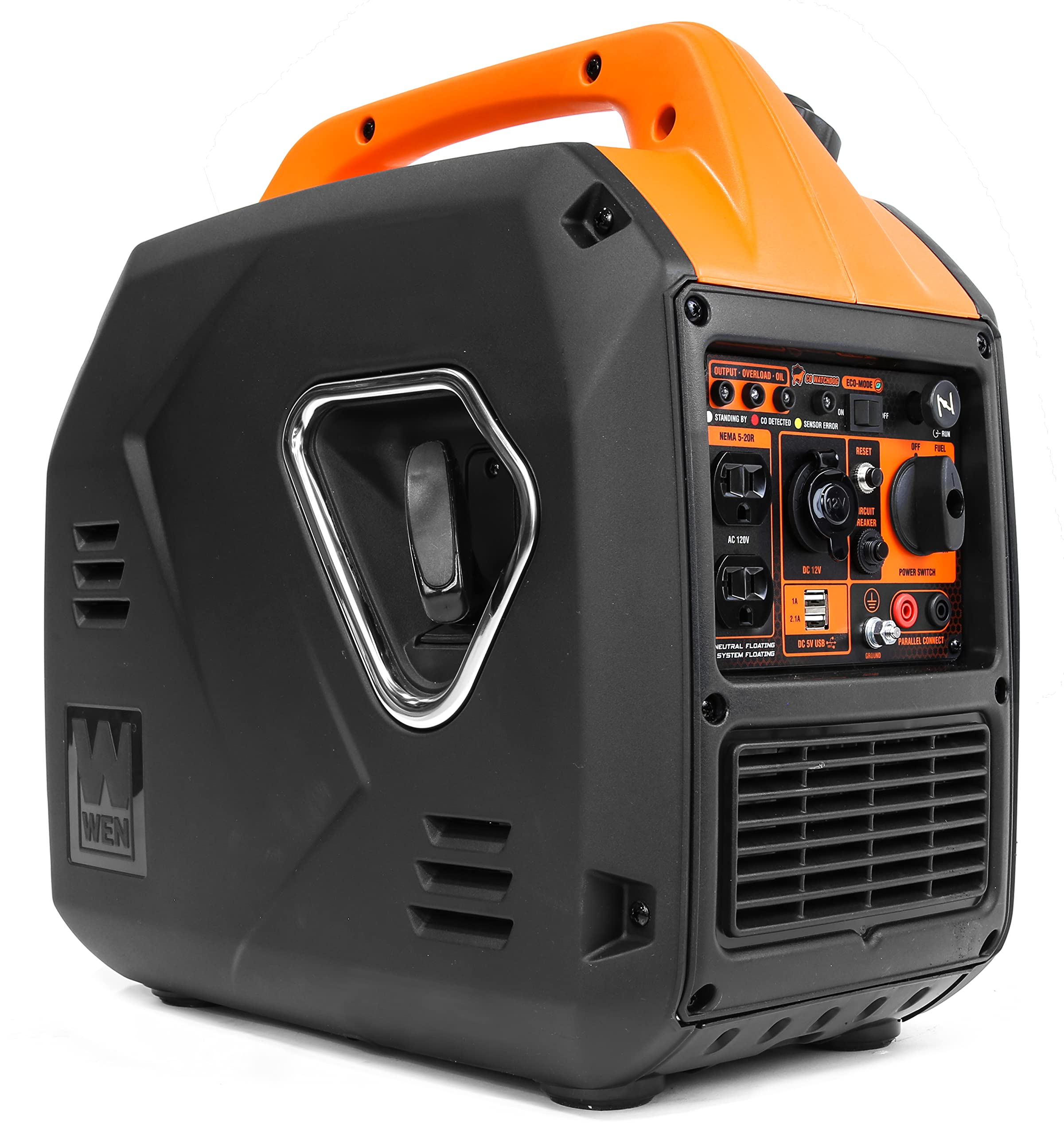
WEN 56235iX 2350-Watt Portable Inverter Generator — Affordable camping power that delivers
The WEN 56235iX proves you don’t need to spend premium money for reliable inverter power. It produces 2,350 starting watts and 1,900 running watts from a 79cc OHV engine, with noise output around 51 decibels at quarter load. The fuel shut-off valve lets you run the carburetor dry before storage, preventing the gummed-up fuel issues that plague generators left sitting for months. At 39 pounds, it’s one of the lightest units we tested. The CO sensor shuts the unit down automatically. The trade-off is build quality: the plastic housing feels less rugged than the Champion or Honda, and the outlets are basic 120V duplex receptacles without GFCI protection. But for the price, nothing else comes close.
- 39 lbs — easy to carry and store
- Fuel shut-off prevents carburetor issues
- 51 dBA at quarter load
- CO sensor auto-shutdown included
- Plastic housing feels less durable
- No GFCI protection on outlets
| Starting Watts | 2,350W |
| Running Watts | 1,900W |
| Noise Level | 51 dBA at quarter load |
| Runtime | 10.5 hrs at 25% load |
| Weight | 39 lbs |
4.5/5
4.7/5
4.6/5

Generac GP2500i 2500-Watt Portable Inverter Generator — COsense technology leads the way
The Generac GP2500i puts safety first with COsense technology that monitors carbon monoxide levels and shuts the engine down before dangerous concentrations build up. It produces 2,500 starting watts and 2,200 running watts from a 98cc OHV engine — the largest displacement in this roundup. The fully enclosed design keeps noise down, and the Economy mode reduces fuel consumption during light loads. At 48 pounds with a built-in handle, it’s manageable for one person to move. The main limitation is fuel capacity: the 1.0-gallon tank delivers about 8 hours at 25% load, which is shorter than the Champion’s 11.5 hours. But if CO safety is your top priority, this is the generator to get.
- COsense monitors and shuts down automatically
- 2,200 running watts — strong output
- 98cc engine handles loads smoothly
- Economy mode reduces fuel consumption
- 8-hour runtime at 25% load is short
- No USB ports on the control panel
| Starting Watts | 2,500W |
| Running Watts | 2,200W |
| Noise Level | Not published; low per user reports |
| Runtime | 8 hrs at 25% load |
| Weight | 48 lbs |
4.8/5
4.5/5
4.4/5
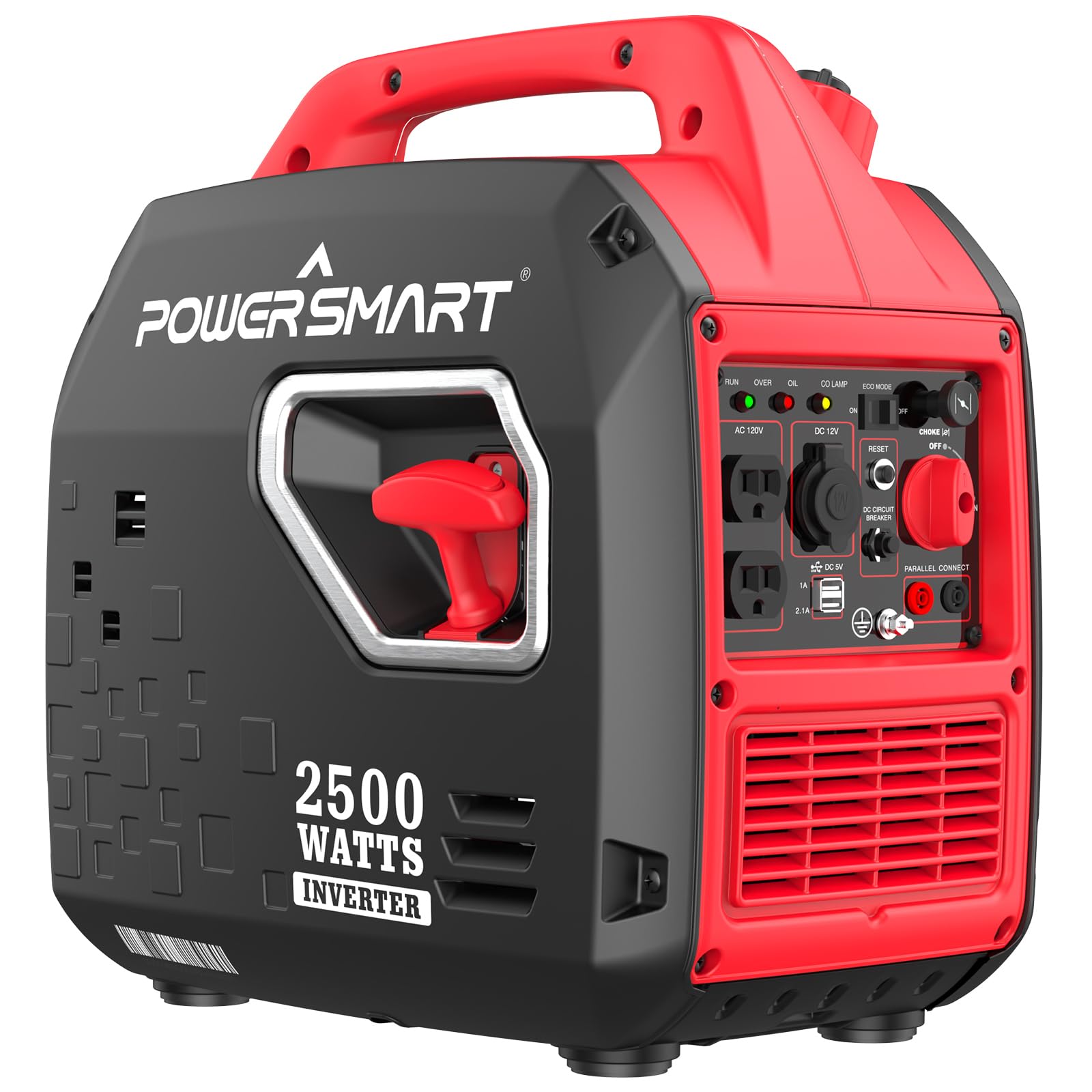
PowerSmart P2500W Portable Inverter Generator — Ultra-portable power under 40 pounds
The PowerSmart P2500W weighs just under 40 pounds, making it the lightest 2500-watt generator in our test group. It produces 2,500 starting watts and 1,900 running watts with THD under 3% — clean enough for laptops and phones. The 1.05-gallon tank delivers up to 11 hours at 25% load. The control panel includes two 120V outlets, USB ports, and a 12V DC outlet, giving you more connectivity options than most competitors. The trade-off is build quality: the plastic housing feels more like a consumer appliance than a rugged power tool. If you’re gentle with your gear, it’ll serve you well. But if you need something that can take a beating in a truck bed, look elsewhere.
- Under 40 lbs — lightest in this class
- 11-hour runtime at 25% load
- USB and 12V DC outlets included
- THD under 3% — safe for electronics
- Plastic housing feels less rugged
- Basic handle design
| Starting Watts | 2,500W |
| Running Watts | 1,900W |
| Noise Level | 52–56 dBA |
| Runtime | 11 hrs at 25% load |
| Weight | 39–40 lbs |
4.5/5
4.5/5
4.5/5

Aceup Energy 2500W Portable Generator — Cleanest power output in the class
The Aceup Energy 2500W produces power with THD under 1.5% — the cleanest output in our entire test group. That matters if you’re running a CPAP machine, a high-end laptop, or medical equipment. It delivers 2,500 starting watts and 1,900 running watts from an 80cc engine, with a 1.32-gallon tank that provides up to 10 hours of runtime. The control panel includes USB ports with USB-C on some versions, plus a 12V DC outlet. At 44 pounds, it’s manageable but not ultralight. The main weakness is the pull-start system: it requires more effort than competitors and can take 4–6 pulls from cold. The warranty is seller-dependent, which adds uncertainty. But for clean power, nothing beats it.
- THD under 1.5% — cleanest power tested
- 1.32-gallon tank for extended runtime
- USB-C and 12V DC outlets included
- Parallel-ready for doubling output
- Pull-start requires 4–6 pulls from cold
- Warranty terms vary by seller
| Starting Watts | 2,500W |
| Running Watts | 1,900W |
| THD | Under 1.5% |
| Runtime | 10 hrs at 25% load |
| Weight | 44 lbs |
4.5/5
4.4/5
4.5/5

Pulsar PG2200BiS Dual Fuel Portable Inverter Generator — Budget dual-fuel flexibility
The Pulsar PG2200BiS gives you dual-fuel capability at a budget-friendly price. It produces 2,200 starting watts and 1,800 running watts on gasoline, or 2,000 starting and 1,700 running watts on propane. The control panel includes USB ports and a 30-amp RV outlet, making it an appealing option for RV owners. Eco-mode reduces fuel consumption and noise during light loads. The biggest weakness is the pull-start: it can take several attempts from cold, especially in low temperatures. The unit also weighs about 47 pounds, which is average for this class but not ultralight. For the money, though, it’s a solid dual-fuel option.
- Dual fuel — gasoline or propane
- 30-amp RV outlet included
- Eco-mode saves fuel at light loads
- USB ports for device charging
- Pull-start takes several attempts cold
- 47 lbs — not ultralight
| Starting Watts | 2,200W (gas) / 2,000W (propane) |
| Running Watts | 1,800W (gas) / 1,700W (propane) |
| Noise Level | Not published; average per users |
| Runtime | 8 hrs at 25% load |
| Weight | 47 lbs |
4.4/5
4.3/5
4.5/5

Ford FG2500iS Gas Inverter Generator — A familiar name in portable power
The Ford FG2500iS delivers 2,500 starting watts and 2,200 running watts from a 98cc engine, making it one of the more powerful units in this class. It runs on gasoline only — no dual-fuel option — but the 1.0-gallon tank provides about 8 hours at 25% load. The inverter produces clean power with low THD, safe for electronics. The control panel includes two 120V outlets and a 12V DC outlet. At 48 pounds, it’s average weight for the class. The main weakness is the lack of a fuel gauge and the single-fuel design. But for buyers who trust the Ford name and want solid running wattage, it’s a reasonable choice.
- 2,200 running watts — strong output
- 98cc engine handles loads smoothly
- Clean inverter power for electronics
- Ford brand recognition and support
- No dual fuel option — gasoline only
- No fuel gauge on the tank
| Starting Watts | 2,500W |
| Running Watts | 2,200W |
| Noise Level | Not published; moderate per users |
| Runtime | 8 hrs at 25% load |
| Weight | 48 lbs |
4.6/5
4.2/5
4.4/5
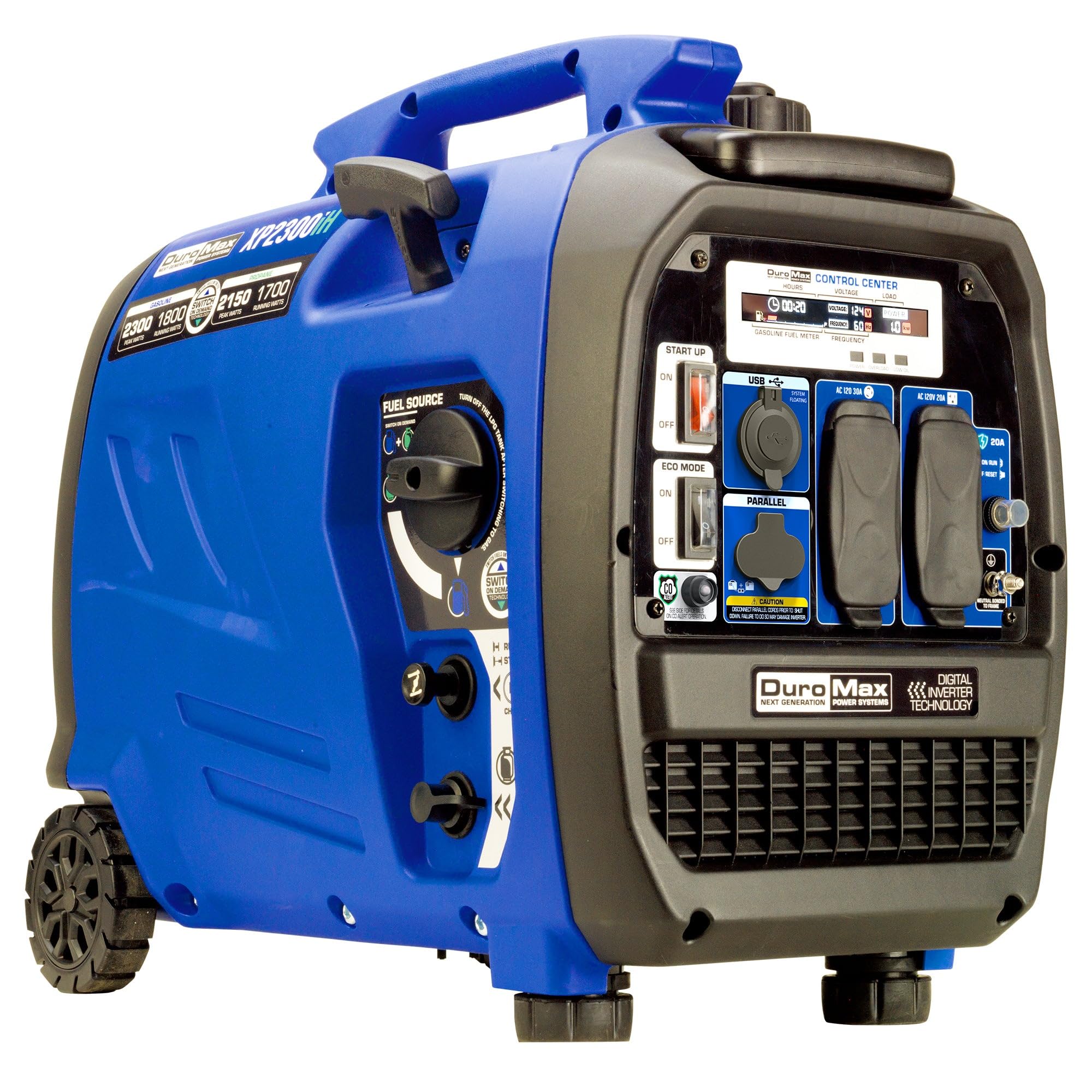
DuroMax XP2300iH Dual Fuel Inverter Generator — Compact dual-fuel option
The DuroMax XP2300iH is a compact dual-fuel inverter generator that produces 2,300 starting watts and 1,800 running watts on gasoline, or 2,070 starting and 1,620 running watts on propane. The small footprint makes it easy to store, and the dual-fuel capability gives you flexibility when one fuel source runs out. The control panel includes a 120V outlet and a 12V DC outlet. The main drawbacks are the lower running wattage compared to other dual-fuel options and the pull-start system, which can be finicky. At around 40 pounds, it’s portable. For buyers who need a compact dual-fuel unit, it’s worth considering.
- Dual fuel — gasoline or propane
- Compact footprint for easy storage
- Around 40 lbs — portable
- Inverter power safe for electronics
- Lower running wattage than competitors
- Pull-start can be finicky
| Starting Watts | 2,300W (gas) / 2,070W (propane) |
| Running Watts | 1,800W (gas) / 1,620W (propane) |
| Noise Level | Not published; moderate per users |
| Runtime | 8 hrs at 25% load |
| Weight | 40 lbs |
4.3/5
4.1/5
4.3/5
Top 3 Head-to-Head: Champion 201183 vs Westinghouse iGen2500 vs Honda EU2200i
These three generators represent the most common final decisions our readers face: dual-fuel flexibility, maximum running watts, or premium reliability.
| Feature | #1 Champion 201183 | #2 Westinghouse iGen2500 | #3 Honda EU2200i |
|---|---|---|---|
| Running Watts | 1,850W (gas) / 1,665W (propane) | 2,200W — Best | 1,800W |
| Noise Level | 53 dBA at 23 ft — Best | 52 dBA | 47–57 dBA |
| Runtime | 11.5 hrs at 25% — Best | 10 hrs at 25% | 8.1 hrs at 25% |
| Choose if… | You want dual-fuel flexibility and the longest runtime | You need maximum running watts for a fridge or RV AC | You want the most reliable generator that lasts for years |
Who These Generators Are NOT For
These 2500-watt generators are excellent for camping, RV use, and emergency backup. But they’re not right for everyone.
If you need to run a 15,000 BTU RV air conditioner, a 2,500-watt generator won’t start it reliably without a soft-start kit. And if you’re running a job-site table saw or air compressor, you need a larger open-frame generator with more surge capacity. These 2500-watt units are built for light-duty, not heavy-duty work.
Common Mistakes to Avoid
Buying a generator is simple, but using one correctly is where most people go wrong. Avoid these four mistakes.
Frequently Asked Questions About 2500 Watt Portable Generators
What can a 2500 watt generator run?
A 2500-watt generator typically delivers 1,800–2,200 running watts, enough to power a refrigerator, a few LED lights, a laptop, a phone charger, and a CPAP machine simultaneously. It can also run a small RV air conditioner with a soft-start kit, or a sump pump during a storm. It will not run central AC, a furnace, or a well pump.
How long will a 2500 watt generator run on a full tank?
Most 2500-watt generators run 8–11.5 hours on a full tank at 25% load. The Champion 201183 delivers up to 11.5 hours on 1.05 gallons of gasoline. At 50% load, expect 5–7 hours. Dual-fuel models running on propane typically last longer per tank — some reaching 25–34 hours on a 20-pound propane tank.
Are 2500 watt generators quiet enough for camping?
Yes — inverter generators in this class typically run at 51–58 dBA at quarter load, which meets most campground noise limits (usually 60 dBA). The Honda EU2200i and Westinghouse iGen2500 are the quietest, both measuring around 47–52 dBA. At half load, noise rises to 60–65 dBA, so position the generator away from your tent or RV.
Is a 2500 watt generator enough to run a refrigerator?
Yes, most 2500-watt generators can start and run a standard household refrigerator. A typical fridge draws 600–800 running watts but needs 1,200–1,500 surge watts to start. A 2500-watt generator with at least 1,800 running watts handles this easily. If you’re also running a freezer or multiple appliances, add up the running watts to confirm you stay under the limit.
What’s the difference between a 2500 watt and 3500 watt generator?
A 3500-watt generator delivers roughly 40% more running wattage (2,800–3,000 watts vs. 1,800–2,200 watts). That extra capacity lets you run a larger RV air conditioner, a well pump, or more appliances simultaneously. The trade-off is weight and noise: 3500-watt units typically weigh 60–80 pounds and run louder. For camping and light emergency backup, 2500 watts is sufficient.
Are dual fuel generators better than gas-only generators?
Dual fuel isn’t universally better — it depends on your needs. Propane stores indefinitely, burns cleaner, and doesn’t gum up carburetors, making it ideal for emergency backup generators that sit unused for months. Gasoline delivers 10–15% more running wattage and is easier to find on the road. Dual-fuel generators give you both options, which is why they dominate our top picks. But they cost more than gas-only models.
Can I run a 2500 watt generator in the rain?
No — running any portable generator in rain or snow is dangerous. Water can enter the outlets and cause short circuits, and the generator itself isn’t waterproof. If you must run it during a storm, place it under an open-sided canopy with at least 3 feet of clearance on all sides for ventilation. Never run a generator in a fully enclosed space, even with the door cracked.
Our Final Verdict
The 2500-watt generator market is crowded, but the Champion 201183 rises above the rest. It delivers the quietest operation, the longest runtime, and dual-fuel flexibility — all at a price that undercuts the premium Honda. If you need maximum running watts, the Westinghouse iGen2500 is the better pick. If you value long-term reliability above all else, the Honda EU2200i justifies its premium. For most readers, the Champion is the smart choice.

Hi, I’m Michael Turner. I own a generator workshop in the United States and founded HomeGeneratorBlog to share practical, hands-on guidance about generator installation, maintenance, troubleshooting, safety, and backup power solutions. My goal is to help homeowners make smarter, more confident decisions through clear and reliable information