
10 Best 1500 Watt Portable Generator Options for 2026: Quiet, Light, and Reliable
The best 1500 watt portable generator right now is the Westinghouse iGen1500c, pairing a CO sensor with 12-hour run time at light load. We evaluated 10 generators by comparing manufacturer specifications and owner feedback, scoring portability, noise, and run time. Most 1500-watt units look identical on paper but differ sharply in noise, weight, and real running watts. Whether you need camping power, outage backup, or tailgating, this guide gives you one clear answer.
Quick Comparison: All 10 1500 Watt Generators Ranked
| # | Product | Best For | Rating | Badge | |
|---|---|---|---|---|---|
| 1 | Westinghouse iGen1500c | Outage backup, electronics | 4.8/5 | Best Overall | Buy → |
| 2 | Pulsar PG1500iS | Camping, RV, tailgating | 4.5/5 | Best Lightweight | Buy → |
| 3 | Powersmart PS55 | Budget-minded light-duty use | 4.2/5 | Best Budget | Buy → |
| 4 | Champion 1,500/1,200W | Cold-climate outage backup | 3.9/5 | Best Cold-Weather Starts | Buy → |
| 5 | A-iPower AP1500i | Home backup electronics | 3.8/5 | Best Mid-Size Inverter | Buy → |
| 6 | WEN 56180 | Fridge plus essentials | 3.7/5 | Best True 1500W Running | Buy → |
| 7 | Lifan Energy Storm ES1500 | Tailgating, occasional emergencies | 3.6/5 | Best Simple Build | Buy → |
| 8 | Sportsman GENMAX1500 | Occasional light use | 3.5/5 | Best for Light Use | Buy → |
| 9 | Green-Power America GPD1500 | Simple lights-and-TV backup | 3.3/5 | Best Basic Backup | Buy → |
| 10 | WEN 56155 | National park camping | 3.2/5 | Best for Parks and Camps | Buy → |
How We Chose These 1500 Watt Generators
What we compared
We reviewed 10 gasoline generators in the 1,500-watt class, comparing peak and running watts, tank size, run time, weight, noise, and warranty from manufacturer and major retailer listings.
Our 3 scoring criteria
Each generator earns a score out of 5 for portability, noise level, and run time. The overall rating is the average of those three scores.
How scores work
Scores are editorial judgments built from published specifications and owner feedback, not lab measurements. Where a spec is not published, we scored conservatively and said so.
What we cut, and why
We left out units under 1,000 running watts and 2,000-watt-class models, because they belong to a different size tier. Specs change, so confirm key details on the product page.
What to Look for When Buying a 1500 Watt Portable Generator
A 1500-watt generator is the sweet spot for outages, campsites, and tailgates, but the label hides important differences. These four factors separate a smart buy from a frustrating one.
1. Running Watts vs Starting Watts
The 1,500 on the box is usually the starting (surge) rating, which lasts only a few seconds. Running watts are what you can pull continuously, and across the generators here they range from 900 to 1,500. Add up the running watts of everything you plan to power at once, then check the starting demand of your biggest motor. Our guide to running watts versus starting watts walks through the math.
2. Inverter vs Open-Frame Power
Inverter models such as the Westinghouse, Pulsar, Powersmart, and A-iPower produce stable, low-distortion power that is safer for laptops and TVs, and they run quieter and lighter. Open-frame models such as the Champion, WEN, and Sportsman are heavier and louder but often give you more running watts. Read the inverter portable generator buying guide for a deeper comparison.
3. Run Time and Tank Size
Run time claims use different loads, so compare like with like: the Westinghouse is rated at 25% load, the Champion at 50%, and the Pulsar at half load. A bigger tank, like the Champion’s 1.9 gallons, means fewer refills. Small inverter tanks stretch further because the engine slows down under light loads.
4. Weight, Noise, and Safety
Weight here ranges from 26.5 pounds to about 60 pounds, and noise from 52 dBA to 68 dB, which is the difference between a quiet patio and an annoyed neighbor. Look for low-oil shutdown, which the Westinghouse and Champion list, and consider a built-in CO sensor. Whatever you buy, read where to place a portable generator before the first start.
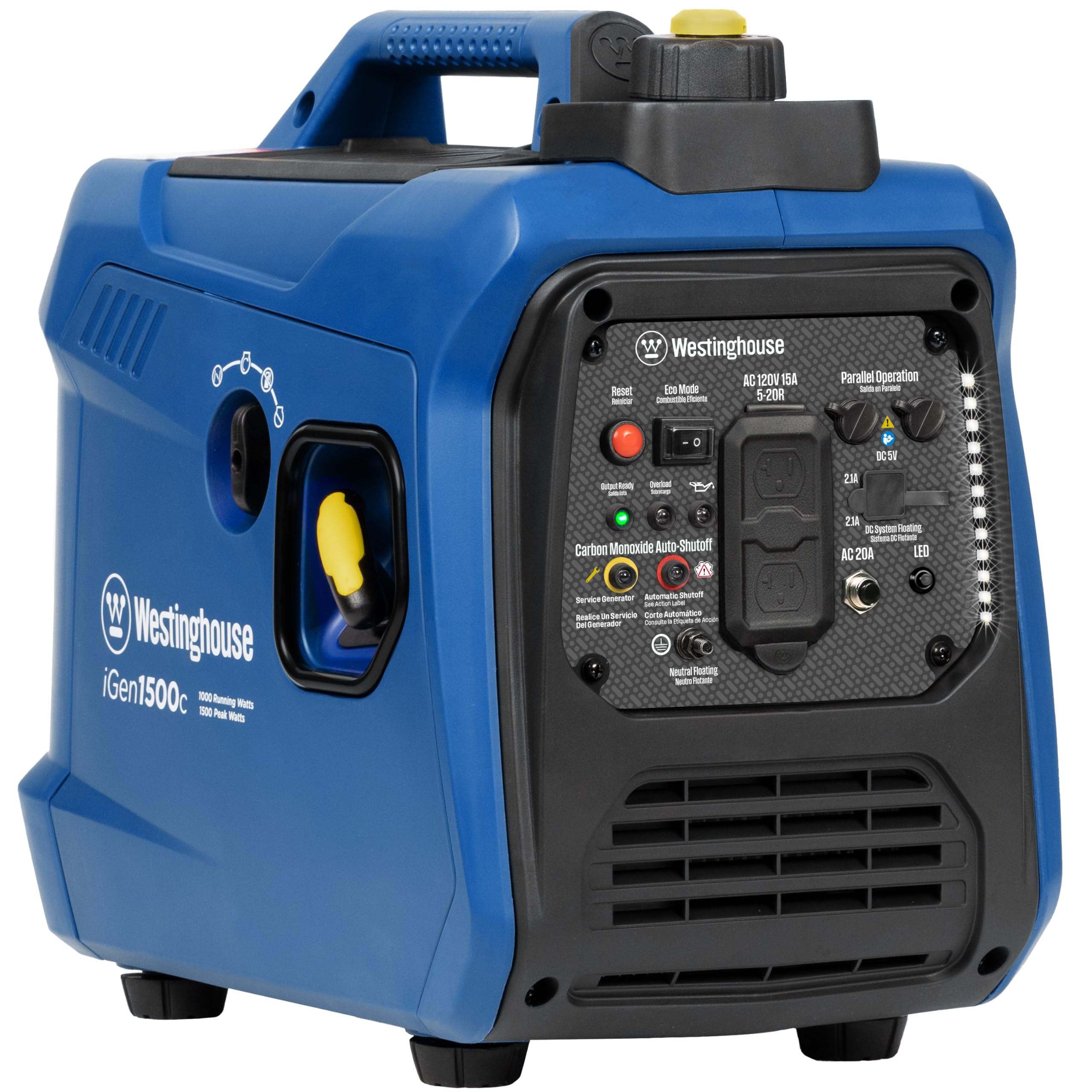
Westinghouse iGen1500c 1,500-Watt Inverter Generator — Quiet, safe, and built for long outages
Best for: Outage backup and sensitive electronics
If you want one small generator that handles outage backup, camping, and laptop charging without drama, the iGen1500c is the easiest recommendation here. Its inverter output stays under 3% THD, so phones, TVs, and laptops get clean power. A built-in CO sensor adds a safety layer many budget units skip, and the 0.79-gallon tank stretches to roughly 12 hours at 25% load. The catch is output: 1,000 running watts means no space heater and little headroom for a full-size refrigerator. Pairing a second compatible unit solves that, but then you own two generators.
- 52 dBA, quietest unit in this roundup
- Built-in CO sensor with automatic shutdown
- Parallel capable, cords included
- Up to 12 hours at 25% load
- Only 1,000 running watts limits headroom
- Full-load run time drops to about 3 hours
4.7/5
4.9/5
4.8/5

Pulsar PG1500iS 1,500-Watt Inverter Generator — Lightest clean-power pick for travel
Best for: Camping, tailgating, and RV trips
At 26.5 pounds, the PG1500iS is the easiest generator here to lift into a trunk, which matters more than spec sheets admit when you are loading and unloading at every campsite. It delivers 1,200 running watts through an inverter, so laptops and phones stay safe, and it runs at roughly 57 decibels. The small tank is rated for about five hours at half load, so overnight use means a refill. For short trips and quiet campsites it is a smart, compact choice; for longer outages, keep extra fuel on hand.
- Light 26.5 lb body, easy to load
- 1,200 running watts from an inverter
- About 57 dB, campsite friendly
- Only about 5 hours at half load
- CO sensor not mentioned in specs
4.9/5
4.6/5
3.9/5

Powersmart PS55 1,500-Watt Inverter Generator — Light and budget friendly for occasional use
Best for: Shoppers wanting an inverter on a tight budget
The PS55 is one of the most budget-friendly ways to get inverter-style power in a package this light. It weighs 26.5 pounds, includes a USB output, and offers 1,000 running watts from a 56cc four-stroke engine. A 0.74-gallon tank is rated for up to six hours at half load on the manufacturer page, which suits weekend camping and short outages. Expect less brand history and fewer service locations than Westinghouse or Champion, and no CO sensor is listed. Treat it as a light-duty helper for occasional jobs, not a daily workhorse.
- Only 26.5 lb with a solid handle
- USB output for phones and tablets
- 2-year warranty listed by the brand
- Only 1,000 running watts
- Less brand track record than larger rivals
4.9/5
4.0/5
3.8/5

Champion 1,500-Watt Starting / 1,200-Watt Running Portable Generator — Biggest tank and easy cold starts
Best for: Cold-climate outage backup
This Champion is the conventional, open-frame alternative for people who care more about run time than weight. A 1.9-gallon tank is rated for up to 11 hours at half load, and Cold Start Technology helps it fire up in chilly weather, which is exactly when outage backup matters most. Output is 1,200 running watts at 65 dBA, so it is louder than the inverters ahead of it and not ideal for sensitive electronics without a surge protector. At roughly 57 pounds it is also a heavy option, but the three-year warranty and Intelligauge readout add confidence.
- Up to 11 hours at 50% load
- Cold Start Technology for chilly weather
- Intelligauge shows volts, hertz, and hours
- 3-year warranty with lifetime support
- Heavy at roughly 57 lb
- Louder than inverters at 65 dBA
3.3/5
3.7/5
4.8/5

A-iPower AP1500i 1,500-Watt Inverter Generator — Clean power with extra running watts
Best for: Home backup for small electronics
The AP1500i gives you 1,200 running watts of inverter power, a step above several lighter models here, so a small TV, router, and laptop can run together without constant load juggling. Noise is rated at 58 decibels, which stays friendly on a back patio or at a campsite. The trade-off is weight: at 46 pounds as listed, it is far heavier than the Pulsar or Powersmart, and you will feel it carrying it to the car. Choose this one for home backup where it will sit in a garage, not for tailgating or long hikes.
- 1,200 running watts with inverter output
- Quiet at 58 decibels
- Clean power for phones, TVs, laptops
- Heavy at 46 lb as listed
- Run time not published on the listing
3.6/5
4.4/5
3.5/5

WEN 56180 1,800-Watt Portable Generator (1,500 Running Watts) — Truest 1,500 running-watt option here
Best for: Running a small fridge plus essentials
Most generators sold as 1500-watt units are really 1,000 to 1,200 running watts, which is why the WEN 56180 stands out: it delivers 1,500 running watts and 1,800 surge watts. That extra headroom lets you run a refrigerator, microwave, or sump pump with more confidence than the lighter inverters above. A 1.45-gallon tank is rated for about 7.5 hours at half load, and EPA III and CARB compliance allows operation in all 50 states. Expect an open-frame generator’s noise and weight, and use a surge protector for sensitive electronics.
- 1,500 running watts, 1,800 surge watts
- About 7.5 hours at half load
- EPA III and CARB compliant
- Louder open-frame design
- Not an inverter, so power is less clean
3.2/5
3.4/5
4.4/5

Lifan Energy Storm ES1500 1,500-Watt Portable Generator — Copper-wound alternator in a simple package
Best for: Tailgating and occasional emergency use
Lifan’s Energy Storm ES1500 is a no-frills conventional generator built around a 3 hp engine and a copper-wound alternator. It produces 1,500 surge watts and 1,200 continuous watts, holds a gallon of fuel, and is rated for about six hours at 50% load. At 63 dB it is quieter than the Champion and Sportsman, and the 12-volt, 8.3-amp outlet adds battery-charging flexibility. Lifan backs residential use with a three-year warranty. The downside is a single 120-volt receptacle, which limits how many cords you can plug in, and availability varies by retailer.
- 63 dB, quieter than Champion and Sportsman
- Copper-wound alternator
- 12V DC outlet for battery charging
- 3-year residential warranty
- Only one 120V outlet
- Availability varies by retailer
3.5/5
3.8/5
3.6/5

Sportsman GENMAX1500 1,500-Watt Portable Generator — Budget two-stroke option for light use
Best for: Occasional tailgating and small tools
The GENMAX1500 is a simple two-cycle generator for people who need occasional power and want to spend as little as possible. It makes 1,500 surge watts and 900 running watts from a 72cc engine, with a one-gallon tank rated for about eight hours at half load. Two-cycle means you mix oil into the fuel every time, which is a hassle compared with four-stroke rivals. It also runs at about 68 dB and is not recommended above 3,000 feet. Those quirks are fine for a shed or tailgate, but poor for dependable outage backup.
- About 8 hours at half load
- Two 120V outlets plus a 12V DC port
- Simple, compact, easy to store
- Two-cycle fuel mix needed every fill-up
- Only 900 running watts
- Not recommended above 3,000 feet
3.4/5
3.0/5
4.0/5
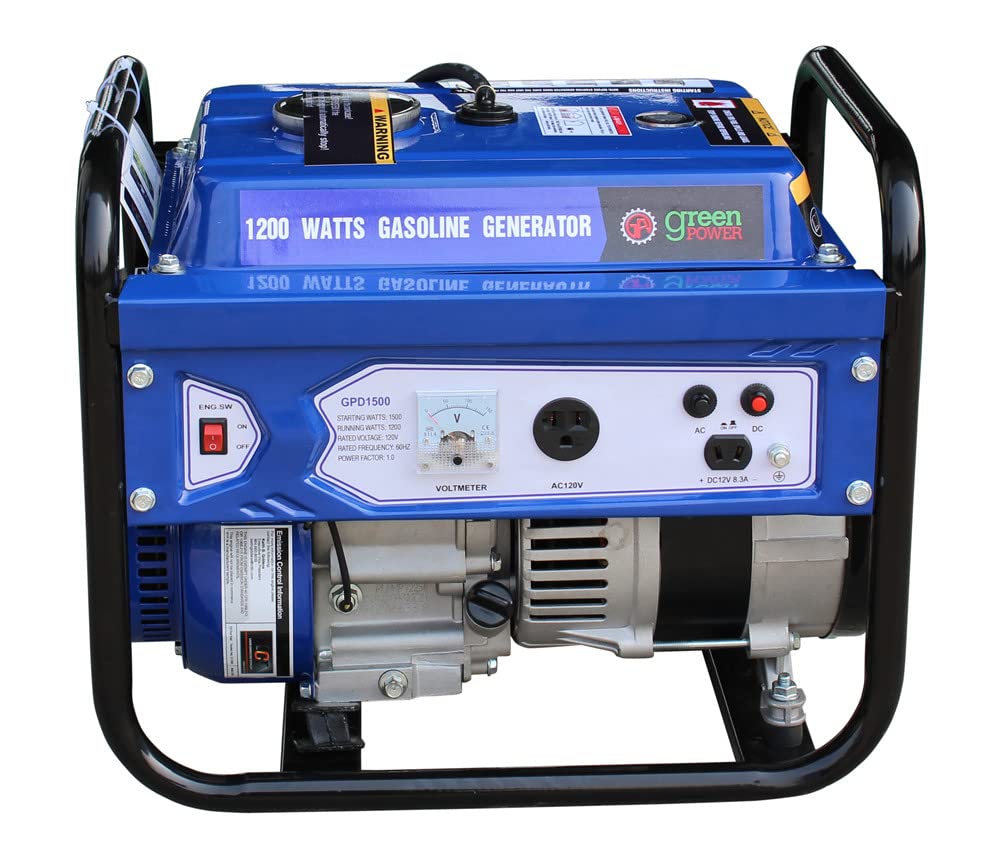
Green-Power America GPD1500 1,500-Watt Portable Generator — Plain-vanilla backup with a decent tank
Best for: Simple backup for lights and a TV
The Green-Power America GPD1500 is about as basic as portable generators get: 1,500 starting watts, 1,200 continuous watts, a 98cc OHV engine, and a 1.3-gallon fuel tank. It is meant for lights, a TV, a radio, a blender, or a small cooker during an outage or at a campsite. At 60 pounds it is among the heaviest units on this list, and owner feedback is thin, with only a single retailer rating when we checked. One reviewer also reported the switch does not stop the engine, so you shut off the fuel instead.
- 1.3-gallon tank for longer sessions
- 1,200 running watts from a 98 cc engine
- Handles lights, TV, blender, small cooker
- Heavy at 60 lb
- Limited owner feedback so far
2.8/5
3.2/5
3.9/5

WEN 56155 1,550-Watt Portable Generator — Spark arrestor makes it park-ready
Best for: National park and forest camping
WEN’s 56155 sits right at the 1,500-watt mark with 1,550 surge watts and 1,350 running watts from a 98cc four-stroke engine. The running-watt rating is higher than the Pulsar, Powersmart, and Champion, so a TV, refrigerator, or slow cooker has more room to breathe. An included spark arrestor certifies it for use in national parks and forests, which is a real advantage for campers, and it is CARB compliant. Details like weight and noise are not published on the page we reviewed, and it has shown as sold out in places, so confirm availability first.
- 1,350 running watts, above most rivals
- Spark arrestor for parks and forests
- CARB compliant for stricter states
- Weight and noise not published
- Availability can be limited
3.1/5
3.1/5
3.4/5
Top 3 Head-to-Head: Westinghouse iGen1500c vs Pulsar PG1500iS vs Powersmart PS55
These three inverter models are the most common final choices for buyers who want clean, lightweight power. They share a 1,500-watt peak rating, but their strengths split in useful ways.
| Feature | #1 Westinghouse | #2 Pulsar | #3 Powersmart |
|---|---|---|---|
| Running watts | 1,000 W | 1,200 W – Best | 1,000 W |
| Noise | As low as 52 dBA – Best | About 57 dB | Not published |
| Run time | Up to 12 hr at 25% load – Best | Up to 5 hr at half load | Up to 6 hr at half load |
| Built-in safety | CO sensor – Best | Not listed | Not listed |
| Choose if… | You want safety and long run time | You want the lightest, most watts | You want an inverter on a budget |
Who These 1500 Watt Generators Are NOT For
A 1500-watt generator is a small-load tool, and it is the wrong choice for several common jobs.
If you want silent, fuel-free power for an apartment or an indoor-adjacent setup, read this power station versus a generator comparison first. Anyone planning to run a space heater or a full-size refrigerator with other appliances should also look at higher running-watt models.
Common Mistakes to Avoid
Small generators fail or hurt people for predictable reasons, and nearly all of them are avoidable.
Frequently Asked Questions About 1500 Watt Portable Generators
What can a 1500 watt generator run?
A 1500-watt generator can run phones, laptops, LED lights, a Wi-Fi router, a TV, fans, and small kitchen appliances like a blender or slow cooker. Add up running watts, not the surge number, and keep the total under about 80 percent of the rated continuous output. Appliances with big motors or heating elements, such as space heaters, air conditioners, and electric water heaters, generally need a larger unit.
Can a 1500 watt generator run a refrigerator?
Usually yes for a compact or energy-efficient fridge, but check the label first. A small fridge typically needs 500 to 700 running watts, while an efficient 18-cubic-foot model can need 500 to 800 running watts and up to 1,500 starting watts. Choose a unit rated for at least 1,200 running watts, and let the fridge start on its own before adding other loads.
Can a 1500 watt generator run a space heater?
Not reliably. A 1,500-watt space heater draws roughly the entire output of a typical 1500-watt generator, and most models here are rated for only 900 to 1,350 running watts, so they overload and shut down. Use a heater on a low setting of around 750 watts, or choose a generator rated for at least 2,000 running watts if heat is your priority.
Is an inverter or conventional 1500 watt generator better?
An inverter is the better choice for phones, laptops, and TVs because it produces stable, low-distortion power, runs quieter, and weighs less. A conventional open-frame unit often offers more running watts for the money and holds more fuel, which suits tools and basic outage backup. If you plug in electronics, pick an inverter; if you only need raw power, open-frame works.
Can a 1500 watt generator run a sump pump?
Often yes for a small pump, but it is borderline for bigger ones. A half-horsepower pump can draw 1,100 to 1,500 running watts, which can exceed what many 1500-watt units deliver continuously. Check your pump’s label for starting watts, choose a model with at least 1,200 running watts, and keep the generator outdoors and out of the rain with a heavy-duty cord.
How long will a 1500 watt generator run on one tank?
It depends on the load and tank size. The Westinghouse iGen1500c is rated for up to 12 hours at 25 percent load on 0.79 gallons, the Champion for up to 11 hours at half load on 1.9 gallons, and the Pulsar for about 5 hours at half load. Running at full load can cut that to around 3 hours, so plan your refueling.
Can you run a 1500 watt generator in a garage or indoors?
Never. Generators release carbon monoxide, which can reach deadly levels indoors within minutes, even with the garage door open. Run the unit outdoors, well away from doors, windows, and vents, with the exhaust pointed away from your home. A CO sensor like the one on the Westinghouse adds protection but does not replace safe placement, and you should still have working CO alarms inside.
Our Final Verdict
The Westinghouse iGen1500c is the best all-round choice, pairing quiet inverter power with a CO sensor and long run time. The Pulsar wins on weight, the Powersmart on budget, and the Champion on tank size. Remember that most 1500-watt generators deliver 1,000 to 1,200 running watts, so match your appliance load first.

Hi, I’m Michael Turner. I own a generator workshop in the United States and founded HomeGeneratorBlog to share practical, hands-on guidance about generator installation, maintenance, troubleshooting, safety, and backup power solutions. My goal is to help homeowners make smarter, more confident decisions through clear and reliable information
One Comment