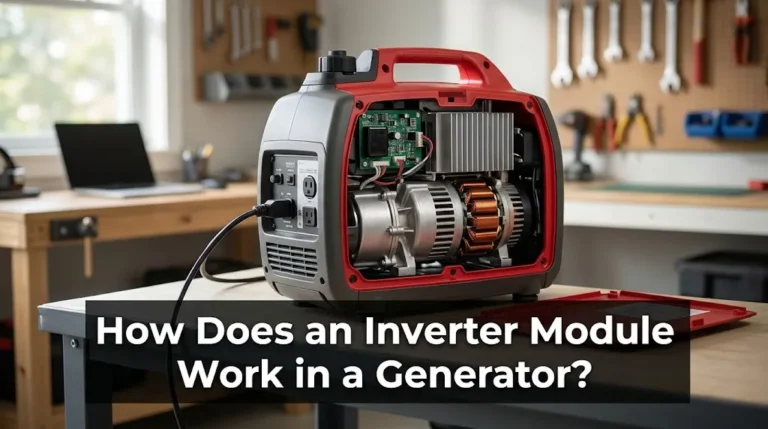
Main Parts of an Inverter Generator
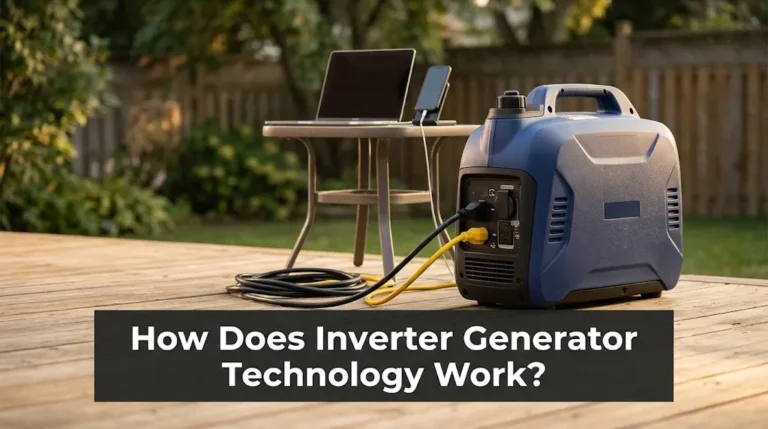
An inverter generator has an engine, fuel system, alternator, rectifier, inverter module, control board, output panel, cooling and exhaust system, and safety shutoffs. Together they turn fuel into steady, clean alternating current that is safe for laptops, phones, and other sensitive electronics.
Open the case on a portable inverter generator and you will not find one big magic box. You will find a small engine, a spinning electrical part, and a set of electronics that clean up the power before it reaches your plug.
That last step is the whole point. A conventional generator ties its output frequency to engine speed. An inverter generator breaks that link. It makes raw power, converts it, then rebuilds it at a steady voltage and frequency.
Once you know the parts in order, the rest gets easier. You can spot a fuel problem, a cooling problem, or an overload problem without guessing, and you can tell which checks are safe to do yourself.
How the parts work together
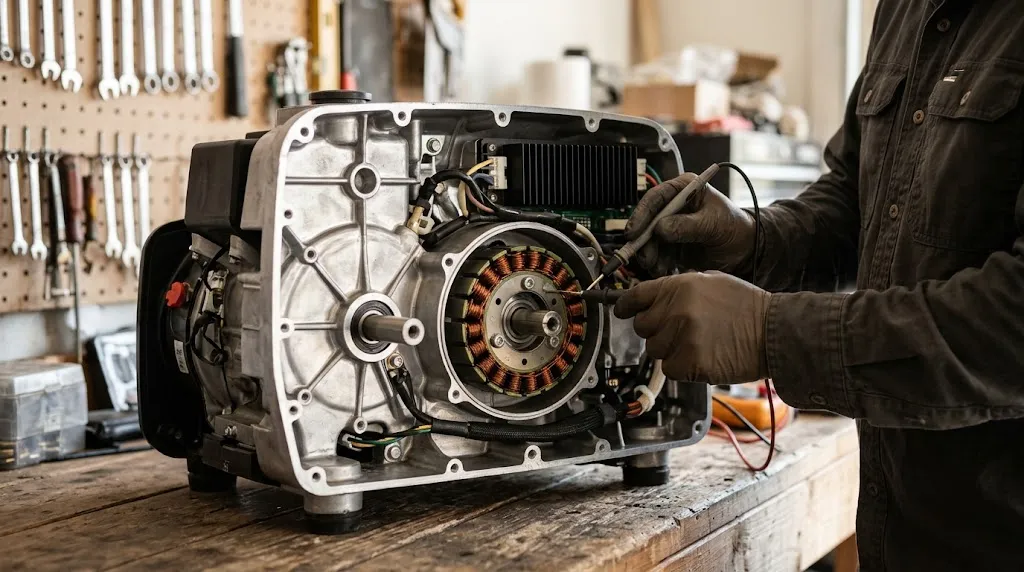
Think of power flowing in a chain. Fuel feeds the engine. The engine spins the alternator. The alternator makes raw alternating current. A rectifier turns that into direct current. The inverter module turns it back into clean alternating current. The control board watches the whole chain and tells the engine how fast to run.
If one link weakens, the symptom usually shows up downstream. Low fuel can look like a power problem. A dirty air filter can look like an engine problem. A tripped breaker can look like a dead outlet.
| Part | What it does | Why it matters to you |
|---|---|---|
| Engine | Burns fuel and spins the alternator | Sets the maximum power and the noise level |
| Fuel system | Stores and delivers fuel to the engine | Controls runtime and cold-start reliability |
| Alternator | Turns spinning motion into electricity | Produces the raw power the inverter will clean up |
| Rectifier | Converts raw AC into DC | Creates a stable input for the inverter stage |
| Inverter module | Rebuilds DC into clean AC | Protects sensitive electronics from rough power |
| Control board | Adjusts engine speed and watches load | Saves fuel at light load and guards against overload |
| Output panel | Holds outlets, breakers, and meters | This is where you plug in and where most faults show up first |
| Cooling and exhaust | Moves air, sheds heat, and vents exhaust | Prevents overheating and keeps noise down |
| Safety shutoffs | Stop the engine on low oil, overload, or high CO | Protect the engine, the wiring, and the people nearby |
For a fuller buying picture, read the inverter portable generator buying guide after this parts tour. It helps you match these parts to the size and outlets you actually need.
1. The engine
The engine is the power source. Most portable inverter generators use a small four-stroke gasoline engine. Some are dual-fuel and can also run on propane. The engine burns fuel, pushes a piston, and turns a crankshaft.
That shaft is the only mechanical link to the alternator. If the engine cannot hold speed under load, output drops. If it runs too rich or too lean, it can surge, smoke, or stall.
Inside the engine you will also find the parts that wear out first in real use: the spark plug, the air filter, the carburetor or fuel injector, and the oil system. Fresh fuel, clean air, and oil at the right level do more for reliability than any add-on.
The first time I opened a small inverter unit after a storm, I expected the inverter board to be the problem. It was a clogged air filter and a tank that was lower than I thought. The unit ran fine once both were sorted, and that check now comes first in my routine.
2. The fuel system
The fuel system starts at the tank and ends at the engine. On a gasoline unit it usually includes a fuel cap with a vent, a fuel valve, a fuel filter, and a fuel line. On a dual-fuel unit it also includes a propane regulator and hose connection.
Fuel quality matters here more than most owners expect. Gasoline goes stale. Ethanol-blended fuel can absorb moisture. A gummed carburetor is a common reason a generator that ran last year will not start this year.
Use ethanol-free fuel where you can get it, add stabilizer for storage, and run the unit dry or follow the manual for long storage. Never refuel a hot engine, and never store fuel inside the house.
3. The alternator
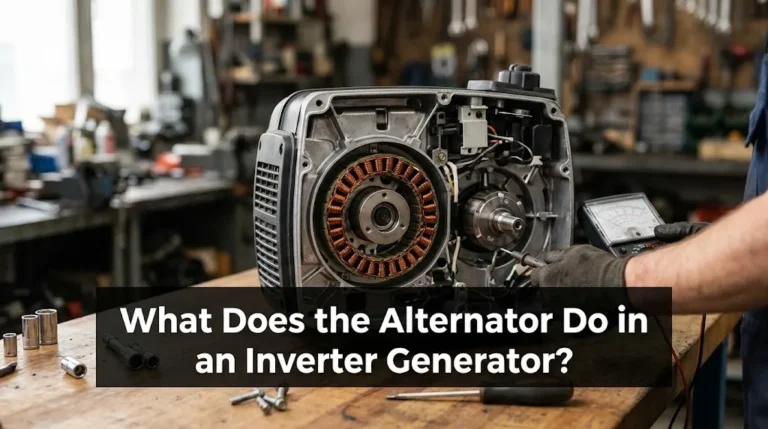
The alternator is the part that turns motion into electricity. It is sometimes called the generator head. The engine spins it, and electromagnetic induction does the rest.
Stator and rotor
An alternator has two main pieces. The stator is the stationary part, with copper windings wrapped around a core. The rotor is the spinning part, with magnets or field windings on a shaft.
As the rotor turns inside the stator, the magnetic field sweeps past the windings and induces current. That is raw alternating current, or AC. It is real power, but it is not yet the clean, steady power your laptop wants.
Many inverter alternators use permanent magnets. That design is compact and efficient, and it helps explain why a small inverter unit can be lighter than an older open-frame generator of similar output.
Why the alternator alone is not enough
On a conventional generator, the alternator output goes straight to the outlets. Engine speed must stay fixed, usually at 3,600 rpm, to hold 60 Hz output in North America. Drop the speed and the frequency drops with it.
An inverter generator takes a different path. It lets the engine speed vary, then fixes the power electronically. That is why it can idle down at light load and still hold steady output.
4. The rectifier
The rectifier is a set of electronic components, often diodes, that converts the alternator’s raw AC into direct current, or DC. Think of it as a one-way gate for electricity.
AC changes direction many times per second. DC flows one way. By blocking the reverse half of the wave and smoothing the result, the rectifier gives the inverter a steadier input to work with.
You will rarely see the rectifier as a separate part you can buy and swap on a small unit. It is often built into the inverter assembly. That matters when you troubleshoot: a rectifier fault can look like an inverter fault, and both usually need a service shop rather than a home repair.
5. The inverter module
The inverter module is the part that gives this kind of generator its name. It takes DC from the rectifier and rebuilds it as AC at the right voltage and frequency.
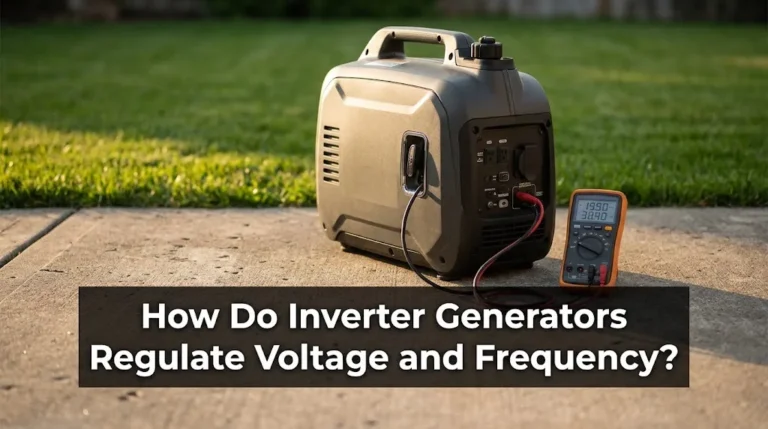
It does this by switching power on and off very fast, thousands of times per second, under microprocessor control. A filter then smooths those rapid pulses into a clean sine wave. A sine wave is the smooth, repeating waveform that utility power uses.
Total harmonic distortion, or THD, is a measure of how far that wave is from a perfect sine wave. Lower is cleaner. Many inverter generators aim for under 3 percent THD. That clean output is why they are a safer choice for laptops, phones, modern furnaces, medical devices, and other electronics with delicate control boards.
Honda describes the same basic sequence on its own inverter page: AC is converted to DC, then back to AC, with a microprocessor controlling both the inverter and engine speed to keep the output clean and steady. You can read that manufacturer explanation in Honda’s guide to what an inverter generator is.
Not every load needs inverter-clean power. A simple resistive heater or an old incandescent bulb will run on rougher power. The risk grows with electronics that use microprocessors, variable-speed motors, or sensitive chargers. If you are unsure about a specific device, check what not to plug into an inverter before you connect it.
6. The control board and eco-mode
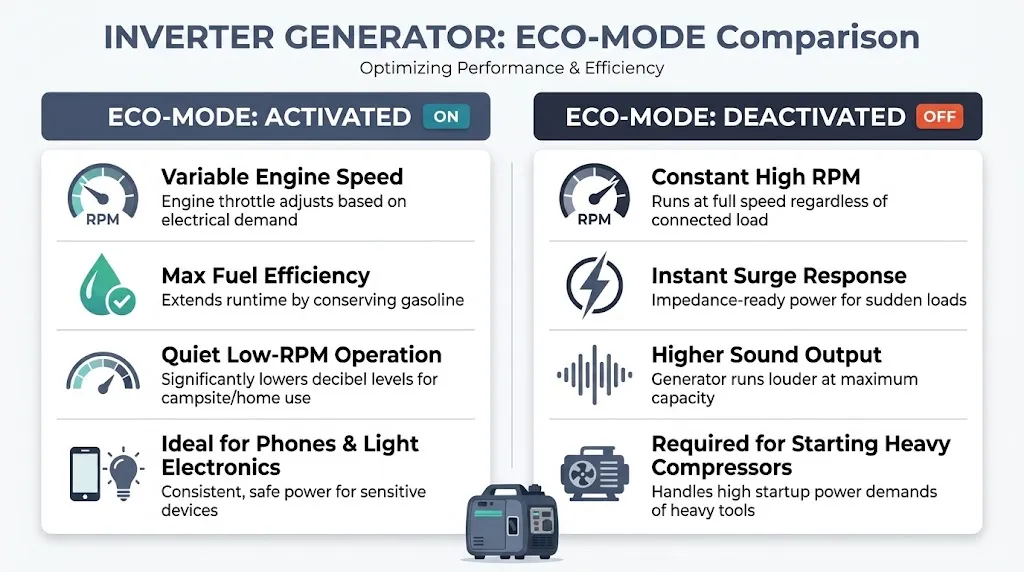
The control board is the brain. It reads load, voltage, and engine speed, then adjusts the throttle. At light load it can drop engine speed well below full speed. At heavy load it opens up again.
That variable-speed control is often sold as eco-mode or economy mode. It saves fuel, cuts noise, and reduces wear when you are only charging phones or running a fridge that cycles on and off.
Eco-mode has one catch. A sudden heavy load, like a motor starting, can take a moment to ramp up. If a tool or compressor stumbles on startup in eco-mode, turn eco-mode off and try again before you assume the generator is too small.
The control board also drives the display on many models. It may show output watts, voltage, run hours, and warning lights. Those numbers are useful, but they are estimates on most portable units, not laboratory measurements.
7. The output panel
The output panel is the part you touch every time you use the generator. It usually holds standard household outlets, a 12-volt DC outlet on some models, a parallel outlet on others, circuit breakers or fuses, and a ground terminal.
Running watts are what a generator can supply continuously. Starting watts are the short surge it can supply when a motor starts. The panel and its breakers are rated for those limits. Exceed them and a breaker should trip before wiring overheats.
GFCI outlets, where fitted, protect against ground faults. A GFCI outlet is a ground-fault circuit interrupter. It trips fast if current leaks through an unintended path, such as wet hands or a damaged cord. That is a safety feature, not a nuisance, and a GFCI that keeps tripping deserves attention.
Some panels also include a parallel kit connection. That lets you link two compatible inverter generators for more total power. The kit keeps their outputs in sync. If you want that option later, check it before you buy, because not every model supports it. See the guide to portable generators with parallel capability for models built for that use.
A portable inverter generator with clear panel labels and accessible breakers is easier to live with during an outage than one where you have to hunt for a reset in the dark.
8. Starter, battery, and ignition
Most small inverter generators start with a recoil pull cord. Larger ones add electric start, which uses a small battery and a starter motor. Remote start adds a wireless control on top of that system.
The ignition system creates the spark that lights the fuel-air mix. It includes the spark plug, the ignition coil, and the wiring between them. A fouled plug or a loose plug wire can cause hard starting, rough running, or no spark at all.
Batteries need care even when the generator sits unused. A battery left flat for months may not recover. Check it during your regular test run, not on the night you need the generator.
9. Cooling, exhaust, and the enclosure
An inverter generator makes heat in three places: the engine, the alternator, and the inverter electronics. Air cooling moves heat away from all three. Fans pull air through vents, across hot surfaces, and out through the exhaust side.
The enclosure does more than make the unit look tidy. It directs airflow, damps sound, and shields hot parts. That is why blocked vents matter. A cover left on a running unit, leaves packed against the intake, or a unit pushed tight against a wall can all cause overheating.
The exhaust system includes the muffler and, on many models, a spark arrestor. A spark arrestor is a screen that catches hot particles before they leave the exhaust. Clean it when the manual says to, especially if you run the unit near dry grass or brush.
Noise comes from the engine, the exhaust, and the cooling fan together. Enclosed inverter units are often quieter than open-frame units because the case, the muffler, and the lower engine speed at light load all help. A decibel rating, or dBA, is a measure of sound level. Ratings are only comparable when they are measured at the same distance and load, so check both before you compare two models.
10. Safety and protection systems
Safety parts are easy to overlook because they only act when something goes wrong. They are also the parts you should never bypass.
Low-oil shutdown stops the engine when oil drops too low. That protects the engine from seizure. Overload protection trips the output before sustained overload damages the inverter or wiring. Over-temperature protection shuts the unit down if cooling fails.
Carbon monoxide shutoff, where fitted, stops the engine when CO builds up around the unit. Carbon monoxide, or CO, is a colorless, odorless gas from burning fuel. It can kill quickly, and you cannot smell it coming. A CO shutoff sensor is a backup, not a substitute for safe placement.
Run the generator outdoors only, at least 20 feet from doors, windows, and vents, with exhaust pointed away from the house. The CDC gives the same 20-foot guidance for portable generators in its carbon monoxide prevention guidance. For models with this feature built in, see portable generators with CO shutoff.
Grounding is another safety part that confuses owners. Some portable generators have a floating neutral, some are bonded, and the right setup depends on how you connect it to your home. Never plug a generator into a household outlet to backfeed the house wiring. That practice, called backfeeding, can energize lines outside your home and endanger utility workers. Use extension cords for individual appliances, or have a licensed electrician install a transfer switch or interlock kit.
What fails first, and what to check first
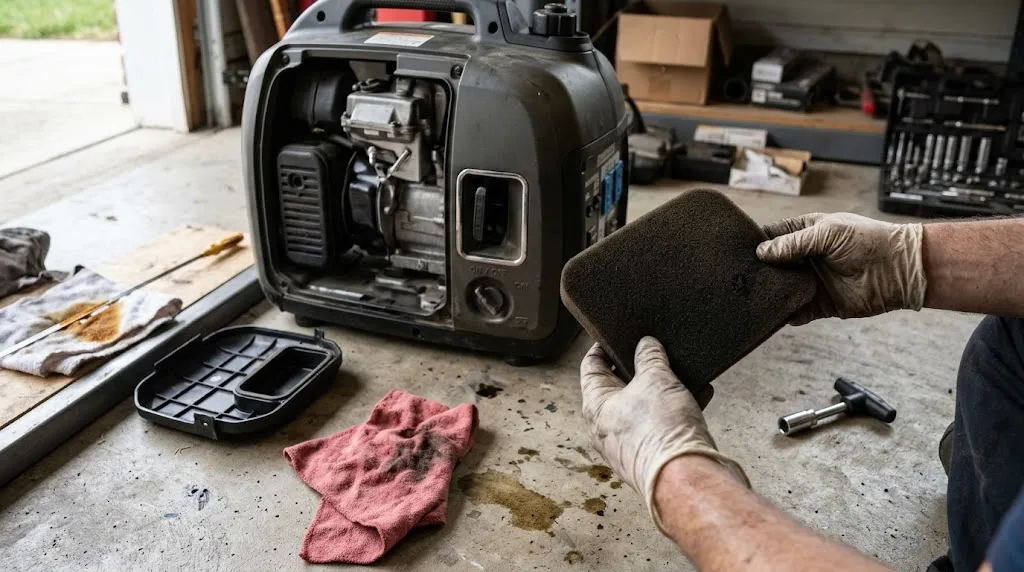
Most field problems are not inverter-board failures. They are fuel, air, oil, or load problems that show up as electrical symptoms. Work through the simple checks first.
| Symptom | Part to check first | Simple first step |
|---|---|---|
| Will not start | Fuel system, spark plug, battery | Check fuel level and valve, then plug condition |
| Starts, then stalls | Air filter, fuel filter, oil level | Clean the filter and check oil before deeper diagnosis |
| Surges under load | Engine, control board, eco-mode | Turn eco-mode off and reduce the load |
| Outlets dead, engine running | Breaker, GFCI, overload light | Unplug loads, reset the breaker, then add loads one at a time |
| Shuts down on its own | Low oil, CO sensor, over-temperature | Check oil, airflow, and placement, then read the warning light |
Stop and get help if you smell fuel after a leak check, see damaged wiring, notice burnt plastic, or find a breaker that trips the moment you reset it. Those are not routine maintenance items.
Which parts you can service yourself
Owner-level work is usually limited to fuel, oil, air filter, spark plug, battery, and exterior cleaning. Your manual lists the intervals and the exact oil and plug types for your model. Follow those, not a generic video for a different unit.
Leave the inverter module, rectifier, control board, and alternator windings to a service shop. Those parts run at high voltage, and a wrong repair can damage the unit or create a shock risk. The same goes for any repair that involves opening a sealed electronics case.
Keep a short log. Note the date, run hours, oil change, filter clean, and any fault light you saw. That log turns a vague complaint at the shop into a useful diagnosis, and it helps you spot a pattern before it becomes an outage-night failure.
Conclusion
The inverter module gets the attention, but it only works because the engine, fuel system, alternator, rectifier, control board, and safety systems do their jobs first. Clean power is a team result, not a single part.
Learn where the fuel valve, oil dipstick, air filter, breakers, and warning lights sit on your own unit. Test it under a real load before you need it.
I am Michael Turner, and I would start with a fuel, oil, and air filter check on a quiet afternoon, not in the middle of an outage.
If this parts tour helped you understand what you are buying, a quiet inverter generator is the category to compare next, especially if you plan to run laptops, a fridge, or medical equipment during an outage.
Frequently Asked Questions
What is the most important part of an inverter generator?
The inverter module is the defining part, because it rebuilds power into a clean sine wave. It still depends on the engine and alternator to make power in the first place, so a failure in either of those will stop output just as surely.
Is the inverter the same as the alternator?
No. The alternator turns spinning motion into raw electricity. The inverter is an electronic module that converts DC back into clean AC. They work in sequence, and neither one replaces the other.
Do all inverter generators have a rectifier?
Yes, in function if not as a separate visible part. Raw AC from the alternator must be converted to DC before the inverter can rebuild it. On many small units the rectifier is built into the inverter assembly.
Can I replace an inverter module myself?
Most owners should not. Inverter modules and control boards run at high voltage and are model-specific. Owner service is best kept to fuel, oil, air filter, spark plug, and battery checks, with electronics left to a qualified service shop.
Why does my inverter generator shut off for no obvious reason?
Check low oil, overload, blocked airflow, and CO sensor warnings first. Those shutoffs are designed to protect the engine and the people nearby. If the unit shuts down again after those checks, stop using it and have it inspected.

Hi, I’m Michael Turner. I own a generator workshop in the United States and founded HomeGeneratorBlog to share practical, hands-on guidance about generator installation, maintenance, troubleshooting, safety, and backup power solutions. My goal is to help homeowners make smarter, more confident decisions through clear and reliable information