What Should You Not Plug Into an Inverter?
Quick Answer
You should not plug oversized appliances, incompatible medical equipment, or devices requiring pure sine wave power into an unsuitable inverter. Space heaters, large air conditioners, refrigerators with high starting loads, sensitive chargers, and motor-driven equipment need particular care. The biggest risks are overloads, overheating, poor power quality, and damaged electronics. These restrictions depend on the inverter’s specifications, not simply the appliance category. For more background, see this inverter generator buying guide.
What should you avoid connecting?
- Large heating appliances: Space heaters, kettles, and hair dryers can quickly exceed smaller inverter ratings.
- High-surge equipment: Refrigerators, pumps, and compressors may need more starting power than the inverter supplies.
- Sensitive electronics: Some computers, audio equipment, and electronic controls require pure sine wave output.
- Medical equipment: Never assume an ordinary inverter provides approved or reliable life-support power.
- Incompatible battery chargers: Certain chargers can overheat or malfunction on modified sine wave electricity.
- Household wiring: Never backfeed a house through a wall outlet or improvised power cord.
The safest first check
- Check compatibility: Confirm the appliance’s voltage, running watts, starting watts, and required waveform before plugging it in.
An inverter makes backup electricity convenient, but a familiar household plug doesn’t guarantee compatibility. Some appliances draw too much power, while others need a cleaner electrical waveform.
I recommend checking the appliance label before considering its size or appearance. This guide explains which connections deserve caution, why they cause trouble, and how to make safer choices.
What Is an Inverter, and Why Does Compatibility Matter?
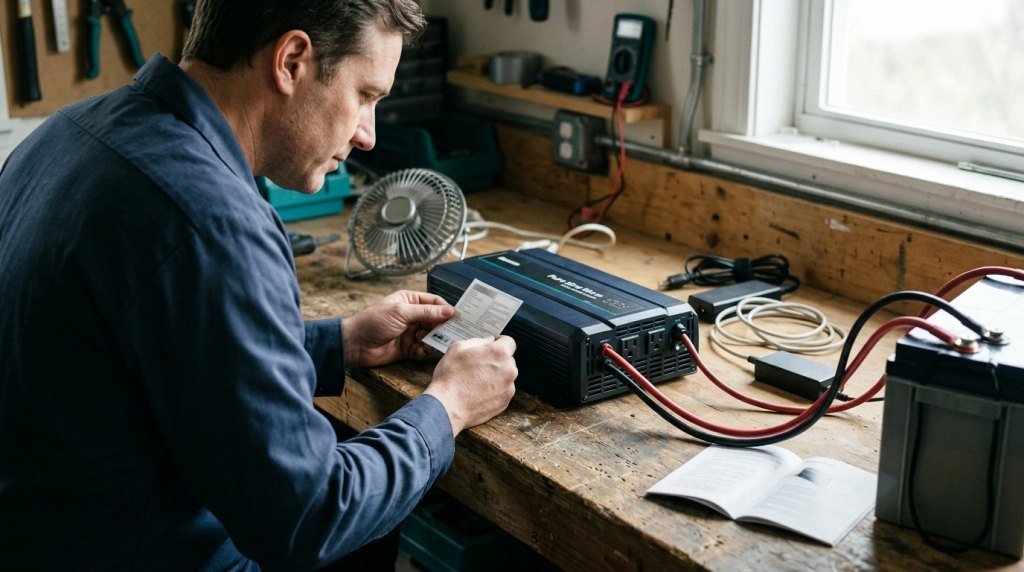
A power inverter converts direct-current electricity from a battery into alternating-current electricity used by household appliances. An inverter generator instead uses an engine and electronic power conversion to deliver regulated AC output.
Both have electrical limits, but they aren’t identical products. A battery inverter also depends on battery capacity, wiring, and the available DC supply.
Three specifications determine whether an appliance will work properly:
- Continuous watts: The power an inverter can supply during normal operation.
- Surge watts: The extra output available briefly when equipment starts.
- Output waveform: The electrical shape supplied to connected equipment, often pure sine wave or modified sine wave.
A pure sine wave inverter produces an electrical waveform similar to utility electricity. A modified sine wave inverter creates a stepped approximation that some appliances cannot tolerate.
According to Eaton’s inverter guidance, sensitive electronics and certain variable-speed equipment benefit from pure sine wave power.
Which Appliances Should You Not Plug Into an Inverter?
Avoid connecting equipment when its electrical requirements exceed the inverter’s capabilities. Some categories are unsuitable only for modified sine wave units, while others need substantially higher wattage.
1. Space Heaters and Other High-Wattage Appliances
Electric heaters convert substantial amounts of electricity directly into heat. A typical portable space heater may draw around 1,500 watts on its highest setting.
That demand is too much for a 1,000-watt inverter. Even a larger inverter needs an adequately sized battery, wiring, and protective devices.
- Space heaters: Often demand 750–1,500 watts depending on their settings.
- Electric kettles: Many models draw around 1,000–1,500 watts or more.
- Hair dryers: Commonly consume roughly 1,200–1,875 watts.
- Toaster ovens: Frequently require around 1,200–1,800 watts.
These are illustrative ranges, not universal product specifications. Heating equipment can work on sufficiently rated inverters, but long operating periods can rapidly drain batteries.
2. Refrigerators, Freezers, and Air Conditioners
Refrigerators and air conditioners aren’t automatically incompatible with inverters. Their main challenge is the electrical surge required to start a compressor.
A refrigerator that consumes modest power while running may demand substantially more for a moment during startup. That brief demand can trigger an inverter’s overload protection.
I would check these three details before connecting cooling equipment:
- Running load: The appliance’s normal operating wattage.
- Starting load: Its compressor or motor startup requirement.
- Power quality: Whether its electronics or motor controls require pure sine wave electricity.
Some modern cooling systems use variable-speed compressors and sophisticated electronics. Manufacturer compatibility matters more than making assumptions based on appliance size.
3. Medical Devices and Life-Support Equipment
Never connect life-sustaining medical equipment to an ordinary inverter without confirming an approved backup-power arrangement. A pure sine wave label alone does not establish medical suitability.
Devices such as oxygen concentrators, ventilators, CPAP machines, and medical monitoring equipment can have different power requirements. Their manufacturers may specify approved battery packs, backup systems, or operating conditions.
- Confirm compatibility directly with the medical device manufacturer.
- Use the manufacturer’s recommended backup supply and accessories.
- Check runtime and alarm behavior under backup conditions.
- Have a separate emergency plan if the device supports essential treatment.
Even reliable inverters can shut down because of overloads, battery depletion, or protective faults. A critical medical device requires more assurance than an ordinary household appliance.
4. Sensitive Computers and Electronic Equipment
Some computers, networking devices, audio systems, and precision electronics work poorly on modified sine wave power. Problems can include buzzing, unexpected shutdowns, excessive heat, or incorrect operation.
Not every electronic device has this limitation. Many modern chargers tolerate different input conditions, but compatibility should be confirmed rather than assumed.
- Desktop computers: Certain power supplies, particularly active power-factor-correction designs, may require pure sine wave output.
- Audio equipment: Modified sine wave power can introduce audible interference.
- Laser printers: Heating and power-control systems may create demanding electrical loads.
- Precision instruments: Some require tightly controlled voltage and waveform quality.
For expensive or sensitive equipment, I prefer choosing a properly rated pure sine wave source. That removes one major compatibility concern, although it doesn’t eliminate overload risks.
5. Power Tool Battery Chargers
Some battery chargers are unsuitable for modified sine wave inverters. Their internal charging circuits may behave unpredictably or generate excessive heat.
This is particularly important when charging rechargeable power-tool batteries. The charger manufacturer’s input requirements should determine whether an inverter is appropriate.
Watch for warning signs:
- The charger becomes unusually hot.
- Charging stops or repeatedly restarts.
- Error lights appear without an apparent battery fault.
- The charger produces unusual buzzing or odors.
Disconnect equipment immediately if overheating or abnormal behavior occurs. Don’t bypass charger protections to make an incompatible combination work.
6. Large Pumps and Motor-Driven Equipment
Sump pumps, well pumps, compressors, and large power tools can overload an inverter during startup. Motors sometimes require several times their normal operating current to begin turning.
Waveform quality can also affect some motors and speed controllers. A pure sine wave inverter is generally preferable when the equipment requires conventional sinusoidal AC power.
Check the equipment’s nameplate and manual before connecting:
- Rated voltage and frequency.
- Continuous running watts or current.
- Starting-current or surge requirements.
- Electronic speed-control compatibility.
If the startup demand exceeds the inverter’s supported surge rating, choose a properly sized power source. Repeatedly resetting an overloaded inverter is not a solution.
7. Damaged Appliances or Improper Power Strips
Do not connect damaged cords, loose plugs, or equipment with exposed wiring to an inverter. Electrical faults can cause overheating, shock, or fire.
Power strips and surge protectors also require attention. Some inverter manuals prohibit particular surge-protected strips or extension arrangements, especially with modified sine wave output.
Follow these basic rules:
- Never use damaged or overheating electrical accessories.
- Do not exceed any outlet, cord, or power-strip rating.
- Avoid daisy-chaining extension cords and power strips.
- Confirm that any surge protector is compatible with the inverter.
- Never connect an inverter’s AC output to another live power source unless the equipment is specifically designed for that arrangement.
Pure Sine Wave vs Modified Sine Wave: What Can You Safely Run?
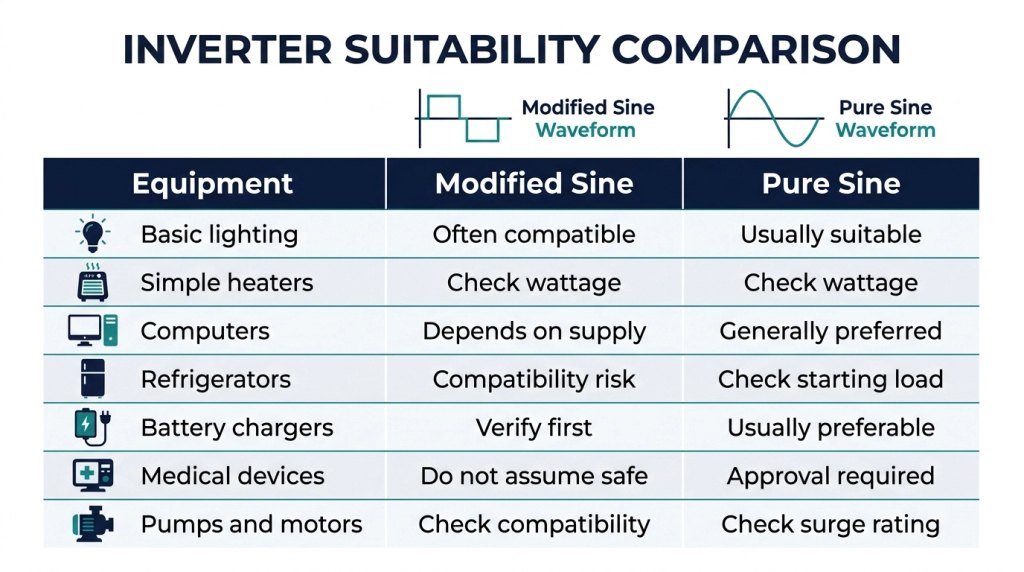
Pure sine wave inverters generally support a wider range of household equipment. Modified sine wave models can operate many basic loads, but compatibility becomes less predictable with electronic controls and certain motors.
This table summarizes the main differences.
| Equipment | Modified Sine | Pure Sine |
|---|---|---|
| Basic lighting | Often compatible | Usually suitable |
| Simple heaters | Check wattage | Check wattage |
| Computers | Depends on supply | Generally preferred |
| Refrigerators | Compatibility risk | Check starting load |
| Battery chargers | Verify first | Usually preferable |
| Medical devices | Do not assume safe | Approval required |
| Pumps and motors | Check compatibility | Check surge rating |
These are general suitability guidelines, not blanket approvals. Every appliance must still match the inverter’s voltage, frequency, continuous output, and starting capacity.
How Do You Know if an Appliance Will Overload Your Inverter?
Compare the total running load with the inverter’s continuous rating, then check its startup surge capacity. An appliance can meet the continuous limit and still trip the inverter while starting.
Here’s a simple example I use to explain the calculation for a 1,000-watt inverter.
| Example Load | Running Watts |
|---|---|
| Laptop charger | 60 W |
| Television | 100 W |
| Small fan | 50 W |
| Total example load | 210 W |
These are sample calculations, not measured values for specific models. The combined 210-watt running demand leaves substantial room below a 1,000-watt continuous rating.
However, you must still check any startup surges. Inverter capacity also doesn’t tell you how long the battery can supply power.
What Happens if You Plug in Something Too Powerful?
An overloaded inverter may sound an alarm, reduce output, or shut down automatically. Protection features vary, and you shouldn’t assume every inverter will disconnect safely under every fault.
Possible warning signs include:
- Repeated overload alarms or fault messages.
- Unexpected appliance shutdowns.
- Excessive inverter or cable temperature.
- Unusual electrical smells or noises.
- Low-battery warnings while heavy loads operate.
Switch the inverter off and disconnect the load when a fault appears. Identify the cause before restarting, especially if cables or connectors feel unusually hot.
For broader backup-power planning, my home generator sizing guide explains how to account for essential household loads.
Can You Plug an Inverter Into a Household Wall Outlet?
No. Never connect a standalone inverter’s AC output to a normal wall outlet to energize household wiring.
This can create dangerous backfeeding and expose people to energized conductors. It can also damage electrical equipment when incompatible power sources are connected.
The same restriction applies to using a portable generator through a household receptacle. A generator or inverter must use an approved connection system when supplying permanent home wiring.
- Individual appliances: Use properly rated direct connections when permitted by the equipment manufacturers.
- Household circuits: Use approved transfer equipment designed for the electrical installation.
- Professional installation: Have a qualified electrician handle permanent wiring connections.
The OSHA generator safety guidance warns against connecting generators directly to building electrical systems without properly installed transfer equipment.
For more details on this particular hazard, read my guide on plugging generators into outlets.
Are Inverter Generators Safe for Sensitive Electronics?
Many inverter generators produce stable, low-distortion electricity suitable for common electronics. Nevertheless, the actual generator’s specifications and the connected appliance’s requirements determine compatibility.
A clean waveform doesn’t make a generator capable of running unlimited equipment. Large motors, electrical heaters, and compressor loads can still exceed its capacity.
I recommend checking these items before connecting expensive electronics:
- The generator’s output voltage and frequency.
- Its published total harmonic distortion specification, if available.
- Continuous and peak wattage ratings.
- Any special grounding or neutral requirements.
- Instructions from the appliance manufacturer.
There’s also a major safety difference between battery inverters and fuel-powered generators. Engine-powered inverter generators produce exhaust and must operate outdoors.
The CDC’s carbon monoxide guidance recommends keeping portable generators more than 20 feet from doors, windows, and vents.
Never run a fuel-powered generator in a garage, basement, or enclosed porch. For additional placement precautions, see my generator carbon monoxide guide.
What Should You Check Before Plugging Anything Into an Inverter?
A short compatibility check can prevent many electrical problems. I would complete it before every unfamiliar appliance is added to a backup-power setup.
- Identify the inverter type. Determine whether it produces pure sine wave or modified sine wave output.
- Read the appliance label. Check voltage, frequency, rated current, and wattage.
- Find the starting demand. Pay particular attention to compressors, pumps, and motor-driven equipment.
- Calculate the total load. Include everything that might run simultaneously.
- Confirm battery capability. Ensure the battery, DC cables, fuses, and installation support the required current.
- Inspect the connection. Check plugs, receptacles, ventilation, and cable condition.
- Follow manufacturer instructions. Do not override safety features or use unsupported connections.
For complicated installations, especially home circuits or substantial battery banks, consult a qualified electrician. Correct wiring is just as important as selecting the right wattage.
Useful Equipment for Safer Inverter Power
If you’re planning a battery-powered inverter setup, I would prioritize clean output, adequate capacity, and accurate load measurements. These three products serve different needs.
The star indicators below represent general suitability for each intended use, not independent laboratory ratings or customer review averages.
🏆 Best for Small Electronics
Renogy 1000W 12V Pure Sine Wave Inverter
★★★★☆ 4/5 suitability
This Renogy model supplies 1,000 continuous watts and up to 2,000 peak watts from a properly configured 12-volt battery system. I’d consider it for modest electronics and selected small appliances, provided their total and surge loads fit.
⚡ Best for Higher Loads
Renogy 2000W 12V Pure Sine Wave Inverter
★★★★☆ 4/5 suitability
With 2,000 continuous watts and a published 4,000-watt peak rating, this model offers more capacity for appropriately sized loads. I’d choose this category only with a battery bank, protective wiring, and installation capable of supporting its substantial DC current.
🔎 Best for Measuring Power
P3 International P4400 Kill A Watt Meter
★★★★☆ 4/5 suitability
The P4400 displays watts, volts, amps, frequency, and energy consumption within its rated limits. I’d use it to understand ordinary operating loads on a compatible AC supply, but not as a substitute for checking brief motor startup surges or inverter compatibility.
Frequently Asked Questions
Can you plug a refrigerator into an inverter?
Yes, provided the inverter supports the refrigerator’s running demand, compressor startup surge, voltage, and waveform requirements. A sufficiently rated pure sine wave inverter is generally preferable. Always check the refrigerator manufacturer’s specifications and confirm the battery system can support the intended operating time.
Can you run a microwave on an inverter?
Some microwaves work on properly sized pure sine wave inverters, but their electrical input can be considerably higher than the advertised cooking output. Inverters must support the actual input demand and any startup requirements. Check the microwave’s nameplate rather than relying on cooking wattage.
Will an inverter damage a television?
A compatible, properly rated pure sine wave inverter can generally power a television safely. Modified sine wave output may cause interference or compatibility problems with some models. Confirm the television’s power requirements and avoid using an inverter that produces unstable or unsuitable electrical output.
Can you plug a power strip into an inverter?
Only when the inverter manufacturer permits it and the strip is compatible and properly rated. Certain surge-protected power strips may be unsuitable for particular inverter outputs. Never exceed the inverter’s total capacity, connect damaged accessories, or use a strip as a substitute for proper household wiring.
Is it safe to leave appliances plugged into an inverter overnight?
It depends on the equipment, installation, manufacturer instructions, and available battery capacity. Unattended operation requires suitable electrical protection and ventilation. Never leave an unsafe or overloaded setup running, and do not operate a fuel-powered inverter generator inside an occupied or enclosed building.
Final Takeaway: Match the Appliance to the Inverter
The safest approach is not to ban every high-wattage appliance or sensitive device. It’s to verify whether your specific inverter can supply the correct waveform, voltage, continuous power, and startup capacity.
Start with the appliance label, confirm the inverter manual, and never improvise electrical connections. When compatibility remains uncertain, ask the equipment manufacturer or a qualified electrician before plugging it in.

Hi, I’m Michael Turner. I own a generator workshop in the United States and founded HomeGeneratorBlog to share practical, hands-on guidance about generator installation, maintenance, troubleshooting, safety, and backup power solutions. My goal is to help homeowners make smarter, more confident decisions through clear and reliable information