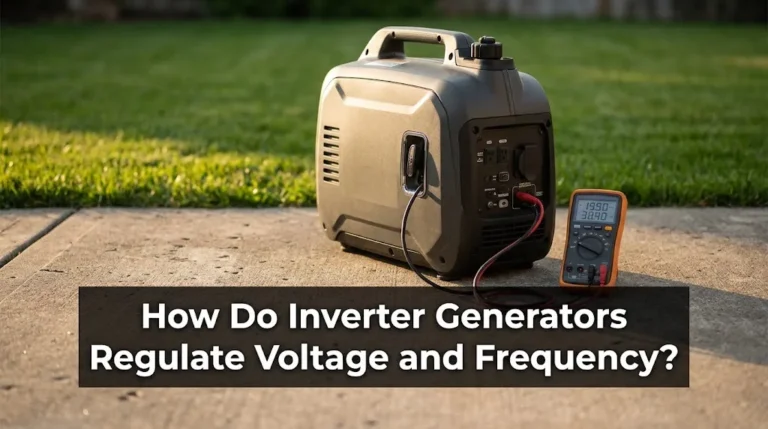
How Does Inverter Generator Technology Work?
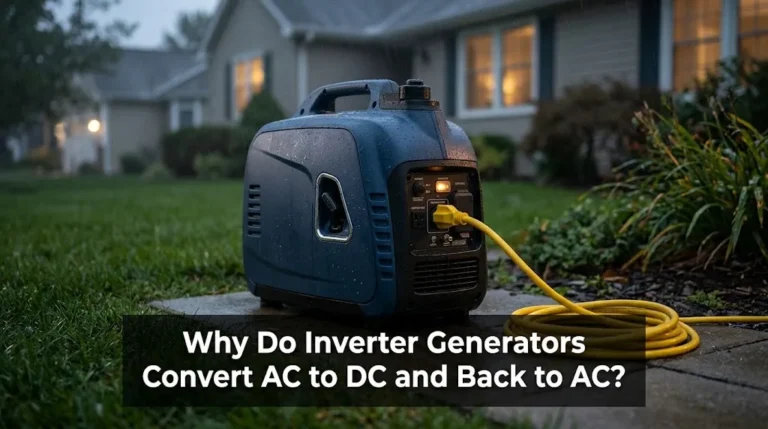
An inverter generator makes raw alternating current with an engine-driven alternator, converts it to direct current, then uses fast-switching electronics and a microprocessor to rebuild it as stable 120-volt, 60-hertz sine-wave power. Because electronics set the output, the engine can slow down under light loads, saving fuel and reducing noise.
Why add an extra conversion at all?
A conventional portable generator ties everything to engine speed. The engine must spin at a fixed speed, usually 3,600 revolutions per minute, so the alternator produces 60-hertz power. Change the speed and the frequency changes. That leaves no room to idle down when the load is light.
An inverter generator breaks that link. The alternator can spin faster or slower. Its raw output does not go straight to your appliances. It goes through electronics first, and those electronics decide the final voltage and frequency. That single design choice explains almost every advantage people notice: cleaner power, quieter light-load running, and better fuel use.
It also explains the trade-offs. More electronics mean more heat to manage, more protection circuits, and a higher repair cost if the inverter module fails. The technology is not magic. It is a controlled detour, and the detour is worth it when you need stable power for modern electronics.
If you are still choosing a size or style, read the inverter portable generator buying guide after this explanation. It will help you match the technology to a real load list, rather than a headline watt number.
How the power travels from fuel to outlet
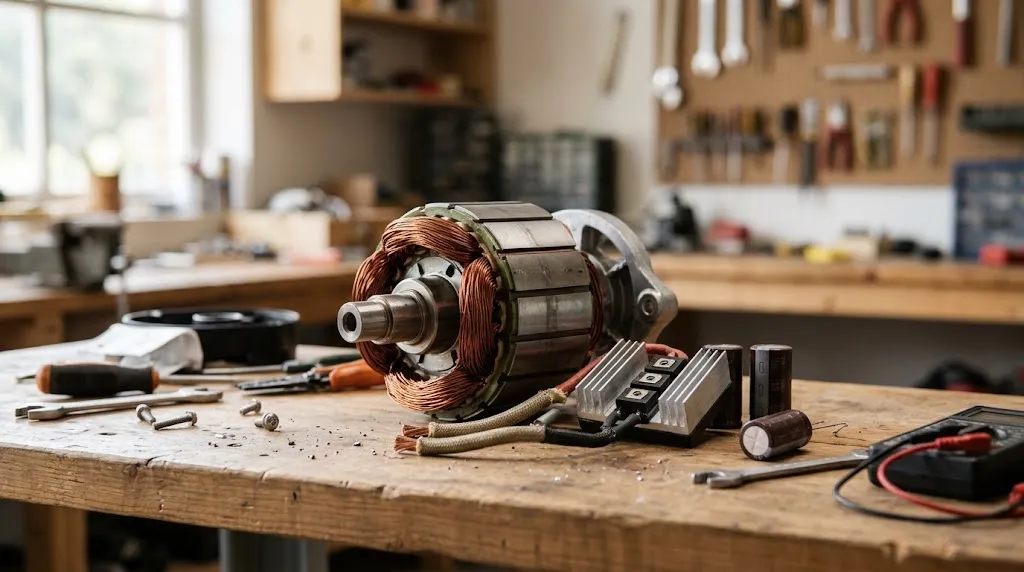
Think of the path as four stages. Fuel energy becomes mechanical energy, mechanical energy becomes rough electrical energy, rough energy becomes direct current, and direct current becomes clean household power.
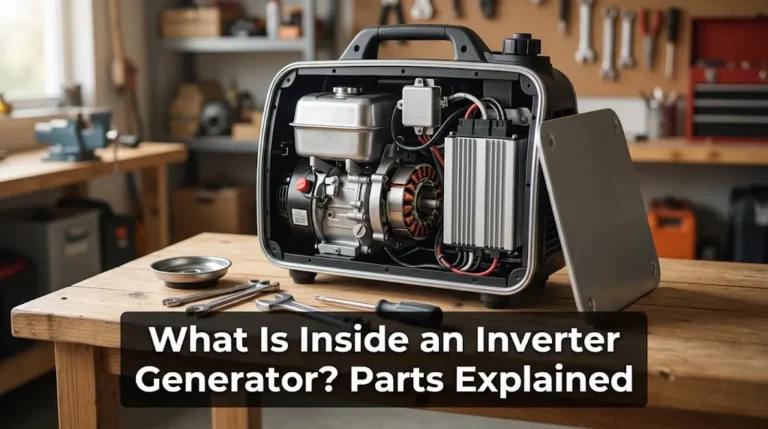
- Engine burns fuel and spins the alternator. Gasoline, propane on dual-fuel models, or another approved fuel drives a small engine. The engine shaft turns the alternator. Nothing here is new. Every fuel generator starts this way.
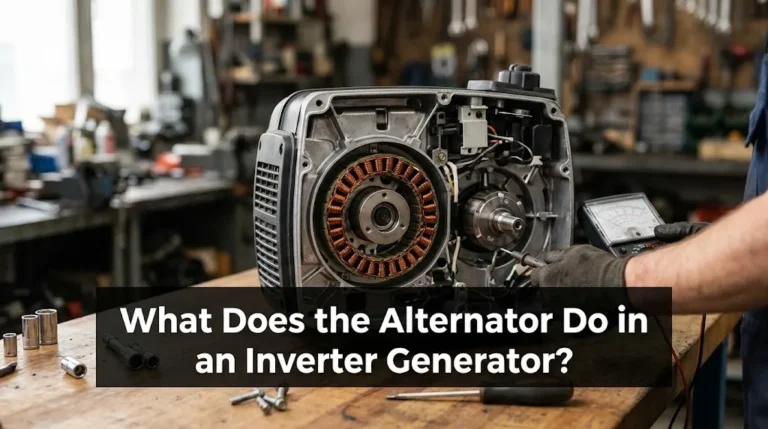
- Alternator makes high-frequency raw AC. Inverter alternators are usually compact, multi-pole designs with permanent magnets. Because the outlet frequency no longer depends on engine speed, the alternator can produce high-frequency, multi-phase AC at a voltage and frequency that would not suit a wall outlet directly. The result is rough, but it is a useful raw material.
- Rectifier converts raw AC to DC. A rectifier, a set of diodes arranged to steer current in one direction, turns that raw AC into direct current (DC). Capacitors smooth out the worst ripples. DC flows in one direction, like power from a battery, which makes it far easier for control electronics to shape.
- Inverter rebuilds stable AC. The inverter module switches that DC on and off thousands of times per second and filters the result into a smooth sine wave. The outlet then sees power close to what a utility supply should deliver: about 120 volts at 60 hertz in the United States, with far less distortion than raw alternator power.
The first time I watched a small inverter drop to a near idle while charging two phones and a camp radio, then pick up smoothly when someone switched on a kettle, the point landed. The engine was not guessing. It was following the load, and the outlet power stayed steady while the sound changed.
Inside the inverter module
The inverter module is the part that gives this generator its name. It is not a single chip. It is a power-electronics assembly with switching transistors, a control board, filters, and protection circuits, all working together in real time.
What is pulse-width modulation?
Pulse-width modulation, usually shortened to PWM, is how the inverter builds a sine wave from DC. Transistors switch the DC supply on and off in rapid pulses. Wider pulses carry more average power. Narrower pulses carry less. By varying pulse width in a precise pattern, the module traces the rising and falling shape of a sine wave.
Those pulses are still too jagged to send to a laptop. An output filter, typically inductors and capacitors, smooths them. The filter removes high-frequency switching noise and leaves the clean, low-frequency sine wave your appliances expect. Good filtering is one reason two generators with similar watt ratings can feel different on sensitive gear.
What does the microprocessor actually control?
A microprocessor, a small control computer, watches the output voltage, frequency, and load current. It adjusts the switching pattern to hold voltage steady when a load changes. It also talks to the engine throttle. When demand rises, it calls for more engine speed. When demand falls, it lets the engine slow down.
That control loop runs constantly. A fridge compressor starting, a microwave cycling, or a phone charger unplugging all change the load in an instant. The processor corrects the output far faster than a mechanical governor could, which is why inverter power tends to hold its shape during those small, constant changes.
Why does the alternator look different?
A conventional alternator must be large enough to make 60-hertz power at a fixed engine speed. An inverter alternator is freed from that job. It can use more poles and permanent magnets, spin at a higher effective frequency, and stay smaller and lighter for the same output. That is part of why many inverter models are easier to carry than an open-frame unit of similar wattage.
Smaller does not mean weaker. It means the heavy work of setting frequency moved from iron and copper to silicon and software. The engine and alternator still set the maximum power available. The electronics cannot create watts the engine did not produce.
Why the engine can slow down
On a conventional generator, slowing the engine would drop the frequency below 60 hertz. Lights might dim, motors might run hot, and clocks could drift. So the engine stays at full speed even when you are only charging a phone.
An inverter generator has no such penalty for slowing down, because the inverter rebuilds frequency electronically. Under a light load, the engine can idle at a much lower speed and still deliver 120 volts at 60 hertz. Fuel use drops. Noise drops. Vibration drops. The unit often sounds more like a conversation than a jobsite machine at quarter load, though the exact sound level varies by model and distance.
Many models call this Eco Mode, Eco Throttle, or a similar name. It is usually a switch, not an automatic mystery setting. Turn it on for steady, light loads. Turn it off when a large motor is about to start. A fridge compressor or air conditioner can pull a sharp starting surge, and an engine already idling low may hesitate for a fraction of a second. That hesitation is not dangerous by itself, but it can cause a brief dip or a nuisance trip on a unit that is already near its limit.
What clean power really means
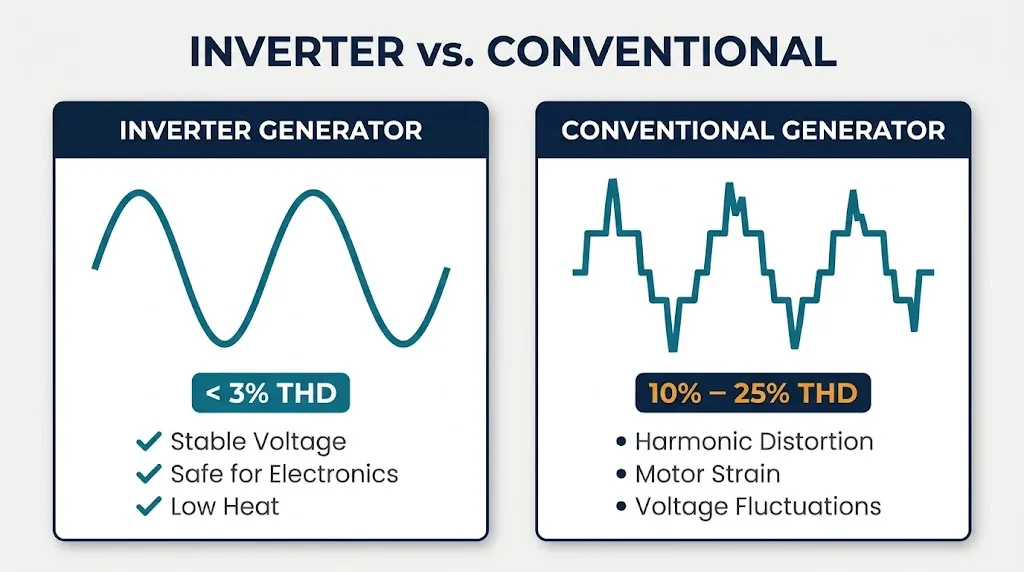
Clean power is not a marketing word with no definition. In generator terms, it usually means low total harmonic distortion (THD). THD measures how far a waveform strays from a perfect sine wave. A perfect sine wave has no distortion. A jagged, stepped waveform has a lot.
Many inverter generators are rated below 3% THD. Conventional open-frame generators often fall in the 10% to 25% range, depending on design and load. That gap matters for electronics with delicate power supplies, variable-speed motors, and digital controls. High distortion can cause excess heat, buzzing, flicker, or erratic behavior in some devices.
For a manufacturer explanation of the same idea, Honda describes inverter generators as converting AC to DC and back to AC to deliver cleaner, more consistent power. Generac uses a similar clean-power standard for its inverter line, listing its portable inverters at under 3% THD. Always check the spec sheet for the exact model you are considering, because a brand name alone does not guarantee a low THD figure.
Low THD does not make every load safe. Motors still need enough starting watts. A generator still has a running-watt limit. And a clean waveform does not protect against overload, bad extension cords, or wet connections. Clean power solves one problem well. It does not solve all of them.
| Feature | Inverter generator | Conventional generator |
|---|---|---|
| Power path | Engine to alternator to DC to rebuilt AC | Engine to alternator straight to outlets |
| Engine speed | Varies with load | Fixed, usually 3,600 RPM |
| Typical THD | Often under 3% | Often 10% to 25% |
| Light-load noise and fuel use | Usually lower, because the engine can slow down | Usually higher, because the engine stays at full speed |
| Electronics complexity | Higher, with a microprocessor and inverter module | Lower, often a simpler voltage regulator |
A worked light-load example
Numbers make the technology easier to judge. Take a quiet evening load: a modern fridge running at about 150 watts, a laptop charger at 65 watts, a router at 10 watts, and a few LED lights at 60 watts. The running total is about 285 watts.
On a 2,200-watt inverter generator, that is a light load. The engine can stay slow, the inverter still delivers a full 120-volt sine wave, and fuel lasts far longer than it would at full load. The fridge compressor will still surge when it starts, perhaps briefly to several times its running watts, so the generator needs headroom above that 285-watt total. That surge is why running watts and starting watts are different numbers, and why a unit that handles the steady load can still trip on startup.
Now add a microwave at 1,000 watts. The total jumps to about 1,285 watts, plus the fridge surge if it happens at the same moment. The microprocessor sees the change and raises engine speed. The output waveform stays controlled, but the sound and fuel use rise with it. This is normal. An inverter generator is efficient at light load. It is not free power at heavy load.
How parallel operation works
Parallel capability lets two compatible inverter generators work together. A parallel kit links their outputs so they share one load. The control boards synchronise voltage, frequency, and phase, which is the timing of the AC wave, so the two outputs add rather than fight each other.
Two 2,200-watt units in parallel do not magically become a large whole-house generator, but they can roughly double the available running watts, minus a small loss in the kit and cables. That is useful for an RV air conditioner or a workshop load that sits just above one small unit.
Compatibility matters. Most manufacturers intend parallel operation only between matching or approved models, using their own kit. Mixing brands, mixing very different sizes, or using a random cable is a bad idea. If you think you may need more power later, a parallel-ready inverter generator is worth choosing at the start, rather than discovering the option is missing later.
For RV use specifically, the best RV inverter generator roundup shows how parallel models, outlet types, and air-conditioner starting loads fit together in practice.
Where inverter technology struggles
Every strength has a limit, and this technology has several worth knowing before you rely on it.
- Maximum watts still rule. Electronics cannot exceed what the engine and alternator can supply. A small inverter will not run a large central air conditioner, an electric range, and a well pump at once.
- Heat is the enemy of electronics. The inverter module, rectifier, and control board generate heat, especially near full load. Blocked vents, dust, or a cover left on a running unit can push temperatures up and trigger a shutdown. Keep airflow clear.
- Overload protection is not a suggestion. Most inverters will trip, shut down, or warn you when the load exceeds the rating. Repeated overloads stress the module. Size with a margin, and stagger motor starts.
- Repair can cost more. A conventional generator often has a simpler regulator and alternator. An inverter module is a specialised part. That is a fair trade for clean power, but it is still a trade.
- It is still a fuel engine. Inverter technology cleans the electricity. It does not remove exhaust, fuel storage, oil changes, or spark plug maintenance. A battery power station is a different product, with no engine and no refuelling, but also a finite stored charge.
Safety limits the technology cannot remove

Run any fuel generator outdoors only, at least 20 feet from windows, doors, and vents, with exhaust pointed away from the house. Use a battery-powered carbon monoxide alarm inside. Never run a generator in a garage, even with the door open, and never connect it to house wiring without a transfer switch or interlock installed by a licensed electrician. Backfeeding, sending generator power into utility lines, can injure utility workers and damage equipment.
Carbon monoxide (CO) is colorless and odorless, and a CO shutoff sensor is a valuable safety feature, not a substitute for distance and ventilation. Some models shut down when CO builds up near the unit. That sensor helps. It does not make an enclosed space safe.
Grounding and house connection rules vary by model and local code. Check the manual and check local code before you wire anything beyond extension cords. A transfer switch (manual or automatic) is the device that safely separates house circuits from the utility supply while generator power is in use.
What to check on a spec sheet
Five numbers tell you more than a headline watt rating. First, running watts, the power the unit can sustain. Second, starting watts, the brief surge it can handle for motors. Third, THD, ideally stated clearly and under 3% for sensitive electronics. Fourth, runtime at a stated load, usually quarter load, so you can compare like with like. Fifth, outlet types, including RV-ready, 30-amp, and GFCI outlets if your loads need them.
Also check parallel capability, fuel type, CO shutoff, and whether eco mode can be switched off for motor starts. A quiet inverter generator that is too small for your fridge surge is not a bargain. It is a unit you will keep tripping.
Two related reads help here. The portable generator frequency guide explains why 60 hertz matters and what happens when it drifts. The portable generator AC power guide explains voltage, outlets, and what household AC actually means in practice. And before you plug in anything unusual, check what not to plug into an inverter, because a clean waveform does not override a watt limit or a device restriction.
Conclusion
The engine makes the power. The alternator turns it into rough electricity. The rectifier and inverter rebuild it into a stable sine wave, and the microprocessor keeps that output steady while the engine speeds up or slows down with demand. That AC to DC to AC path is the whole technology, and it is why inverter generators run quieter, sip fuel at light load, and suit sensitive electronics better than a fixed-speed unit.
Start with your real running and starting watts, check the THD rating, and leave headroom for motor surges. — Michael Turner
If you want clean, stable power for a fridge, laptop, router, and lights during an outage, or for an RV trip where noise matters, a small inverter generator is a solid option to compare first.
Frequently Asked Questions
How does inverter generator technology work in simple terms?
It makes rough AC power with an engine and alternator, converts that power to DC, then rebuilds it as a clean 120-volt, 60-hertz sine wave. Electronics control the final output, so the engine speed can change with load without changing the power your appliances receive.
Is inverter generator power safe for laptops and sensitive electronics?
Generally, yes, when the model is rated for low THD, usually under 3%, and you stay within its running watts. Use good extension cords, avoid overloading the unit, and follow the device manual. Low THD helps, but it does not replace proper sizing or surge protection.
Why is an inverter generator quieter than a conventional generator?
Two reasons work together. The engine can slow down under light loads because output frequency is set electronically, not by engine speed. Many inverter models also use enclosed cases, sound-dampening material, and tuned mufflers, which further reduce noise.
Can two inverter generators be connected together?
Many compatible models can, using a manufacturer-approved parallel kit. The two units synchronise their output so their power adds up for a larger load. Check the manual for approved pairings, because not every model supports parallel operation and mixed brands are generally not recommended.
Does an inverter generator use less fuel?
Often, yes, especially at light or variable loads, because the engine slows down instead of running at full speed all the time. At sustained full load, the advantage shrinks, because the engine must still work hard to produce the same watts. Fuel use always depends on load, tank size, and the specific model.

Hi, I’m Michael Turner. I own a generator workshop in the United States and founded HomeGeneratorBlog to share practical, hands-on guidance about generator installation, maintenance, troubleshooting, safety, and backup power solutions. My goal is to help homeowners make smarter, more confident decisions through clear and reliable information