Can an Inverter Generator Power a House? Sizing, Hookup & What It Can Run
Quick Answer
Yes, an inverter generator can power a house, but only for selected essentials. Most homes need a 5,000 to 9,500 running-watt unit, a safe connection, and a clear load plan. Start with what size inverter generator you need before you buy or plug anything in.
What it can do
- Essentials first: A mid-size unit can run a fridge, lights, phones, a CPAP, and a furnace blower.
- Whole house, rarely: Full electric heat, central AC, and an electric water heater usually need a standby system.
- Size matters most: Add running watts, then add the largest starting watt load on top.
- Clean power helps: Inverter output suits laptops, TVs, and medical devices better than raw open-frame power.
- Safe hookup only: Use a transfer switch, interlock, or heavy-duty extension cords to chosen appliances.
Do this first
- List your must-run loads, check each nameplate, and size for the highest starting load.
- Place the generator outdoors, at least 20 feet from the house, with exhaust pointed away.
I have run a fridge and a CPAP through a multi-day outage on an inverter generator, and I have also watched a smaller unit trip the moment a window AC kicked on. That gap is the whole story here.
This guide covers what an inverter generator can power in a house, how to size it, how to connect it safely, and how long it will run. You will get real wattage ranges, a load table, and the mistakes I see most often.
In This Guide
- What Does It Mean to Power a House With an Inverter Generator?
- Can an Inverter Generator Power a Whole House?
- What Size Inverter Generator Do You Need to Power a House?
- What Can an Inverter Generator Run in a House?
- How Do You Connect an Inverter Generator to Your House Safely?
- How Long Can an Inverter Generator Power a House?
- Inverter Generator vs Conventional Generator vs Standby Generator for Home Backup
- Common Mistakes That Overload or Damage Your Setup
- FAQ
What Does It Mean to Power a House With an Inverter Generator?
An inverter generator is a portable generator that makes clean, stable power. It converts raw engine power into a smooth sine wave, which is the steady electrical wave sensitive electronics expect.
That clean output is measured in part by THD, or total harmonic distortion. Lower THD means cleaner power for laptops, phones, TVs, and CPAP machines.
Powering a house can mean three different things, and people mix them up. It can mean running a few essentials by extension cord, feeding selected circuits through a transfer switch, or trying to run the full home as normal.
Most inverter generators suit the first two uses. The third use usually needs a large standby generator or a very large portable unit.
What is portable power in a home outage?
Portable power means a movable source you start, fuel, and connect by hand. You choose the loads, you manage the fuel, and you shut it down to refuel.
That control is a strength and a limit. You can keep food cold and lights on, but you cannot run every circuit at once without a large, planned setup.
Section Takeaway: Powering a house usually means powering chosen essentials, not every circuit at once, and clean inverter power is what makes that plan safe for electronics.
Can an Inverter Generator Power a Whole House?
Yes, in a narrow sense, if your whole-house load is small and you manage it carefully. No, not in the normal sense, if you want central AC, electric heat, and an electric water heater running together.
A typical home can draw 10,000 to 20,000 watts when major appliances run at once. Most inverter generators top out near 7,500 to 9,500 running watts.
That math sets the limit. You can power a house in outage mode, but you cannot ignore the load list.
What loads break the plan first?
- Central AC: 3,000 to 5,000 running watts, with a much higher starting surge.
- Electric heat: 5,000 to 15,000 watts, far beyond most portable units.
- Electric water heater: 3,000 to 4,500 watts, and it runs in long cycles.
- Electric range: 2,000 to 5,000 watts per burner or oven cycle.
- Well pump: 1,000 to 2,000 running watts, with a starting surge two to three times higher.
Gas heat changes the picture. A gas furnace needs only its blower and controls, often 500 to 1,200 watts, so it fits a mid-size inverter generator.
Small homes, cabins, and apartments with gas heat do far better than large all-electric homes. Your fuel type matters as much as your generator size.
Safety note: Never run a generator indoors, in a garage, or near open windows, doors, or vents. Carbon monoxide can build up fast, so keep the unit outdoors and well away from the house.
Section Takeaway: A whole house on normal use is usually out of reach, but a whole house on essential loads is very doable with the right size and a strict load plan.
What Size Inverter Generator Do You Need to Power a House?

Size by running watts first, then check starting watts. Running watts are the steady power a load uses, while starting watts are the short surge a motor needs to start.
Learn the difference in our guide to running watts vs starting watts, because that surge is what trips most undersized units. A fridge may run at 150 watts and start at 800 watts.
How do you do the wattage math?
- List every load you must run at the same time.
- Add their running watts together.
- Add the largest starting watt surge from that list.
- Add a 20% margin for safety and future loads.
- Pick a generator with running watts above that total.
Use our step-by-step guide to calculate the generator wattage you need to work through your own list. Nameplate watts beat guesswork every time.
Here is a quick example. Fridge 150 watts, furnace blower 800 watts, lights 200 watts, phones and laptop 150 watts, and CPAP 100 watts total 1,400 running watts.
Add the fridge starting surge of about 650 extra watts, then add 20% margin. That load needs roughly 2,500 running watts, so a 3,000-watt unit fits with room to spare.
What size fits which home?
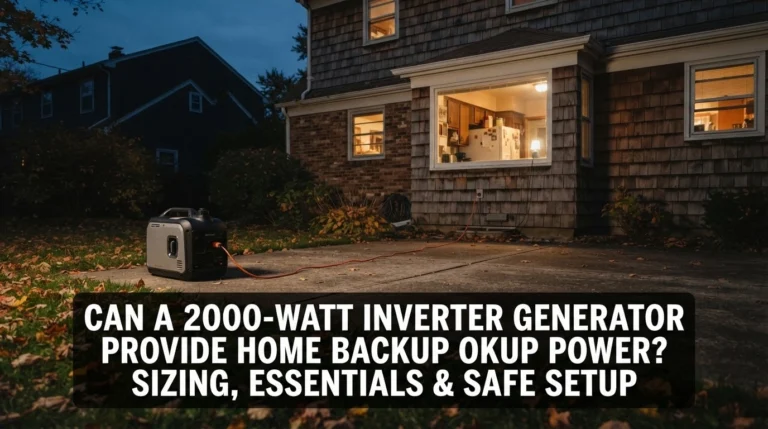
- 2,000 watts: Lights, phones, laptop, small fridge, and CPAP, one at a time.
- 3,000 to 3,500 watts: Fridge, freezer, lights, electronics, and a gas furnace blower.
- 5,000 watts: Fridge, freezer, furnace, sump pump, lights, and a window AC in rotation.
- 7,500 to 9,500 watts: Most essentials at once, plus a well pump or larger AC with care.
Check the spec sheet for both running and starting watts before you buy. Some brands list only the larger surge number, which can mislead first-time buyers.
Section Takeaway: Add running watts, add the largest starting surge, add 20% margin, and buy above that total — that simple math prevents most overload trips.
What Can an Inverter Generator Run in a House?
A mid-size inverter generator can run the loads that keep a home safe and livable. It struggles with heat-producing loads that draw steady, high power.
The table below uses typical ranges, not model-specific specs. Check your own appliance nameplate, because age and size change the numbers.
| Appliance | Running watts | Starting watts | Typical fit |
|---|---|---|---|
| Refrigerator | 100-200 | 600-1,200 | Yes, most sizes |
| Freezer | 100-200 | 600-1,200 | Yes, most sizes |
| Gas furnace blower | 500-1,200 | 1,000-2,000 | Yes, 3,500W+ |
| Sump pump | 800-1,200 | 1,800-3,000 | Yes, 5,000W+ |
| Window AC, 8,000 BTU | 700-1,000 | 1,800-2,500 | Yes, in rotation |
| CPAP machine | 30-100 | 30-100 | Yes, any size |
| Laptop and phones | 50-150 | 50-150 | Yes, any size |
| Microwave, 1,000W | 1,000-1,500 | 1,000-1,500 | Yes, alone |
| Electric water heater | 3,000-4,500 | 3,000-4,500 | Rarely, large unit |
| Central AC | 3,000-5,000 | 6,000-12,000 | Usually no |
A 5,000-watt unit covers a strong essentials list. See how much power a 5,000-watt inverter generator provides for a full load example.
Rotation is the trick most new owners miss. Run the microwave alone for five minutes, then switch back to the fridge and lights.
I keep a short list on the fridge during an outage. It stops the late-night guesswork and keeps the generator from tripping.
Section Takeaway: A 5,000-watt inverter generator can run most essentials, but heat and central AC need rotation or a much larger system.
How Do You Connect an Inverter Generator to Your House Safely?

You have three safe paths, and one dangerous path to avoid. The safe paths are extension cords, a transfer switch, or an interlock kit with an inlet box.
The dangerous path is backfeeding through a dryer outlet or a suicide cord. It can energize utility lines and put line workers at risk.
Which connection fits your home?
- Extension cords: Simplest and safest for a few appliances, with heavy-duty outdoor-rated cords.
- Transfer switch: Powers chosen circuits through your panel, installed by a licensed electrician.
- Interlock kit: Locks the main breaker off while the generator feeds selected circuits.
- Inlet box: A fixed outdoor plug that connects the generator to the panel safely.
If you have no transfer switch yet, read our guide on a generator without a transfer switch to see the safe cord-based options. Do not improvise a panel connection.
Check your local code and your panel type before you buy hardware. Some panels accept interlocks, and some need a full transfer switch instead.
The Consumer Product Safety Commission and the CDC both stress outdoor placement and proper connection. Their guidance is the baseline, not a suggestion.
Safety note: Use a transfer switch or interlock installed by a licensed electrician, and never plug a generator directly into a wall outlet. Check your owner’s manual before use.
Section Takeaway: Cords work for a few loads, a transfer switch or interlock works for circuits, and backfeeding is never safe.
How Long Can an Inverter Generator Power a House?
Runtime depends on tank size, load, and eco mode. A 5,000-watt inverter generator may run 8 to 12 hours at 25% load and 5 to 8 hours at 50% load, but check the spec sheet for your model.
Eco-throttle, or economy mode, slows the engine when demand drops. It saves fuel and cuts noise, but it can lag when a motor starts.
How do you stretch fuel in a long outage?
- Run in cycles: Cool the fridge for two hours, then rest it for one hour.
- Use eco mode: Turn it on for light loads, off for motor starts.
- Cut phantom loads: Unplug chargers, TVs, and standby devices you do not need.
- Store fuel safely: Keep fresh gasoline in approved cans, away from heat, and use stabilizer.
- Plan refills: Let the unit cool before refueling, and never refuel while it runs.
For a longer outage, plan your fuel by the day, not by the tank. Our guide to generator size for a power outage helps you match tank, load, and outage length.
Dual-fuel models add flexibility. Propane stores longer than gasoline and runs cleaner, though it may cut running watts by about 10%.
The U.S. Department of Energy offers general home energy and backup-power guidance. Use it to plan load priorities before storm season.
Safety note: Store fuel outdoors in approved containers, keep it away from the running generator, and let the unit cool fully before refueling.
Section Takeaway: Runtime is a load plan, not just a tank size — cycle loads, use eco mode, and plan fuel by the day.
Inverter Generator vs Conventional Generator vs Standby Generator for Home Backup

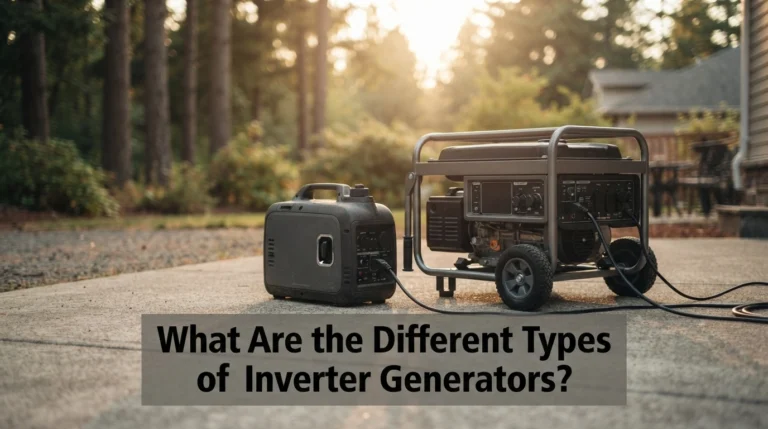
Each type fits a different home. Inverter units win on clean power and noise, conventional units win on low cost per watt, and standby units win on whole-house coverage.
Noise matters in a neighborhood outage. Inverter models often run near 52 to 62 dB at 25% load, while open-frame models can run much louder.
| Feature | Inverter generator | Conventional portable | Standby generator |
|---|---|---|---|
| Power quality | Clean sine wave, low THD | Rougher, higher THD | Stable, home-grade |
| Noise | Quiet, eco mode | Loud, fixed speed | Moderate, enclosed |
| Fuel use | Efficient at light load | Fixed speed, more fuel | Gas or propane, auto |
| Whole house | Essentials only | Essentials plus more | Yes, sized to home |
| Start | Manual or electric | Manual or electric | Automatic |
| Cost | Mid to high per watt | Low per watt | High, installed |
Parallel capability is a useful middle path. Two matching inverter units can join with a parallel kit to double running watts for a larger load.
Check independent testing notes from Consumer Reports when you compare brands. Their noise and load tests help you see past marketing claims.
Section Takeaway: Choose inverter for clean, quiet essentials, conventional for cheap watts, and standby for automatic whole-house backup.
Common Mistakes That Overload or Damage Your Setup
Most failures are not bad generators. They are bad load plans, stale fuel, or unsafe placement.
I have seen a clean unit surge and stall because two motor loads started at once. One small change in order would have fixed it.
- Starting everything at once: Start the largest motor first, then add small loads.
- Ignoring starting watts: A fridge, pump, or AC needs a surge your running total hides.
- Using thin cords: Long, light-duty cords drop voltage and heat up under load.
- Stale fuel: Old gasoline clogs the carburetor and causes hard starts and surging.
- Running indoors: A garage or porch traps carbon monoxide, even with a door open.
- Skipping oil checks: Low oil can trigger shutdown, and running low can damage the engine.
- No break-in: Follow the manual for the first oil change and load limits.
Test your setup before the storm. Run your essential list for an hour, check for trips, and note the real fuel use.
The EPA offers general guidance on fuel storage and emissions for small engines. Keep fuel fresh, sealed, and stored safely.
Safety note: Run generators outdoors and well away from windows, doors, and vents, and install battery carbon monoxide alarms in your home.
Section Takeaway: Start big motors first, use heavy cords, keep fuel fresh, and test the full load list before you need it.
FAQ
Can a 3,000-watt inverter generator power a house?
Yes, for essentials in a small home. It can run a fridge, lights, electronics, and a gas furnace blower, but it cannot run central AC or electric heat at the same time.
Can an inverter generator power a house through the panel?
Yes, with a transfer switch or interlock kit and inlet box installed by a licensed electrician. Never backfeed through a wall outlet or dryer outlet.
Can two inverter generators power a house together?
Yes, if both units are parallel-capable and you use the correct parallel kit. Two 3,500-watt units can give you about 7,000 running watts for larger essential loads.
Will an inverter generator run a refrigerator and freezer together?
Yes, most 3,000-watt and larger units can run both, if their starts are staggered. Start one, let it settle, then start the other to avoid a double surge.
How much fuel will I need for a 24-hour outage?
It depends on load, but plan for 5 to 10 gallons for a 5,000-watt unit at light to moderate load. Cycle loads and use eco mode to stretch each tank.
Is an inverter generator safe for a CPAP and laptop?
Yes, inverter power is well suited to CPAP machines, laptops, and phones. Its clean sine wave and low THD protect sensitive electronics better than rough open-frame power.
An inverter generator can power a house in 2026 if you size it for essentials, connect it safely, and manage loads in rotation. List your must-run loads, add the largest starting surge, and test the setup before the next outage.
Start with your wattage math today. That one step turns a hopeful purchase into a backup plan you can trust.

Hi, I’m Michael Turner. I own a generator workshop in the United States and founded HomeGeneratorBlog to share practical, hands-on guidance about generator installation, maintenance, troubleshooting, safety, and backup power solutions. My goal is to help homeowners make smarter, more confident decisions through clear and reliable information