What Size Inverter Generator Do You Need to Run a House? Sizing, Wattage & Safe Setup
Quick Answer
Most homes need a 5,000 to 7,500 running-watt inverter generator for essentials, and 7,500 to 12,000 running watts for near-whole-home use. Start with your fridge, lights, furnace blower, and one large motor load, then add a 20% safety margin. If you want a deeper sizing walkthrough, use this inverter generator sizing guide before you buy.
Size it in 4 quick steps
- List essentials first: Pick the loads you must keep on during an outage.
- Add running watts: Total the steady watts for everything running at once.
- Add starting watts: Add the largest motor surge, not every surge at once.
- Add a margin: Add 20% headroom so the generator does not run flat out.
- Check 120V and 240V: Confirm the generator has the outlets your loads need.
Do this before you shop
- Write your load list on paper, then match it to a generator with enough running watts and surge watts.
- Plan the hookup now, because a safe transfer switch or interlock changes what you can run.
I’ve sized inverter generators for my own home, for friends, and for readers who just want the lights and fridge to stay on. The right size is rarely the biggest one you can buy.
It’s the size that covers your must-run loads, handles one big motor start, and still has room to breathe. This guide shows you the math, the real watt numbers, and the safe way to connect it in 2026.
In This Guide
- What size inverter generator do you need to run a house?
- How do you calculate the watts your house needs?
- What can each inverter generator size run?
- Running watts vs starting watts: why surge changes everything
- Can one inverter generator run a whole house?
- How do you connect an inverter generator to your house safely?
- Inverter vs conventional vs dual fuel for home backup
- How long will it run, and how much fuel will you use?
- What sizing mistakes should you avoid?
- Frequently asked questions
What size inverter generator do you need to run a house?
For most homes, a 5,000 to 7,500 running-watt inverter generator covers the essentials during an outage. That range usually handles a fridge, freezer, lights, phones, a furnace blower, and a sump pump.
It will not run everything at once. It will keep your home safe, fed, and comfortable if you manage loads.
An inverter generator is a portable generator that makes clean, stable power through an inverter. That clean sine wave matters for laptops, phones, TVs, and modern furnace controls.
It also matters for medical gear like a CPAP machine. Dirty power can cause glitches, buzzing, or shutdowns in sensitive electronics.
Here is the short sizing rule I use in real homes. Essentials-only use lands near 3,000 to 5,000 running watts.
Comfortable backup with heat or cooling lands near 5,000 to 7,500 running watts. Near-whole-home use often needs 7,500 to 12,000 running watts, plus 240V power.
- 3,000-4,000 watts: Fridge, lights, phones, laptop, and a small fan or TV.
- 5,000-7,500 watts: Essentials plus a furnace blower, sump pump, microwave, or window AC.
- 7,500-12,000 watts: Near-whole-home use, including a larger AC, well pump, or electric water heater in turns.
Your house may sit outside those ranges. A small, efficient home can do well on less.
A large home with electric heat, a big central AC, and a well pump will need more. That is why the load list matters more than a single number.
If you want a second check on your home size, read this guide to what size generator you need for a home. It helps you compare your load list with common home sizes.
Section Takeaway: Most homes should start at 5,000 to 7,500 running watts for essentials, then size up only when a large motor or 240V load demands it.
How do you calculate the watts your house needs?
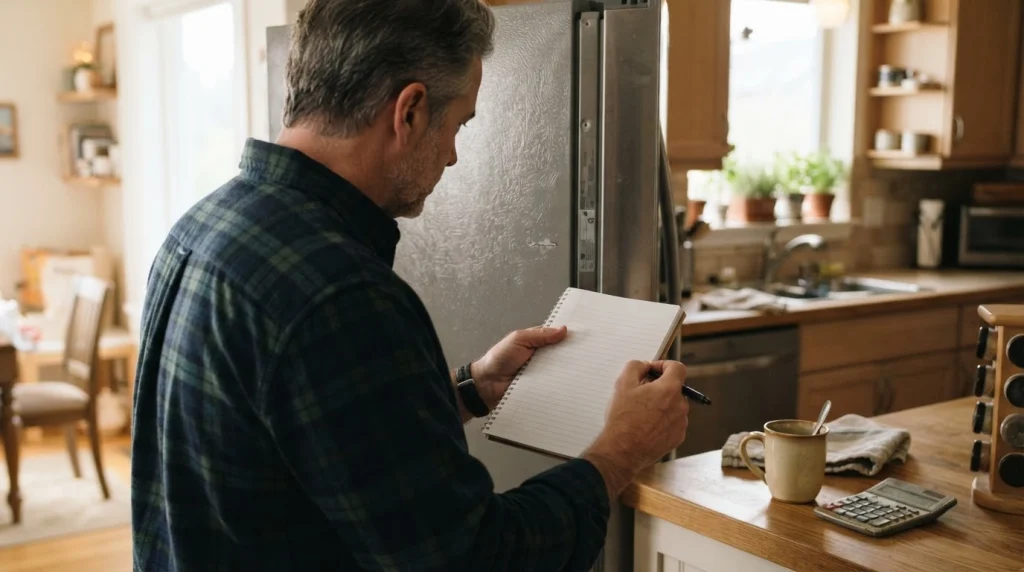
You calculate your house watts by adding running watts, then adding the largest starting surge. You do not add every starting watt together.
That one detail saves many buyers from overspending. Motors rarely start at the exact same second.
Step 1: List what must run at the same time
Walk through your home and write down every load you plan to run together. Be honest about what you will actually use.
A fridge that cycles on and off still counts. A light you switch on for an hour still counts while it is on.
- Must-run: Fridge, freezer, furnace blower, sump pump, well pump, CPAP, lights, and phones.
- Nice to have: TV, microwave, coffee maker, window AC, and a laptop charger.
- Run in turns: Water heater, dryer, oven, and large power tools.
Step 2: Find running watts for each item
Check the label on the appliance or its manual. Use the running watts figure, not the peak or surge figure, for this step.
Typical ranges help when a label is missing. A modern fridge often uses 100 to 200 running watts, while a freezer uses a similar range.
A gas furnace blower often uses 500 to 900 running watts. A sump pump often uses 800 to 1,200 running watts.
Step 3: Add the largest starting watts
Motors need a short burst of extra power to start. That burst is called starting watts, or surge watts.
A fridge may need 1,200 to 2,000 starting watts for a second or two. A sump pump may need 1,500 to 2,500 starting watts.
Add only the largest surge to your running total. Then add a 20% margin for safety and for loads you forgot.
Here is a simple example. Fridge 150 watts, freezer 150 watts, furnace blower 700 watts, lights 200 watts, and phones 50 watts total 1,250 running watts.
Add the largest surge, say 1,800 watts for the fridge, and you get 3,050 watts. Add 20% and you land near 3,660 watts.
That home could run on a 4,000 running-watt unit with room to spare. Add a window AC or sump pump, and the number climbs fast.
For a step-by-step worksheet, use this guide to calculating the generator wattage you need. It walks through the same math with more appliance examples.
Safety note: Never guess the watts for a well pump, furnace, or central AC. Check the nameplate or manual, and ask a licensed electrician if the load is hard-wired.
Section Takeaway: Add running watts, add only the largest starting surge, then add 20% headroom — that total is your real target size.
What can each inverter generator size run?
Generator size is easier to judge when you see real load combos. The table below uses typical running watts and assumes you manage loads in turns.
Check your own appliance labels before you buy. Older fridges, pumps, and AC units can draw far more than new ones.
| Generator size (running watts) | Good for | Typical limits |
|---|---|---|
| 2,000-3,000 | Fridge, lights, phones, laptop, small TV | No furnace blower, sump pump, or AC |
| 3,500-4,500 | Essentials plus furnace blower or sump pump | One large motor at a time |
| 5,000-7,500 | Comfortable home backup, window AC, microwave | Central AC and well pump need careful sizing |
| 7,500-12,000 | Near-whole-home use, 240V loads in turns | Electric heat and dryers still need load control |
I once ran a fridge, freezer, furnace blower, and lights through a multi-day outage on a mid-size inverter unit. The trick was simple.
We kept the microwave and coffee maker off while the furnace blower started. That small pause kept the generator from tripping.
Common appliance ranges help you plan. Use them as a starting point, not a promise.
- Refrigerator: 100-200 running watts, 1,200-2,000 starting watts.
- Freezer: 100-200 running watts, 1,200-2,000 starting watts.
- Furnace blower: 500-900 running watts, 1,200-2,200 starting watts.
- Sump pump: 800-1,200 running watts, 1,500-2,500 starting watts.
- Window AC: 900-1,500 running watts, 2,000-3,000 starting watts.
- Microwave: 1,000-1,500 running watts, with little extra surge.
- Well pump: 1,000-2,000 running watts, 3,000-6,000 starting watts.
Well pumps and central AC units are the usual deal-breakers. Their starting surge can be three to five times their running watts.
A soft-start kit can help some AC units, but it is not a fix for every system. Check with your HVAC tech before you count on it.
Section Takeaway: Match the generator to your real load combo, not to a headline watt number — motor starts decide the size.
Running watts vs starting watts: why surge changes everything
Running watts are the steady power a device uses while it runs. Starting watts are the short burst it needs to start.
That burst lasts only a second or two. It can still trip an undersized generator.
Think of it like pushing a heavy cart. It takes a hard push to get moving, then less effort to keep rolling.
A motor works the same way. Its start-up current spikes, then settles to a lower running current.
Generator makers list both numbers for a reason. A 5,000 running-watt unit may offer 6,250 starting watts.
That does not mean it can run 6,250 watts all day. It means it can handle a brief surge up to that level.
Here is where buyers get caught. They add every appliance’s starting watts together.
That math oversizes the generator by thousands of watts. It also pushes them toward a louder, heavier, thirstier unit.
The better method is simple. Add all running watts, then add the single largest starting surge.
Then stagger the rest. Start the fridge first, wait a few seconds, then start the next motor load.
For a clear side-by-side explainer, read this guide to running watts vs starting watts. It shows how the two numbers work together in real sizing.
Section Takeaway: Size for running watts plus your largest surge, not for every surge added together.
Can one inverter generator run a whole house?
Yes, one large inverter generator can run a whole house in some cases. It depends on your loads, your wiring, and how much you are willing to manage.
Most homes cannot run every circuit at full load on a portable inverter generator. That is normal, and it is not a failure.
Whole-home use usually means one of three setups. Each one has a different cost and a different level of convenience.
- Essentials panel: A transfer switch feeds only key circuits, such as fridge, heat, lights, and sump pump.
- Near-whole-home: A larger 240V inverter generator feeds most circuits, with heavy loads run in turns.
- Standby system: A fixed standby generator with an automatic transfer switch powers the home with less manual work.
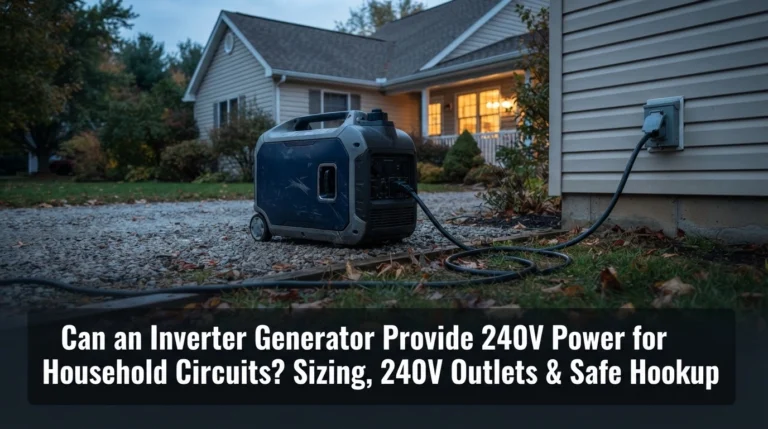
A 240V outlet matters here. Many small inverter generators are 120V only.
They can run extension cords and single circuits, but they cannot feed a 240V panel directly. A large inverter generator with a 240V outlet can, when connected correctly.
Parallel capability can help too. Two smaller inverter units linked with a parallel kit can share the load.
That setup adds cost and complexity. It can also give you a quieter small unit for light use and a paired setup for outages.
Check the spec sheet for parallel support and for the total running watts when paired. Not every model supports it.
Electric heat, electric water heaters, dryers, and ovens are the hardest loads. They draw steady, high watts with no easy pause.
A 5,500-watt water heater alone can use most of a mid-size generator. Run it in turns, or plan for a larger unit.
If you are weighing a portable unit against a fixed system, compare your load list with this whole-home portable generator guide. It helps you see where a portable unit stops and a standby unit starts.
Safety note: Never backfeed your home through a dryer outlet or a suicide cord. Use a transfer switch, inlet, or interlock installed by a licensed electrician.
Section Takeaway: One large inverter generator can cover near-whole-home use, but only with 240V power, a safe hookup, and load management.
How do you connect an inverter generator to your house safely?
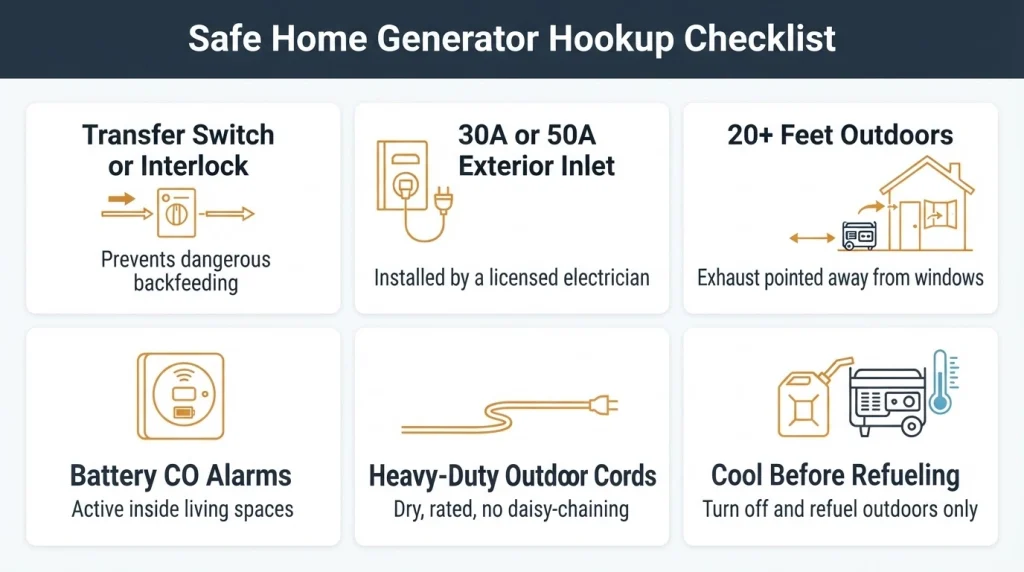
You connect an inverter generator safely through a transfer switch, a generator inlet, or an interlock kit. You never plug it straight into a wall outlet.
Backfeeding is dangerous. It can energize lines outside your home and put utility workers at risk.
It can also damage your generator and your home wiring. The safe path costs more up front, but it is the only path I recommend.
Use a transfer switch or interlock
A manual transfer switch lets you choose which circuits get generator power. An interlock kit does a similar job at your main panel.
Both stop the generator and the grid from feeding the panel at the same time. A licensed electrician should install either one.
Ask your electrician about a 30-amp or 50-amp inlet. The inlet size should match your generator and your load plan.
Place the generator outdoors
Run the generator outdoors, at least 20 feet from your home, with exhaust pointed away. Keep it away from windows, doors, and vents.
Carbon monoxide is colorless and odorless. It can build up fast in a garage, even with the door open.
Use battery CO alarms inside your home during an outage. The CDC and the U.S. Consumer Product Safety Commission both stress outdoor placement and CO alarms for portable generators.
Use the right cords and grounding
Use heavy-duty, outdoor-rated extension cords in good condition. Match the cord rating to the load.
Keep cords dry and out of walkways. Do not daisy-chain power strips on a generator.
Check your manual for grounding needs. Some inverter generators need a ground rod in certain setups, while others use a bonded neutral.
Your electrician can confirm what your hookup needs. Do not guess on grounding or neutral bonding.
For outage planning, this generator size guide for power outages pairs well with the hookup plan above. It helps you match your outage loads to a safe, practical size.
Safety note: Turn the generator off and let it cool before refueling. Store fuel outdoors in approved containers, away from heat and living spaces.
Section Takeaway: A transfer switch or interlock, outdoor placement, and the right inlet are what make home hookup safe.
Inverter vs conventional vs dual fuel for home backup
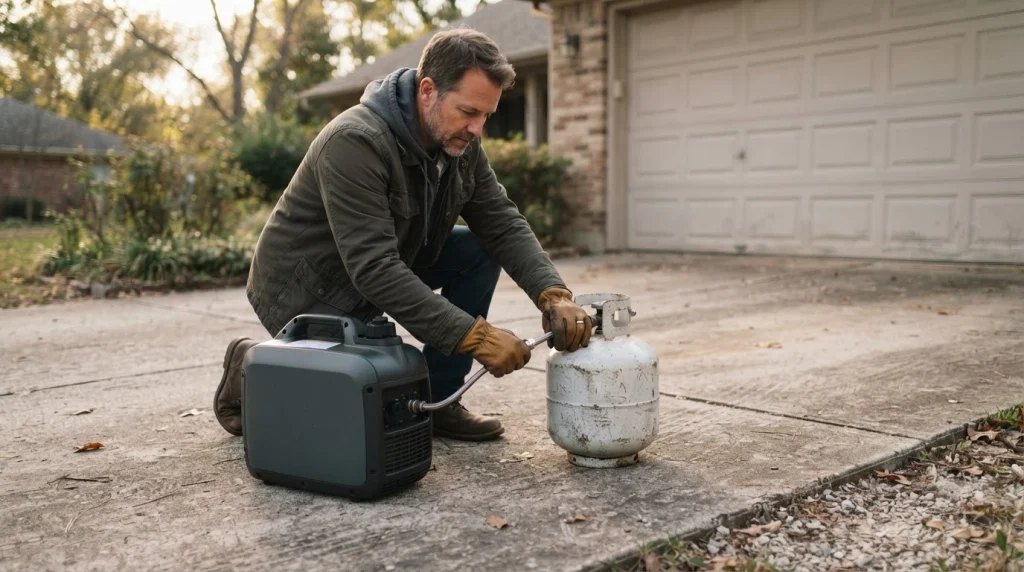
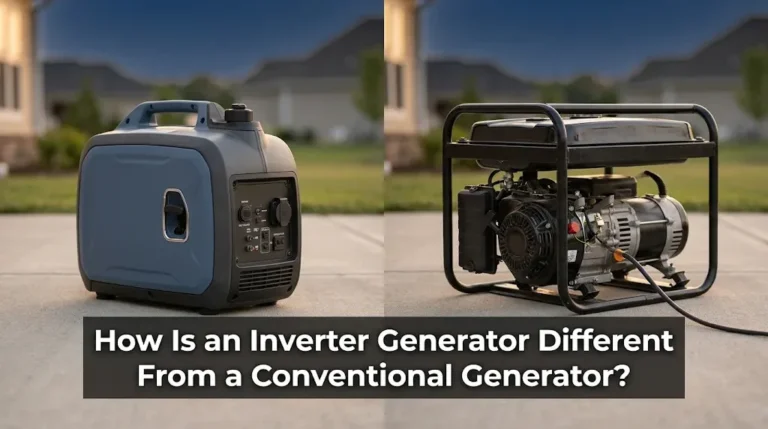
An inverter generator is usually the best fit for home backup when you need clean power and quieter running. A conventional generator can cost less per watt.
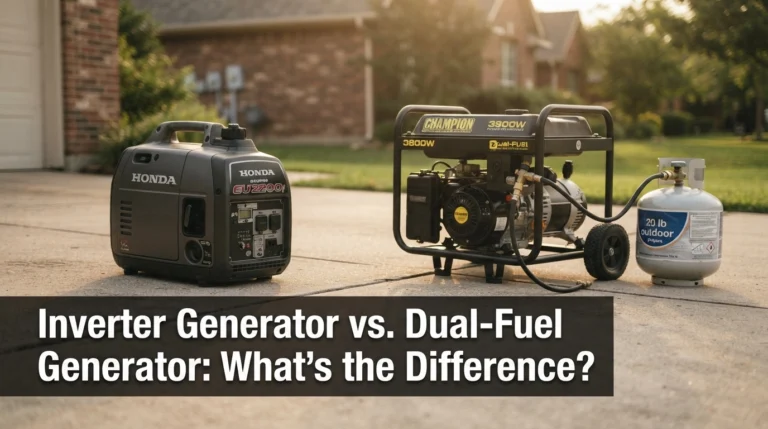
A dual-fuel model adds propane as a second fuel choice. That flexibility helps during long outages.
| Type | Best for | Trade-off |
|---|---|---|
| Inverter | Clean power, quieter, fuel-efficient at light loads | Higher cost per watt, fewer very large models |
| Conventional | Lower cost, high watts for tools and large loads | Louder, less stable power for sensitive electronics |
| Dual fuel | Gasoline or propane, easier long-term fuel storage | Slightly lower watts on propane, heavier |
Noise is a real factor in a neighborhood outage. Inverter models often run quieter at light loads because the engine speed can drop.
Conventional models often run at a fixed speed. That can mean more noise, even when the load is small.
Fuel efficiency matters too. Eco mode on an inverter generator can stretch runtime when loads are light.
Turn eco mode off for a large motor start. The engine needs full speed to handle the surge cleanly.
Total harmonic distortion, or THD, is another spec to check. Lower THD usually means cleaner power for electronics.
Many inverter models list THD under 3%. Check the spec sheet for your model, and do not trust a vague marketing claim.
Consumer Reports is a useful independent check for noise, runtime, and real-world performance before you buy. Compare its notes with the spec sheet, not with a sales page alone.
Section Takeaway: Choose an inverter for clean, quiet home backup, and choose dual fuel when propane storage and long outages matter most.
How long will it run, and how much fuel will you use?
Runtime depends on tank size, load, and eco mode. A generator rated for 10 hours at 25% load will run far less at 75% load.
That is why the spec sheet lists runtime at a set load. Always check the load level behind the number.
As a rough guide, a mid-size inverter generator may run 8 to 12 hours on a tank at light to moderate load. A larger unit under heavy load may run 6 to 9 hours.
Fuel use rises with load. Running at half load uses far less fuel per hour than running near full load.
Plan fuel for at least 24 to 48 hours of outage use. Store extra fuel safely, and rotate it so it does not go stale.
- Track load: Note which loads run together, and cut non-essentials at night.
- Use eco mode: Use it for light loads, and switch it off for motor starts.
- Refuel safely: Let the unit cool, refuel outdoors, and wipe up spills.
- Store fuel right: Use approved containers, add stabilizer if your manual allows it, and keep fuel away from living spaces.
Propane can store longer than gasoline. That is one reason dual-fuel models appeal to outage planners.
Natural gas is another option for fixed standby units. It needs a proper gas hookup and a licensed installer.
The U.S. Department of Energy offers general guidance on home energy and backup power planning. Use it to sanity-check your fuel and load plan.
Safety note: Never store fuel in a living space, and never run a generator in a garage, basement, or enclosed porch.
Section Takeaway: Runtime is a load question, not just a tank question — lighter loads and eco mode stretch every gallon.
What sizing mistakes should you avoid?
The most common mistake is buying by the headline number alone. A 9,500-watt peak rating is not 9,500 running watts.
Read the running watts first. Then check the starting watts, the outlet types, and the runtime at your load.
- Ignoring surge: Forgetting motor starts leads to trips and overload shutdowns.
- Adding every surge: Adding all starting watts together leads to an oversized, thirsty unit.
- Skipping 240V: Buying a 120V-only unit when your panel or well pump needs 240V.
- Running at 100%: Running flat out all day shortens life and leaves no room for a motor start.
- Forgetting fuel: Buying a big unit with no plan for fuel, storage, or refills.
- Skipping the hookup: Buying first, then learning the transfer switch costs more than expected.
Another mistake is trusting a single watt chart. Your fridge, pump, and AC may differ from the chart.
Use the chart to plan, then confirm with labels and manuals. A quick check with a plug-in watt meter can help for plug-in loads.
Do not use a watt meter on hard-wired loads. Leave those checks to a licensed electrician.
Break-in and maintenance matter too. Follow your manual for the first oil change and for regular oil, filter, and spark plug care.
Stale fuel is a top cause of hard starts. Run the unit monthly, or follow your manual’s storage steps.
The EPA also notes the value of proper maintenance and safe fuel handling for small engines. A clean, well-kept unit starts easier when you need it most.
Section Takeaway: Buy for running watts, confirm surge and outlets, and plan fuel and hookup before you checkout.
Frequently asked questions
What size inverter generator do I need for a 2,000 sq ft house?
Most 2,000 sq ft homes need 5,000 to 7,500 running watts for essentials, and 7,500 to 12,000 running watts for near-whole-home use. Your exact size depends on heat, cooling, well water, and electric appliances.
Can a 5,000-watt inverter generator run a house?
Yes, it can run many essentials, including a fridge, freezer, lights, furnace blower, and phones. It may not run a central AC, well pump, and water heater at the same time.
Can a 3,500-watt inverter generator run a house?
It can run a small set of essentials, such as a fridge, lights, phones, and a TV. It will struggle with a furnace blower, sump pump, or window AC at the same time.
Do I need a 240V inverter generator for my house?
You need 240V if you plan to feed a home panel, run a well pump, or power a large central AC. A 120V-only unit works best for extension cords and single-circuit loads.
Can I parallel two inverter generators to run my house?
Yes, if both models support parallel operation and you use the correct parallel kit. Check the combined running watts, and confirm the kit and outlets match your load plan.
How much bigger should my generator be than my load?
Add about 20% headroom above your running watts plus your largest surge. That margin helps with motor starts, forgotten loads, and hot-weather performance.
Is it safe to run an inverter generator overnight?
It can be safe outdoors with a proper hookup, enough fuel, and working CO alarms inside. Keep it at least 20 feet from the home, and check oil and fuel before a long run.
Start with your load list, not with a sales page. Add running watts, add the largest surge, and add 20% headroom.
Then match that number to a generator with the right outlets, clean power, and a safe hookup. That is how you buy once, and buy right, in 2026.

Hi, I’m Michael Turner. I own a generator workshop in the United States and founded HomeGeneratorBlog to share practical, hands-on guidance about generator installation, maintenance, troubleshooting, safety, and backup power solutions. My goal is to help homeowners make smarter, more confident decisions through clear and reliable information