What Is Inside an Inverter Generator? Parts Explained
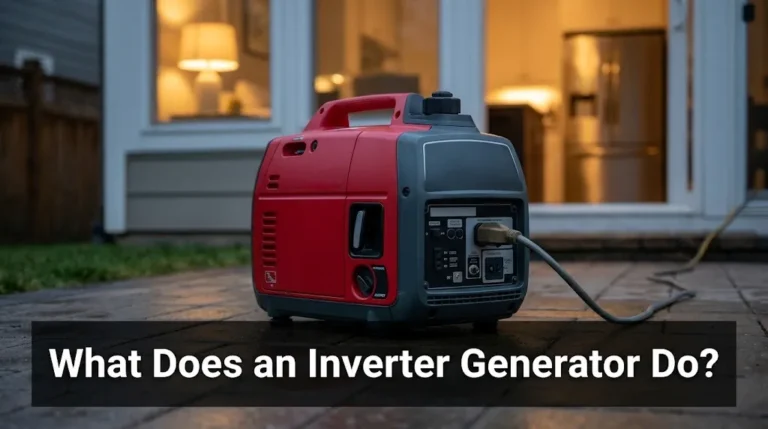
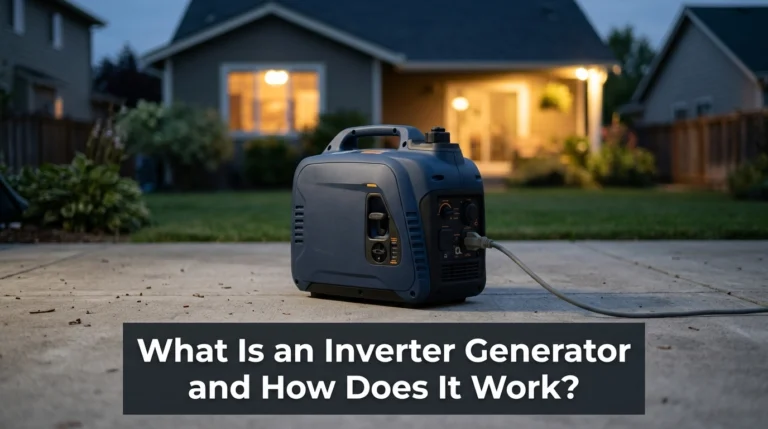
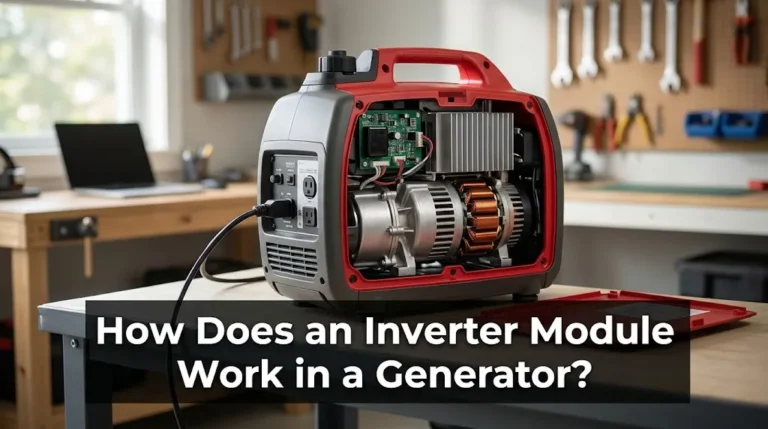
Inside an inverter generator are a small fuel engine, an alternator, a rectifier, an inverter module, a control board, and a set of safety sensors. Together, they turn fuel into clean, steady 120-volt power for laptops, fridges, and other sensitive equipment.
Open the side cover and you will not find one big mysterious box. You will find a compact engine on one side, a set of spinning electrical parts in the middle, and a flat panel of electronics doing the quiet work that makes the power usable. Each part has a clear job. When one fails, the symptom usually points straight back to it.
This guide walks through those parts in the order power flows through them. It also covers the parts most guides skip: cooling, exhaust, outlets, and the safety switches that shut the unit down before a small problem becomes a dangerous one.
Inside at a Glance
Use this table as a map. The sections below explain each row in plain language.
| Part | What it does | What you notice when it works |
|---|---|---|
| Engine | Burns fuel and spins a shaft | Steady sound, no surging |
| Fuel and air system | Stores fuel, mixes it with air, and feeds the engine | Easy starts and stable running |
| Alternator | Turns spinning motion into raw electricity | Power is available, even if it is still rough |
| Rectifier | Changes raw alternating current (AC) into direct current (DC) | Nothing visible, but the next stage can work |
| Inverter module | Rebuilds DC into clean, stable AC | Sensitive electronics run without flicker or resets |
| Control board | Watches load and adjusts engine speed | The engine quiets down under a light load |
| Cooling and exhaust | Moves heat and exhaust away from the engine | Lower noise and no overheating shutdown |
| Control panel and outlets | Lets you start, monitor, and connect loads safely | Clear readings and working breakers |
| Safety sensors | Stop the engine for low oil, overload, or carbon monoxide (CO) | A shutdown that protects the engine and the people nearby |
If you are still choosing a unit, this parts map pairs well with an inverter portable generator buying guide. The buying questions make more sense once you know which part answers each one.
How Does Power Flow Through an Inverter Generator?
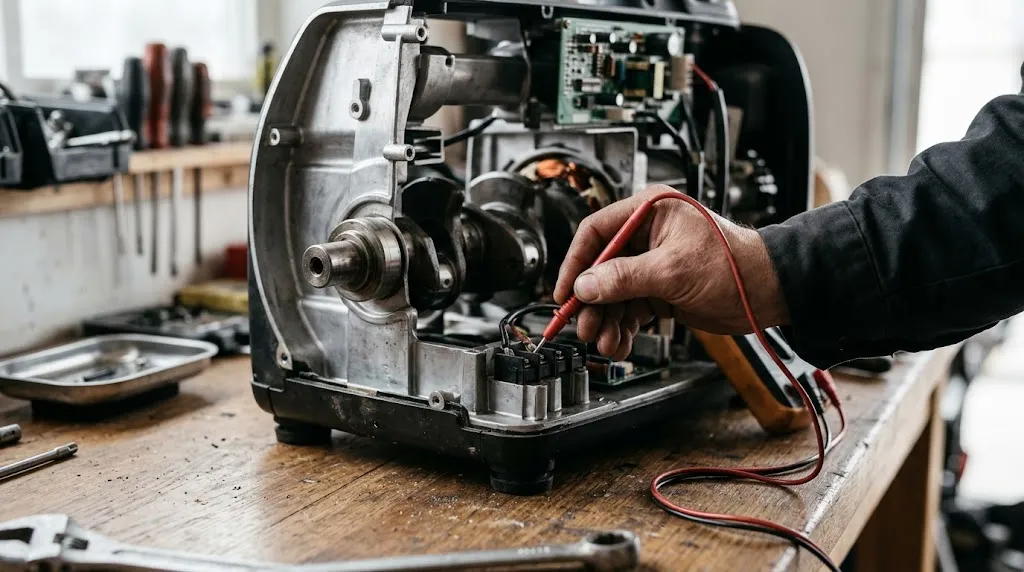
Power does not go straight from the engine to your wall outlet. It takes a detour, and that detour is the whole point.
- Fuel and air enter the engine, burn, and push a piston up and down.
- The piston turns a crankshaft, which spins the alternator.
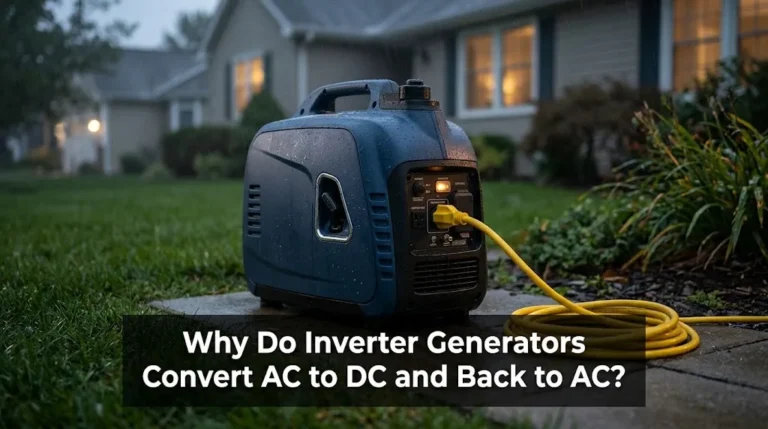
- The alternator produces raw AC power. At this stage, the voltage and frequency can swing with engine speed.
- A rectifier converts that raw AC into DC power.
- Capacitors smooth the DC power, like a small reservoir smoothing a pulsing water flow.
- The inverter module switches that DC power back into AC, this time at a controlled voltage and frequency.
- Filters clean up the rebuilt waveform before it reaches the outlets.
That AC-DC-AC path is why an inverter generator can slow its engine down under a light load. A conventional generator must hold about 3,600 RPM to keep 60-hertz output. An inverter generator does not. Its electronics rebuild the output, so the engine only needs to spin fast enough to supply the power being used.
The Engine: The Muscle
Most portable inverter generators use a small, single-cylinder, four-stroke engine. Four-stroke means the engine has separate intake, compression, power, and exhaust strokes, and it runs on straight fuel, not a fuel-and-oil mix. Many are overhead-valve engines, which puts the valves in the cylinder head and helps keep the unit compact and efficient.
Inside that engine you will find the usual suspects: a piston, a crankshaft, valves, a spark plug, and an oil sump. The spark plug ignites the fuel-air mixture. The oil lubricates moving parts and carries some heat away. Skip oil changes and the engine wears faster, runs hotter, and can seize. That is not a theory. It is the most common expensive failure I see on neglected units.
Engine size is measured in cubic centimeters (cc). A small camping unit might use a 79cc or 98cc engine. A mid-size home backup unit might use a 212cc or 224cc engine. Larger cc does not automatically mean better power quality. It means more mechanical capacity to spin the alternator under load.
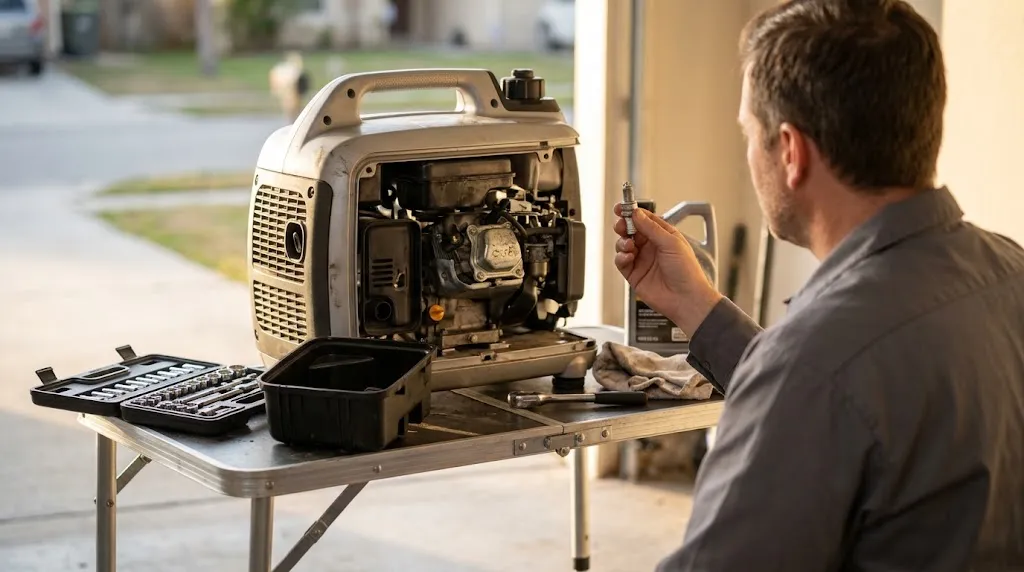
The first time I pulled the side cover off a neighbor’s dead 2,200-watt unit, I expected a fried inverter. It was a clogged air filter and a fouled plug, and the whole fix took twenty minutes. Start with the simple engine parts before you blame the electronics.
The Fuel and Air System
Fuel starts in the tank, passes through a fuel valve or petcock, and reaches either a carburetor or a fuel injector. A carburetor mixes fuel and air using vacuum and small jets. Fuel injection sprays a measured amount of fuel into the intake. Fuel injection tends to start more easily in cold weather and handle stale fuel a little better, but both systems hate old gasoline.
The air filter sits in the intake path. Its job is simple: keep dust out of the cylinder. A dirty filter starves the engine of air, makes it run rich, and can cause surging, hard starts, and black smoke. Clean it on the schedule in your manual. In dusty conditions, check it sooner.
Dual-fuel models add a propane regulator and a fuel selector. Propane enters as a gas, so there is no carburetor bowl to gum up on that fuel. The regulator drops tank pressure to a level the engine can use. Tri-fuel models add a natural gas connection as well. The engine itself stays the same. The fuel delivery path changes.
Ethanol-free fuel and fuel stabilizer help when a unit sits for months. Gasoline breaks down, absorbs moisture, and leaves varnish in small jets. That varnish is why so many generators fail to start after a long, quiet summer.
The Alternator: Rotor and Stator
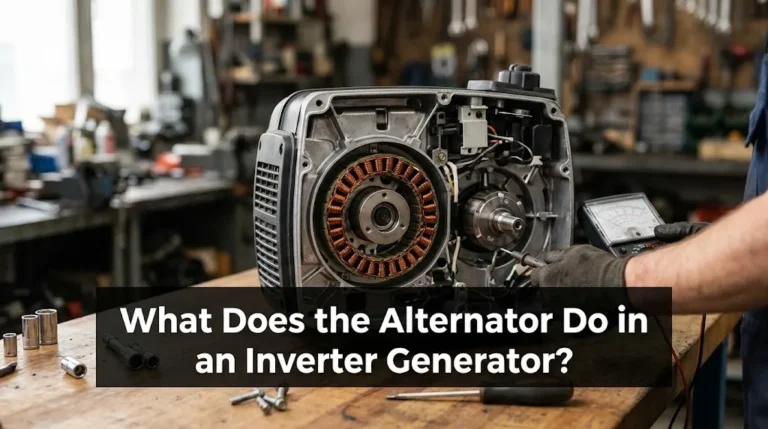
The alternator is sometimes just called the generator head. It has two main parts. The rotor spins with the engine shaft. The stator stays still around it. As the rotor’s magnetic field sweeps past the stator windings, it induces an electric current. That is electromagnetic induction, the same basic idea behind large power plants, just shrunk to fit in a suitcase.
Many inverter generators use a brushless, permanent-magnet alternator. Permanent magnets mean there are no brushes to wear out and replace. Brushless designs also tend to be lighter and more compact, which is one reason inverter models can be smaller than open-frame units with similar output.
On some Honda models, the alternator is combined with the engine flywheel. That integration saves space and weight. It also means the alternator is not a separate bolt-on part you can casually swap. Your manual will show whether your model uses that layout.
Raw alternator output in an inverter generator is often high-frequency, multi-phase AC. It is not meant to go straight to your fridge. It is raw material for the rectifier and inverter to refine.
The Rectifier: Why Change AC to DC First?
Changing AC to DC first sounds wasteful. Why not use the alternator power directly? Because raw power follows the engine. Speed up, slow down, add a load, drop a load, and the raw waveform changes. A rectifier breaks that link.
A rectifier uses diodes, which act like one-way valves for electricity. Current can flow through in one direction but not the other. Arranged in a bridge, diodes flip the negative half of the AC waveform so the output flows in one direction. The result is DC, but it is still pulsing. Capacitors then smooth those pulses into a steadier DC supply.
Think of it as a staging area. The rectifier and capacitors hold a usable pool of DC power. The inverter can then draw from that pool and rebuild a precise AC waveform, no matter whether the engine is idling along or working hard.
The Inverter Module: The Part That Gives It Its Name
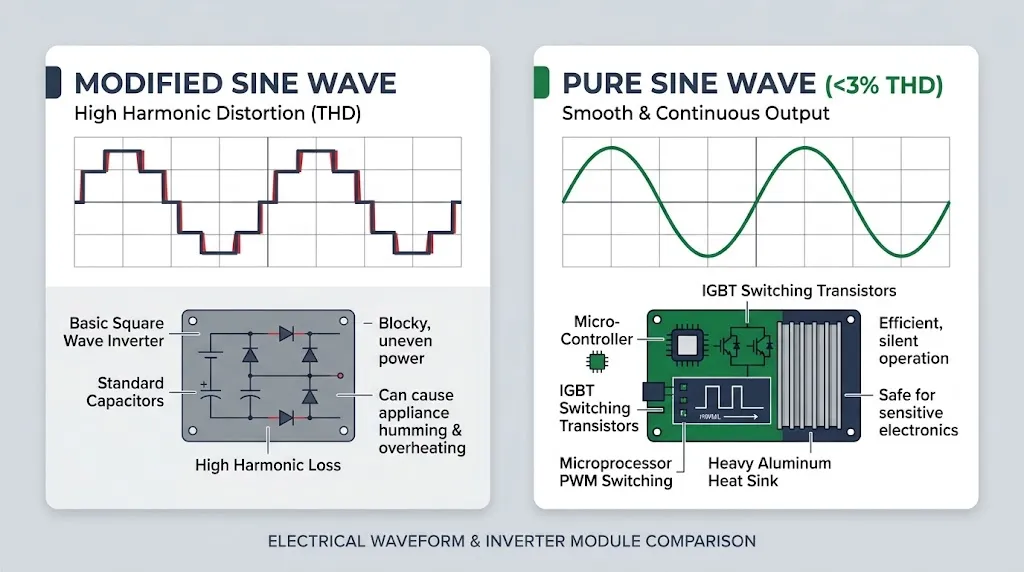
The inverter module is a flat assembly of circuit boards, heat sinks, and power transistors. Those transistors, usually IGBTs or MOSFETs, switch on and off thousands of times per second. By varying the width of those pulses, a technique called pulse-width modulation, the module shapes an average voltage that traces a smooth sine wave.
A sine wave is the smooth, rolling shape of normal household power. A pure sine wave inverter rebuilds that shape closely. A modified sine wave is blockier, with abrupt steps. Most quality inverter generators aim for a pure sine wave, and many keep total harmonic distortion (THD) under 3 percent. THD is a measure of how much unwanted harmonic energy is mixed into the output. Lower is cleaner. High THD can overheat motors, buzz in audio gear, and confuse microprocessor controls in modern appliances.
Heat sinks matter here. Those switching transistors generate heat, especially under a heavy load. A large aluminum heat sink, good airflow, and a cooling fan keep the module inside its safe temperature range. Block the vents and you are not just making the unit louder or hotter. You are shortening the life of its most expensive electronic part.
Honda describes this same process in its inverter explanation: the alternator produces AC, it is converted to DC, and the inverter converts it back to AC while a microprocessor controls both the process and engine speed. You can read that manufacturer overview in Honda’s guide to what an inverter generator is. For a plain-English look at a well-built inverter generator, the inverter module is the feature to compare first, not just the wattage sticker.
The Control Board and Eco Mode
The control board is the brain. A microprocessor reads load, voltage, and engine speed, then tells the throttle how fast to run. In eco mode, sometimes called economy mode, that control loop becomes the star of the show.
With eco mode on and only a phone charger plugged in, the engine drops to a low idle. Plug in a fridge and the compressor kicks on, and the board raises engine speed within a second or two. That is why inverter generators can run much longer on a small tank at light load. They are not burning full-throttle fuel for a trickle of power.
Eco mode has limits. A large motor starting up, like an air conditioner compressor, needs a surge of power. If eco mode is on and the engine is idling low, the unit may stumble or trip before it can ramp up. Many manuals suggest turning eco mode off for heavy motor loads. That advice is worth following. It is not a defect. It is physics meeting a throttle delay.
The control board also handles overload protection, low-oil shutdown, and, on many models, CO shutdown. It reads sensors, makes a decision, and either warns you or stops the engine. When a unit shuts down for no obvious reason, the control board is often just doing its job.
Cooling, Exhaust, and Noise Control
Small engines make a lot of heat in a small box. Air-cooled models use fins on the cylinder head, a fan on the flywheel, and ducted airflow to carry heat out. Enclosed, suitcase-style models add sound insulation and carefully routed vents. Open-frame inverter models have more airflow but less sound damping.
The exhaust path includes an exhaust pipe, a muffler, and, on many models, a spark arrestor. The muffler quiets the sharp exhaust pulses. The spark arrestor is a fine screen that catches hot carbon particles before they can start a fire in dry grass or leaves. Remove it and you gain nothing noticeable in power. You lose a real fire safeguard, and you may break local rules for use on public land.
Noise control is a system, not a single part. Enclosure panels absorb sound. Rubber mounts reduce vibration transmitted to the frame. A slower engine in eco mode is quieter than the same engine at full throttle. That is why two units with the same wattage can sound very different at a campsite. The quiet one is usually the one whose engine, enclosure, and control board are working together.
The Control Panel, Outlets, and Parallel Ports
The control panel is the part you actually touch. A typical panel includes a start switch or recoil starter, an eco-mode switch, indicator lights, and a set of outlets. Indicator lights may show power, overload, and low oil. A digital display, where fitted, may show voltage, frequency, load level, and total running hours.
Outlets vary by model. Most have standard 120-volt household duplex outlets. Many add a 12-volt DC outlet and USB ports for direct charging. RV-ready models add a TT-30 outlet, which is a 30-amp RV plug. Larger models may add a twist-lock outlet for higher loads. Each outlet sits behind a circuit breaker. The breaker trips when current exceeds a safe level, protecting the wiring and the inverter module.
Parallel ports let you connect two compatible inverter generators with a special cable or kit. The two units sync their output and share the load, giving you roughly double the power without buying one huge machine. That only works with compatible models and the correct parallel kit. Mixing brands or mismatched units is not a safe shortcut. If parallel use matters to you, check models with parallel capability before you buy, and use the kit your manual specifies. A search for an inverter generator parallel kit should start from your exact model, not just the wattage.
Starting systems also live here. Recoil start is a pull cord. Electric start adds a small starter motor and a battery. Some larger models add remote start. That starter battery is small. It is not a backup power battery. It only cranks the engine.
Safety Parts You Should Not Bypass
Safety note: Never run a fuel-powered generator indoors, in a garage, or in an enclosed shed, even with a door open. Carbon monoxide is colorless and odorless, and it can build up fast. Keep the unit outdoors, at least 20 feet from doors, windows, and vents, with exhaust pointed away from the house.
Do not bypass a CO sensor, low-oil switch, or overload breaker to keep a unit running. Those parts shut the unit down for a reason. Fix the cause, or stop and get help.
Key safety parts include:
- CO sensor and shutoff: Measures carbon monoxide near the unit and stops the engine before levels become dangerous. Keep its vents clear and test it as your manual describes.
- Low-oil sensor: Stops the engine when oil drops too low. Check oil on level ground, with the engine off and cool.
- Overload breaker: Trips when you draw more current than the unit can safely supply. Reset it only after you unplug the excess load.
- GFCI outlets: Ground-fault circuit interrupter outlets cut power fast if current leaks through an unintended path, such as wet skin or a damaged cord.
- Grounding terminal: A bolt or nut on the frame for connecting a grounding wire where your manual or local code requires it.
- Spark arrestor: Catches hot particles in the exhaust. Clean it when it clogs, or the engine can lose power and overheat.
Honda’s CO-MINDER system is one example of this approach. It monitors CO levels and shuts the engine down before detected levels near the generator become dangerously high. You can see how Honda frames that protection in its inverter generator advantages guide. Other brands use different names, but the principle is the same. If your model has CO shutoff, learn its warning lights before an outage. Models with CO shutoff are worth comparing if you will run a unit near a home, cabin, or RV.
What Is Not Inside an Inverter Generator?
This is where confusion creeps in. A standard fuel-powered inverter generator does not contain a large lithium battery. It makes power as long as it has fuel. A portable power station, by contrast, stores power in a battery and has no fuel engine. It can run indoors. A fuel generator cannot.
A portable inverter generator also does not contain a transfer switch. A transfer switch is a separate device, installed by an electrician, that safely connects a generator to your home wiring and prevents backfeeding into the grid. Backfeeding can electrocute utility workers. Never plug a generator into a household outlet to power the house. That is not a clever workaround. It is a known, dangerous mistake.
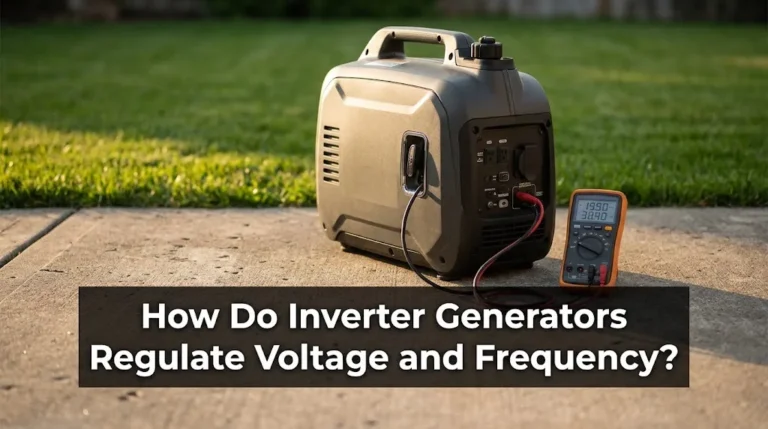
Finally, most portable inverter generators do not contain an automatic voltage regulator in the old sense. The inverter module and control board have taken over that job. They regulate voltage and frequency electronically, rather than relying on a separate regulator to smooth a fixed-speed alternator output.
What Breaks First? A Symptom Map
Competitor guides often list parts and stop. The more useful question is which part to check first when something goes wrong. Use this map as a starting point, then follow your manual.
| Symptom | Check this part first | Why |
|---|---|---|
| Will not start | Fuel, spark plug, air filter, oil level | Stale fuel and a fouled plug cause most no-starts |
| Surging or hunting | Carburetor jets, air filter, throttle linkage | A lean fuel mixture makes engine speed hunt up and down |
| Engine runs, no power output | Breakers, inverter module, outlet wiring | A tripped breaker is cheap. An inverter fault is not |
| Shuts down after a few minutes | CO sensor area, oil level, cooling vents, overload | Safety sensors stop the engine before damage or danger builds |
| Louder than usual | Muffler, enclosure panels, eco-mode setting | A loose panel or a failed muffler changes sound fast |
Do not open the inverter module housing to probe live circuits. Capacitors can hold a charge after shutdown, and the module is not a user-serviceable part on most models. If breakers are fine, fuel is fresh, and the engine runs but produces no power, that is a service-shop problem, not a driveway experiment.
Should You Open It Yourself?
Basic checks are fine for most owners: oil level, air filter, spark plug, fuel valve, and visible vents. Keep the engine off and cool. Disconnect the spark plug wire before you work near moving parts. Take a photo before you remove a cover, so every screw and panel goes back where it belongs.
Stop and get professional help if you see melted wiring, a burnt smell from the inverter housing, fuel leaking near hot parts, or repeated breaker trips with no load connected. Those signs point to an electrical fault, not a maintenance task. A licensed electrician is also the right call for any home wiring connection. Portable outlets are for extension cords and direct plug-in loads, unless your home has a proper transfer switch or interlock installed to code.
For storage, a cover helps, but only when the unit is off and cool. Running a generator under a cover traps heat and exhaust. If you want to protect the unit between outages, see a guide to inverter generator covers, and never use a storage cover as a running shelter.
Conclusion
An inverter generator is an engine, an alternator, a rectifier, an inverter module, and a control board working as one system. The engine makes raw power. The electronics clean it. The sensors keep it safe. Remember that order, and troubleshooting gets much simpler.
Before your next outage, check oil, fuel, and air filter, then confirm the outlets and breakers work under a small load. That is the check I run first in my own workshop, and it is the one Michael Turner would start with on any unit that has sat too long.
If you want to see how these parts come together in a real unit, a portable inverter generator is a solid option to compare for home backup, RV use, and sensitive electronics. Look for clean sine wave output, eco mode, and CO shutoff, not just the biggest wattage number.
Frequently Asked Questions
What is the main difference between an inverter generator and a regular generator inside?
A regular generator sends alternator power straight to the outlets. An inverter generator adds a rectifier and an inverter module. Those parts convert the power to DC and rebuild it as clean, stable AC, which is why inverter output is safer for sensitive electronics.
Does an inverter generator have a battery inside?
Most fuel-powered inverter generators do not have a large power-storage battery. Some electric-start models have a small starter battery that only cranks the engine. A portable power station is different. It stores energy in a large battery and has no fuel engine.
What does the inverter module actually do?
The inverter module takes smoothed DC power and switches it rapidly to rebuild AC power at a controlled voltage and frequency. Pulse-width modulation shapes those pulses into a smooth sine wave. Filters then remove leftover electrical noise before the power reaches the outlets.
Why does my inverter generator slow down when the load is light?
That is eco mode working as designed. The control board senses a light load and lowers engine speed to save fuel and reduce noise. When load rises, the board raises engine speed again. Turn eco mode off for large motor loads that need a fast surge of power.
What should I check first if the engine runs but there is no power?
Check the circuit breakers first, then unplug all loads and reset them. Next, check for an overload light and confirm you are using the correct outlet. If breakers are fine and the engine still produces no output, do not open the inverter module. Take the unit to a qualified service shop.

Hi, I’m Michael Turner. I own a generator workshop in the United States and founded HomeGeneratorBlog to share practical, hands-on guidance about generator installation, maintenance, troubleshooting, safety, and backup power solutions. My goal is to help homeowners make smarter, more confident decisions through clear and reliable information