How Is an Inverter Generator Different From a Conventional Generator?
Quick Answer
An inverter generator rebuilds its power into a clean sine wave, while a conventional generator sends raw power straight from the engine to the outlet. That one change affects power quality, noise, fuel use, size, and price.
The short version
- Power quality: Inverters usually hold total harmonic distortion (THD) under 3%, while conventional models often run 10 to 25%.
- Engine speed: An inverter slows down at light loads, while a conventional generator holds about 3,600 RPM all the time.
- Noise and fuel: The slower engine makes inverters quieter and thriftier.
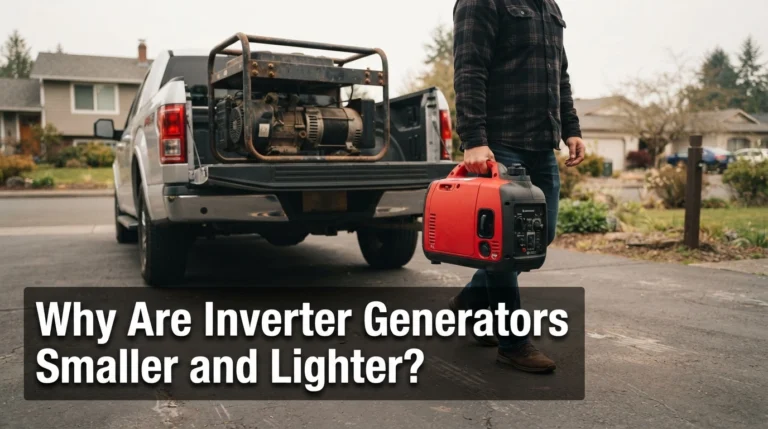
- Size and weight: Inverters are usually smaller and lighter at the same wattage.
- Price and power: Conventional models cost less per watt.
Pick fast
- Choose an inverter for phones, laptops, a CPAP, a fridge, camping, or an RV.
- Choose a conventional generator for big, tough loads on a tight budget, like a job site or a large well pump.
I have run both types through multi-day outages, quiet campsites, and job sites. The difference shows up fast, and it is not just the price tag.
This guide covers how each type makes power, what that means for your gear, and which one fits your home, RV, or campsite.
In This Guide
- What Is an Inverter Generator?
- What Is a Conventional Generator?
- Inverter vs Conventional Generator: What Is the Core Difference?
- How Does Power Quality Compare? THD and Clean Power
- How Do Noise, Fuel Use, and Runtime Compare?
- What Size Do You Need, and What Can Each Type Run?
- Which Generator Should You Buy for Home, RV, and Camping?
- How Do You Run Either Type Safely?
- Frequently Asked Questions
- The Bottom Line
What Is an Inverter Generator?
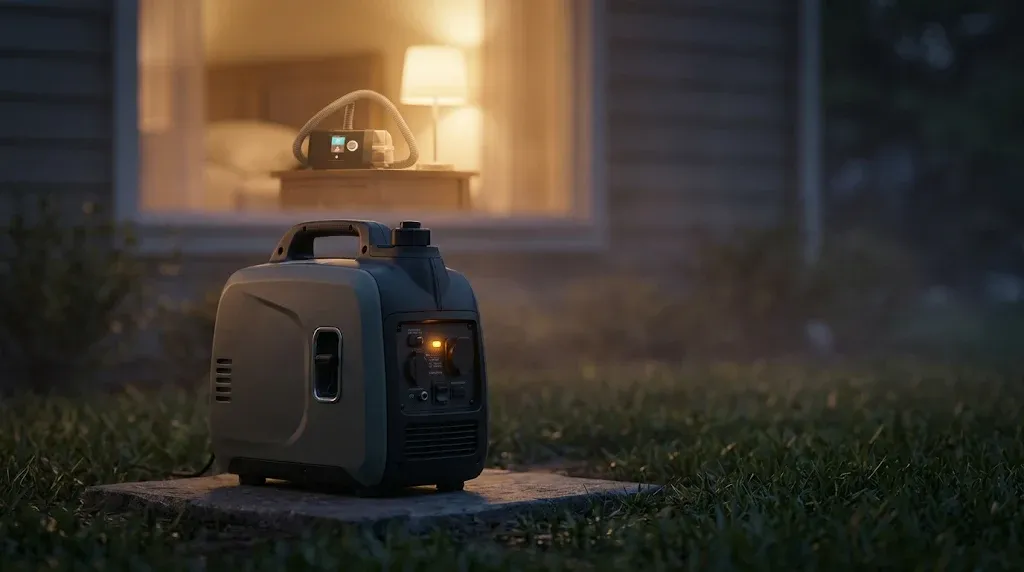
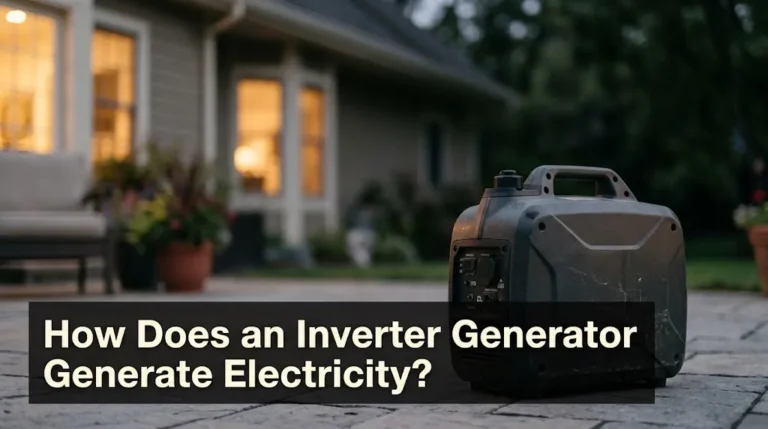
An inverter generator is a portable power source that makes raw power, turns it into direct current (DC), and then rebuilds it as clean alternating current (AC). That rebuild is the whole point of the design.
How does an inverter generator make power?
Power takes three steps inside the machine.
- The engine spins an alternator, which makes raw, high-frequency AC power.
- A rectifier turns that raw AC into DC, which gives the electronics a clean slate.
- The inverter module rebuilds the DC as a steady 120-volt, 60-hertz sine wave, the same shape as power from a wall outlet.
A microprocessor watches the load and sets the engine speed to match it. A phone charger gets a quiet idle, while a fridge gets more throttle.
That speed control is called eco mode on most models. Flip it on, and the engine slows down when demand drops.
I first saw the payoff during a three-night outage at home. My inverter idled through the night on a fridge, a CPAP, and a few lights, and the house stayed quiet enough to sleep.
Section takeaway: An inverter generator trades a simple design for smart electronics, and you get clean power, a quieter engine, and better fuel use at light loads in return.
What Is a Conventional Generator?
A conventional generator, also called an open-frame generator, makes AC power straight from the engine and sends it to the outlet with no rebuild step. It is the older, simpler design, and it still does plenty of jobs well.
The engine spins the alternator at a fixed speed, about 3,600 revolutions per minute (RPM) for 60-hertz power. That speed never drops, even when you plug in only a phone charger.
Why do conventional generators run at full speed?
Frequency depends on speed in this design. Slow the engine, and the frequency drops with it.
Your lights would flicker and motors would strain. So the governor holds the engine at full speed no matter what the load is.
Where this design wins is raw watts per dollar. A big open-frame model can run a well pump, a large air conditioner, or a full set of power tools for far less than an inverter of the same size.
Section takeaway: A conventional generator is simple, strong, and cheap per watt, but it pays for that simplicity with fixed speed, rougher power, and more noise.
Inverter vs Conventional Generator: What Is the Core Difference?
The core difference is how each type handles the link between engine speed and power quality. An inverter breaks that link with electronics, while a conventional generator keeps it.
| Feature | Inverter Generator | Conventional Generator |
|---|---|---|
| How power is made | AC to DC, then rebuilt as clean AC | Raw AC straight to the outlet |
| Engine speed | Varies with load | Fixed near 3,600 RPM |
| Power quality (THD) | Usually under 3% | Often 10 to 25% |
| Noise | Quieter, especially at light load | Louder at every load |
| Fuel use at light load | Lower, thanks to eco mode | Higher, since speed never drops |
| Size and weight | Smaller and lighter at the same watts | Bigger and heavier, open frame |
| Cost per watt | Higher | Lower |
| Best for | Electronics, camping, RVs, home backup | Big tools, pumps, and budget power |
For the fuller head-to-head, see our generator vs inverter comparison. It covers the same split from the buying side, with more on cost and size.
Section takeaway: Inverters win on clean power, quiet running, and light-load fuel use, while conventional generators win on watts per dollar and simple, rugged power.
How Does Power Quality Compare? THD and Clean Power
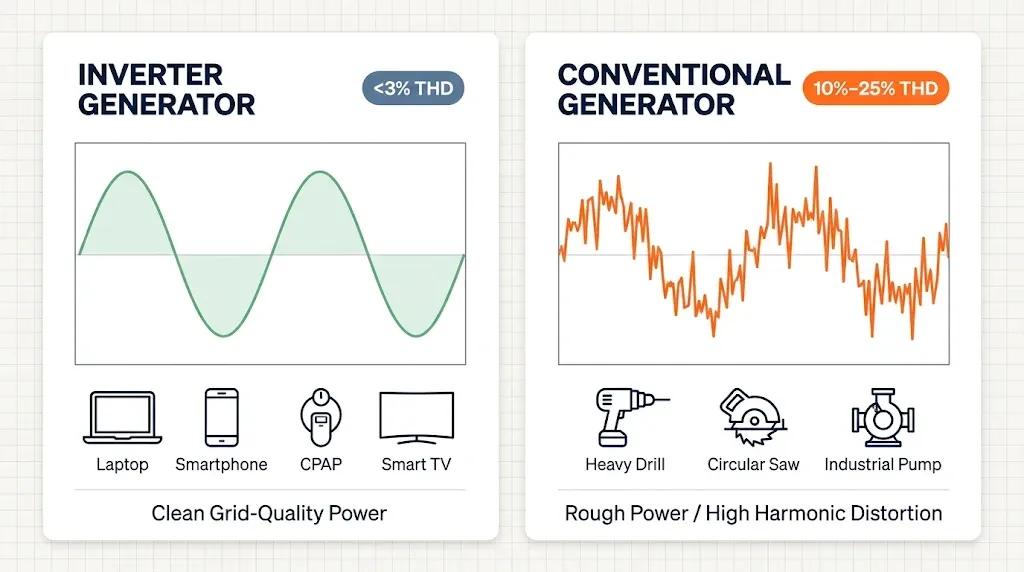
Power quality comes down to the shape of the wave. A clean sine wave rises and falls smoothly, like power from the grid.
THD, or total harmonic distortion, measures how far a wave strays from that smooth shape. Lower THD means cleaner power and happier electronics.
Quality inverter generators usually hold THD under 3%. Conventional generators often run 10 to 25%, though some sources list 6 to 25% for conventional models, so the range varies by model and source.
That gap matters most for sensitive gear. Laptops, phones, modern fridges, furnace controls, and a CPAP all prefer a steady sine wave.
Rough power can cause buzzing or overheating in those devices. A cheap conventional unit once made my window air conditioner surge on startup, and I shut it down rather than risk the compressor.
Which devices need clean power?
Use an inverter for anything with a circuit board or a sensitive motor.
- Laptops, phones, tablets, and their chargers.
- CPAP machines and other small medical devices.
- Modern fridges, furnace blowers, and variable-speed motors.
- TVs, game consoles, and audio gear.
Check the spec sheet before you buy, and look for a stated THD figure. If a maker does not publish one, treat that as a warning sign.
If clean power is your main concern, our roundup of low-THD portable generators narrows the field to models built for it.
Section takeaway: Under 3% THD is the inverter standard, 10 to 25% is the conventional norm, and that gap decides which of your devices each type can safely run.
How Do Noise, Fuel Use, and Runtime Compare?
Noise is where most owners feel the difference first. An inverter at light load hums, while a conventional unit roars.
Many small inverters are rated near 50 to 60 decibels at quarter load. Many open-frame conventional models are rated near 70 decibels or higher at the same load, so check the spec sheet for the exact figure.
Fuel use follows the same split. An inverter slows down when demand drops, so it burns less fuel overnight on a fridge and a few lights.
A conventional generator burns fuel at full speed even when the load is tiny. At 25% load, a small inverter often runs 8 hours or more on one tank, while a conventional model runs fewer hours on the same fuel.
What about runtime at light load?
Eco mode is the key, and it works best when loads stay small and steady.
- Turn eco mode on for overnight loads like a fridge, a CPAP, and lights.
- Turn it off for big motors, since a slow engine can lag on startup.
- Top up with fresh fuel, since stale gasoline clogs carburetors.
Fuel choice matters too. Gasoline is easy to find but goes stale in months, while propane stores for years and burns cleaner.
Dual-fuel and tri-fuel models let you switch fuels without buying a second machine.
The U.S. Department of Energy and the Environmental Protection Agency both publish guidance on fuel use and emissions that is worth a read before you stock up.
Safety note: Store fuel outdoors in approved containers, away from the generator and any ignition source, and never refuel a hot or running generator.
Section takeaway: Inverters are quieter and thriftier at light loads because the engine slows down, while conventional generators hold full speed and full noise no matter how small the load is.
What Size Do You Need, and What Can Each Type Run?
Size starts with two numbers, not one. Running watts are what a load needs to keep going, and starting watts are the short surge a motor needs to get moving.
A fridge may need 700 running watts and 2,100 starting watts. Size for the surge, or the generator will trip just when the compressor kicks in.
Here is a worked example from a real outage night: a fridge at 700 running watts, a CPAP at 90 watts, LED lights at 60 watts, and phone chargers at 20 watts.
Running watts totalled 870, which is 700 plus 90 plus 60 plus 20. The fridge surge adds about 1,400 watts over its running draw, so the peak hit about 2,270 watts.
A 2,000-watt inverter would trip on that peak, while a 3,000-watt inverter would handle it. That is why the peak, not the running total, picks the size.
| Appliance | Typical Running Watts | Typical Starting Watts |
|---|---|---|
| Refrigerator | 700 | 2,100 |
| Window air conditioner | 1,000 | 2,200 |
| Sump pump | 800 | 1,300 |
| Furnace blower | 800 | 1,400 |
| CPAP machine | 90 | 90 |
| Laptop and phone chargers | 80 | 80 |
These are typical figures, not spec-sheet numbers. Check the label on your own appliance, since real draws vary by brand and age.
As a rule of thumb, a 2,000-watt inverter covers lights, chargers, a CPAP, and a small fridge if you stagger the starts. Whole-home backup usually needs a larger conventional unit or a standby generator with a transfer switch.
For gear that hates rough power, see our guide to generators for sensitive electronics. It lists what to look for beyond the wattage number.
Section takeaway: Add up running watts, then add the biggest motor surge on top, and buy for that peak, not for the running total alone.
Which Generator Should You Buy for Home, RV, and Camping?

The right type depends on where you will use it and what you will plug in. Start with the use case, then pick the size.
For home backup during outages
Pick an inverter if you run a fridge, a CPAP, phones, and lights. Clean power protects the gear you cannot afford to lose.
Pick a conventional generator if you need big watts on a budget, like a well pump or a large air conditioner. Keep sensitive electronics on a separate inverter instead.
For RV and camping trips
Pick an inverter almost every time. Campgrounds often set noise limits, and neighbours will thank you for the quieter engine.
Look for parallel capability if you run an RV air conditioner. Two small inverters are easier to lift than one heavy conventional unit.
For job sites and heavy tools
Pick a conventional generator for saws, compressors, and welders. These loads are tough, they surge hard, and they do not need clean power.
Price follows the same pattern. Expect an inverter to cost roughly twice as much as a conventional model at the same wattage, as of 2026.
Our inverter generator buying guide walks through size, outlets, and parallel kits in more detail once you know your use case.
Section takeaway: Buy an inverter for electronics, camping, and RV life, and buy a conventional generator for big, tough loads where clean power and quiet running matter less.
How Do You Run Either Type Safely?
Safety rules do not change between the two types. Clean power is safer for your gear, not safer for your lungs.
Both types make carbon monoxide, a colourless and odourless gas that can kill in minutes. Every generator belongs outdoors.
Run it at least 20 feet from your home, with the exhaust pointing away from the house. Keep it clear of windows, doors, and vents, and never run it in a garage.
Fit battery-powered CO alarms on every level of your home, and test them before storm season. The CDC carbon monoxide guidance and the Consumer Product Safety Commission both stress the same 20-foot, outdoor-only rule.
For home hookups, use a transfer switch or an interlock kit installed by a licensed electrician. Never backfeed power through a household outlet, since it can energise lines workers believe are dead.
Our carbon monoxide safety guide covers placement, alarms, and CO shutoff features.
Safety note: Run generators outdoors and well away from windows, doors, and vents, use a transfer switch or interlock installed by a licensed electrician, and check your owner’s manual before use.
Section takeaway: Place any generator outdoors at least 20 feet from home, fit CO alarms, and connect to the house only through a transfer switch or interlock fitted by a licensed electrician.
Frequently Asked Questions
Can a conventional generator damage electronics?
Yes, since rough power with high THD can stress circuit boards and sensitive motors. Laptops, phones, and modern appliance controls are most at risk, so use an inverter for them.
Can an inverter generator run a refrigerator?
Yes, most 2,000-watt and larger inverters can run a standard fridge, but you must cover the starting surge. A typical fridge needs about 700 running watts and 2,100 starting watts.
Are inverter generators worth the extra cost?
They are worth it if you run electronics, camp near others, or need long runtimes at light loads. For big tools and pumps on a tight budget, a conventional generator gives more watts per dollar.
Can you parallel two conventional generators?
Most cannot be paralleled, since they lack the syncing electronics that inverters use. A few models offer it, so check the manual first.
How loud is an inverter generator compared with a conventional one?
An inverter is much quieter at light loads, often near 50 to 60 decibels at quarter load. A conventional model often sits near 70 decibels or higher.
Do inverter generators use less fuel?
Yes, at light loads they do, since eco mode slows the engine to match demand. At full load the gap shrinks, since both types must work hard.
The Bottom Line
An inverter generator rebuilds power into a clean sine wave, slows down at light loads, and runs quieter than a conventional generator. A conventional generator is simpler, stronger per dollar, and better for big, tough loads.
Match the machine to the job, size for the biggest starting surge, and run either type outdoors at least 20 feet from home. Get those three choices right, and either type will serve you well.

Hi, I’m Michael Turner. I own a generator workshop in the United States and founded HomeGeneratorBlog to share practical, hands-on guidance about generator installation, maintenance, troubleshooting, safety, and backup power solutions. My goal is to help homeowners make smarter, more confident decisions through clear and reliable information