Why Are Inverter Generators Smaller and Lighter?
Quick Answer
Inverter generators are smaller and lighter because they do not need a big, heavy alternator spinning at a fixed 3,600 RPM to make usable power. A small high-speed alternator makes raw power, and an inverter generator trades iron and copper for a compact inverter module, so the same watts fit in a much smaller case.
The three weight savers
- Smaller alternator: A high-speed, multi-pole alternator makes the same watts with far less iron and copper.
- Electronics, not speed: The inverter module sets voltage and frequency, so the engine can slow down and shrink.
- Smaller engine: A lighter load on the alternator means a smaller engine, a smaller tank, and a smaller frame.
- Less steel: A compact core needs a shorter frame, thinner panels, and less bracing to hold it together.
- Plastic housing: Many inverters use a moulded case that cuts weight and muffles noise at the same time.
Keep in mind
- Light weight has a trade-off: the smallest inverters top out near 2,000 watts, so check your watt list before you buy.
- Compare dry weight on the spec sheet, since fuel and oil add several pounds to any unit.
I first felt the difference in a driveway, not on a spec sheet. I lifted a 2,000-watt inverter with one hand and carried it to the tailgate, then I went back for my old open-frame unit and needed both hands, a ramp, and a second person to get it into the truck.
That gap is not a trick of packaging. It comes from how the two machines make power, and this guide explains the three reasons inverters weigh less, how much lighter they really are, and what you give up for the smaller size.
In This Guide
- What Makes an Inverter Generator Different?
- Why Does the Alternator Make the Biggest Difference?
- How Does Electronics Replace Heavy Iron?
- Why Can the Engine Be Smaller Too?
- How Much Smaller and Lighter Are They, Really?
- What Does the Smaller Size Cost You?
- When Does Light Weight Matter Most?
- How Do You Pick the Right Size Without Going Too Small?
- Frequently Asked Questions
What Makes an Inverter Generator Different?
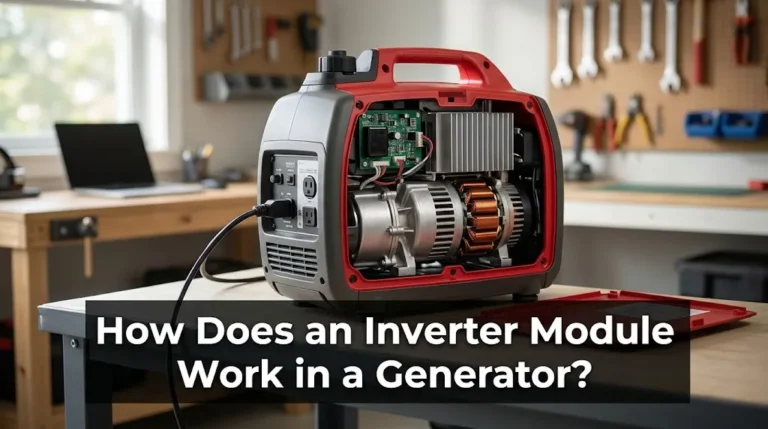
An inverter generator is a portable generator that makes raw power, turns it into DC, then rebuilds it as clean AC through an inverter module. That middle step is the whole story behind the size.
A conventional generator has no middle step. Its alternator must make grid-quality AC straight from the engine shaft, so the alternator itself has to be big, heavy, and precisely governed.
The inverter design splits the job in two. The alternator only has to make rough power, and the electronics clean it up.
That split frees the designer from the heaviest constraint in a generator: the alternator must spin at one fixed speed. Once speed no longer sets the output frequency, every part downstream can shrink.
Section Takeaway: An inverter generator is smaller because it splits power-making into two steps, so the alternator only makes rough power and light electronics rebuild it into clean AC.
Why Does the Alternator Make the Biggest Difference?
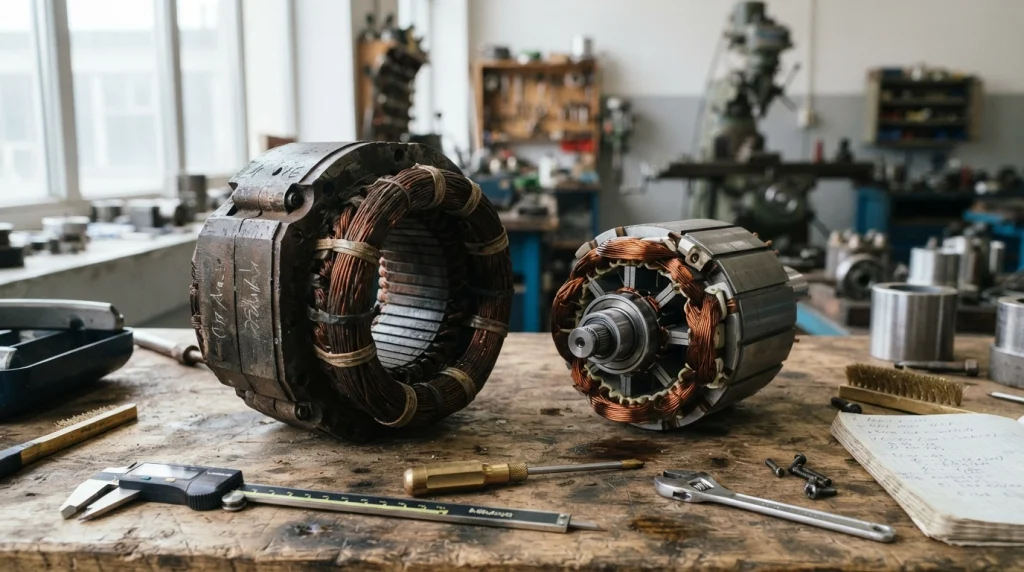
The alternator is the heaviest single part in most portable generators. In an inverter, it is a fraction of the size, and that one change drives most of the weight saving.
A conventional alternator needs many pounds of iron in its core and copper in its windings. It must hold a steady 60 Hz output while the engine holds a steady 3,600 RPM, so it needs mass to smooth out every surge and dip in load.
An inverter alternator works differently. It spins faster and uses more magnetic poles, so it makes the same watts from a much smaller package.
Power output rises with speed, so a small alternator spinning fast can match a large alternator spinning slow. The fast, raw output is rough, and its voltage and frequency swing with engine speed.
That roughness does not matter here, because the inverter module fixes it downstream. The alternator can stay small and rough, and the electronics do the fine work.
If you want the full tour of that part, read what the alternator does in an inverter generator for the step-by-step path from engine spin to raw power.
Section Takeaway: The alternator is the biggest weight saver, because a small high-speed alternator makes the same watts with far less iron and copper, and the inverter module cleans up the rough output.
How Does Electronics Replace Heavy Iron?
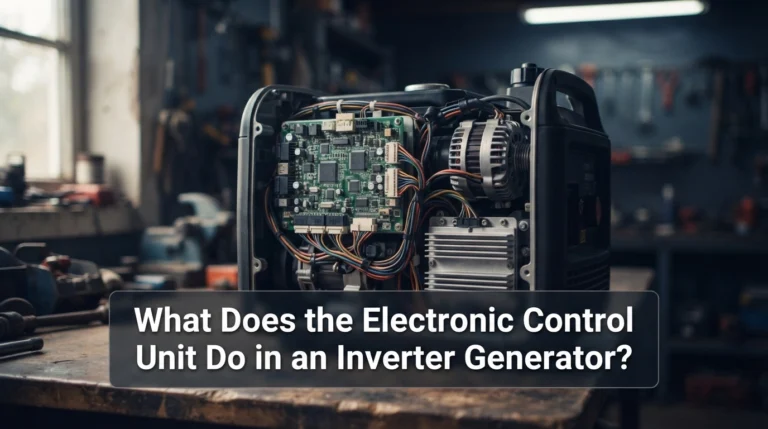
Electronics replace heavy iron by doing with silicon what a conventional generator does with mass. A circuit board weighs ounces, while the iron it replaces weighs tens of pounds.
Here is the path in plain terms. The alternator makes high-frequency AC, the rectifier turns it into DC, and the inverter module turns that DC back into clean 120-volt AC at a steady 60 Hz.
Each stage is a compact electronic part, not a spinning mass of metal. The inverter module also watches the output thousands of times per second, trimming voltage and frequency as loads switch on and off.
A conventional generator does the same job with a governor and a heavy spinning rotor. The rotor’s mass resists change, which steadies the output, but that mass is exactly what you carry.
The electronic route has a second payoff: clean power. Most inverter generators hold total harmonic distortion, or THD, under 3 percent.
THD measures how far the power wave strays from a pure sine wave. A low number means smooth power that suits laptops, phones, TVs, and CPAP machines.
Conventional open-frame generators often run much higher, typically 10 to 25 percent, with some sources listing 6 to 25 percent. That rougher power is fine for many tools, but it is a poor match for sensitive electronics.
The conversion step is worth a closer look if the wiring puzzles you. My guide on why inverter generators convert AC to DC and back to AC walks through each stage and what it fixes.
Section Takeaway: A circuit board weighing ounces replaces tens of pounds of spinning iron, and it steadies voltage and frequency while holding THD under 3 percent.
Why Can the Engine Be Smaller Too?
The engine shrinks because it no longer has to hold one fixed speed under every load. In a conventional generator, the engine must run at 3,600 RPM whether you power a phone charger or a circular saw.
That fixed speed sets the engine size. It must be big enough to hold speed when a large load hits, and it must carry a heavy flywheel to smooth the gaps between power strokes.
An inverter engine can slow down. At light load it may idle near half speed, then rev up only when demand rises.
This is eco mode, or eco-throttle. The inverter module sets the output frequency, so the engine is free to match its speed to the load.
A variable-speed engine can be smaller for the same rated watts. It does not need the same reserve to hold a fixed speed, and it can lean on the inverter to cover short surges.
The smaller engine brings smaller supporting parts with it. The fuel tank, muffler, air filter housing, and cooling shroud all shrink to match.
One small change at the alternator lets the engine shrink, and the smaller engine lets everything around it shrink too. Speed control is the hinge of that cascade, and my guide on how inverter generators regulate voltage and frequency explains how the electronics hold output steady while the engine speed moves.
Safety note: A smaller engine still makes carbon monoxide, so run any generator outdoors only, at least 20 feet from doors, windows, and vents, with the exhaust pointed away from your home.
Section Takeaway: The engine can be smaller because eco mode lets it slow down at light load, and the inverter module, not engine speed, holds the output steady.
How Much Smaller and Lighter Are They, Really?
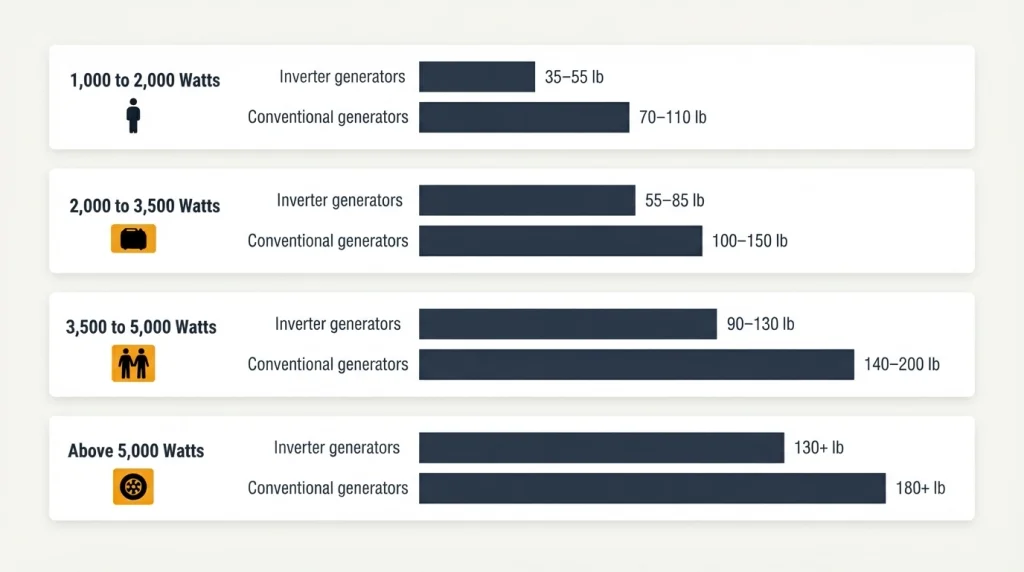
How much smaller depends on the size class, but the gap is large at the small end and narrows as watts climb. A 2,000-watt inverter is often half the weight of a conventional unit with the same running watts.
The table below uses typical ranges, not one model. Check the spec sheet for the exact unit you buy, since dry weight, fuel, and oil change the number you actually lift.
| Size class (running watts) | Typical inverter weight | Typical conventional weight | One-person carry? |
|---|---|---|---|
| 1,000 to 2,000 watts | 35 to 55 lb | 70 to 110 lb | Yes, most adults can manage it |
| 2,000 to 3,500 watts | 55 to 85 lb | 100 to 150 lb | Yes, with a handle and a short carry |
| 3,500 to 5,000 watts | 90 to 130 lb | 140 to 200 lb | Often needs wheels or two people |
| Above 5,000 watts | 130 lb and up | 180 lb and up | Wheels are the norm for both types |
Weight is only half the story. An inverter case is also shorter and narrower, so it fits in a car trunk, an RV bay, or a closet shelf where an open-frame unit will not fit.
Fuel adds weight to both types, so compare dry weight first. A gallon of gasoline adds about 6 pounds, and a full tank on a larger unit can add 15 to 25 pounds.
Section Takeaway: A small inverter is often half the weight of a conventional unit with the same watts, and the gap narrows as watts climb past 5,000.
What Does the Smaller Size Cost You?
Small size costs you peak watts, and that is the trade-off to weigh before you buy. The lightest inverters top out near 2,000 running watts, which covers essentials but not a whole home.
Starting watts are the pinch point. A fridge may need 600 running watts but 1,200 watts to start, and a window AC can need two to three times its running watts at startup.
A small inverter handles one such surge at a time. It struggles when two large loads start together, and it will trip its overload protection rather than sag and damage your gear.
Cost per watt is the second trade-off. Inverter power usually costs more per watt than conventional power at the same size, because the electronics add cost that iron does not.
Repair is the third. An inverter module is harder to fix than a simple alternator fault, and a failed module can cost more than a conventional repair.
None of this makes a small inverter a bad buy. It makes it a specific buy, best when clean power, quiet running, and portability matter more than maximum watts per dollar.
Section Takeaway: The smaller size costs you peak watts and costs more per watt, so a light inverter is best when portability and clean power matter more than raw output.
When Does Light Weight Matter Most?

Light weight matters most when you move the generator often. Camping, tailgating, RV trips, and job sites all reward a unit you can carry alone.
It also matters during an outage. You may need to carry the unit from a garage shelf to the yard in the dark, in rain, while tired, and every pound counts then.
Here is a worked example from a camping trip I took last summer. I needed power for a small fridge, lights, phones, and a CPAP at night, and the site sat about 60 yards from the car park down a dirt path.
My load list was simple, and I ran the numbers before I left. The fridge drew about 150 running watts, the lights 40 watts, phone charging 20 watts, and the CPAP 90 watts, for a steady total near 300 watts.
The fridge compressor added a short starting surge near 600 watts. That put my peak near 750 watts, well inside a 2,000-watt inverter with room to spare.
That math shaped the carry, not just the purchase. A 2,000-watt inverter in the 45 to 55 pound range went down the path in one trip, with my free hand holding a torch.
A conventional unit of the same watts would have weighed near 90 pounds. I would have needed two trips or a second person, plus a wheel kit that does not roll well on a dirt path.
For the full parts tour behind that compact case, see what is inside an inverter generator to match each part to the weight it saves.
Safety note: Never run a generator in a tent, RV, or garage, even with a door open. Carbon monoxide has no smell or colour, so place the unit outdoors at least 20 feet from sleeping areas and use a battery CO alarm nearby.
Section Takeaway: Light weight pays off most when you carry the unit often, and a 300-watt camping load with a 750-watt peak fits a 2,000-watt inverter with room to spare.
How Do You Pick the Right Size Without Going Too Small?
Pick size from your watt list, not from the weight you like. A light unit you cannot use is just a light paperweight.
Start with your must-run loads. List each item, its running watts, and its starting watts, and add the running watts together.
Then add the largest starting surge once. Only one large motor starts at a time in a well-run setup, so you do not need to add every surge together.
Next, add a 20 percent margin. That margin covers a hot day, a tired compressor, and the phone charger you forgot to list.
Here is a quick example with a freezer-based outage list. A chest freezer at 100 running watts, LED lights at 60 watts, a router at 15 watts, laptop and phone charging at 85 watts, and a CPAP at 90 watts total 350 running watts.
Add the freezer starting surge of about 500 extra watts, and the peak hits near 850 watts. A 20 percent margin lifts the target to about 1,020 watts, so a 2,000-watt inverter covers it with room for a fan or a second charger.
If your list includes a window AC or a sump pump, the numbers jump fast. A small window AC can add 1,000 watts or more at startup, and that alone can push you into the 3,500-watt class.
Parallel capability is the escape hatch for light units. Two 2,000-watt inverters linked with a parallel kit can share a larger load, and you still carry each one alone.
As of 2026, my rule is simple: buy the smallest inverter that covers your watt list with a 20 percent margin. If the lightest unit that meets the math still feels heavy, add wheels or pick a parallel pair instead of going smaller.
If budget is the next question, the best affordable inverter generator roundup compares light, budget-friendly units by the same watts-first logic.
Section Takeaway: Add running watts, add the largest starting surge once, add a 20 percent margin, and buy the smallest inverter that covers that total.
The Bottom Line: Small Size Is a Design Choice, Not an Accident
Inverter generators are smaller and lighter because they let electronics do the heavy work. A small high-speed alternator makes rough power, a circuit board rebuilds it into clean AC under 3 percent THD, and a variable-speed engine shrinks to match.
That design trades peak watts and cost per watt for portability, quiet running, and clean power. For a fridge, CPAP, lights, and charging, it is a trade most campers and homeowners gladly make.
Start with your watt list, add the largest surge once, and add a 20 percent margin. Then pick the lightest inverter that covers the total, test it before you need it, and keep it outdoors at least 20 feet from your home when it runs.
As of 2026, I still reach for a small inverter first whenever I need to carry power somewhere.
It is light enough to lift alone, quiet enough to run at night, and clean enough for the gear I care about. — Michael Turner
If you want quiet, clean power you can carry alone, a small to mid-size inverter generator is a solid option like this, especially when you need to run a fridge, CPAP, and charging without the weight of a conventional open-frame unit.
Frequently Asked Questions
Why are inverter generators so much lighter than conventional generators?
They use a small high-speed alternator plus an inverter module instead of a large iron-core alternator that must spin at a fixed 3,600 RPM. The electronics weigh ounces and replace tens of pounds of iron and copper, and the smaller engine and frame follow from that one change.
Are smaller inverter generators less powerful?
Yes, at the small end. Most light inverters top out near 2,000 running watts, which covers a fridge, lights, CPAP, and charging, but not a whole home.
Does a lighter inverter generator run quieter?
Usually, yes. The engine can slow down at light load because the inverter sets the output frequency, and the moulded case muffles sound.
Can I carry a 2,000-watt inverter generator alone?
Most adults can, since typical units in that class weigh 35 to 55 pounds dry. Fuel adds about 6 pounds per gallon, so carry it with a low tank or fill it at the site.
Do inverter generators still need a transfer switch for home backup?
Yes, for any connection to home wiring. Use a transfer switch or interlock kit installed by a licensed electrician, and never backfeed through a wall outlet.
Where can I learn more about generator safety?
Start with the Consumer Product Safety Commission for generator CO safety, the Centers for Disease Control and Prevention for carbon monoxide guidance, the Environmental Protection Agency for emissions rules, and the U.S. Department of Energy for home backup power basics.

Hi, I’m Michael Turner. I own a generator workshop in the United States and founded HomeGeneratorBlog to share practical, hands-on guidance about generator installation, maintenance, troubleshooting, safety, and backup power solutions. My goal is to help homeowners make smarter, more confident decisions through clear and reliable information