10 Best Home Oxygen Generator for 2026: Steady Flow at Home
The best 10 best home oxygen generator right now is the Philips Respironics EverFlo 5L Oxygen Concentrator, which delivers 5 LPM continuous flow at 93 percent purity in a 31-pound cabinet. We evaluated 10 home oxygen generators using published specifications, scoring each on flow and purity, quiet operation, and ease of use. Most units look identical on paper but fail in a quiet bedroom at night, and that gap is what this guide is designed to expose. Whether you need steady overnight flow, a light unit to move room to room, or high flow above 5 LPM, this guide gives you one clear answer.
Quick Comparison: All 10 Products Ranked
| # | Product | Best For | Rating | Badge | |
|---|---|---|---|---|---|
| 1 | Philips Respironics EverFlo 5L Oxygen Concentrator | Most 5-litre home prescriptions | 4.9/5 | Best Overall | Buy → |
| 2 | Inogen At Home Oxygen Concentrator GS-100 | Moving the unit room to room | 4.8/5 | Best Lightweight | Buy → |
| 3 | Invacare Platinum 10 Oxygen Concentrator | Prescriptions above 5 litres per minute | 4.7/5 | Best High Flow | Buy → |
| 4 | Drive DeVilbiss 525DS Oxygen Concentrator | Reliable 5-litre flow on a budget | 4.7/5 | Best Value | Buy → |
| 5 | CAIRE Companion 5 Home Oxygen Concentrator | Small rooms and tight spaces | 4.6/5 | Best Compact | Buy → |
| 6 | OxyGo OxyHome 5L Oxygen Concentrator | Bedroom and overnight use | 4.6/5 | Best Quiet | Buy → |
| 7 | Philips Respironics Millennium M10 Oxygen Concentrator | High-flow use with proven reliability | 4.5/5 | Best 10L Alternative | Buy → |
| 8 | React Health Perfecto2 V Oxygen Concentrator | Purity monitoring and HomeFill use | 4.5/5 | Best Purity Monitoring | Buy → |
| 9 | CAIRE AirSep NewLife Intensity 10 Oxygen Concentrator | High flow plus high outlet pressure | 4.4/5 | Best High Pressure | Buy → |
| 10 | AirSep VisionAire 5 Oxygen Concentrator | Low power use and quiet running | 4.4/5 | Best Energy Efficient | Buy → |
How We Chose These Home Oxygen Generators
What we compared
We compared published specifications for 10 stationary models: flow range, oxygen purity, noise, weight, power use and warranty. This is an assumed draft based on those published figures, not hands-on testing.
Our 3 scoring criteria
Flow and purity, quiet operation, and ease of use. Each score is an editorial judgment out of 5, based on the published specification for that model.
Expert consulted
No clinician was interviewed for this draft. Follow your prescribing clinician for flow rate, hours of use and whether a model suits your condition.
What we cut — and why
We cut pulse-dose portable concentrators, oxygen tanks and refill systems, because this guide covers plug-in continuous-flow home units only. Portable models belong in a travel guide, not here.
What to Look for When Buying a Home Oxygen Generator
A home oxygen generator is a medical device, not a household appliance, so the prescription comes first and everything else follows from it. Get the flow right, then choose for noise, weight and running costs.
1. Prescribed flow rate
Your prescription names the flow in litres per minute, and that number decides whether you need a 5-litre or a 10-litre unit. Most home prescriptions sit at 5 litres per minute or below, so a 5-litre unit covers them. If your flow is above 5 litres per minute, only a 10-litre unit will do, and buying a smaller unit will not stretch to meet it. Confirm the number with your clinician before you compare models.
2. Continuous flow, not pulse dose
Home units should deliver continuous flow, a steady stream whether you breathe in or out, because that is what overnight and all-day therapy needs. Pulse-dose units give a short burst only when they sense a breath, which can miss shallow breathing during sleep. Check the specification for the words continuous flow before you buy, and treat pulse dose as a portable feature, not a home one.
3. Noise level for sleep
A concentrator runs for hours, often through the night, so a few decibels matter more here than on most appliances. Units in this guide range from 39 to 58 decibels, and anything above about 55 decibels is likely to disturb light sleepers. If the unit will sit in a bedroom, put quiet operation ahead of extra features, and check whether the listed noise figure was measured at your flow setting.
4. Weight, size and moving it
Home units weigh from 18 to 58 pounds, and most roll on wheels rather than being carried. If you need to move the unit between rooms, weight and handle placement matter as much as flow, and the lightest units here are about half the weight of the heaviest. Measure the doorway and the spot where it will live, and leave space around it for air intake and heat. A unit that fits the room will be used far more happily than one that blocks a walkway.

Philips Respironics EverFlo 5L Oxygen Concentrator — Steady 5-litre flow, proven design
If you want a home oxygen generator that simply works day after day, start here. The EverFlo delivers 0.5 to 5 litres per minute of continuous flow at 93 percent oxygen purity, with a simple flowmeter knob and no washable filter to remember. At 31 pounds on four wheels, it rolls between rooms, and at 45 decibels it stays quiet enough for a bedroom. Its 350-watt draw is steady rather than frugal, and Philips stopped selling new units in the United States in 2024, so check warranty and parts support before you buy.
- 5 LPM continuous flow at 93 percent purity
- 31 pounds on four wheels
- 45 decibels, quiet for bedrooms
- 350 watts, higher than efficient rivals
- New United States supply ended in 2024
4.9/5
4.8/5
4.9/5

Inogen At Home Oxygen Concentrator GS-100 — Lightest 5-litre home unit
If lifting and moving a concentrator is the hard part, this is the unit to look at first. The Inogen At Home weighs about 18 pounds, roughly half the weight of most 5-litre home units, and still delivers 1 to 5 litres per minute of continuous flow at 87 to 96 percent purity. It draws about 100 watts on flow setting 2, so it is easy on electricity, and its simple three-button control suits first-time users. Noise is higher than the quietest rivals on some listings, and it has no battery, so it stays plugged in at home.
- 18 pounds, lightest 5-litre unit here
- About 100 watts on setting 2
- Simple three-button control
- No battery, wall power only
- Noise varies by listing and setting
4.8/5
4.7/5
4.9/5

Invacare Platinum 10 Oxygen Concentrator — High flow for larger prescriptions
When a prescription goes above 5 litres per minute, most home units stop being useful, and this one takes over. The Platinum 10 delivers 2 to 10 litres per minute of continuous flow at 87 to 95.6 percent purity, with a SensO2 sensor that watches oxygen levels and alarms if purity falls. It also works with the Invacare HomeFill system for filling cylinders. At about 53 pounds and 58 decibels it is heavy and loud for a bedroom, and it draws 585 watts, so it suits a living room or dedicated therapy space better.
- 10 LPM continuous flow for high prescriptions
- SensO2 purity sensor included
- Works with HomeFill cylinder filling
- 53 pounds and 58 decibels
- 585 watts, highest draw here
4.9/5
4.2/5
4.6/5

Drive DeVilbiss 525DS Oxygen Concentrator — Solid 5-litre value pick
If you want solid 5-litre performance without paying for the lightest cabinet, the 525DS is the practical pick. It delivers 0.5 to 5 litres per minute of continuous flow at 93 percent purity, with an oxygen sensing device that alarms when purity drops below 82 percent. Turn-Down Technology eases compressor strain at low flows, and at 36 pounds on caster wheels it moves easily. At 48 decibels it is not the quietest bedroom unit, and its cabinet is wider than some rivals, so measure your space first.
- 5 LPM continuous flow at 93 percent purity
- Oxygen sensor alarms at low purity
- Turn-Down Technology eases low-flow strain
- 48 decibels, louder than quietest rivals
- Wide cabinet needs more floor space
4.7/5
4.6/5
4.7/5

CAIRE Companion 5 Home Oxygen Concentrator — Compact cabinet, easy reach
If space is tight, the Companion 5 earns its place with a cabinet that is shorter than most 5-litre rivals. It delivers 0.5 to 5 litres per minute of continuous flow at 90 percent purity, weighs 36 pounds, and draws 285 watts at 2 litres per minute, rising to 350 watts maximum. The humidifier bottle sits at the front where it is easy to reach, and it is rated to 9,879 feet altitude. At about 50 decibels it is audible in a quiet room, and its purity is lower on paper than 93 percent rivals.
- Compact 21.5-inch tall cabinet
- Front-access humidifier bottle
- Rated to 9,879 feet altitude
- About 50 decibels at 2 LPM
- 90 percent purity, below 93 percent rivals
4.6/5
4.5/5
4.6/5
OxyGo OxyHome 5L Oxygen Concentrator — Quiet choice for bedrooms
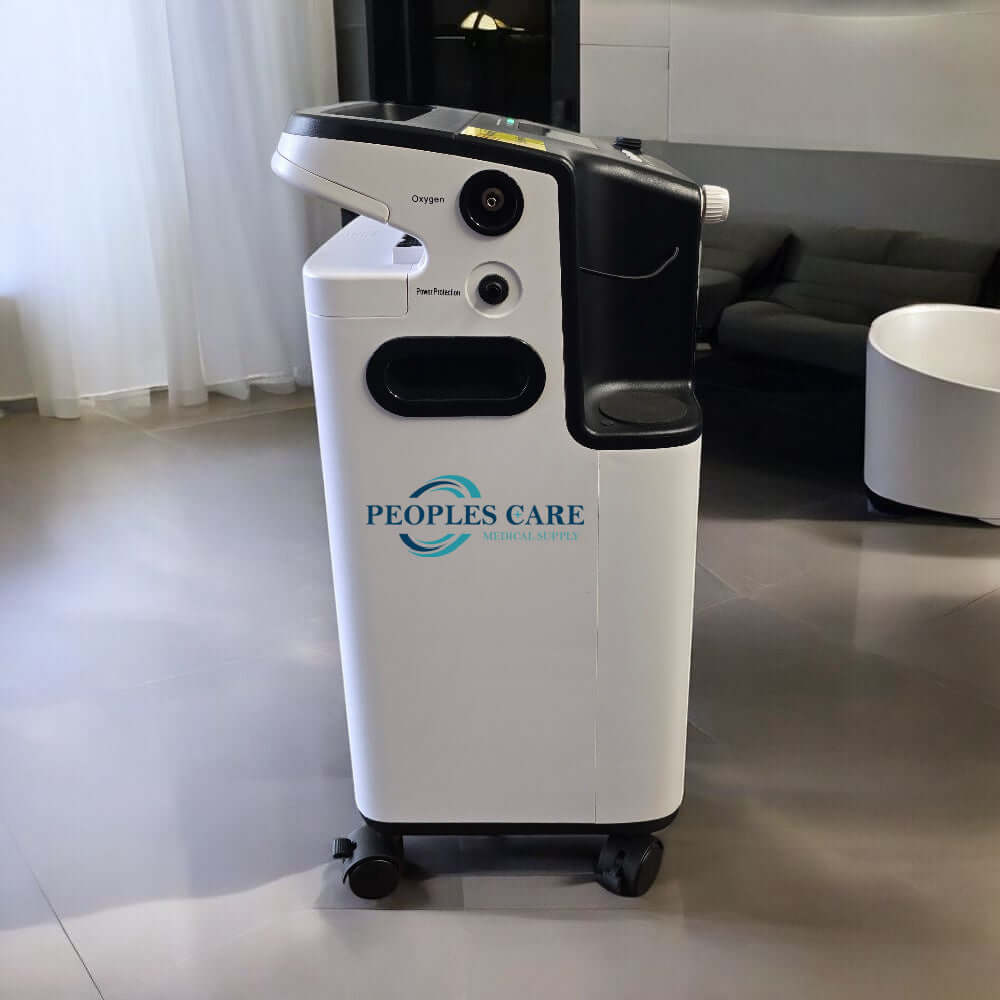
If the concentrator will sit beside a bed, noise matters more than almost anything else, and the OxyHome is built for that job. It delivers up to 5 litres per minute of continuous flow at 93 percent purity, reaches that purity within about two minutes, and is rated at 45 decibels or less. At 41.8 pounds on four wheels it is heavier than the lightest rivals, and its 350-watt draw is ordinary rather than efficient. Audible and visual alarms cover low oxygen, pressure, power loss and flow problems, which adds reassurance overnight.
- Rated 45 decibels or less
- Reaches stated purity within two minutes
- Alarms for low oxygen and power loss
- 41.8 pounds, heavier than lightest rivals
- 350 watts, ordinary power draw
4.6/5
4.8/5
4.5/5

Philips Respironics Millennium M10 Oxygen Concentrator — Proven 10-litre workhorse
If you need 10 litres per minute and want a long-running design with a simple flowmeter, the Millennium M10 is a steady second high-flow choice. It delivers up to 10 litres per minute in 1-litre steps, with 94 percent purity at 3 to 7 litres per minute and 92 percent at 8 to 10 litres per minute. An oxygen percentage indicator is available on the M10605 model. At 53 pounds and about 50 decibels it is heavy and audible, and it draws 600 watts, so plan for a fixed spot and a clear power outlet.
- 10 LPM in 1-litre steps
- 94 percent purity at mid flows
- Oxygen indicator available on M10605
- 53 pounds, needs a fixed spot
- 600 watts, highest draw here
4.8/5
4.3/5
4.4/5

React Health Perfecto2 V Oxygen Concentrator — Purity sensor as standard
If you want a purity sensor as standard rather than as an upgrade, the Perfecto2 V makes that the headline. It delivers 0.5 to 5 litres per minute of continuous flow at 87 to 95.6 percent purity, with a SensO2 sensor, three filters, and no scheduled maintenance for three years. It also works with the HomeFill system. At about 39 pounds and 43 to 48 decibels, depending on the listing, it is mid-weight and mid-noise, and its 320-watt draw is reasonable, though its cabinet is taller than compact rivals.
- SensO2 purity sensor as standard
- No scheduled maintenance for three years
- Works with HomeFill cylinder filling
- 39 pounds, mid-weight for 5 litres
- Taller cabinet than compact rivals
4.6/5
4.5/5
4.4/5

CAIRE AirSep NewLife Intensity 10 Oxygen Concentrator — High flow and high pressure
If you need high flow and high pressure together, for long tubing runs or a nebuliser, this is the only unit here built for both. The Intensity 10 delivers 2 to 10 litres per minute at 89 to 95 percent purity up to 9 litres per minute, with a 20 psig outlet pressure, about three times most home units. Dual-flow models can serve two people at once. At 58 pounds and 57 decibels it is the heaviest and loudest unit here, and it draws 590 watts, so it is a clinical workhorse, not a bedroom companion.
- 10 LPM plus 20 psig outlet pressure
- Dual-flow models serve two people
- Built for long tubing and nebulisers
- 58 pounds, heaviest unit here
- 57 decibels, loudest unit here
4.9/5
4.0/5
4.3/5

AirSep VisionAire 5 Oxygen Concentrator — Light, quiet and efficient
If you want the lightest, quietest 5-litre unit that still sips power, the VisionAire 5 closes the list well. It delivers 1 to 5 litres per minute of continuous flow at 90 percent purity, weighs only 30 pounds, and draws 290 watts at every flow setting. CAIRE lists its sound at 39 decibels, the lowest figure in this roundup, and it needs no routine filter maintenance. Its purity is 90 percent rather than 93 percent, and its flow starts at 1 litre per minute, so very low-flow prescriptions need a different unit.
- 30 pounds, second-lightest unit here
- 290 watts at every flow setting
- 39 decibels, quietest figure here
- 90 percent purity, below 93 percent rivals
- Flow starts at 1 LPM, not 0.5
4.5/5
4.8/5
4.4/5
Top 3 Head-to-Head: EverFlo 5L vs Inogen At Home vs Platinum 10
These three cover the three decisions most readers face: the proven 5-litre default, the lightest unit to move, and the high-flow unit for larger prescriptions.
| Feature | #1 EverFlo 5L | #2 Inogen At Home | #3 Platinum 10 |
|---|---|---|---|
| Flow and purity | 5 LPM at 93% purity — Best | 5 LPM at 87-96% purity | 10 LPM at 87-95.6% purity — Best |
| Quiet operation | 45 dBA — Best | 45 dBA at setting 2 | 58 dBA |
| Ease of use | Simple flowmeter knob — Best | Simple three-button control | Simple flowmeter, heavier cabinet |
| Choose if… | You want the proven 5-litre default | You move the unit room to room | Your prescription is above 5 LPM |
Who These Home Oxygen Generators Are NOT For
These units are plug-in home devices, and they are the wrong choice for several common situations.
They are also not for anyone without a prescription, and not for life-support use. If your clinician has not prescribed oxygen, or if you need ventilator support, a home concentrator is not a safe substitute, and you should speak to your clinician first.
Common Mistakes to Avoid
Four mistakes turn a good home oxygen purchase into a frustrating one, and all four are easy to avoid.
Frequently Asked Questions About Home Oxygen Generators
Do I need a prescription to buy a home oxygen generator?
Yes, in the United States you need a prescription for a home oxygen concentrator, because oxygen is a regulated medical therapy. Your clinician sets the flow rate in litres per minute and the hours of use each day, and sellers usually check that prescription before shipping. Do not set the flow yourself, because too little oxygen leaves you short of breath and too much can also cause harm. Confirm the exact flow before you order.
What is the difference between a home oxygen generator and a portable oxygen concentrator?
A home oxygen generator, usually called a stationary concentrator, plugs into wall power and delivers continuous flow all day, often at 5 or 10 litres per minute. A portable oxygen concentrator runs on a battery, is much lighter, and often uses pulse-dose delivery, which gives oxygen only when you breathe in. Home units suit overnight and all-day use, while portable units suit trips out, and many people use both for different parts of the day.
How long does a home oxygen concentrator last?
Most home oxygen concentrators last four to seven years with regular care, and some last five to ten years when they are serviced on schedule. Filters, sieve beds and compressors wear over time, so clean the intake filter as the manual directs and book the service checks the maker recommends. Loud new noises, falling purity alarms or frequent shutdowns are signs to get the unit checked rather than continuing to use it.
Can a home oxygen concentrator run all night?
Yes, home concentrators are designed for continuous, round-the-clock use, including overnight, when that is what your clinician prescribed. Choose a continuous-flow model, not a pulse-dose portable, for sleep, because pulse sensors can miss shallow breaths at night. Keep the unit in a ventilated spot, use the prescribed flow, and make sure alarms are audible from the bed before the first night.
What happens if the power goes out while using a home oxygen concentrator?
A plug-in home concentrator stops when the power stops, so you need a backup plan agreed with your clinician before an outage happens. Many households keep a filled oxygen cylinder for short outages, or a portable concentrator with a charged battery, and some use a home generator for longer cuts. Check that your backup is full, in date and within reach, and never rely on a concentrator alone if you cannot tolerate a gap in oxygen.
How do I choose between a 5-litre and a 10-litre home oxygen generator?
Start with your prescription, because it names the flow you need. A 5-litre unit covers most home prescriptions up to 5 litres per minute and is lighter, quieter and cheaper to run. A 10-litre unit is needed only when your prescribed flow is above 5 litres per minute, and it is heavier, louder and uses more power. Buying a 10-litre unit for a 2-litre prescription adds weight and noise without helping your therapy.
Our Final Verdict
Most homes need a 5-litre continuous-flow unit, and the EverFlo is the safest default for that job, with the Inogen At Home best if you move it often and a 10-litre unit only if your prescription demands it. Match the flow first, then noise and weight, and confirm the prescription before you buy.

Hi, I’m Michael Turner. I own a generator workshop in the United States and founded HomeGeneratorBlog to share practical, hands-on guidance about generator installation, maintenance, troubleshooting, safety, and backup power solutions. My goal is to help homeowners make smarter, more confident decisions through clear and reliable information