10 Best Portable Oxygen Generator Machines for 2026: Breathe Easier Anywhere
The best portable oxygen generator machine right now is the Inogen Rove 6 — the only pick here with six pulse settings at 4.8 pounds. We evaluated 10 portable oxygen concentrators using published specifications, scoring each on oxygen delivery, battery life, and ease of use. Most portable machines look identical on paper but fail on long days away from power. Whether you need daily home use, air travel, or continuous flow, this guide gives you one clear answer.
Quick Comparison: All 10 Products Ranked
| # | Product | Best For | Rating | Badge | |
|---|---|---|---|---|---|
| 1 | Inogen Rove 6 Portable Oxygen Concentrator | Everyday use and travel | 4.9/5 | Best Overall | Buy → |
| 2 | Philips Respironics SimplyGo Mini Portable Oxygen Concentrator | Travel and errands | 4.8/5 | Best for Travel | Buy → |
| 3 | Inogen Rove 4 Portable Oxygen Concentrator | Short outings, lowest weight | 4.7/5 | Lightest | Buy → |
| 4 | Caire FreeStyle Comfort Portable Oxygen Concentrator | Long days away from power | 4.7/5 | Best Battery Life | Buy → |
| 5 | Philips Respironics SimplyGo Portable Oxygen Concentrator | Continuous-flow prescriptions | 4.6/5 | Best Continuous Flow | Buy → |
| 6 | Caire Eclipse 5 Portable Oxygen Concentrator | Continuous flow up to 3 LPM | 4.6/5 | Best High Output | Buy → |
| 7 | ResMed Mobi Portable Oxygen Concentrator | Daily use, long internal battery | 4.5/5 | Best for Daily Use | Buy → |
| 8 | Drive DeVilbiss iGo2 Portable Oxygen Concentrator | Active days, auto-adjusting dose | 4.4/5 | Best SmartDose | Buy → |
| 9 | GCE Zen-O Portable Oxygen Concentrator | Pulse and continuous flexibility | 4.4/5 | Best Dual Mode | Buy → |
| 10 | OxyGo FIT Portable Oxygen Concentrator | Lower-flow, hip-carry use | 4.3/5 | Best for Lower Flow | Buy → |
How We Chose These Portable Oxygen Concentrators
This is an assumed draft. It compares published manufacturer specifications and does not report hands-on testing. Scores are editorial judgments based on those published figures, not measured test results.
What we compared
10 models, using published weight, flow range, battery runtime at the stated setting, FAA acceptance, and noise level where the maker publishes it.
Our 3 scoring criteria
Oxygen delivery and flow range; battery life and portability; ease of use and travel readiness. Each score is out of 5.
Expert consulted
No clinician was consulted for this assumed draft. Confirm your prescription and flow setting with your own clinician before you choose a model.
What we cut — and why
Stationary 5-litre home concentrators and non-prescription oxygen gadgets were cut because they are not portable concentrators. The Inogen One G5 was not listed separately because the Rove 6 is its current successor.
What to Look for When Buying a Portable Oxygen Generator Machine
A portable oxygen concentrator is a prescription medical device, not a general gadget. Your prescription decides the delivery mode and setting first, and weight, battery, and travel rules decide which model fits your day.
1. Pulse Dose vs Continuous Flow
Pulse dose gives a burst of oxygen when you breathe in, which saves battery and keeps the unit light. Continuous flow gives a steady stream at all times, which some prescriptions require, including during sleep. Most light models in this list are pulse-only, so check your prescription before you fall for a light weight. If you need continuous flow, shortlist only the models that list it.
2. Weight and Carrying
Weight is quoted with a specific battery, so compare the same battery size across models. A 2.8-pound unit is easy on a shoulder strap for short errands, while a 10-pound unit usually needs a cart or a strong carry bag. Think about stairs, car transfers, and how long you will carry it, not just the headline number. The same carry planning matters for portable power for van life trips, where every pound and every bag counts.
3. Battery Runtime at Your Setting
Headline runtimes are usually quoted at the lowest setting, with a new battery and a steady breath rate. Your runtime will fall as the setting rises, so plan from the runtime at your prescribed setting, not the maximum. Carry a spare battery or a car charger for long days, and allow a safety margin for delays. The same margin planning applies to portable power for off-grid living, where there is no wall outlet to fall back on.
4. FAA Approval, Prescription, and Power Backup
In the United States, a portable oxygen concentrator needs a prescription, and airlines have their own notice and battery rules. Most models here meet FAA acceptance criteria for in-flight use, but that does not replace your airline’s check. Tell the airline in advance, carry enough battery for at least 150 percent of the flight time where the airline asks for it, and keep spare batteries in your carry-on.

Inogen Rove 6 Portable Oxygen Concentrator — Six Settings, Still Light
Best for: everyday use and travel
If you need one portable oxygen concentrator for home, errands, and flights, the Rove 6 is the easiest choice in this list. It weighs 4.8 pounds with the standard battery, offers six pulse settings up to 1,260 ml per minute, and runs up to 6 hours 15 minutes on that battery at setting 1. The extended battery stretches that to 12 hours 45 minutes at setting 1, which covers long travel days. It is quiet at 37 dBA, meets FAA acceptance criteria, and uses a simple control panel. The trade-off is pulse-only delivery, so it cannot serve a continuous-flow prescription.
- Six pulse settings, 1,260 ml/min max
- 4.8 lb with standard battery
- 12h 45m extended runtime, setting 1
- Quiet 37 dBA operation
- Pulse dose only, no continuous flow
- Extended battery adds a pound
4.9/5
4.9/5
4.8/5

Philips Respironics SimplyGo Mini Portable Oxygen Concentrator — Small, Simple, Travel-Ready
Best for: travel and errands
If travel is your main use, the SimplyGo Mini is hard to beat for simplicity. It weighs 5 pounds with the standard battery, offers five pulse settings up to 1,000 ml per minute, and has a clear touch-screen display that is easy to read on the move. The standard battery runs up to 4.5 hours at setting 2, and the extended battery doubles that to 9 hours at the same setting. It meets FAA acceptance criteria and fits easily in a carry bag. Its limit is pulse-only delivery, so it will not suit a continuous-flow prescription or most sleep use.
- Clear touch-screen display
- 5 lb with standard battery
- 9h extended runtime, setting 2
- Strong 1,000 ml/min output
- Pulse dose only, no continuous flow
- 43 dBA, louder than Rove 6
4.7/5
4.8/5
4.9/5

Inogen Rove 4 Portable Oxygen Concentrator — Lightest Carry Here
Best for: short outings, lowest weight
If weight matters more than anything else, the Rove 4 is the pick. It weighs about 2.8 pounds with the standard battery, offers four pulse settings up to 840 ml per minute, and fits easily in a small bag or purse. The standard battery runs up to 3 hours at setting 1, while the extended battery reaches up to 5 hours 45 minutes at the same setting. It meets FAA acceptance criteria and is simple to carry for appointments and short trips. The trade-off is clear: only four settings, pulse-only delivery, and a shorter runtime than the larger models in this list.
- About 2.8 lb, lightest here
- Fits in a small bag
- Four pulse settings, 840 ml/min
- Simple, easy to carry
- Short standard-battery runtime
- Pulse dose only, no continuous flow
4.6/5
4.8/5
4.7/5

Caire FreeStyle Comfort Portable Oxygen Concentrator — Longest Extended Runtime
Best for: long days away from power
If long battery life is your priority, the FreeStyle Comfort deserves a close look. It weighs 5 pounds with the 8-cell battery, offers five pulse settings up to 1,050 ml per minute, and has a curved body that sits comfortably against you. The 8-cell battery runs up to 8 hours at setting 1, or 4 hours at setting 2, while the 16-cell battery doubles those figures to 16 hours and 8 hours. It runs at 39.9 dBA at setting 2 and includes AutoSAT and AutoDOSE features. The limit is pulse-only delivery, and the larger battery adds weight and height.
- 16h extended runtime, setting 1
- Curved, comfortable body shape
- 1,050 ml/min max output
- AutoSAT and AutoDOSE features
- Pulse dose only, no continuous flow
- 16-cell battery adds weight
4.7/5
4.9/5
4.5/5
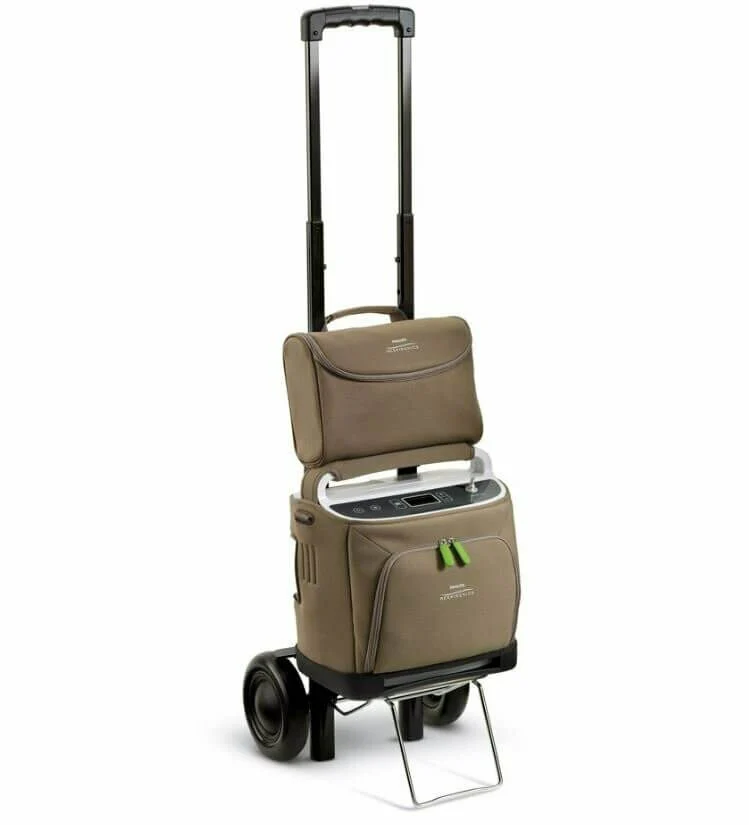
Philips Respironics SimplyGo Portable Oxygen Concentrator — Continuous Flow in a Portable Body
Best for: continuous-flow prescriptions
If your prescription calls for continuous flow, the SimplyGo is the most portable option here that still offers it. It delivers continuous flow from 0.5 to 2 LPM, plus pulse settings 1 to 6 and a Sleep mode, in a 10-pound unit with a rugged case and cart. One battery runs up to 3 hours 24 minutes at pulse setting 1, or 2 hours 54 minutes at 0.5 LPM continuous. Battery life falls fast at 2 LPM. Philips stopped selling it in the United States in January 2024, with service support stated through January 2029, so check availability before you buy.
- Continuous flow to 2 LPM
- Pulse, continuous, and Sleep modes
- Rugged case, mobile cart included
- 10 lb, light for continuous flow
- Short battery on continuous flow
- Discontinued in US, January 2024
4.8/5
4.2/5
4.6/5

Caire Eclipse 5 Portable Oxygen Concentrator — Highest Continuous Flow Here
Best for: continuous flow up to 3 LPM
If you need the highest continuous flow in a transportable unit, the Eclipse 5 is the clear pick. It delivers continuous flow from 0.5 to 3 LPM and nine pulse settings, with AutoSAT adjusting the pulse dose as your breathing changes. It weighs 18.4 pounds with the battery and comes with a rolling cart, so think of it as transportable rather than shoulder-carry portable. One battery runs up to 5.1 hours at pulse setting 2, or 2 hours at 2 LPM continuous. It is the right choice when flow range matters more than light weight.
- Continuous flow to 3 LPM
- Nine pulse settings, AutoSAT
- Rolling cart included
- Works with CPAP and BiPAP
- 18.4 lb, heaviest here
- Short battery at 3 LPM
4.9/5
4.2/5
4.4/5

ResMed Mobi Portable Oxygen Concentrator — Long Internal Battery, Simple Controls
Best for: daily use, long internal battery
If you want a simple daily unit with a strong built-in battery, the ResMed Mobi is a solid choice. It weighs 5.5 pounds, offers four pulse settings up to 681 ml per minute, and uses Pulse-Wave technology to adjust the dose as your activity changes. The internal battery runs up to 8.6 hours at setting 1 and 6 hours at setting 2, and an optional external battery adds up to 4.5 hours at setting 1. It is quiet at 38.2 dBA at setting 2 and meets FAA acceptance criteria. Its limit is four settings only, with no continuous flow, so it suits lower-flow daily use best.
- 8.6h internal battery, setting 1
- One-touch startup, simple controls
- Pulse-Wave activity adjustment
- Quiet 38.2 dBA, setting 2
- Only four pulse settings
- Pulse dose only, no continuous flow
4.4/5
4.7/5
4.5/5

Drive DeVilbiss iGo2 Portable Oxygen Concentrator — Adjusts as You Move
Best for: active days, auto-adjusting dose
If your day swings between sitting and moving, the iGo2 is built for that pattern. It weighs about 5 pounds, offers five pulse settings up to 1,014 ml per minute, and uses SmartDose technology to adjust delivery as your breathing rate changes. The battery runs 3.5 hours at setting 2, and a second battery can extend a long day. It is quiet at 37 dBA at setting 2, meets FAA acceptance criteria, and has a slim, purse-like shape. The trade-off is a shorter standard runtime than the leaders here, and pulse-only delivery with no continuous flow.
- SmartDose auto-adjusting delivery
- About 5 lb, slim shape
- 1,014 ml/min max output
- Quiet 37 dBA, setting 2
- 3.5h runtime at setting 2
- Pulse dose only, no continuous flow
4.4/5
4.3/5
4.5/5

GCE Zen-O Portable Oxygen Concentrator — Two Modes, Two Battery Slots
Best for: pulse and continuous flexibility
If you want one unit that can switch between pulse and continuous flow, the Zen-O is a flexible choice. It offers pulse settings 1 to 6 and continuous flow from 0.5 to 2 LPM, with Auto and Eco modes that respond to your breathing rate. It weighs 10.27 pounds with one battery and holds two 12-cell batteries, giving up to 4 hours 30 minutes at pulse setting 2 on one battery, or 9 hours on two. It is quiet at 38 dBA at pulse setting 2 and meets FAA acceptance criteria. The trade-off is size and weight, plus a short runtime on continuous flow at higher settings.
- Pulse and continuous in one unit
- Two battery slots, 9h total
- Auto and Eco modes
- 38 dBA at pulse setting 2
- 10.27 lb, heavier than pulse-only units
- Short continuous-flow runtime
4.6/5
4.3/5
4.3/5

OxyGo FIT Portable Oxygen Concentrator — Hip-Carry Light for Lower Flow
Best for: lower-flow, hip-carry use
If your prescription is for lower pulse settings and you want the smallest carry possible, the OxyGo FIT is worth a look. It weighs 2.8 pounds with the single battery, offers three pulse settings up to 630 ml per minute, and is small enough to wear on your hip. The single battery runs up to 2.7 hours at setting 1, while the double battery reaches up to 5 hours at the same setting. It runs at 40 dBA at setting 2 and meets FAA acceptance criteria. The trade-off is a narrow range: only three settings, pulse-only delivery, and a short runtime on the single battery.
- 2.8 lb, hip-carry size
- Simple three-setting control
- 5h double-battery runtime, setting 1
- Quiet 40 dBA, setting 2
- Only three pulse settings
- Short single-battery runtime
4.2/5
4.4/5
4.3/5
Top 3 Head-to-Head: Inogen Rove 6 vs Philips SimplyGo Mini vs Inogen Rove 4
These three are the most common final choices because they cover the same pulse-dose need at three different sizes. The Rove 6 gives the most output, the SimplyGo Mini gives the simplest travel screen, and the Rove 4 gives the lightest carry.
| Feature | #1 Rove 6 | #2 SimplyGo Mini | #3 Rove 4 |
|---|---|---|---|
| Oxygen delivery | Pulse 1-6, 1,260 ml/min — Best | Pulse 1-5, 1,000 ml/min | Pulse 1-4, 840 ml/min |
| Battery life | Up to 12h 45m extended, setting 1 — Best | Up to 9h extended, setting 2 | Up to 5h 45m extended, setting 1 |
| Ease of use | Simple panel, 37 dBA | Touch screen, clear display — Best | Simple panel, lightest carry |
| Choose if… | You want the most output and longest days | You want the simplest travel screen | You want the lightest possible carry |
Who These Portable Oxygen Generator Machines Are NOT For
A portable concentrator is the wrong tool when your prescription needs more than it can deliver, or when you need power and oxygen around the clock without a backup plan.
These machines are also not a substitute for medical advice. If your oxygen needs change, if you feel breathless at your prescribed setting, or if you need oxygen while sleeping on pulse dose, stop and ask your clinician before you keep using a portable unit.
Common Mistakes to Avoid
Most bad buys in this category come from the same four errors, and all four are easy to avoid with a prescription check and a battery plan.
Frequently Asked Questions About Portable Oxygen Generator Machines
Can I use a portable oxygen concentrator on a plane?
Yes, if the model meets FAA acceptance criteria and your airline approves it. Oxygen tanks and liquid oxygen are generally not allowed, while approved concentrators are. Tell the airline 48 to 72 hours before you fly, carry enough battery for the flight plus the margin the airline asks for, and keep spare batteries in your carry-on with their terminals protected.
How long does a portable oxygen concentrator battery last?
It depends on the setting, battery size, breath rate, and battery age. In this list, standard batteries run from about 2.7 hours to about 6 hours 15 minutes at the lowest setting, while extended batteries reach up to 16 hours at setting 1 on the FreeStyle Comfort. Always check the runtime at your prescribed setting, not the headline maximum, and plan a spare for long days.
Do I need a prescription for a portable oxygen concentrator?
Yes, in the United States a portable oxygen concentrator is a prescription medical device. A supplier will ask for a prescription that states the delivery mode and flow setting. Do not buy a unit that skips that step, and do not change your setting without asking your clinician, because the wrong dose can leave you under-oxygenated.
What is the difference between pulse dose and continuous flow?
Pulse dose gives a burst of oxygen only when you breathe in, which saves battery and keeps the unit light. Continuous flow gives a steady stream at all times, measured in litres per minute. Pulse settings are not the same as LPM, so a pulse setting of 2 does not mean 2 LPM. Your prescription decides which mode you need, and only some portable models offer continuous flow.
Can I use a portable oxygen concentrator while sleeping?
It depends on your prescription and the model. Pulse-dose units may not detect shallow breathing during sleep, so many clinicians do not recommend them for overnight use. Continuous-flow models, and the SimplyGo Sleep mode, are designed for that need, but you still need your clinician to confirm the mode and setting. Never assume a travel unit is safe for sleep without that check.
How long does a portable oxygen concentrator last?
A well-maintained concentrator typically lasts 4 to 8 years, depending on use, care, and the model. Inogen lists an expected service life of up to 8 years for the Rove 6. Batteries wear faster, usually over a few hundred charge cycles, so expect to replace batteries sooner than the unit itself. Regular filter and sieve-bed care, where the maker allows it, helps the unit last longer.
What is the lightest portable oxygen concentrator?
The lightest models in this list are the Inogen Rove 4 and the OxyGo FIT, both about 2.8 pounds with a standard battery. Both are pulse-only units for lower flow settings, so they suit short outings and errands best. If you need higher settings or longer runtime, the next step up is a 4.8 to 5 pound unit such as the Rove 6, SimplyGo Mini, or FreeStyle Comfort.
Our Final Verdict
Most buyers should start with their prescription, then choose between light pulse-only travel and heavier continuous-flow flexibility. The Rove 6 covers the widest pulse range in the lightest capable package, which is why it leads this assumed draft. Check the battery runtime at your prescribed setting before you decide.
Hi, I’m Michael Turner. I own a generator workshop in the United States and founded HomeGeneratorBlog to share practical, hands-on guidance about generator installation, maintenance, troubleshooting, safety, and backup power solutions. My goal is to help homeowners make smarter, more confident decisions through clear and reliable information