Jackery Portable Generator Review: Is It Worth Buying?
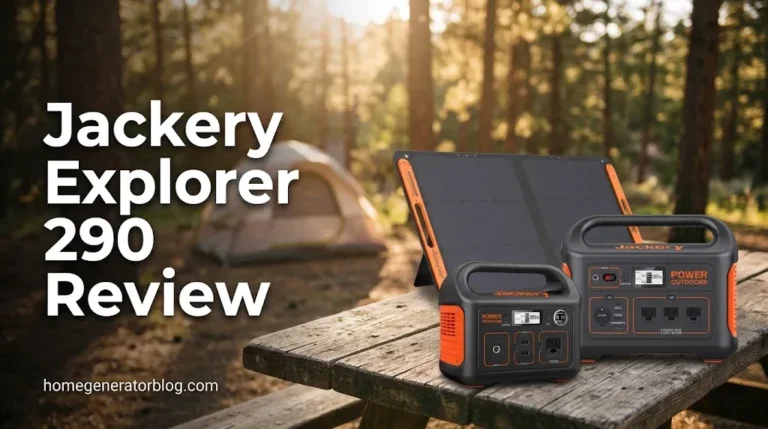
A Jackery portable generator is a rechargeable battery-powered power station designed to supply electricity without gasoline or diesel. It provides convenient portable power for camping, road trips, outdoor activities, and temporary household power outages.
Jackery offers multiple Explorer models to accommodate different energy requirements and budgets. Smaller units prioritize portability, while higher-capacity models support more demanding electrical appliances.
This Jackery portable generator review evaluates battery capacity, charging flexibility, practical performance, maintenance, and overall buying value using published manufacturer specifications rather than hands-on testing.
🏆 My Quick Verdict
Research-based assessment of the product range, not an Amazon customer rating or laboratory test score.
💡 Best For: Campers, RV travelers, remote workers, and homeowners seeking convenient battery-powered backup electricity.
⚡ Key Specs:
Selected Explorer models offer 288Wh to 2042Wh of battery capacity, with AC, DC, USB, and compatible solar charging options depending on the model.
✅ Bottom Line: Jackery delivers a practical alternative to conventional fuel-powered generators for moderate electricity requirements. Choosing sufficient battery capacity remains essential for satisfactory performance.

Jackery Portable Generator at a Glance
- Rechargeable battery operation eliminates gasoline storage and engine maintenance.
- Multiple capacity options accommodate recreational and emergency power requirements.
- Compatible solar panels enable off-grid battery recharging.
- Selected newer Explorer models incorporate lithium iron phosphate batteries.
- Different output connections accommodate compatible household appliances and personal electronics.
- Available runtime depends on battery capacity, appliance consumption, and conversion losses.
Jackery Portable Generator Specifications
Jackery Explorer specifications vary considerably between individual models. Comparing continuous output and battery capacity helps identify an appropriately sized power station.
| Model | Battery Capacity | Rated AC Output |
|---|---|---|
| Explorer 300 | 293Wh | 300W |
| Explorer 300 v2 | 288Wh | 300W |
| Explorer 600 v2 | 640Wh | 500W |
| Explorer 1000 v2 | 1070Wh | 1500W |
| Explorer 1000 Plus | 1264Wh | 2000W |
| Explorer 1500 v2 | 1536Wh | 2000W |
| Explorer 2000 v2 | 2042Wh | 2200W |
Specifications are based on the official Jackery buying guide. Confirm the exact model and regional electrical specifications before purchasing.
Design and Build Quality
Jackery portable power stations emphasize convenient transportation and straightforward access to electrical connections. Their enclosed construction integrates the battery, inverter, and charging electronics into one unit.
The recognizable orange-and-dark exterior makes Jackery products easy to distinguish. Integrated carrying handles on many Explorer models simplify transportation between vehicles, campsites, and indoor locations.
Display screens provide useful information about remaining battery charge and power consumption. These readings help users understand how connected equipment affects the available energy reserve.
Physical size and weight increase with battery capacity. Buyers who regularly move their power station should consider handling requirements alongside electrical performance.
Setup, Installation and Ease of Use
- Unpack the power station and inspect its enclosure, charging cables, and electrical ports for damage.
- Review the model-specific manual to understand operating limits and charging requirements.
- Recharge the battery using the supplied or manufacturer-approved charging equipment.
- Position the generator on a stable, dry surface with adequate ventilation.
- Connect compatible appliances after checking their operating wattage and startup requirements.
- Activate the appropriate output using the corresponding control button.
- Monitor remaining battery capacity and disconnect equipment that is no longer needed.
- Secure the power station during vehicle transportation and prevent movement around the cargo area.
- Store charging accessories separately in a clean, dry location when not in use.
Core Performance and Feature Breakdown
Jackery generator performance primarily depends on stored energy and inverter output. Understanding these two specifications prevents unrealistic runtime expectations.
Battery Capacity and Runtime
Battery capacity is measured in watt-hours and represents stored electrical energy. A larger battery can generally support the same appliance for a longer period.
For example, a 1070Wh Explorer 1000 v2 theoretically contains enough energy to operate a constant 100W load for approximately 10.7 hours. Actual runtime will be shorter because electrical conversion consumes energy.
Using an illustrative efficiency assumption of 85%, the following estimates demonstrate how appliance consumption affects runtime.
| Example Load | Estimated Runtime |
|---|---|
| 10W LED light | 90.9 hours |
| 50W fan | 18.2 hours |
| 65W laptop load | 14.0 hours |
| 100W constant load | 9.1 hours |
These figures are mathematical illustrations, not measured runtime results. Inverter standby consumption, environmental conditions, and variable appliance demand can reduce actual operating time.
AC Output and Appliance Compatibility
Continuous AC output determines which electrical appliances the station can support. Equipment exceeding the inverter rating may trigger overload protection.
Refrigerators, pumps, and other motor-driven appliances can require additional startup power. Their starting requirements must remain within the generator’s supported surge limits.
Solar Charging Performance
Compatible solar panels allow Jackery stations to replenish their batteries away from electrical outlets. Charging performance depends on panel capacity, sunlight intensity, orientation, and supported input limits.
Cloud cover and partial shading can substantially reduce available charging power. Solar charging should therefore be planned around realistic local weather conditions.
Expert Insight
Calculate your expected daily energy consumption in watt-hours before selecting a portable generator. An inverter capable of starting an appliance does not necessarily contain enough battery capacity to operate it throughout the day.
Key Features Explained
1. Rechargeable Lithium Battery
Jackery uses rechargeable lithium battery technology across its portable power station range. Newer products such as the Explorer 1000 v2 feature LiFePO4 chemistry, which is particularly suitable for frequent charging and discharging.
2. Integrated Battery Management System
Battery management electronics monitor operating conditions and help protect internal components against electrical abnormalities. These protective systems do not eliminate the need to follow temperature, charging, and ventilation requirements.
3. Multiple Charging Methods
Compatible Jackery models support charging from household outlets, vehicle connections, and solar panels. This flexibility allows owners to replenish stored electricity in different environments without depending on one charging source.
4. Dedicated Electrical Outputs
AC outlets, USB connections, and DC outputs provide different ways to power compatible equipment. Available connections and charging protocols vary, so confirm that the selected model supports your devices.
Real-World Usability and Maintenance
Jackery generators require relatively little routine maintenance because they contain no combustion engine. Owners avoid spark plug replacement, carburetor servicing, and engine oil changes.
Keep ventilation openings clean and inspect charging cables periodically for visible deterioration. Disconnect damaged accessories and arrange appropriate replacements before continuing operation.
For emergency preparedness, periodically check battery charge during extended storage. Follow the manufacturer’s storage temperature and recharge recommendations for the specific model.
Jackery Portable Generator Pros and Cons
Pros
- Produces no combustion exhaust during battery-powered operation.
- Provides a wide selection of capacities for different electricity requirements.
- Offers convenient access to electricity in locations without conventional outlets.
- Requires less routine mechanical maintenance than gasoline-powered generators.
Cons
- Stored energy can be depleted quickly by high-wattage appliances.
- Solar panels may require an additional purchase depending on the package.
- Larger models can be inconvenient to carry over considerable distances.
Common Jackery Portable Generator Issues and Fixes
Generator Is Not Charging
Loose connections, incompatible charging accessories, or unsuitable operating temperatures can interrupt charging. Inspect the connections, verify charger compatibility, and follow the manufacturer’s temperature requirements.
Battery Drains Faster Than Expected
Unexpectedly high appliance consumption or inverter standby losses can reduce runtime. Check the displayed output wattage and switch off unnecessary electrical connections.
AC Output Stops Working
An overload or protective shutdown may interrupt electrical delivery. Disconnect the appliance, allow the station to recover, and restart it according to the model-specific manual.
What to Know Before You Buy
A Jackery purchase should be based on actual energy requirements rather than the largest available inverter rating. Prepare a list of appliances and estimate their combined daily consumption.
- Battery chemistry: Confirm whether the selected model uses LiFePO4 or another lithium battery chemistry.
- Expansion compatibility: Only selected power stations support compatible additional battery modules.
- Package contents: Verify whether solar panels, charging adapters, and connection cables are included.
- Electrical requirements: Check regional voltage, frequency, and appliance startup wattage.
- Warranty coverage: Confirm the warranty applicable to the specific model, retailer, and purchase region.
For extended outages involving multiple large appliances, conventional generators may offer different operational advantages. Read our comparison of Jackery versus traditional generators before deciding which technology suits your household.
Who Should Buy It and Who Should Skip It?
✅ Who Should Buy It
- Campers needing electricity for lighting, fans, and communication equipment.
- Remote workers operating laptops and other compatible electronics away from outlets.
- Homeowners preparing for occasional short-duration electricity interruptions.
- RV travelers seeking supplemental electricity for compatible appliances.
✗ Who Should Skip It
- Households expecting uninterrupted whole-home electricity from a small portable station.
- Contractors operating machinery beyond the supported inverter capacity.
- Buyers requiring continuous high-wattage heating or cooling for extended periods.
- Users requiring dependable life-support or other safety-critical electrical backup.
Alternatives to Consider
EcoFlow and BLUETTI offer competitive alternatives in the approximately one-kilowatt-hour power station category.
EcoFlow DELTA 2
Best For: Users seeking flexible battery expansion and everyday appliance compatibility.
Main Advantage: Supports a compatible extra battery for increased energy storage.
Trade-off: Expanding capacity requires purchasing additional compatible equipment.
Key Spec: 1024Wh capacity and 1800W rated AC output.
BLUETTI AC180
Best For: Camping and moderate household backup requirements.
Main Advantage: Provides a combination of LiFePO4 battery chemistry and substantial AC output.
Trade-off: Its capacity remains limited for prolonged operation of demanding appliances.
Key Spec: 1152Wh capacity and 1800W rated AC output.
Outdoor enthusiasts can also compare additional options in our guide to the best portable solar generators for camping.
Is a Jackery Portable Generator Worth It?
A Jackery portable generator is worth considering when convenient access to stored electricity matters more than unlimited operating duration. Its value is particularly strong for users who frequently travel, camp, or work outside conventional electrical infrastructure.
Occasional users should evaluate whether a smaller model provides adequate functionality at a lower purchase cost. Frequent users may benefit from investing in greater storage capacity and a battery chemistry suited to repeated cycling.
Compare the complete package price, including any required charging accessories, against competing products before purchasing. The most economical choice is the station that meets your actual requirements without unnecessary capacity.
Final Verdict
Jackery portable generators represent a practical choice for recreational electricity and selected emergency backup applications. Their range of battery capacities makes it possible to match different usage requirements.
The Explorer 1000 v2 is a sensible starting point for buyers seeking a balance between stored energy and appliance compatibility. Choose a smaller or larger model according to your measured electricity consumption.
Frequently Asked Questions
Can a Jackery portable generator run a refrigerator?
Yes, suitably sized Jackery generators can operate compatible refrigerators. Check the refrigerator’s running wattage, startup surge, and expected daily energy consumption against the selected power station’s specifications.
What size Jackery generator should I buy?
The appropriate Jackery size depends on your appliance wattage and required runtime. Calculate total electricity consumption in watt-hours and select a model with sufficient battery capacity and inverter output.
Can you use a Jackery generator indoors?
Yes, Jackery battery-powered generators can generally be used indoors under approved operating conditions. Keep the unit dry, adequately ventilated, and away from excessive heat or combustible materials.
Does a Jackery portable generator come with solar panels?
Solar panels are included only in packages that specifically list them. Standard portable power station packages and solar generator bundles may contain different accessories.
How long is the Jackery generator warranty?
Jackery warranty coverage varies by model and purchase conditions. Selected newer models offer up to five years of coverage when eligible extended warranty terms apply.
What maintenance does a Jackery portable generator require?
Jackery generators primarily require proper battery storage, periodic charging, and basic cleaning. Follow the specific manufacturer’s manual for storage charge levels, temperature limits, and recommended recharge intervals.
Affiliate disclosure: HomeGeneratorBlog earns a small commission when you purchase through links on this page — at no extra cost to you. Our editorial process is independent: affiliate relationships never influence which products we recommend or how we rank them.

Hi, I’m Michael Turner. I own a generator workshop in the United States and founded HomeGeneratorBlog to share practical, hands-on guidance about generator installation, maintenance, troubleshooting, safety, and backup power solutions. My goal is to help homeowners make smarter, more confident decisions through clear and reliable information