What Is an Inverter Generator Parallel Kit? What’s Inside, How It Doubles Watts
Quick Answer
An inverter generator parallel kit is a cable set and outlet box that links two compatible inverter generators so they sync and act as one larger unit. It lets you combine their watts to run multiple appliances at once without buying a bigger, heavier generator.
What a Parallel Kit Does
- Syncs two units: The cables match voltage and frequency so the generators share the load safely.
- Combines watts: Two 2,200-watt units can deliver roughly 3,600 running watts together, minus a small loss.
- Adds a bigger outlet: Most kits add a 30-amp RV or twist-lock outlet you do not get on a small unit alone.
- Keeps portability: You carry two light units separately instead of lifting one heavy unit.
- Requires compatibility: Both generators need parallel ports and a kit made for that brand or model family.
Fast Check Before You Buy
- Check both manuals for parallel capability and the exact kit part number.
I learned the value of a parallel kit the hard way at a campsite. One small inverter would not start the RV air conditioner, even though it ran everything else fine.
This guide goes deeper than a product listing. You will learn what is inside the box, how syncing works, which kits fit which generators, and when a kit makes no sense at all.
In This Guide
- What Is an Inverter Generator Parallel Kit?
- What’s Inside a Parallel Kit?
- How Does a Parallel Kit Work?
- What Are the Different Types of Parallel Kits?
- Will a Parallel Kit Work With Your Generators?
- How Many Watts Do You Actually Get?
- When Do You Need a Parallel Kit — and When Don’t You?
- How Do You Choose the Right Parallel Kit?
- Frequently Asked Questions
What Is an Inverter Generator Parallel Kit?
An inverter generator parallel kit is a manufacturer-designed connection system that links two parallel-capable inverter generators into one power source. It does not add power on its own.
Think of it as a bridge. The bridge lets two small engines share one load safely and evenly.
Without that bridge, two generators would fight each other. Their voltage and frequency would drift, and connected appliances could get damaged.
That syncing is possible because of how inverter power is made. You can see the full path in this guide to how inverter generator technology works.
- Not a splitter: A simple Y-cord does not sync power and is not a substitute.
- Not universal: The kit must match the parallel ports on your specific models.
- Not for conventional generators: Open-frame non-inverter units rarely support this system.
Section Takeaway: A parallel kit is a syncing bridge, not a power booster. It only works when both generators were built for parallel operation.
What’s Inside a Parallel Kit?
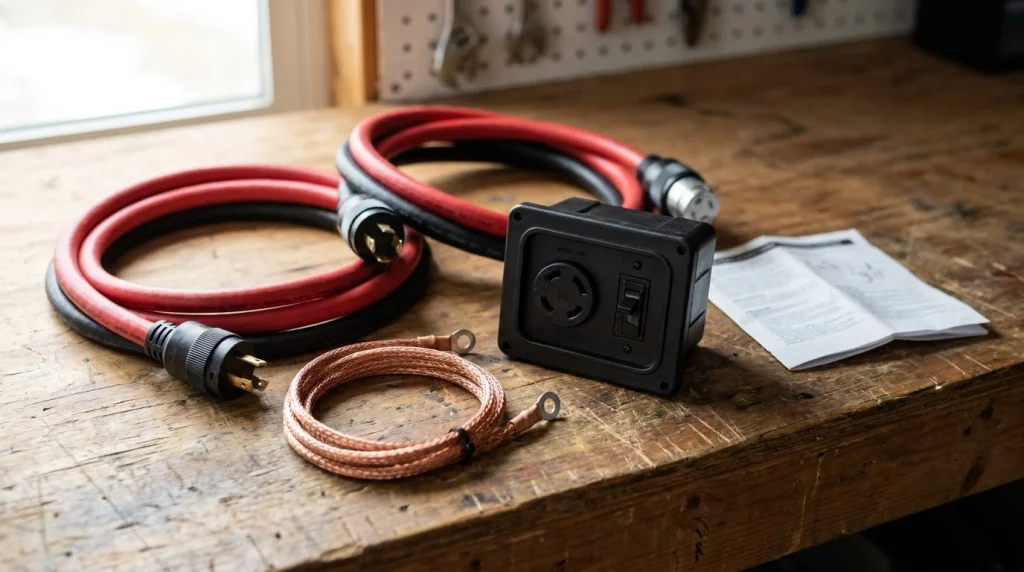
Most kits contain two parallel cables, a grounding wire, and an outlet box or panel. Some kits are just cables because the outlet already sits on one generator.
I have opened kits that looked almost identical on a shelf. The plugs inside told a different story once I tried to fit them.
- Parallel cables: Two color-coded leads that plug into the parallel ports on each unit.
- Ground wire: A wire that connects both frames so they share a common ground.
- Outlet box: A small panel with a 30-amp outlet, and sometimes standard 120V outlets.
- Circuit breaker: Protection on the outlet box that trips instead of overloading the pair.
- Instructions: The start order and connection order for that specific brand.
Better kits feel solid in your hand. The cables stay flexible in cold weather, and the plugs lock in without forcing.
Cheap kits often skimp there. Loose plugs can arc, overheat, or drop out under load.
How Does a Parallel Kit Work?
A parallel kit works by letting the two inverter modules talk to each other through the parallel cables. They lock voltage, frequency, and phase together before power reaches the outlet.
Once locked, the pair shares the load. If your load rises, both engines respond together.
The connection order that matters
- Place both generators outdoors on level ground, at least a few feet apart.
- Connect the ground wire and parallel cables with both units off.
- Plug your load into the kit outlet, but leave the load switched off.
- Start one generator, let it stabilize, then start the second one.
- Turn the load on last, starting with the largest appliance first.
Safety note: Run both generators outdoors only, well away from windows and doors. Carbon monoxide can build up fast, and guidance from the U.S. Consumer Product Safety Commission stresses outdoor placement for every generator.
Shutdown reverses the order. Turn the load off first, then shut down the generators, then unplug the cables.
Section Takeaway: The kit syncs first and delivers power second. Follow the start order in your manual, because skipping it is where most problems begin.
What Are the Different Types of Parallel Kits?
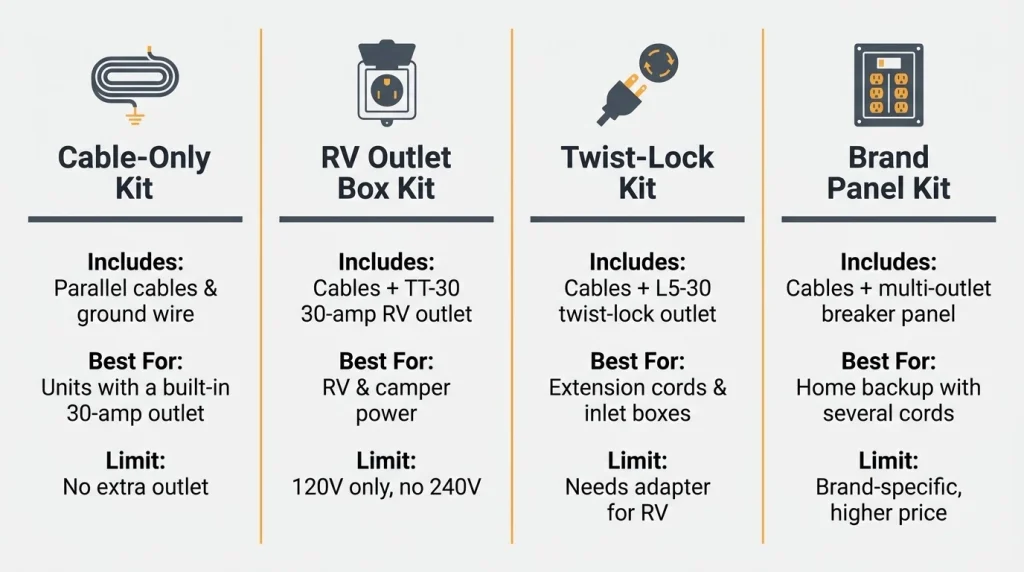
There are three common types: cable-only kits, kits with a 30-amp RV outlet box, and kits with a twist-lock outlet for transfer use. Your choice depends on what you plan to plug in.
| Kit Type | What You Get | Best For | Limit |
|---|---|---|---|
| Cable-only kit | Parallel cables and ground wire only | Pairs where one unit already has a 30-amp outlet | No extra outlet if neither unit has one |
| RV outlet box kit | Cables plus TT-30 30-amp RV outlet | RV and camper power | 120V only, no 240V loads |
| Twist-lock kit | Cables plus L5-30 or similar twist-lock outlet | Extension cords and inlet boxes | Needs an adapter for direct RV plug-in |
| Firman / brand panel kit | Cables plus panel with breakers and multiple outlets | Home backup with several cords | Brand-specific plugs, higher price |
Most RV owners pick the TT-30 box. It plugs straight into the shore-power cord with no adapter hunt.
Home users often prefer a twist-lock. It connects more cleanly to a heavy extension cord or inlet.
Will a Parallel Kit Work With Your Generators?
A parallel kit will work only if both generators have parallel ports and the manufacturer lists them as parallel-capable. Same-brand pairs are the safest bet.
Some brands allow different wattages from the same family. Others require matching models, so check both manuals before you spend anything.
- Check the ports: Look for covered parallel outlets on the front panel of each unit.
- Check the manual: Search for the exact kit name or part number the maker specifies.
- Check the brand rule: Honda, Yamaha, Champion, WEN, and Generac each use different plugs and logic.
- Check wattage pairing: A mismatched pair is usually limited by the smaller unit’s output.
Cross-brand pairing gets asked about a lot. Even when plugs can be adapted, the sync electronics may not cooperate, and warranties can be voided.
My rule stays simple. If the maker does not list the pair, I do not run the pair.
Section Takeaway: Compatibility is decided by the manufacturer, not by plug shape. Confirm ports, model family, and the specified kit before you buy.
How Many Watts Do You Actually Get?
You get close to the combined running watts of both units, not quite double the starting watts. Plan on about 80 to 90 percent of the simple added total for real loads.
Two 2,000-watt running units might give you about 3,200 to 3,600 usable watts. That is often enough for a 13,500 BTU RV air conditioner plus a fridge.
For exact AC math, see what size inverter generator can run an RV air conditioner. Starting watts still decide whether the compressor kicks on.
- Running watts matter most: Use the lower running figure for steady loads.
- Altitude lowers output: Expect less power in the mountains, as of 2026 guidance in most manuals.
- Heat lowers output: A pair baking in sun will not hold its rated load as well.
- 240V is separate: Most small parallel pairs still give 120V only, unlike models covered in whether an inverter generator can provide 240V power.
Do not plan to run at 100 percent all day. Leave a 20 percent buffer and the pair will run quieter and last longer.
When Do You Need a Parallel Kit — and When Don’t You?

You need a parallel kit when one small inverter is not quite enough, but one large generator feels too heavy or loud. RV travel is the classic case.
That is why parallel pairs show up so often in guides to the best portable generators for RV camping. You run one unit at night and both units for AC at midday.
Good reasons to buy a kit
- You already own one parallel-capable unit and need a bit more power.
- You want to lift two 45-pound units instead of one 90-pound unit.
- You want backup if one unit fails or needs service.
- You camp often and only need full power for a few hours a day.
Reasons to skip the kit
- You need 240V power for a well pump or dryer.
- You need 5,000 running watts or more every day.
- Your current generator has no parallel ports.
- You would rather fuel and maintain one engine, not two.
In that last case, compare a single larger unit from the best inverter generators list instead. One unit can be simpler and cheaper overall.
Fuel use also matters for the planet and your wallet. The EPA notes that running only the power you need cuts wasted fuel, and a single unit on light loads does that well.
Section Takeaway: A kit shines for flexible, part-time extra power. For constant high loads or 240V needs, buy a single larger generator instead.
How Do You Choose the Right Parallel Kit?
Choose the kit your generator manufacturer specifies for your exact models first. Then check the outlet type, cable length, and breaker rating.
- Brand and model fit: Match the kit part number to both manuals.
- Outlet type: Pick TT-30 for RVs or twist-lock for home cords.
- Breaker rating: Confirm the kit breaker matches the combined output you plan to use.
- Cable length: Longer cables give safer spacing between the two hot, running units.
- Build quality: Look for thick insulation, strain relief, and plugs that seat firmly.
Price is the last filter, not the first. A cheap kit that does not sync cleanly is not a bargain, as testing coverage from Consumer Reports on generator safety keeps reminding buyers.
Store the kit dry and coiled loosely. Cracked insulation or bent pins will cause faults you will chase for hours.
Frequently Asked Questions
Can you use any parallel kit with any inverter generator?
No, parallel kits are brand and model specific because plugs and sync electronics differ. Use only the kit your manufacturer lists for your pair. Adapting a different kit can cause poor sync, damage, or a voided warranty.
Do you need two identical generators for a parallel kit?
Not always, but identical models are the simplest and safest pairing. Some brands allow two different wattages from the same family, with output limited by the smaller unit. Check both manuals for the approved combinations.
Does a parallel kit give you 240V power?
Most small parallel kits give 120V only, even when they add a 30-amp outlet. A few larger manufacturer systems can provide 240V, but they are model specific. Never assume 240V is available from a standard kit.
Can you run only one generator while the kit is connected?
Follow your manual, because some kits allow single-unit use and others do not. In most setups, you disconnect the kit to run one unit alone at its normal outlets. That gives you the quiet, fuel-saving option for light loads.
How much does an inverter generator parallel kit cost?
Most genuine kits fall in a general range from about $50 to $150, depending on outlet type and brand. Cable-only kits cost less, and panel kits cost more. Check the maker’s current listing for the exact price for your model.
Can you make your own parallel cables?
You should not make your own parallel cables unless you fully understand the sync system for your models. A wiring mistake can damage both inverter modules or create a shock risk. A listed manufacturer kit is the safer choice.
A parallel kit turns two easy-to-carry inverters into one flexible power system. Buy the specified kit, follow the start order, and leave a watt buffer.
Start by checking your manual for parallel capability today. That one check will tell you if a kit is even an option for your setup.

Hi, I’m Michael Turner. I own a generator workshop in the United States and founded HomeGeneratorBlog to share practical, hands-on guidance about generator installation, maintenance, troubleshooting, safety, and backup power solutions. My goal is to help homeowners make smarter, more confident decisions through clear and reliable information