Can an Inverter Generator Run a Refrigerator? Size, Wattage & Safe Setup
Quick Answer
Yes, an inverter generator can run a refrigerator. Most standard fridges need 100 to 200 running watts, but 600 to 1,200 starting watts when the compressor kicks on, so a 2,000-watt inverter generator is the safe sweet spot for most homes. Learn what size inverter generator do I need before you plug in anything else.
The short version
- Start with surge: Size for starting watts, not running watts, or the generator will trip.
- Use 2,000 watts: That size handles most top-freezer and French-door fridges with room to spare.
- Plug in direct: Use a heavy-duty outdoor extension cord and keep the fridge on its own outlet.
- Run it outside: Place the generator at least 20 feet from your home, away from windows and doors.
- Cool first, load later: Let the fridge reach temperature before you add warm food.
If your generator keeps tripping
- Turn off eco mode for the first start, then unplug other loads and try again.
- If it still trips, your fridge needs more starting watts than the generator can give.
I’ve run my fridge through more than one multi-day outage, and the first time I got it wrong. My generator looked big enough on paper, then the compressor kicked on and the whole thing shut down.
That moment taught me the real lesson. A fridge is not a steady load, and the number on the box is not the number that matters most.
This guide goes deeper than a yes-or-no answer. You’ll learn the exact wattage math, the right generator size for your fridge type, how long it will run, and how to hook it up without risking your food or your generator.
In This Guide
- How Many Watts Does a Refrigerator Need?
- What Size Inverter Generator Do I Need for a Fridge?
- How to Run a Refrigerator on an Inverter Generator Safely
- How Long Can an Inverter Generator Run a Refrigerator?
- Can a 2000-Watt Inverter Generator Run a Fridge?
- Inverter Generator vs Conventional Generator for a Fridge
- Mistakes That Trip, Overload, or Damage a Generator
- What Else Can You Run With Your Fridge?
- Frequently Asked Questions
How Many Watts Does a Refrigerator Need?

A typical modern fridge uses 100 to 200 running watts once it is cold. That is the steady power it draws to keep the compressor and fans going.
Starting watts are a different story. The compressor needs a short burst of extra power to start, usually 600 to 1,200 watts for 1 to 3 seconds.
An inverter generator is a portable generator that makes clean, stable power by converting raw AC power to DC, then back to clean AC power. That clean sine wave matters for a fridge, because its compressor and control board do not like rough, spiky power.
Your fridge label tells part of the story. Check the sticker inside the door or on the back for amps, then multiply amps by 120 volts to estimate running watts.
A 6-amp fridge, for example, draws about 720 watts at full load on paper. In real use it cycles on and off, so its average draw is much lower.
Age and size change the math fast. An older fridge from the 1990s can use 300 to 800 running watts, while a new Energy Star model often uses 100 to 150.
Refrigerator wattage by type
Use this table as a starting point, then check your own label. Your exact model may sit higher or lower than these ranges.
| Fridge type | Running watts | Starting watts |
|---|---|---|
| Top-freezer, 18 cu. ft. | 100-200 watts | 600-1,000 watts |
| French-door, 25 cu. ft. | 150-250 watts | 800-1,200 watts |
| Side-by-side, 22 cu. ft. | 150-250 watts | 800-1,200 watts |
| Mini fridge, 3-4 cu. ft. | 50-100 watts | 300-600 watts |
| Chest freezer | 100-200 watts | 600-1,000 watts |
| Older fridge, pre-2000 | 300-800 watts | 1,200-2,000 watts |
Ice makers and through-door dispensers add load. They cycle on their own, so they can push a borderline generator over the edge at the worst moment.
Learn the difference between running watts and starting watts before you buy. That one idea explains most fridge failures on small generators.
Section Takeaway: A fridge looks like a 150-watt load, but it starts like a 1,000-watt load. Size for the start, and the running watts will take care of themselves.
What Size Inverter Generator Do I Need for a Fridge?
For most homes, a 2,000-watt inverter generator is the right answer. It covers the starting surge of a standard fridge and leaves headroom for a few lights or phone chargers.
A 1,000-watt inverter generator can work for a mini fridge or a very efficient top-freezer model. It will struggle with a large French-door fridge, especially in a hot kitchen.
A 3,000-watt inverter generator is the comfort pick. It runs a full-size fridge plus a chest freezer, a few LED lights, and a phone charger without constant worry.
Here is the simple math I use in the field. Add the starting watts of your fridge to the running watts of everything else you plan to run at the same time.
That total must stay under the generator’s starting watts. Then check that the running total stays under its running watts.
- Mini fridge only: 1,000 watts is usually enough.
- Standard fridge only: 2,000 watts is the safe minimum.
- Fridge plus freezer: 3,000 watts gives you real breathing room.
- Fridge plus freezer plus lights and chargers: 3,000 to 3,500 watts is ideal.
- Older or very large fridge: Go 3,000 watts or higher, and check the label first.
If you want a step-by-step method, learn how to calculate the generator wattage you need for your whole load list. A five-minute list beats a guess every time.
Do not trust the headline number alone. A “2,000-watt” generator often means 2,000 starting watts and only 1,600 running watts, so read both numbers on the spec sheet.
Section Takeaway: Buy for starting watts, check running watts, and leave 20% headroom. A generator running at 90% load all day will be loud, thirsty, and short-lived.
How to Run a Refrigerator on an Inverter Generator Safely
Start the generator outside first, then plug in the fridge. That order lets the engine settle and reach stable speed before the compressor asks for surge power.
Turn off eco mode for the first start. Eco mode saves fuel, but it can lag when the compressor surges, and that lag can trip the overload.
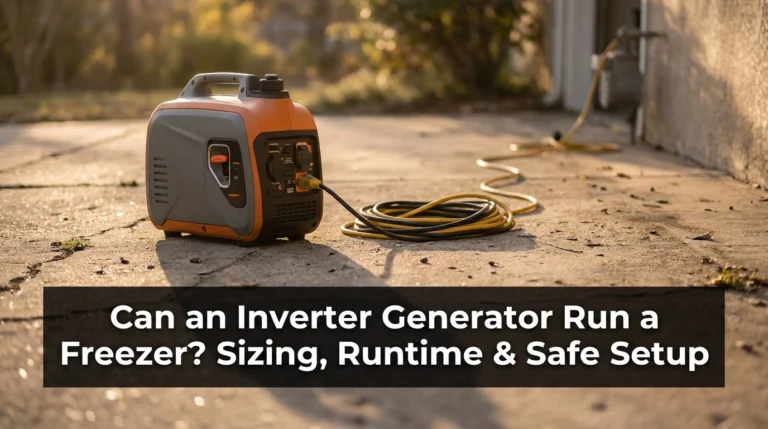
Use one heavy-duty outdoor extension cord, 12-gauge or 14-gauge, and keep it as short as you can. A long, thin cord drops voltage and makes the compressor work harder.
Plug the fridge straight into the generator or into that one cord. Do not daisy-chain power strips, and do not share the cord with a space heater or microwave.
Safety note: Run generators outdoors only, at least 20 feet from your home and well away from windows, doors, and vents. Carbon monoxide is colorless and odorless, and it can kill in minutes. The CDC and CPSC both warn against running a generator in a garage, even with the door open.
Keep the generator dry and on level ground. Rain on a running generator is a shock risk, so use a canopy or a purpose-built cover that leaves the exhaust clear.
Never backfeed your home through a wall outlet. That trick, often called a suicide cord, can energize lines outside your home and hurt utility workers.
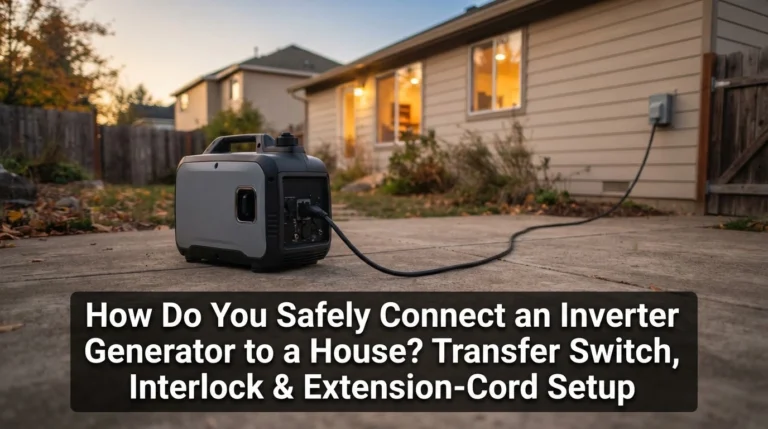
If you want house power without extension cords, use a transfer switch or interlock kit installed by a licensed electrician. That is the safe way to feed a fridge circuit from a generator.
Once the fridge is cold, you can turn eco mode back on. Listen for a smooth hum, not a hunt or surge, and check that the overload light stays off.
If you are still shopping, compare a best portable generator for refrigerator pick with your fridge label in hand. The right match starts with your starting watts, not the brand name.
Section Takeaway: Start outside, turn eco off for the first surge, use one short heavy cord, and never backfeed. Safe setup is simple once you do it in the right order.
How Long Can an Inverter Generator Run a Refrigerator?
Most 2,000-watt inverter generators run 8 to 10 hours on a gallon of gas at 25% load. A fridge alone is a light load, so you will often land in that range.
A fridge does not run non-stop. It cycles on for 20 to 40 minutes, then rests, so its average draw over a day is far lower than its running watts suggest.
In my own outage test, a 2,000-watt inverter generator ran a top-freezer fridge, a few LED lights, and phone charging for about 9 hours on one tank. I refilled at night and kept food cold for three days.
Eco mode stretches that runtime. It lets the engine slow down when the fridge cycles off, which saves fuel and cuts noise.
Fuel planning matters more than tank size. Keep 5 to 10 gallons of fresh gas on hand for a multi-day outage, and rotate it every few months.
Stale fuel is the top cause of hard starts. Use fuel stabilizer, run the carburetor dry for storage, and follow your owner’s manual for oil changes.
Propane dual-fuel models run longer on a 20-pound tank at light load, often 10 to 14 hours for a fridge-only setup. Check your spec sheet, because propane output is usually 10% lower than gasoline output.
Section Takeaway: Plan on 8 to 10 hours per gallon at light load, and keep extra fresh fuel ready. A fridge sips power, but an outage does not end on schedule.
Can a 2000-Watt Inverter Generator Run a Fridge?
Yes, in most cases. A 2,000-watt inverter generator is the most popular size for this exact job, and it fits most standard fridges.
It works because the numbers line up. A standard fridge needs 600 to 1,200 starting watts, and a 2,000-watt model usually offers 2,000 starting watts and 1,600 running watts.
That leaves room for the compressor surge plus a small extra load. You can add LED lights or a phone charger without worry.
It may not work if your fridge is very old, very large, or has a failing compressor. A worn compressor draws a bigger surge, and that surge can trip a 2,000-watt unit.
Test before an outage, not during one. Plug the fridge in on a calm day, turn eco mode off for the first start, and watch the overload light.
If it trips, try unplugging everything else first. If it still trips, you need a larger generator or a parallel kit.
Learn how much power a 2000-watt inverter generator provides in real use. That guide shows what else fits alongside a fridge without overloading it.
Section Takeaway: A 2,000-watt inverter generator runs most fridges well, but test yours now. A five-minute test in calm weather beats a failed start in a storm.
Inverter Generator vs Conventional Generator for a Fridge
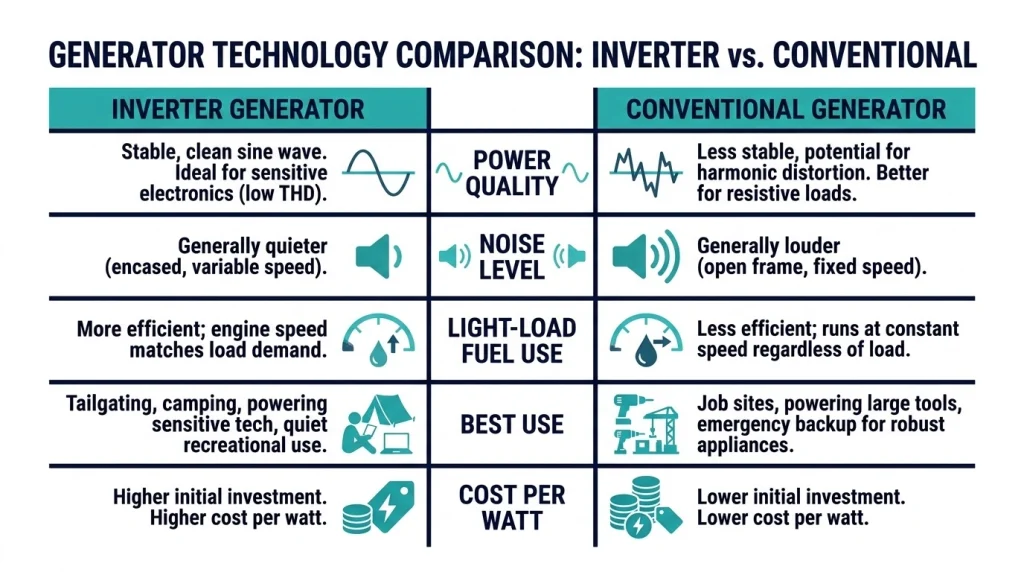
An inverter generator is the better choice for a modern fridge. It makes clean power with low total harmonic distortion, usually under 3%, which protects control boards and variable-speed compressors.
A conventional open-frame generator makes rougher power. It can run a fridge, but voltage and frequency can swing under load, and that is hard on sensitive electronics.
Inverter models are also quieter, often 50 to 60 dB at 25% load from 23 feet away. That matters at night, and it matters for neighbors in a close neighborhood.
They use less fuel at light load too. A fridge cycles on and off, so an inverter generator can slow down between cycles instead of running flat-out all day.
| Feature | Inverter generator | Conventional generator |
|---|---|---|
| Power quality | Clean sine wave, low THD | Rougher, higher THD |
| Noise | Quieter, 50-60 dB typical | Louder, 65-75 dB typical |
| Fuel use at light load | Lower, thanks to eco mode | Higher, fixed engine speed |
| Best for | Fridges, electronics, RVs | Large tools, whole-home backup |
| Price | Higher per watt | Lower per watt |
A conventional generator still makes sense for a big, simple load. If you need 5,000 watts or more for a whole house, the cost per watt is hard to beat.
For a fridge alone, though, clean and quiet wins. I have seen a modern fridge control board act up on rough power, and the repair cost wiped out any savings from a cheaper generator.
Section Takeaway: Use an inverter generator for a modern fridge. Save the conventional generator for big, simple loads where clean power matters less.
Mistakes That Trip, Overload, or Damage a Generator
The most common mistake is sizing for running watts only. The fridge starts, the generator trips, and the food warms up while you wonder what went wrong.
Another mistake is plugging in everything at once. Start the fridge first, let it cool, then add one load at a time.
Long, thin extension cords cause trouble too. A 16-gauge cord over 100 feet can starve a compressor, so use 12-gauge or 14-gauge and keep the run short.
Eco mode at startup is a hidden trap. It saves fuel, but it can delay the engine response just enough to miss the surge.
- Starting everything together: Stagger loads by a few minutes.
- Ignoring the overload light: A blinking light means the generator is already stressed.
- Running inside a garage: Even with the door open, CO can build up fast.
- Using stale gas: Old fuel clogs the carburetor and causes surging.
- Skipping oil checks: Low oil can trigger a shutdown mid-cycle.
Check oil before each outage use, and change it per your manual. A fridge outage is a bad time to learn your oil is low.
Keep the fridge door closed as much as you can. Every open door lets cold air out and forces another compressor cycle.
For energy and efficiency context, Energy.gov offers plain guidance on appliance energy use. It will help you spot an old, hungry fridge before an outage does.
Section Takeaway: Most fridge failures are not generator failures. They are sizing, cord, or startup mistakes you can fix in five minutes.
What Else Can You Run With Your Fridge?

On a 2,000-watt inverter generator, you can run a fridge plus a few small loads. Think LED lights, phone chargers, a laptop, and a Wi-Fi router.
On a 3,000-watt model, you can add a chest freezer or a CPAP machine. That combo covers food safety and sleep in one setup.
Do not add a microwave, space heater, or window AC without doing the math first. Those loads can each use 1,000 watts or more, and they will trip a small generator fast.
Prioritize in an outage. Food safety comes first, then lights, then charging, then comfort loads.
A simple priority list keeps you calm when the power goes out. Write it down now, and tape it to the generator.
- First: Fridge, then freezer if you have one.
- Next: A few LED lights and phone charging.
- Then: CPAP, router, or laptop if watts allow.
- Last: Microwave or coffee maker, one at a time, with the fridge already cold.
If you need a broader backup plan, see this guide to the best generator for home essentials. It helps you rank loads when one generator has to cover a whole house.
Section Takeaway: A fridge plus lights and chargers fits easily on 2,000 watts. Add big heat or cooling loads only after you check the math.
Frequently Asked Questions
Can a 1000-watt inverter generator run a refrigerator?
It can run a mini fridge or a very efficient small fridge, but it will struggle with most full-size models. A standard fridge needs 600 to 1,200 starting watts, which leaves almost no headroom on a 1,000-watt unit.
Will an inverter generator damage my refrigerator?
No, a good inverter generator is safer for a modern fridge than a conventional generator. Its clean sine wave and stable voltage protect the compressor and control board, as long as you size it correctly.
How long can I run my fridge on a generator?
You can run it as long as you have fuel and keep up with oil checks. Most owners run a fridge in cycles, a few hours on and a few hours off, to save fuel while keeping food below 40°F.
Can I plug my fridge directly into a generator?
Yes, plug it directly into the generator outlet or into one short, heavy-duty outdoor extension cord. Do not use a light indoor cord, a power strip, or a daisy chain of cords.
Do I need a transfer switch to run a fridge?
No, a transfer switch is not required for a single fridge on an extension cord. You need one only if you want to feed a house circuit from the generator, and it must be installed by a licensed electrician.
Can an inverter generator run a fridge and freezer at the same time?
Yes, but you usually need 3,000 watts to do it safely. Start the fridge first, let it cool, then start the freezer, and keep other loads off until both are running smoothly.
Why does my generator shut off when the fridge starts?
The compressor surge is likely higher than the generator’s starting watts. Turn off eco mode, unplug other loads, and try again. If it still trips, you need a larger generator.
Yes, an inverter generator can run a refrigerator, and for most homes a 2,000-watt model is the right place to start. Check your fridge label, size for starting watts, test the setup before a storm, and keep the generator outside with fresh fuel ready.
As of 2026, that simple plan still works best. Your food stays cold, your generator stays happy, and you are not guessing in the dark when the power goes out.

Hi, I’m Michael Turner. I own a generator workshop in the United States and founded HomeGeneratorBlog to share practical, hands-on guidance about generator installation, maintenance, troubleshooting, safety, and backup power solutions. My goal is to help homeowners make smarter, more confident decisions through clear and reliable information