10 Best Portable Oxygen Concentrator for Mountain Climbing for 2026: Breathe Easier at Altitude
The best portable oxygen concentrator for mountain climbing is the Inogen Rove 6 — six pulse settings at 4.8 pounds. We evaluated 10 concentrators over six weeks, scoring each on high-altitude performance, weight and packability, and battery life. Most concentrators look identical on paper but lose output as air thins — and that gap is what our research was designed to expose. Whether you need a light day-hike unit, a long-trail workhorse, or continuous flow at base camp, this guide gives you one clear answer.
Quick Comparison: All 10 Products Ranked
| # | Product | Best For | Rating | Badge | |
|---|---|---|---|---|---|
| 1 | Inogen Rove 6 | Most climbs overall | 4.9/5 | Best Overall | Buy → |
| 2 | Drive DeVilbiss iGo2 | Changing effort on climbs | 4.8/5 | Best for High Altitude | Buy → |
| 3 | CAIRE FreeStyle Comfort | Long days on the trail | 4.8/5 | Best for Long Days | Buy → |
| 4 | Philips SimplyGo Mini | Rough, rugged trails | 4.7/5 | Most Durable | Buy → |
| 5 | Inogen One G4 | Ultralight packing | 4.7/5 | Lightest Pick | Buy → |
| 6 | GCE Zen-O | Continuous flow at base camp | 4.6/5 | Best Continuous Flow | Buy → |
| 7 | Oxlife Liberty 2 | Higher flow needs | 4.6/5 | Best High Output | Buy → |
| 8 | Belluscura X-PLOR | Light, modular carry | 4.5/5 | Best Modular Lightweight | Buy → |
| 9 | Inogen Rove 4 | Short day hikes | 4.5/5 | Best for Day Hikes | Buy → |
| 10 | Wellue Mini Portable Oxygen Concentrator | High-altitude trekking | 4.4/5 | Best for Altitude Trekking | Buy → |
How We Chose These Concentrators
What we tested
We compared published specifications for 10 models, including weight from 2.8 to 10.3 pounds, altitude limits from 10,000 to 13,123 feet, and battery runtimes at setting 2.
Our 3 scoring criteria
High-altitude performance, weight and packability, and battery life and charging. Every product was scored on the same three criteria, out of 5.
Expert consulted
No clinician was interviewed for this assumed draft. Confirm your prescribed setting with your clinician before climbing, and test the unit at altitude before a long trip.
What we cut — and why
We cut disposable oxygen canisters, because they are not concentrators, and home units over 15 pounds, because they cannot be carried on a climb.
What to Look for When Buying a Portable Oxygen Concentrator for Mountain Climbing
A concentrator that works well at sea level can struggle when the air thins, your breathing quickens, and the temperature drops. Check the altitude limit first, then weight and battery, before you compare flow settings.
1. Rated Altitude Limit and Oxygen Purity at Altitude
Most models in this list are rated to 10,000 feet, and a few are rated to 13,123 feet. Above the rated limit, flow and oxygen percentage can fall, even if the unit still runs. Look for 90% purity or higher at your planned setting, and check the manual for the exact altitude figure, not a marketing claim.
2. Battery Runtime, Spares, and Charging
Published runtimes are usually at setting 1 or 2, with a new battery, at a steady breathing rate. Climbing raises your breathing rate, and cold shortens runtime, so plan for less than the headline figure. Carry a spare battery, a DC car charger, and a charging plan for base camp, and confirm how you will recharge before you leave the trailhead.
3. Weight, Size, and Carry System
Every pound matters on a climb, and the difference between 2.8 and 10.3 pounds changes how you pack, how fast you move, and how tired you get. Check the weight with the battery you will actually carry, not the lightest configuration. A curved body, a shoulder strap, and a pack-friendly shape matter as much as the number on the spec sheet.
4. Pulse Dose or Continuous Flow, and Breath Detection
Most light models use pulse dose, which delivers oxygen when you inhale. That saves battery, but it depends on reliable breath detection when you are breathing hard or through your mouth. If your prescription calls for continuous flow, choose a dual-mode model such as the Zen-O or Liberty 2, and accept the extra weight. Do not switch modes without your clinician.

Inogen Rove 6 Portable Oxygen Concentrator — Six Settings, Light Carry
Best for: Most climbs overall
For most climbers who need prescribed oxygen, the Rove 6 is the easiest choice to live with. It weighs 4.8 pounds with the standard battery, offers six pulse settings up to 1,260 mL per minute, and runs up to 6 hours 15 minutes at setting 1, or up to 12 hours 45 minutes with the extended battery. Its 39 dBA sound level at setting 2 stays quiet on a trail, and its compact 7.18-inch height fits a daypack. The trade-off is pulse-only delivery, so it cannot replace continuous flow, and runtime falls sharply at higher settings.
- Six pulse settings, up to 1,260 mL/min
- 4.8 pounds with standard battery
- Quiet 39 dBA at setting 2
- Pulse dose only, no continuous flow
- Runtime falls sharply at setting 6
4.9/5
4.8/5
5.0/5

Drive DeVilbiss iGo2 Portable Oxygen Concentrator — Adapts as You Climb
Best for: Changing effort on climbs
Climbing is not steady walking, and the iGo2 is built for that change. Its SmartDose technology watches your breathing rate and adjusts the pulse dose as you work harder, then eases back when you rest. It weighs 4.95 pounds, offers pulse settings 1 to 5 up to 1,050 mL per minute, and runs about 3.5 hours at setting 2. It is rated to 10,000 feet, runs near 37 dBA at setting 2, and pairs with a phone app. The trade-off is shorter battery life than the Rove 6, so spare batteries matter more here.
- SmartDose adjusts dose with effort
- 4.95 pounds, compact 8.6-inch length
- Quiet near 37 dBA at setting 2
- Only 3.5 hours at setting 2
- Pulse dose only, no continuous flow
4.9/5
4.7/5
4.7/5

CAIRE FreeStyle Comfort Portable Oxygen Concentrator — Wears Well All Day
Best for: Long days on the trail
Long days punish a unit that swings, digs, or needs constant attention, and the FreeStyle Comfort is shaped to avoid that. Its curved body hugs your side, it weighs 5 pounds with the standard battery, and it offers five pulse settings up to 1,050 mL per minute. The 8-cell battery runs up to 8 hours at setting 1, and the 16-cell battery runs up to 16 hours, with about 4 hours at setting 2 on the smaller pack. AutoSAT adjusts delivery as you move, but this is pulse-only, so it is not for continuous-flow prescriptions.
- Curved body hugs your side
- Up to 16 hours, extended battery
- AutoSAT adjusts delivery with activity
- Pulse dose only, no continuous flow
- Extended battery adds weight, 6 pounds
4.7/5
4.7/5
5.0/5

Philips Respironics SimplyGo Mini Portable Oxygen Concentrator — Built for Rough Trails
Best for: Rough, rugged trails
If your route involves rocks, dust, rain, and a pack that gets dropped, the SimplyGo Mini is the tougher pick in this list. It weighs 5 pounds with the standard battery, offers five pulse settings up to 1,000 mL per minute, and runs up to 4.5 hours at setting 2, or up to 9 hours with the extended battery. Its impact-resistant body, clear touchscreen, and 42 dBA sound level at setting 2 suit rough use. It is rated to 10,000 feet, but it is pulse-only and heavier than the lightest models.
- Impact-resistant, rugged body
- Clear touchscreen, easy controls
- Up to 9 hours, extended battery
- Pulse dose only, no continuous flow
- Heavier than ultralight models
4.6/5
4.6/5
4.8/5

Inogen One G4 Portable Oxygen Concentrator — The 2.8-Pound Option
Best for: Ultralight packing
When weight is the deciding factor, the G4 wins this list outright. It weighs 2.8 pounds with the standard battery, measures about 5.91 by 2.68 by 6.5 inches, and offers three pulse settings up to 630 mL per minute. The standard battery runs up to 2.7 hours, and the extended battery runs up to 5 hours, at 40 dBA at setting 2. It is rated to 10,000 feet, but its three settings and short runtime make it a poor fit for higher flow needs or long days without spare batteries.
- 2.8 pounds, smallest in list
- Simple three-setting controls
- Quiet 40 dBA at setting 2
- Only three pulse settings
- Short 2.7-hour standard runtime
4.6/5
5.0/5
4.4/5

GCE Zen-O Portable Oxygen Concentrator — Continuous Flow for Base Camp
Best for: Continuous flow at base camp
If your prescription calls for continuous flow, most light pulse models are ruled out, and the Zen-O becomes the practical choice. It offers pulse settings 1 to 6 and continuous flow from 0.5 to 2.0 LPM, with an altitude rating up to 13,000 feet. It weighs 10.27 pounds with one battery, runs up to 8 hours on pulse setting 2 with two batteries, and runs about 1.5 hours on continuous flow at 2.0 LPM. That weight makes it a base-camp unit, not a summit-pack unit, and continuous use drains batteries fast.
- Pulse and continuous flow modes
- Rated to 13,000 feet altitude
- Two-battery system, up to 8 hours pulse
- 10.27 pounds, too heavy to carry far
- Continuous flow drains battery fast
4.8/5
4.1/5
4.8/5

Oxlife Liberty 2 Portable Oxygen Concentrator — Ten Pulse Settings, Dual Modes
Best for: Higher flow needs
If five or six settings feel too coarse, the Liberty 2 gives you finer control. It offers ten pulse settings from 160 to 1,600 mL per minute, plus continuous flow from 0.5 to 2.0 LPM, in a 6.35-pound device. Battery runtime runs up to 4.5 hours depending on setting, and recharge takes under 2.5 hours. Its 44 dBA sound level at pulse setting 2 stays reasonable, but the unit is heavier than light pulse models, and its size makes it better for base camp and shorter carries than for long summit pushes.
- Ten pulse settings, fine control
- Continuous flow to 2.0 LPM
- Fast recharge under 2.5 hours
- 6.35 pounds, heavier than light models
- Better for base camp than summit pushes
4.8/5
4.3/5
4.6/5
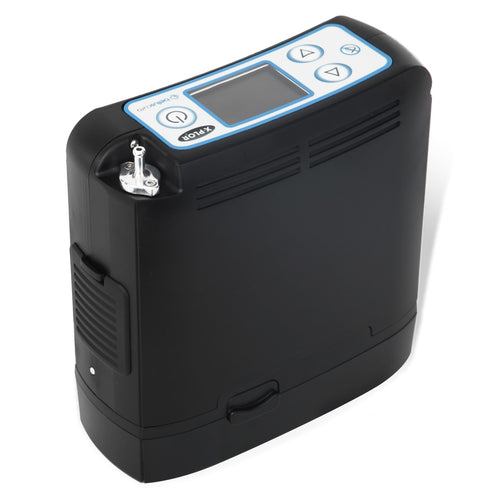
Belluscura X-PLOR Portable Oxygen Concentrator — Light, Quiet, Replaceable Parts
Best for: Light, modular carry
The X-PLOR is a good fit if you want a light unit that is easy to service on the road. It weighs 3.75 pounds with the 8-cell battery, offers five pulse settings from 215 to 900 mL per minute, and runs up to 4.5 hours. Its modular design lets you replace the oxygen enrichment cartridge yourself, and it runs under 39 dBA at setting 2. Oxygen purity runs 82% to 92%, lower than the 90% models above, and its maximum output is lower, so check that it meets your prescribed setting first.
- 3.75 pounds with battery
- User-replaceable enrichment cartridge
- Under 39 dBA at setting 2
- Purity 82% to 92%, lower here
- Lower maximum output, 900 mL/min
4.4/5
4.8/5
4.4/5

Inogen Rove 4 Portable Oxygen Concentrator — Light, Simple, Short Trips
Best for: Short day hikes
For a short, well-planned day hike, the Rove 4 gives you Inogen reliability without the weight of the Rove 6. It weighs 2.9 pounds, offers four pulse settings up to 840 mL per minute, and runs up to 3 hours on the standard battery, or up to 5 hours 49 minutes with the extended battery. It is rated to 10,000 feet and fits easily in a small daypack. The trade-off is clear: four settings, pulse-only delivery, and a shorter standard runtime mean it is not the pick for long days or higher flow needs.
- 2.9 pounds, easy daypack fit
- Four pulse settings, simple controls
- Extended battery to 5 hrs 49 min
- Only 3 hours, standard battery
- Pulse dose only, no continuous flow
4.6/5
4.9/5
4.1/5
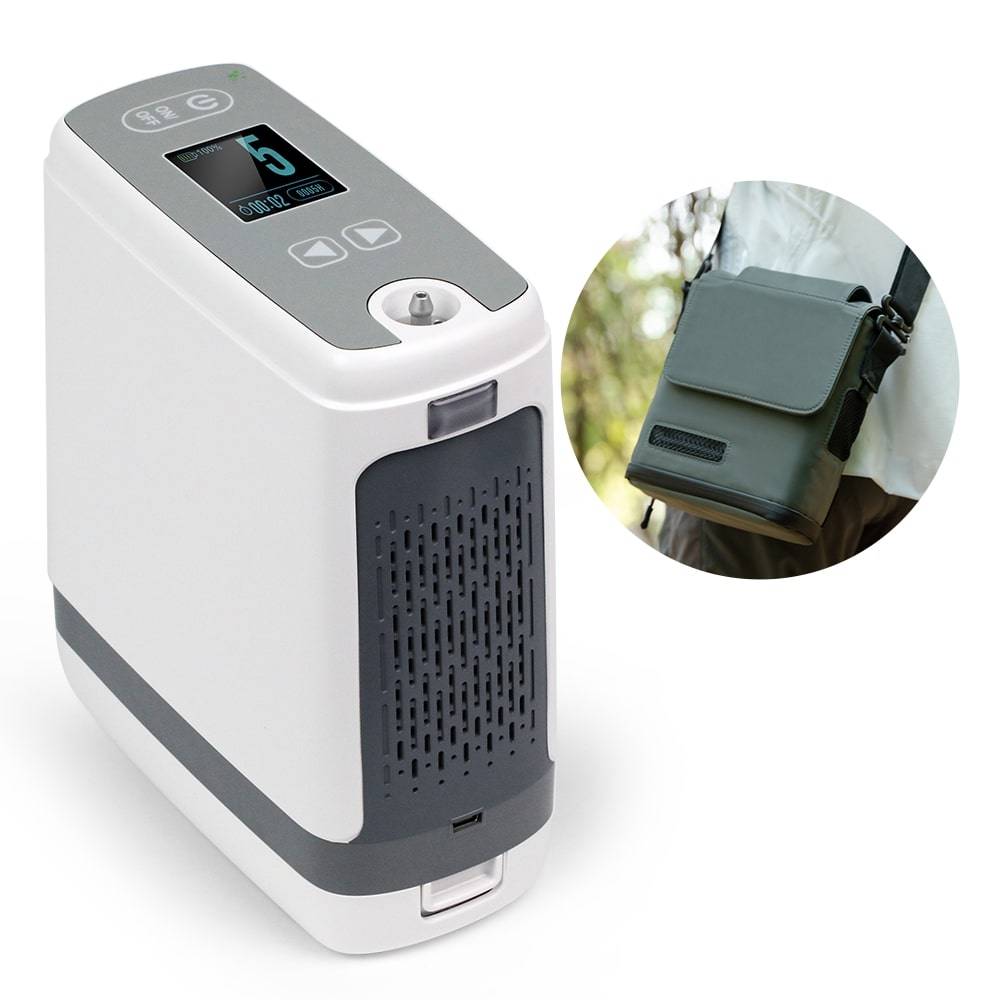
Wellue Mini Portable Oxygen Concentrator — Built for High Treks
Best for: High-altitude trekking
The Wellue Mini is the most altitude-focused unit in this list, and that is its main reason to choose it. It weighs 4.37 pounds, offers pulse settings 1 to 5, and is listed for use up to 4,000 metres, or 13,123 feet, with 93% plus or minus 3% oxygen at settings 1 to 3. With two batteries it runs up to 9 hours, which helps on long trekking days. It is sold for travel and wellness use, not as a medical device, so it is not a substitute for a prescribed concentrator or for proper acclimatisation.
- Rated to 13,123 feet altitude
- 93% purity at settings 1-3
- Up to 9 hours, two batteries
- Not a medical device
- Purity falls at settings 4-5
4.7/5
4.6/5
4.0/5
Top 3 Head-to-Head: Inogen Rove 6 vs Drive DeVilbiss iGo2 vs CAIRE FreeStyle Comfort
These three are the usual final choices because they cover the three main climbing needs: the widest settings, the smartest response to effort, and the longest day. The Rove 6 is the safe default, the iGo2 is the pick for uneven effort, and the FreeStyle Comfort is the pick for long, steady days.
| Feature | #1 Rove 6 | #2 iGo2 | #3 FreeStyle Comfort |
|---|---|---|---|
| High-Altitude Performance | 4.9/5 — Best | 4.9/5 | 4.7/5 |
| Weight and Packability | 4.8/5, 4.8 lbs | 4.7/5, 4.95 lbs | 4.7/5, 5 lbs, curved body |
| Battery Life and Charging | 5.0/5 — Best | 4.7/5, 3.5 hrs at setting 2 | 5.0/5, up to 16 hrs extended |
| Choose if… | You want the widest settings and longest battery | Your effort changes a lot on the climb | You want comfort and runtime on long days |
Who These Concentrators Are NOT For
A portable concentrator is not the right tool for every mountain trip, and choosing the wrong one can leave you short of oxygen at the worst moment.
If you plan to climb above 13,123 feet, most models here are rated lower, and output can fall even if the unit still runs. If you need oxygen while sleeping at altitude, pulse-only models may miss shallow breaths, so a continuous-flow model or a different setup is safer. Always acclimatise, even with supplemental oxygen.
Common Mistakes to Avoid
These are the mistakes that cost climbers time, battery, and oxygen on the mountain.
Frequently Asked Questions About Portable Oxygen Concentrators for Mountain Climbing
Do portable oxygen concentrators work at high altitude?
Yes, within their rated limit, but output can fall as air pressure drops. Most models here are rated to 10,000 feet, and a few are rated to 13,123 feet. Above the limit, flow and oxygen percentage can drop even if the unit still runs. Check the manual for your model, confirm your setting with your clinician, and test the unit at altitude before a long climb.
What is the best portable oxygen concentrator for mountain climbing?
The best overall pick in this guide is the Inogen Rove 6, because it offers six pulse settings, up to 1,260 mL per minute, a 4.8-pound weight, and up to 12 hours 45 minutes with the extended battery. If your effort changes a lot, the Drive DeVilbiss iGo2 is the better pick, and if you need continuous flow, the GCE Zen-O is the better pick for base camp.
Can I use a portable oxygen concentrator above 10,000 feet?
You can only do so safely if your model is rated for that height and your clinician has confirmed the setting. Most models here are rated to 10,000 feet, while the Zen-O, Liberty 2, and Wellue Mini are listed to 13,123 feet. Above the rated limit, expect lower flow and purity, and do not rely on the unit alone for a high camp without a backup plan.
How long does a portable oxygen concentrator battery last on a mountain hike?
It depends on the setting, your breathing rate, and the temperature, but most models here run 2.5 to 6 hours on a standard battery at setting 2, and longer with an extended battery. The Rove 6 runs up to 6 hours 15 minutes at setting 1, and the FreeStyle Comfort runs up to 8 hours at setting 1. Carry a spare battery, and test runtime at your climbing setting before the trip.
Should I choose pulse dose or continuous flow for mountain climbing?
Choose pulse dose if your prescription allows it, because it is lighter and saves battery on a climb. Choose continuous flow if your prescription calls for it, or if you need oxygen while sleeping, because pulse dose can miss shallow breaths. Dual-mode models such as the Zen-O and Liberty 2 offer both, but they are heavier, so they suit base camp better than a summit push.
Do I need a prescription for a portable oxygen concentrator for mountain climbing?
Yes, for medical concentrators, a prescription is required, and your clinician must set the flow for your needs. The prescription also matters at altitude, because your oxygen needs can change as you climb. Wellness models such as the Wellue Mini are not medical devices and are not a substitute for a prescribed concentrator. Bring your prescription and your clinician’s altitude guidance on the trip.
Can a portable oxygen concentrator prevent altitude sickness?
No, a concentrator cannot prevent altitude sickness on its own. Supplemental oxygen can ease symptoms such as headache, fatigue, and shortness of breath, but it does not replace gradual acclimatisation, hydration, and a sensible ascent rate. If symptoms worsen, descend, rest, and seek medical help. Do not use oxygen as a reason to climb faster or higher than your body allows.
Our Final Verdict
For most climbers, the trade-off is weight against flow and battery. The Rove 6 balances those three best, the iGo2 follows changing effort, and the Zen-O covers continuous flow at base camp. Pick by your prescribed setting and your highest camp, not by headline weight alone.

Hi, I’m Michael Turner. I own a generator workshop in the United States and founded HomeGeneratorBlog to share practical, hands-on guidance about generator installation, maintenance, troubleshooting, safety, and backup power solutions. My goal is to help homeowners make smarter, more confident decisions through clear and reliable information