
Inverter Portable Generator: Complete 2026 Buying Guide
Quick answer: An inverter portable generator uses electronic circuitry to produce clean, stable power (under 3% total harmonic distortion) safe for laptops and phones, while running quieter and more fuel-efficient than a standard open-frame generator. Most homeowners do well with a 2,000–4,000-watt unit for essentials, or 7,000+ watts for whole-home backup.
If you’ve ever stood in a big-box aisle staring at a wall of generators, you know the confusion. “Inverter” gets slapped on everything now, and half the signage doesn’t explain what it actually means for your house.
Here’s the short version: an inverter generator converts engine power to DC, then inverts it back to a clean, stable AC sine wave using onboard electronics. A conventional generator just spins an alternator and sends out whatever comes off it — good enough for a power tool, rougher on a laptop charger or a furnace control board.
Who Actually Needs an Inverter Generator?
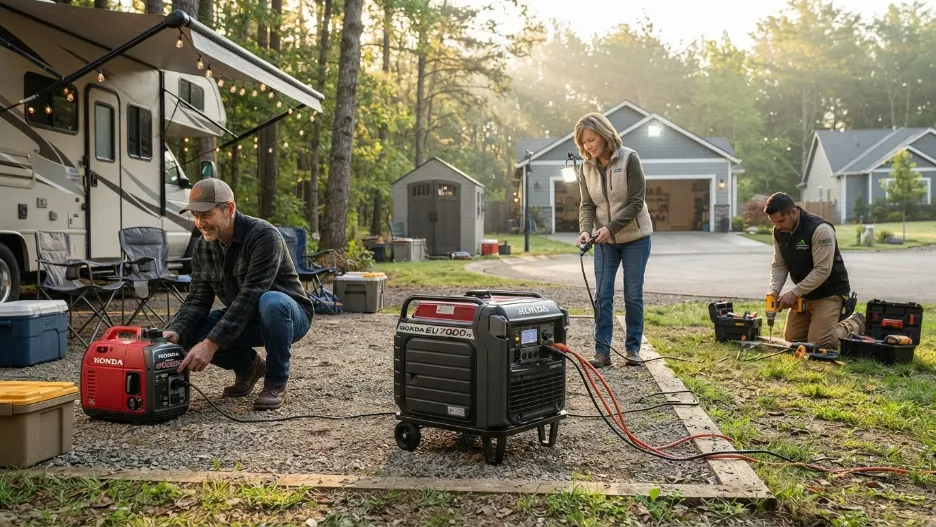
Not everyone. Here’s how it breaks down by real use case.
| Your Situation | Best Fit | Why |
|---|---|---|
| Camping, tailgating, RV trips | 2,000–3,500W inverter | Light, quiet, runs sensitive electronics safely |
| Short outages, fridge + Wi-Fi + a few lights | 3,500–5,000W inverter | Covers essential circuits without overkill |
| Multi-day outages, well pump, furnace, sump pump | 7,000–9,000W inverter or dual-fuel | Handles high-surge appliances plus daily comforts |
| Job site tools, no sensitive electronics | Conventional generator | Cheaper per watt, tougher for daily abuse |
| Whole-house backup, central AC included | Standby generator instead | No portable inverter unit realistically covers this load |
Inverter vs. Conventional Generator: The Real Differences
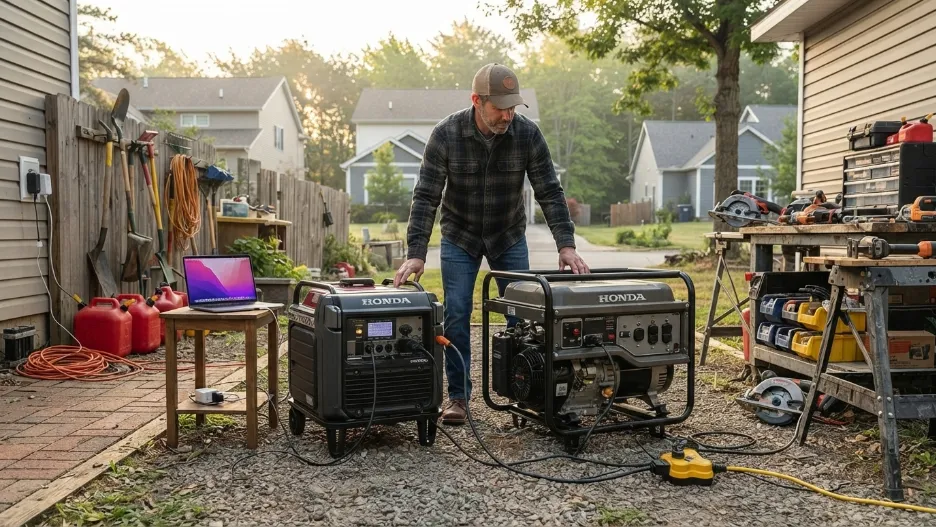
Most articles list this as a pros-and-cons wall. It’s simpler than that in practice.
A conventional generator’s engine runs at a fixed speed — usually 3,600 RPM — whether you’re powering a single lamp or maxing it out. That constant speed means more fuel burned for small loads, more noise, and voltage that wobbles enough to occasionally trip a laptop charger’s protection circuit.
An inverter generator throttles its engine speed to match your actual load. Light load, quiet hum and long runtime. Heavy load, it revs up. The electronics smooth the output into a clean sine wave — the same kind of power you get from the utility grid.
| Factor | Inverter Generator | Conventional Generator |
|---|---|---|
| Power quality (THD) | Under 3% — safe for electronics | Often 10–20% — riskier for sensitive gear |
| Noise at 25% load | 52–58 dBA | 68–75 dBA |
| Fuel efficiency | Higher — throttles with load | Lower — runs at fixed speed |
| Weight | Lighter for equal wattage | Heavier, bulkier frame |
| Max wattage available | Typically tops out lower per unit | Higher ceiling, better for heavy tools |
| Upfront cost | Higher per rated watt | Lower per rated watt |
| Parallel capability | Common — link two units for more power | Rare |
What to Actually Look For When Buying
Power Needs
Add up the running watts of what you want powered, then add the single highest starting-watt appliance on top — that surge, usually from a fridge or well pump compressor kicking on, is what trips people up. A fridge alone can spike to 2,200 starting watts even though it only runs at 700.
Fuel Type
Straight gasoline units are the cheapest and most common. Dual-fuel models add propane, which stores indefinitely and burns cleaner — useful if your generator sits unused for months between outages. Tri-fuel adds natural gas if you already have a line to the house.
Noise
If you have neighbors within shouting distance, noise matters more than most buyers expect. A conventional generator at full load can hit 75 dBA — roughly a running vacuum cleaner, all night, outdoors. Inverter units at partial load often stay in normal-conversation range.
Portability
Check actual dry weight, not just the box dimensions. A 3,000-watt inverter generator commonly weighs 60–90 lbs; the same wattage in a conventional frame can push past 150 lbs. If you’re carrying it up basement stairs during a storm, that difference matters.
Budget
Expect to pay roughly 30–60% more for an inverter unit versus a conventional generator at the same wattage. That premium buys quieter operation, better fuel economy, and electronics you can trust with a laptop — not just raw power.
Runtime
Inverter generators usually have smaller fuel tanks than conventional units of similar output, since they’re built for portability first. Expect 8–10 hours at 25% load on a full tank, dropping to 4–5 hours at higher loads. Check the manufacturer’s runtime chart at multiple load percentages, not just the marketing headline number.
The first time I ran a 3,500-watt inverter generator through a five-day outage after an ice storm, the thing that surprised me wasn’t the noise — it was how much the runtime shrank once I plugged in a space heater alongside the fridge. Half my “10-hour tank” turned into barely five. Budget your fuel math for your worst-case load, not your average one.
Common Buyer Mistakes
- Buying on running watts alone. Starting watts are what actually stall the engine or trip a breaker.
- Skipping the CO sensor. Newer models with automatic carbon monoxide shutoff cost a bit more but exist for a real reason — CO poisoning from generators kills people every year.
- Assuming any generator can power a whole house. Portable inverter units rarely exceed 10,000 watts; a standby generator or a smart load-management setup is the right tool for full-home backup.
- Ignoring the extension cord gauge. An undersized cord causes voltage drop and heat — a fire risk that has nothing to do with the generator itself.
- Storing gasoline without stabilizer. Fuel left untreated for months gums up carburetors, which is the single most common reason a generator won’t start when you finally need it.
For a full breakdown of exactly how many watts your specific appliances need, see our generator wattage sizing guide, which walks through the math appliance by appliance.
If you’re deciding between a small inverter for weekend trips and a larger dual-fuel unit for home backup, a model like a dual-fuel inverter generator splits the difference well — quiet enough for camping, big enough to run a fridge, sump pump, and a few lights at once.
Do You Really Need an Inverter, or Will Conventional Work?
If your main concern is running power tools on a job site and nobody’s phone or laptop is plugged into it, a conventional generator saves real money. If you’re powering a house full of electronics, a CPAP machine, or anything with a sensitive circuit board, the inverter’s clean power isn’t a luxury — it’s protection for equipment that isn’t cheap to replace.
For campers and RV owners, the noise difference alone usually settles it. Campgrounds increasingly restrict decibel levels, and a conventional generator running all night is the fastest way to get asked to leave.
Conclusion
Match the generator to the load, not the label. Add up your real running and starting watts, decide how much noise and weight you’re willing to live with, and buy the smallest unit that comfortably covers your worst-case scenario. For most homeowners facing occasional outages, a mid-size inverter generator in the 3,500–7,000-watt range hits that balance. As always, plan your fuel and placement before the storm hits, not during it — Michael Turner
If you’re shopping for a mid-size unit that covers a fridge, sump pump, and a few essentials without the noise of a conventional generator, a quiet inverter portable generator in the 3,500–5,000-watt range is a solid starting point for most homes.
Is an inverter generator worth the extra cost over a conventional one?
For most homeowners, yes — the cleaner power protects electronics, and the lower noise and better fuel efficiency pay off over years of use. If you only need to run tools with no sensitive electronics, a conventional generator can save money upfront.
Can an inverter generator run a refrigerator?
Yes. Most refrigerators need 100–250 running watts and can surge to 2,200 starting watts briefly, which a 2,000-watt or larger inverter generator handles comfortably.
How long will an inverter generator run on a full tank?
Typically 8–10 hours at 25% load, dropping to 4–5 hours at higher loads, depending on tank size and model. Always check the manufacturer’s runtime chart at the load percentage you’ll actually use.
Is it safe to run an inverter generator in the rain?
Not without cover. Even weather-resistant models need a generator canopy or tent rated for ventilation, since blocking airflow to keep it dry creates a carbon monoxide risk.
Can I connect two inverter generators together for more power?
Only if both units are explicitly rated for parallel operation and you use the manufacturer’s parallel kit — mismatched or unsupported models can damage both generators.
For official safety guidance on generator carbon monoxide risks, see the CDC’s generator safety fact sheet and the Consumer Product Safety Commission’s generator and CO guidance.

Hi, I’m Michael Turner. I own a generator workshop in the United States and founded HomeGeneratorBlog to share practical, hands-on guidance about generator installation, maintenance, troubleshooting, safety, and backup power solutions. My goal is to help homeowners make smarter, more confident decisions through clear and reliable information

8 Comments