What Size Generator Do I Need for My House?
Quick answer: Add up the running watts of everything you want powered at once, then add the single highest starting-watt appliance on top of that number. Multiply the total by 1.25 for a safety margin. Most homes running fridge, sump pump, furnace blower, and lights land between 5,000 and 7,500 watts. Whole-house coverage with central AC usually needs 14,000 to 20,000 watts.
Every outage starts the same way: the lights die, the fridge hums to a stop, and someone asks how big a generator we actually need. There’s no single number that fits every house. It depends on what you refuse to live without for the next three days.
This guide walks through the real math, not just a rule of thumb pulled from a spec sheet.
The Simple Formula Behind Generator Sizing

Two numbers matter on every appliance label: running watts (what it draws once it’s on) and starting watts (the short surge it needs to kick on, sometimes 2–3 times higher). Motors — fridges, pumps, AC compressors — are the culprits behind that surge.
Here’s the formula:
- Add the running watts of every appliance you’ll run simultaneously.
- Find the single highest starting-watt appliance in that list, and add it on top of your running total.
- Multiply the result by 1.2–1.25 to leave headroom.
You don’t add every appliance’s starting watts together. Only one motor typically kicks on at a time — the generator just needs enough surge capacity to cover the biggest jolt while everything else is already running steady.
Wattage Chart: Common Household Appliances
Use this as your starting worksheet. Actual draw varies by model and age, so check the nameplate on your own appliances when you can.
| Appliance | Running Watts | Starting Watts |
|---|---|---|
| Refrigerator | 700 | 2,200 |
| Chest freezer | 500 | 1,300 |
| Sump pump (1/3 hp) | 800 | 1,300 |
| Well pump (1/2 hp) | 1,000 | 2,100 |
| Gas furnace blower fan | 800 | 2,350 |
| Window AC unit (10,000 BTU) | 1,200 | 3,600 |
| Central AC (3-ton) | 3,500 | 10,500 |
| Space heater | 1,500 | 1,500 |
| Electric water heater | 4,000 | 4,000 |
| Washing machine | 1,200 | 2,300 |
| Electric dryer (240V) | 5,000 | 5,750 |
| Microwave | 1,000 | 1,000 |
| Coffee maker | 1,000 | 1,000 |
| Garage door opener | 550 | 1,100 |
| TV (LED, 50″) | 150 | 150 |
| Wifi router/modem | 25 | 25 |
| CPAP machine | 40 | 40 |
| LED light bulb (each) | 10 | 10 |
| Your running total | Add the “Running Watts” column for everything you’ll use at once | |
Worked Example: Sizing for a Typical Outage
Say you want to keep the essentials running during a multi-day outage: the fridge, a sump pump, the furnace blower, six LED lights, a wifi router, and phone chargers.
Running watts: 700 (fridge) + 800 (sump pump) + 800 (furnace fan) + 60 (six LED bulbs) + 25 (router) + 50 (chargers) = 2,435 watts.
Now find the highest single starting-watt draw in that list — the furnace blower at 2,350 watts. Add that on top: 2,435 + 2,350 = 4,785 watts of surge capacity needed.
Apply the 25% safety margin: 4,785 × 1.25 = roughly 5,980 watts. Round up. A generator rated around 6,500–7,500 running watts with a higher surge rating handles this load with room to spare — and room to add a window AC unit if summer heat is part of the outage.
The first time I sized a generator for my own place, I did the math on paper, bought exactly what it said, and then remembered the chest freezer in the garage two days before a forecasted ice storm. Sizing on paper is a good start — walk your house and count every motor that might kick on before you buy, not just the obvious ones.
Why the 20–25% Safety Margin Matters
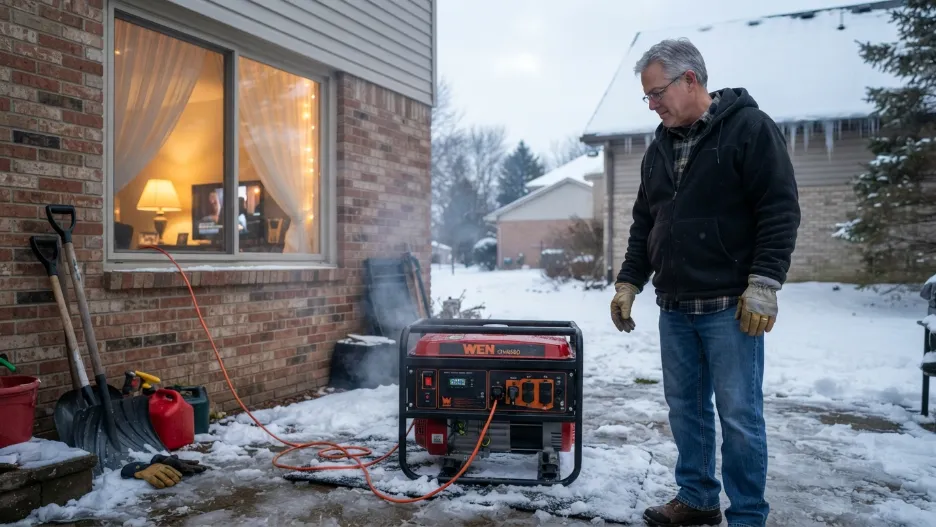
Running a generator at 100% of its rated capacity for hours at a time shortens its life and increases the odds of nuisance shutdowns. Heat builds up, the engine works harder, and voltage can sag right when a motor tries to start.
A 20–25% cushion means the unit spends most of its time at a comfortable 75–80% load — quieter, more fuel-efficient, and far less likely to trip a breaker the moment the AC compressor kicks on.
Portable vs. Whole-House Standby: Different Math
Portable generators are sized around a load you choose and manage — you decide what’s plugged in. A 7,000–9,000 watt portable or inverter generator covers most homes running the essentials plus a window AC unit.
Whole-house standby generators are sized to cover everything at once, including central air — which is why they run 14,000 to 22,000 watts and get installed by a licensed electrician with an automatic transfer switch. If your goal is “the whole house keeps running like nothing happened,” you’re shopping in that range, not the portable range.
Do You Need to Size for Central Air Conditioning?
Central AC is the single biggest variable in this whole calculation. A 3-ton unit alone can demand 10,000+ starting watts. If you’re not planning to run central air during an outage, leave it out of your math entirely and rely on window units or fans instead — it’s the fastest way to right-size a portable generator instead of overbuying.
A Second Worked Example: Whole-House With Central Air
Not everyone is fine losing AC for a week. Here’s the math for a household that wants central air, the fridge, and normal daily life to keep running.
Running watts: 3,500 (central AC, 3-ton) + 700 (fridge) + 4,000 (electric water heater) + 1,200 (washing machine) + 1,000 (microwave) + 500 (misc lights and electronics) = 10,900 watts.
Highest single starting draw: central AC at 10,500 watts. Add it in: 10,900 + 10,500 = 21,400 watts of surge capacity needed.
With the 25% margin, that’s roughly 26,750 watts — a job for a whole-house standby generator in the 22–26 kW range, not a portable unit. This is the point where most homeowners stop doing the math themselves and call an electrician for a formal load calculation, which accounts for diversity factors code allows on top of raw appliance totals.
Does Fuel Type Change the Sizing?
Gasoline and diesel generators produce their full rated output. Propane, though more stable for long-term storage, typically derates output by roughly 10% compared to the same engine on gasoline. If you’re planning to run primarily on propane, size up slightly, or lean toward a dual-fuel model so you’re not locked into one number.
Altitude matters too. Engines lose roughly 3–4% of output for every 1,000 feet above sea level. A generator rated at sea level won’t hit that number at 6,000 feet in a mountain town — check the manufacturer’s derating chart if you live at elevation.
How Long Should the Generator Run Each Day?
Sizing wattage is half the picture. Runtime per tank matters just as much if you’re planning for a multi-day outage rather than a few hours.
A generator running at 50% load typically burns through a tank faster than the same unit running at 25% load, simply because it’s working harder. Most portable units at moderate load run 8–12 hours per tank of gasoline, or considerably longer on a propane tank or natural gas hookup. If the outage could stretch past a day or two, factor fuel storage and resupply into your plan alongside the wattage math — a generator that’s perfectly sized but out of fuel by hour ten isn’t solving the problem.
Common Sizing Mistakes
- Adding every starting watt together. You only need to cover the single highest surge, not the sum of all of them, since appliances rarely start at the exact same instant.
- Ignoring the well pump. Rural homes on well water often forget this until the water stops running on day one.
- Skipping the margin. Buying exactly to the calculated number leaves no room for voltage sag or an appliance that draws more than its label states.
- Forgetting seasonal loads. A generator sized for a mild spring outage may fall short in July with AC in the mix, or in January with a space heater running.
What About a Battery Backup Instead of a Generator?
Solar generators and home battery systems get sized differently — in watt-hours of storage, not just running watts. A portable power station rated for 2,000 watts of continuous output can still run a fridge and some lights, but the real question is how many hours it lasts before the battery is empty, since there’s no engine refueling it mid-outage.
For short outages of a few hours, a battery system avoids fuel storage and CO risk entirely. For outages measured in days, fuel-burning generators still win on total available energy, unless the battery is paired with solar panels actively recharging it. If your outage pattern is mostly brief and infrequent, it’s worth pricing both options before committing to a fuel-burning unit sized for a worst-case week that rarely happens.
Generator Safety While You Run the Numbers
Safety note: Portable generators produce carbon monoxide, an odorless gas that can be fatal within minutes. Run generators outdoors only, at least 20 feet from doors, windows, and vents, with the exhaust pointed away from the house. Never run one in a garage, even with the door open. Install battery-backed CO alarms in the home. Never connect a portable generator to household wiring without a properly installed transfer switch — backfeeding can electrocute utility workers repairing the line.
The CDC’s generator safety fact sheet covers CO poisoning symptoms and prevention in more detail, and the Consumer Product Safety Commission publishes seasonal storm safety guidance worth bookmarking before hurricane or winter storm season.
Conclusion
Sizing a generator comes down to honest math, not the biggest number on the shelf. Add your running watts, layer in the largest single starting surge, and build in a margin. For most homes, that lands in the 5,000–7,500 watt range for essentials, or well into five figures if central air and whole-house coverage are the goal. Do the worksheet before you shop — Michael Turner.
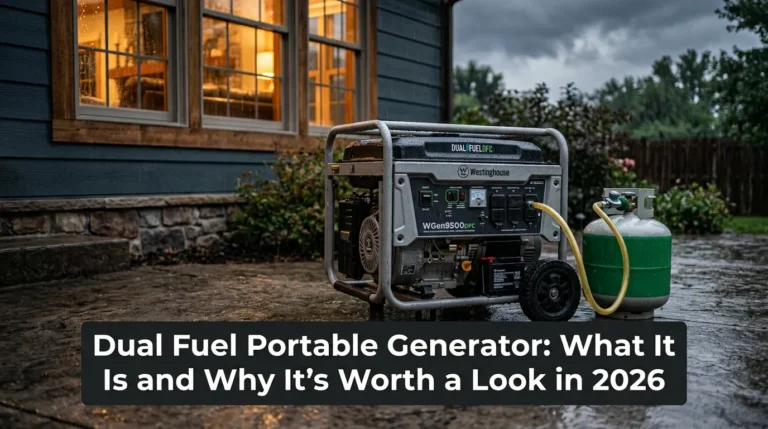
Once you’ve run the numbers, a dual-fuel portable generator in the 7,000–9,000 watt range covers most households — flexible enough to run on gasoline or propane depending on what’s available during an outage.
Frequently Asked Questions
Can a 5,000-watt generator run a house?
A 5,000-watt generator can run the essentials — fridge, sump pump, furnace blower, lights, and small electronics — in most homes. It won’t run central air conditioning or a full electric range at the same time as everything else.
What size generator do I need to run central air conditioning?
A 3-ton central AC unit alone can need 10,000+ starting watts, so covering it usually means a 12,000–17,000 watt generator or a whole-house standby system, especially if you want other appliances running at the same time.
Do I need a bigger generator if I have a well water system?
Yes. Well pumps often draw 1,000 running watts and over 2,000 starting watts, and homes on well water lose water pressure entirely during an outage, so this load should never be left off the worksheet.
Is it safe to undersize a generator and just limit what I plug in?
Manual load management works fine with a portable generator and a manual transfer switch — you decide what runs. Automatic transfer switches on standby systems typically need to cover the full connected load or include automatic load-shedding, per code.
How much bigger should my generator be than my calculated wattage?
Add 20–25% above your calculated total. Running a generator consistently near its maximum rated output shortens its lifespan and increases the risk of it stalling when a motor tries to start.

Hi, I’m Michael Turner. I own a generator workshop in the United States and founded HomeGeneratorBlog to share practical, hands-on guidance about generator installation, maintenance, troubleshooting, safety, and backup power solutions. My goal is to help homeowners make smarter, more confident decisions through clear and reliable information