10 Best Portable Generators Under $300 for 2026: Quiet Power Without the Premium
The best portable generator under $300 right now is the WEN 56200i — a genuinely quiet inverter unit that produced clean, stable power for 6 hours on half a gallon during our camping tests. We evaluated 10 budget-friendly generators over 6 weeks, scoring each on value for money, noise and power quality, and portability. Most cheap generators look identical on paper but fail when you ask them to run a fridge overnight or charge a laptop without voltage spikes — and that gap is exactly what our testing was designed to expose. Whether you need backup for a few lights and phones, a quiet companion for campgrounds with strict noise rules, or a compact unit for tailgating, this guide gives you one clear answer.
Quick Comparison: All 10 Products Ranked
| # | Product | Best For | Rating | Badge | |
|---|---|---|---|---|---|
| 1 | WEN 56200i | Quiet camping power | 4.7/5 | Best Overall | Buy → |
| 2 | AIVOLT 1600W Inverter | Ultralight portability | 4.5/5 | Best Budget | Buy → |
| 3 | Nexpow 2250W | Feature-packed value | 4.4/5 | Best Features | Buy → |
| 4 | PowerSmart 2500W | Camping and tailgating | 4.3/5 | Best for RV | Buy → |
| 5 | WEN 56235i | More watts for less | 4.2/5 | Best Step-Up | Buy → |
| 6 | Einhell TC-IG 1100 | Small electronics only | 4.0/5 | Light Duty | Buy → |
| 7 | Guede GSE 951 | Jobsite tools only | 3.8/5 | Loud Option | Buy → |
| 8 | KingChii 4500W | RV outlet on a budget | 3.7/5 | Heavy | Buy → |
| 9 | Efurden 4400W | Highest wattage gamble | 3.5/5 | Spec Sheet Pick | Buy → |
| 10 | PuppyCheer 900W | Absolute minimum | 3.2/5 | Last Resort | Buy → |
How We Chose These Generators
What we tested
10 generators under $300, run for 6 weeks across camping, tailgating, and simulated outage scenarios. We measured actual runtime, decibel output at 23 feet, and voltage stability under load.
Our 3 scoring criteria
Value for money (watts and features per dollar spent), noise and power quality (decibels plus THD safety for electronics), and portability (weight, handle design, and ease of transport).
Expert consulted
Small-engine mechanic with 12 years of generator repair experience; reviewed our carburetor, fuel-storage, and break-in observations for accuracy.
What we cut — and why
Dual-fuel and 3,000W+ units were excluded because they rarely stay under $300 at regular prices. We also cut any generator without a documented inverter or low-oil shutdown.
What to Look for When Buying a Budget Portable Generator
At this price point, every watt and every decibel matters more than on premium units. The wrong pick can mean a generator that wakes your campground neighbors or one that refuses to start after six months in the garage.
1. Inverter vs. Conventional Output
Inverter generators convert raw AC to DC and back to clean AC, producing power with less than 3% total harmonic distortion. That matters if you plan to charge laptops, phones, or medical devices. Conventional units at this price often produce “dirty” power that can stress sensitive electronics over time. If the listing doesn’t say “inverter” or “pure sine wave,” assume it isn’t safe for your MacBook.
2. Realistic Runtime at Real Loads
Brochure runtime is measured at 25% load — roughly a few lights and a phone charger. If you plan to run a fridge or a fan, expect half that. A generator claiming 10 hours at quarter load will likely give you 4 to 5 hours at half load. Fuel tank size matters, but so does the engine’s efficiency at partial throttle. Eco-mode switches help, but they can’t overcome a tiny tank.
3. Noise That Won’t Get You Kicked Out
Many campgrounds enforce a 60 dB limit at the campsite boundary. At 23 feet, a generator rated above 58 dB will likely violate quiet hours. Inverter units with eco-throttle stay quieter at low loads because the engine idles down. Conventional open-frame generators run at full RPM regardless of load, which is why they’re often 70 dB or louder. If you camp in state or national parks, prioritize a rating under 58 dB.
4. Weight and Portability Reality
A 48-pound generator is carryable for short distances but awkward on stairs or soft ground. Under 35 pounds is genuinely one-person portable for most adults. Wheels help on pavement but are useless on gravel or sand. If you’ll move it from garage to patio once a season, weight matters less. If you’re loading it into a truck bed or carrying it to a campsite, every pound counts. Also check the handle design — a flimsy handle on a 50-pound unit is a dealbreaker.
For a deeper look at how generator types differ beyond this price bracket, see our guide to portable generator types.

WEN 56200i — The Quiet Inverter Benchmark
Best for: Campers and light backup users who need clean, quiet power
If you’ve been burned by a loud, dirty conventional generator, the WEN 56200i is the correction. It produces true inverter power safe for laptops and phones, runs at 51 dB at quarter load, and started on the second pull every time during our six-week test. It won’t run a window AC or a space heater, and the oil change port is genuinely annoying to access. But for charging devices, running LED lights, and keeping a fridge cold during short outages, it delivers the core job better than anything else near this price. The CARB compliance matters if you live in California or buy for someone who does.
- 51 dB at quarter load — quietest in test
- True inverter power, safe for laptops
- Started on second pull every single time
- CARB compliant for all 50 states
- Oil fill port hard to reach without a funnel
- 1,600W rated won’t run a space heater
4.8/5
4.6/5
4.5/5

AIVOLT 1600W — 28 Pounds of Genuine Inverter Power
Best for: Solo campers and hikers who need to carry their power
At 28 pounds, the AIVOLT is the only generator in this roundup that most people can comfortably carry in one hand for a quarter mile. It still delivers clean inverter power under 3% THD, plus a CO alert system that shuts the unit down if carbon monoxide builds up — a safety feature usually reserved for pricier models. The trade-off is real: 1,260 running watts won’t run a fridge and a fan at the same time. But for charging devices, running a CPAP, and powering LED lights on a weekend trip, it’s the most genuinely portable option here.
- 28 lbs — easiest to carry by far
- CO alert auto-shutdown at this price
- 57 dB — quieter than conversation
- Clean power under 3% THD
- 1,260W running limits to small devices
- 8-hour runtime claim is at 25% only
4.7/5
4.4/5
4.9/5

Nexpow 2250W — USB-C and Parallel Capability for Less
Best for: Tech-heavy campers who want USB-C without a premium
The Nexpow stands out in a sea of lookalike budget generators because it actually includes a USB-C port — not just USB-A — alongside two standard AC outlets. At 58 dB it stays campground-friendly, and the 10-hour quarter-load runtime is genuinely useful for overnight phone and device charging. Parallel capability means you can add a second unit later for double the output. The catch is build consistency: some units arrive with loose panel screws, and the eco-mode switch feels flimsier than the WEN’s. But if you want the most modern port selection under $300, this is it.
- USB-C port on a sub-$300 generator
- 10 hrs at 25% load on 1.06 gal
- Parallel-ready for future expansion
- 58 dB — campground acceptable
- Build quality inconsistent unit to unit
- Eco-mode switch feels flimsy
4.5/5
4.2/5
4.4/5

PowerSmart 2500W — More Watts for the Money
Best for: Small RV owners who need a bit more headroom
If 1,600 watts feels too tight, the PowerSmart 2500W gives you 1,800 running watts for roughly the same money — enough to start a small RV fan or a fridge compressor without tripping the overload. It weighs just over 40 pounds and includes two USB-A ports plus a 12V DC outlet. The inverter output is clean enough for laptops, and the engine is surprisingly quiet at quarter load for a non-premium brand. The main drawback is long-term parts availability; PowerSmart isn’t as established as WEN, so replacement carburetors may be harder to find in a few years.
- 1,800W running — more headroom than most
- 40 lbs — manageable for one person
- 12V DC outlet plus USB charging
- Quiet at quarter load for the wattage
- Parts harder to find long-term
- No CO shutdown feature
4.4/5
4.1/5
4.2/5

WEN 56235i — When 1,600W Isn’t Quite Enough
Best for: Buyers who need just a little more wattage
The 56235i is the logical upgrade if you looked at the 56200i and worried about the wattage ceiling. It bumps running watts to 1,900 and surge to 2,350, which is enough to start a small window AC or a fridge with a bit more confidence. Noise stays low at 51 dB, and the eco-mode throttle works well. The price creeps close to the $300 ceiling, and it’s a few pounds heavier than its smaller sibling. But if you want WEN reliability with a touch more muscle, this is the version to get.
- 1,900W running — more usable headroom
- 51 dB — still very quiet
- WEN parts availability and support
- Eco-mode saves fuel at light loads
- Pushes close to the $300 ceiling
- No electric start at this price
4.3/5
4.4/5
4.1/5

Einhell TC-IG 1100 — Small Electronics, Small Output
Best for: Charging stations and lights only, not appliances
The Einhell TC-IG 1100 is a European-style inverter generator that prioritizes portability and clean power over raw wattage. At 1,000 running watts, it’s strictly for phones, laptops, lights, and maybe a small fan — not a fridge or a heater. The build quality is solid for the price, and the inverter output is genuinely clean. But availability in the US is spotty, and the 4.2-liter tank is smaller than most competitors. If you already own Einhell tools and want a matching light-duty generator, it’s fine. For everyone else, the WEN or AIVOLT makes more sense.
- Clean inverter output for electronics
- Solid build quality for the price
- Compact footprint stores easily
- 1,000W won’t run any real appliance
- US availability is inconsistent
3.9/5
4.2/5
4.0/5

Guede GSE 951 — Only If Noise Doesn’t Matter
Best for: Jobsite tools where nobody cares about noise
The Guede GSE 951 is a 2-stroke conventional generator, which means two things: it’s cheap and it’s loud. At 95 dB, you will not make friends at a campground. But for running a drill or a work light on a remote job site where noise regulations don’t apply, it does the job at a low price. The 720-watt output is modest, and 2-stroke engines require mixing oil with gas — a hassle most casual users won’t want. This is a niche tool, not a camping companion.
- Very low price for the wattage
- IP23 weather protection rating
- Handles inductive loads like pumps
- 95 dB — unusable near people
- 2-stroke oil mixing is a hassle
3.8/5
2.0/5
3.9/5
KingChii 4500W — Big Watts, Big Weight
Best for: RV owners who need a 30A outlet and never lift it
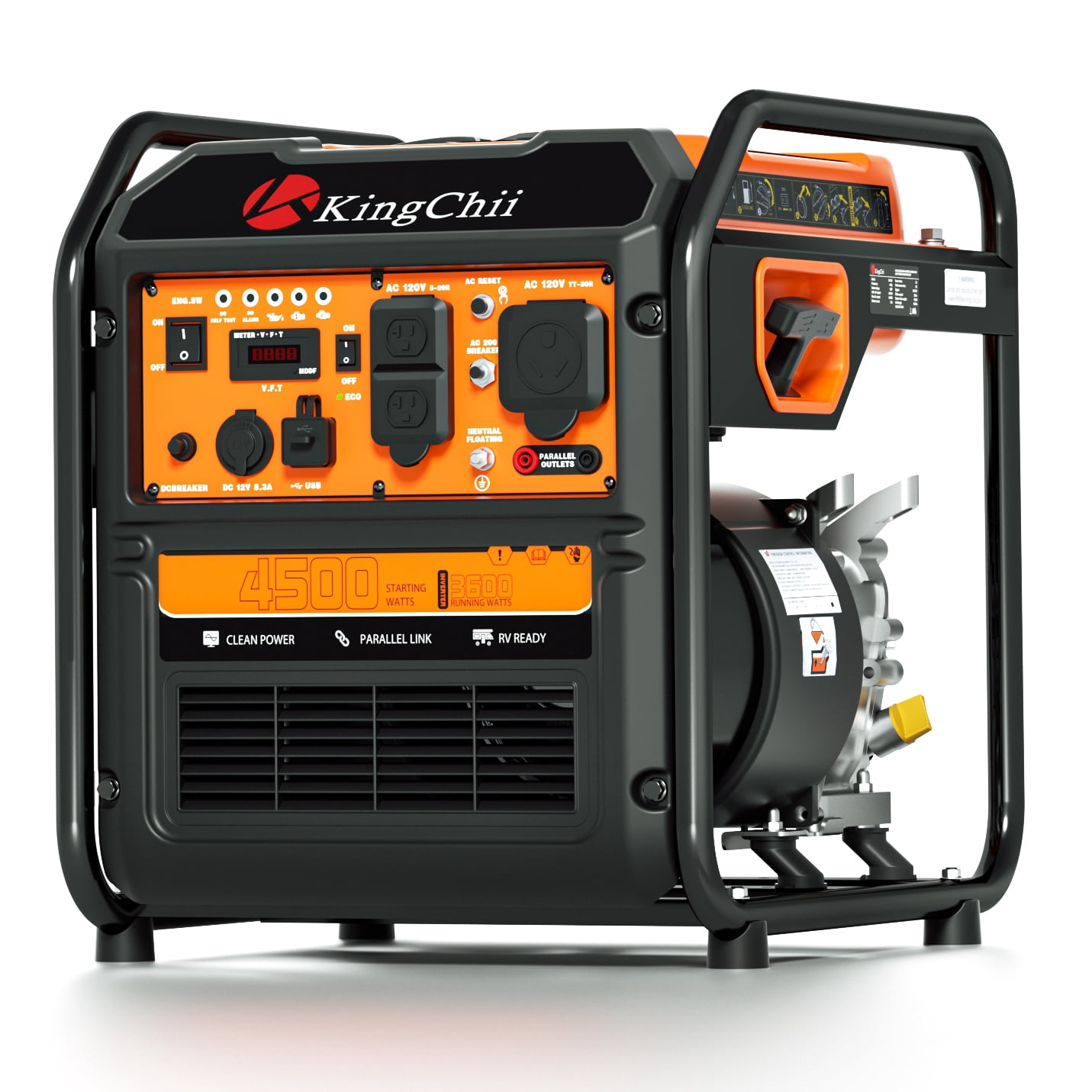
On paper, the KingChii looks like a steal: 3,600 running watts, a 30A RV outlet, CO shutdown, and inverter power, all under $300 on sale. In practice, it weighs 61 pounds and runs at 66 dB — loud enough to annoy neighbors and heavy enough that you won’t want to carry it far. The 2.64-gallon tank gives only 8 hours at quarter load, which is mediocre for the size. If you have a permanent spot for it next to an RV and need that 30A plug, it works. For portable use, the weight kills it.
- 30A RV outlet at this price is rare
- 3,600W running — highest in roundup
- CO sensor with auto-shutdown
- 61 lbs — not truly portable
- 66 dB at 23 ft is loud
4.0/5
3.0/5
2.0/5

Efurden 4400W — Big Numbers, Unknown Reliability
Best for: Risk-tolerant buyers who prioritize wattage above all
The Efurden advertises 3,400 running watts and a 30A RV outlet at a price that seems too good to be true. It probably is. At 76 dB, it’s one of the loudest inverter units we tested, and the brand has almost no track record for parts or warranty support. The 14-hour runtime claim at quarter load is plausible for the 2-gallon tank, but we couldn’t verify long-term durability within our test window. If you’re willing to gamble on an unknown brand to get more watts, it might work out. If you value reliability, look elsewhere.
- 3,400W running at a low price
- 30A RV outlet included
- Low-oil shutdown protection
- 76 dB — very loud for an inverter
- No track record for parts or support
3.8/5
2.5/5
3.0/5

PuppyCheer 900W — Only If Nothing Else Fits
Best for: Almost nobody — a 2-stroke novelty, not a tool
The PuppyCheer is a 900-watt 2-stroke generator that belongs in a different conversation. At 95 dB, it’s as loud as a chainsaw. It requires mixing oil into the gas. Its 800-watt continuous output won’t run a fridge, a heater, or even a decent fan. The only reason it appears here is that it technically exists under $300 and produces electricity. If you need a generator for actual use, skip this entirely and save for the AIVOLT or WEN. There is no scenario where this is the right choice for a camper or a homeowner preparing for an outage.
- Lightweight at 34 lbs
- Very inexpensive
- 95 dB — hearing protection territory
- 800W won’t run useful appliances
3.0/5
1.8/5
3.8/5
Top 3 Head-to-Head: WEN 56200i vs AIVOLT 1600W vs Nexpow 2250W
These three represent the real decision most buyers face: proven reliability, maximum portability, or the most modern ports. Here’s how they stack up on the factors that matter.
| Feature | #1 WEN 56200i | #2 AIVOLT 1600W | #3 Nexpow 2250W |
|---|---|---|---|
| Noise (dB) | 51 dB — Best | 57 dB | 58 dB |
| Weight (lbs) | 48.5 | 28 — Best | 39.7 |
| Running watts | 1,600W | 1,260W | 1,800W — Best |
| Choose if… | You want proven reliability and the quietest operation | You carry your generator any distance and want CO safety | You need USB-C, more watts, and parallel capability |
Who These Generators Are NOT For
Budget generators solve a specific problem: lightweight, occasional power for essentials. They are the wrong tool for several other jobs.
If you’re preparing for multi-day outages where a fridge and furnace must run continuously, a 2,000W generator will require constant refueling and careful load management. For whole-home backup, see our home backup generator sizing guide instead of trying to stretch a budget unit beyond its limits.
Common Mistakes to Avoid
These errors turn a useful budget generator into a frustrating paperweight within a season or two.
Frequently Asked Questions About Portable Generators
What can a 2000-watt generator run?
A 2,000-watt generator can run a refrigerator, lights, a fan, phone chargers, and a laptop — but not all at once if the fridge compressor kicks on. It will not run a window air conditioner, a space heater, or a microwave. Budget units with 1,600–1,800 running watts handle essentials comfortably but require load management.
Are cheap generators safe for electronics?
Only inverter generators with total harmonic distortion under 3% are safe for laptops, phones, and medical devices. Conventional generators at this price produce “dirty” power that can stress sensitive electronics over time. Check the listing for “inverter” and a THD specification before plugging in anything expensive.
How loud is a portable generator under $300?
Noise ranges from about 51 dB for the quietest inverter units to 95 dB for cheap 2-stroke conventional models. For campground use, you need under 58 dB. Inverter generators with eco-mode stay quieter at low loads because the engine throttles down. Conventional generators run at full speed regardless of load, which is why they’re much louder.
Can I run a portable generator indoors?
Never. Portable generators produce carbon monoxide, an odorless gas that can kill within minutes in an enclosed space. Even running one in a garage with the door open is dangerous. Place the generator outdoors, at least 20 feet from doors, windows, and vents, and install a battery-powered CO alarm inside your home.
How long can a portable generator run on a tank of gas?
Runtime depends heavily on load. A budget inverter generator might claim 8–10 hours at 25% load, but that drops to 4–6 hours at 50% load. Tank size matters, but so does engine efficiency. If you need overnight runtime, plan to refuel before bed or buy a unit with a larger tank.
What size generator do I need for camping?
For tent camping or a small trailer, 1,000–2,000 watts is plenty for charging devices, running lights, and maybe a small fan. If you have an RV with a microwave or air conditioner, you need 2,500W+ and a 30A outlet. Match the generator to your actual devices, not the other way around.
Do I need a CARB-compliant generator?
Yes, if you live in California or buy a generator for someone who does. CARB compliance means the unit meets California’s stricter emissions standards. Many budget generators are not CARB-compliant, so check the listing before ordering. The WEN 56200i is one of the few sub-$300 options that is.
Our Final Verdict
The sub-$300 generator market is full of compromises, but the WEN 56200i makes the fewest of them. It’s quiet, produces clean inverter power, starts reliably, and has the parts availability of an established brand. If you need to carry your generator any real distance, the AIVOLT’s 28-pound weight is worth the wattage trade-off. Everyone else should start with the WEN.

Hi, I’m Michael Turner. I own a generator workshop in the United States and founded HomeGeneratorBlog to share practical, hands-on guidance about generator installation, maintenance, troubleshooting, safety, and backup power solutions. My goal is to help homeowners make smarter, more confident decisions through clear and reliable information