Who Builds the Quietest Generator? 2026 Brand & Model Guide
Quick Answer
Honda builds some of the quietest gasoline-powered portable generators available from a major manufacturer. The Honda EU1000i is rated at just 42 dB(A) at quarter load and 50 dB(A) at rated load, while the more powerful EU2200i runs at 48–57 dB(A). If low noise is your priority, an enclosed inverter portable generator is usually the best design to choose.
Quietest generator choices
- Quietest overall: Honda EU1000i, rated at 42–50 dB(A).
- Best all-around: Honda EU2200i, rated at 48–57 dB(A).
- More power: Honda EU3000iS, rated at 50–57 dB(A).
- Budget alternative: Champion’s 2000-watt inverter is rated at 53 dB(A) from 23 feet.
- What to compare: Check noise level, load percentage, measurement distance, and running wattage together.
Generator noise sounds like a minor specification until you’ve listened to one run beside a campsite or bedroom for eight hours. A few decibels can make a noticeable difference when the engine never stops.
For 2026, Honda remains my first place to look when quiet operation matters most. However, the quietest model isn’t automatically the best generator for every job.
Who Builds the Quietest Generator in 2026?
Honda is the strongest answer among mainstream gasoline portable-generator brands. Its small enclosed inverter generators consistently carry some of the lowest published noise ratings in their classes.
The standout is the Honda EU1000i. Honda rates it at 42 dB(A) at quarter load and 50 dB(A) at rated load.
- Honda EU1000i: 42 dB(A) at 25% load and 50 dB(A) at rated load.
- Honda EU2200i: 48 dB(A) at 25% load and 57 dB(A) at rated load.
- Honda EU3000iS: 50 dB(A) at 25% load and 57 dB(A) at rated load.
- Champion 2000W inverter: Manufacturer rating of 53 dB(A) from 23 feet.
- Yamaha EF2200iS: 57 dB(A) at quarter load and 65 dB(A) at rated load.
That doesn’t mean every Honda is quieter than every competing generator. Model size, electrical load, testing distance, and enclosure design all matter.
What Is Considered a Quiet Generator?
A quiet generator is generally an enclosed inverter generator designed to reduce engine and exhaust noise while adjusting engine speed to electrical demand. Small models commonly fall around the 50–60 dB(A) range under lighter operating conditions.
Definition: Generator noise is normally expressed in A-weighted decibels, or dB(A). The A-weighted scale emphasizes sound frequencies in a way that better reflects how human hearing responds to noise.
Decibels aren’t a simple linear measurement. The Occupational Safety and Health Administration explains that the decibel scale is logarithmic, so relatively small numerical changes can represent substantial differences in sound energy.
This is why I wouldn’t dismiss a five- or ten-decibel difference when shopping. It can change how intrusive a generator feels during overnight use.
How Do the Quietest Generators Compare?
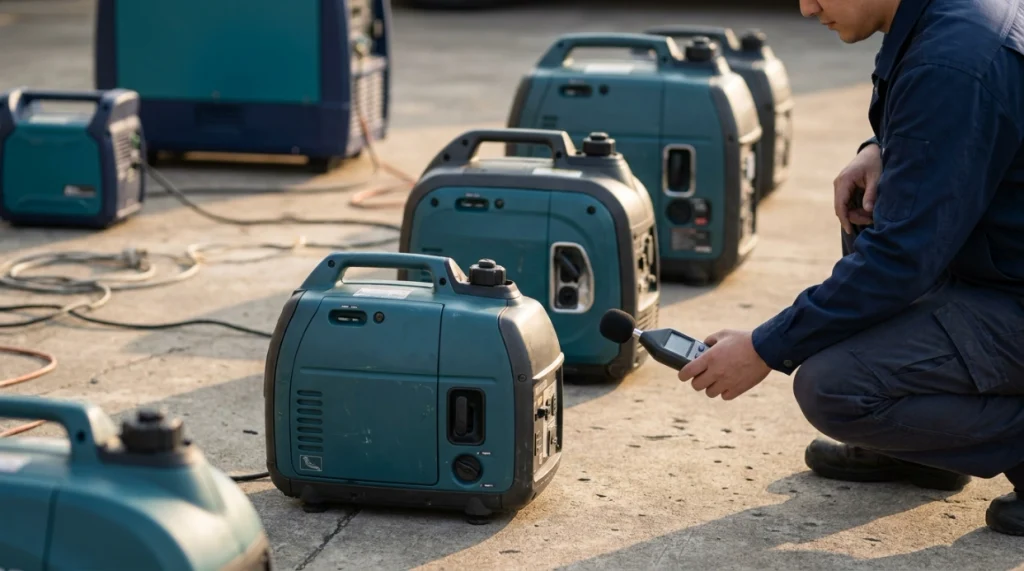
The Honda EU1000i has the lowest published rating in this group, but its 900-watt continuous output limits what it can run. The EU2200i usually offers a better balance between useful power and low noise.
| Generator | Running Output | Low-Load Noise | Rated-Load Noise | Best Use |
|---|---|---|---|---|
| Honda EU1000i | 900W | 42 dB(A) at 1/4 load | 50 dB(A) | Camping and light electronics |
| Honda EU2200i | 1,800W | 48 dB(A) at 1/4 load | 57 dB(A) | Camping and basic backup |
| Honda EU3000iS | 2,800W | 50 dB(A) at 1/4 load | 57 dB(A) | RV and larger backup loads |
| Champion 2000W Inverter | 1,600W | 53 dB(A) manufacturer rating | Not separately listed | Budget-conscious users |
| Yamaha EF2200iS | 1,800W | 57 dB(A) at 1/4 load | 65 dB(A) | Camping and portable power |
Important: Manufacturer noise tests aren’t always performed under identical conditions. Treat cross-brand numbers as a useful shopping guide rather than laboratory-perfect comparisons.
Why Are Honda Generators So Quiet?
Honda’s quiet inverter models combine enclosed cases, load-dependent engine control, compact engines, and engineered mufflers. Those features attack several major sources of generator noise at once.
The Honda EU2200i, for example, uses an enclosed inverter design and Honda’s Eco Throttle system. At light loads, the engine doesn’t need to operate as aggressively as a conventional fixed-speed generator.
- Enclosed housing: Panels help contain mechanical and combustion noise.
- Variable engine speed: The engine can slow when electrical demand drops.
- Purpose-built muffling: The exhaust system is designed around quiet portable operation.
- Smaller efficient engines: Compact inverter generators don’t need oversized engines for modest loads.
- Load matching: Keeping the generator comfortably below maximum output usually reduces engine noise.
Does Generator Load Affect How Loud It Is?
Yes. An inverter generator normally gets louder as electrical demand rises. That’s why you should always check whether a published dB rating was measured at quarter load, half load, or full rated output.
The EU2200i demonstrates this clearly. Honda lists 48 dB(A) at quarter load but 57 dB(A) at rated load.
If noise matters, don’t buy a generator that must run near maximum capacity all night. Calculate your required generator power capacity first and leave reasonable operating headroom.
- Light load: Lower engine speed and quieter operation on many inverter models.
- Moderate load: Engine speed rises as demand increases.
- Heavy load: Expect the generator to become noticeably louder.
- Starting surge: Refrigerators, pumps, and air conditioners can cause brief increases in engine speed.
Is Honda Quieter Than Yamaha?
Based on published specifications for comparable 2,000-watt-class models, Honda’s EU2200i carries a lower noise rating than Yamaha’s EF2200iS. Honda lists 48–57 dB(A), while Yamaha lists 57–65 dB(A) from quarter to rated load.
Both are enclosed inverter generators. Yamaha remains a respected alternative, but Honda has the advantage when the lowest published noise number is the deciding factor.
Is Honda Quieter Than Champion?
Honda generally wins on minimum published noise, while Champion can deliver strong value for less money. Champion rates several small inverter models around 53 dB(A) from 23 feet.
Its 2000-watt model provides 1,600 running watts, compared with 1,800 running watts from the EU2200i. For occasional camping or light backup, that tradeoff can make sense.
When I compare generators for quiet operation, I don’t shop by decibels alone. I first eliminate models that can’t comfortably handle the required load, then compare noise among the remaining choices.
Which Quiet Generator Size Should You Buy?
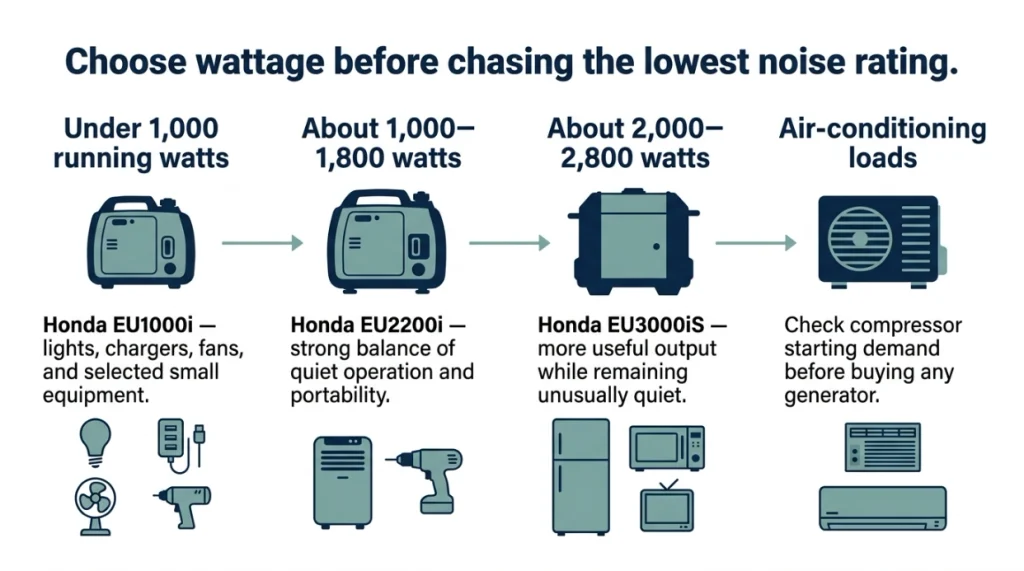
Choose wattage before chasing the lowest noise rating. A whisper-quiet 1,000-watt generator won’t help if your appliances require 2,500 watts to operate.
Use the appliance-by-appliance method in my portable generator watts guide before picking a model.
- Under 1,000 running watts: Honda EU1000i works for lights, chargers, fans, and selected small equipment.
- About 1,000–1,800 watts: Honda EU2200i is a strong balance of quiet operation and portability.
- About 2,000–2,800 watts: Honda EU3000iS gives you more useful output while remaining unusually quiet.
- Air-conditioning loads: Check compressor starting demand before buying any generator.
If air conditioning is part of your backup plan, use the generator sizing guide for air conditioners. Starting wattage often matters more than the AC unit’s normal running draw.
Does a Bigger Generator Always Make More Noise?
No. Larger engines often produce more noise, but generator design matters just as much as wattage. A large enclosed inverter can be quieter than a much smaller open-frame generator.
The Honda EU3000iS is a good example. It produces 2,800 rated watts while Honda lists only 50 dB(A) at quarter load and 57 dB(A) at rated output.
- Open-frame design: Usually exposes more mechanical and exhaust noise.
- Enclosed inverter design: Uses panels and variable engine speed to reduce noise.
- Engine loading: An overloaded small generator can sound worse than a larger unit running comfortably.
- Placement: Increasing distance can dramatically improve perceived noise at your home or campsite.
Can You Make a Generator Quieter?
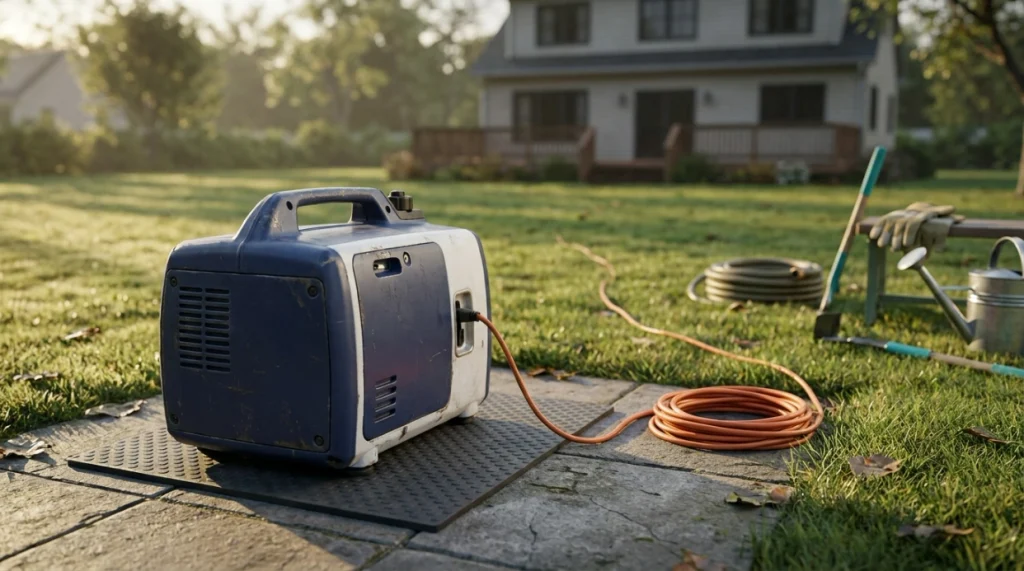
You can reduce how much generator noise reaches you, but you should never sacrifice ventilation or carbon-monoxide safety. Safe placement matters more than sound reduction.
The CDC recommends operating portable generators outdoors more than 20 feet from windows, doors, and vents. Never run one in a garage, basement, shed, or enclosed DIY sound box.
- Increase distance: Put the generator farther from occupied spaces while following your extension-cord and electrical setup requirements.
- Point exhaust away: Keep exhaust directed away from people and buildings.
- Reduce unnecessary load: Eco modes work best when the generator isn’t heavily loaded.
- Use stable footing: A solid anti-vibration surface can reduce rattling.
- Fix loose panels: Vibrating covers, handles, or fasteners can create extra mechanical noise.
A purpose-built outdoor generator shelter may help with weather protection and noise, but it must preserve the clearances and airflow specified by the generator manufacturer. Never improvise a sealed enclosure around a running gasoline engine.
Is a Battery Power Station Quieter Than a Generator?
Yes. A battery power station can be nearly silent because it doesn’t have a combustion engine. You may hear cooling fans when the inverter is under heavy load, but there’s no engine or exhaust noise.
That makes battery systems attractive for indoor electronics, camping, and short outages. However, they store a fixed amount of energy and must eventually be recharged.
A gasoline inverter generator can keep producing electricity as long as you safely refuel it. That’s why I still prefer engine-driven generators for extended outages where grid power may stay down for days.
My Picks for Quiet Generator Buyers
If quiet operation is at the top of your list, these are the three models I’d put on the shortlist first.
🏆 Best Overall
Honda EU2200i
★★★★★ 4.9/5 fit rating
The EU2200i provides 2,200 starting watts, 1,800 rated watts, and a published 48–57 dB(A) noise range. I like this size because it gives you far more practical backup capability than a 1,000-watt unit without giving up Honda’s low-noise design.
🤫 Quietest Pick
Honda EU1000i
★★★★☆ 4.7/5 fit rating
Honda rates the EU1000i at just 42 dB(A) at quarter load and 50 dB(A) at rated output. I’d choose it when low noise and portability matter more than running large appliances.
💰 Best Budget
Champion 2000W Inverter Model 100705
★★★★☆ 4.5/5 fit rating
Champion lists 2,000 starting watts, 1,600 running watts, and a 53 dB(A) noise rating from 23 feet. It’s the option I’d compare when Honda-level pricing is hard to justify for occasional use.
Frequently Asked Questions
What brand makes the quietest portable generator?
Honda makes some of the quietest mainstream gasoline portable generators. The EU1000i carries a published rating of 42 dB(A) at quarter load, while the more powerful EU2200i is rated at 48 dB(A) at quarter load.
What is the quietest Honda generator?
The Honda EU1000i is the quietest model in Honda’s current portable inverter lineup based on published specifications. Honda rates it at 42 dB(A) at quarter load and 50 dB(A) at its 900-watt rated output.
Is 50 dB loud for a generator?
No. Around 50 dB(A) is exceptionally quiet for an engine-driven portable generator. The experience still depends on distance, surroundings, load, and whether nearby walls reflect sound back toward you.
Are inverter generators quieter than regular generators?
Usually, yes. Enclosed inverter generators can reduce engine speed when demand is low, while many conventional open-frame generators operate at a more constant engine speed. The enclosure also helps contain mechanical noise.
What is the quietest generator for camping?
The Honda EU1000i is a strong choice when your electrical needs are light because of its 42–50 dB(A) rating and compact size. For refrigerators, larger chargers, or more simultaneous devices, the EU2200i provides substantially more usable wattage while remaining quiet.
So, Who Really Builds the Quietest Generator?
Honda gets my pick if your main requirement is the lowest noise from a gasoline-powered portable generator. The EU1000i leads on published sound level, while the EU2200i is the model I’d choose for most people because its extra wattage makes it far more useful.
Don’t buy by the lowest dB number alone. Match the generator to your running and starting wattage needs, then compare noise ratings among models that can comfortably handle that load.
Get those two decisions right and you’ll end up with backup power you can use without feeling like there’s a lawn mower running beside the house all night.

Hi, I’m Michael Turner. I own a generator workshop in the United States and founded HomeGeneratorBlog to share practical, hands-on guidance about generator installation, maintenance, troubleshooting, safety, and backup power solutions. My goal is to help homeowners make smarter, more confident decisions through clear and reliable information