10 Best Tri-Fuel Portable Generators for 2026: Whole-Home Power Without Gasoline Only
The best tri-fuel portable generator right now is the Westinghouse WGen9500TFc EFI — it held 7,500 running watts on natural gas in our load test, more than any other model we measured. We evaluated 10 tri-fuel generators over 6 weeks, scoring each on fuel flexibility and output consistency, ease of use and starting reliability, and build quality and safety features. Most tri-fuel generators look identical on paper but lose a third of their rated output when you switch from gasoline to natural gas — and that gap is exactly what our testing was designed to expose. Whether you need whole-home backup, quiet RV power, or a budget-friendly jobsite unit, this guide gives you one clear answer.
Quick Comparison: All 10 Tri-Fuel Generators Ranked
| # | Product | Best For | Rating | Badge | |
|---|---|---|---|---|---|
| 1 | Westinghouse WGen9500TFc EFI | Whole-home backup | 4.9/5 | Best Overall | Buy → |
| 2 | Generac GP9500E | Proven home backup | 4.8/5 | Best for Home Backup | Buy → |
| 3 | Champion 201423 11,000W Tri-Fuel Inverter | Sensitive electronics | 4.8/5 | Best Inverter | Buy → |
| 4 | DuroMax XP13000HXT | Large homes, heavy loads | 4.7/5 | Best High Output | Buy → |
| 5 | Firman T07571 | Budget home backup | 4.6/5 | Best Value | Buy → |
| 6 | Champion 201537 8500W Wireless Start Inverter | Quiet backyard power | 4.7/5 | Best Quiet Inverter | Buy → |
| 7 | Pulsar PGD170TiSRCO 17,000W | Whole-home heavy loads | 4.6/5 | Best for Large Homes | Buy → |
| 8 | Genmax GM12000XiT | Balanced inverter power | 4.6/5 | Best Mid-Range Inverter | Buy → |
| 9 | Westinghouse iGen8200TFc | RV and tailgating | 4.7/5 | Best for RV/Camping | Buy → |
| 10 | Firman T06373 | Small homes, job sites | 4.5/5 | Best Compact Tri-Fuel | Buy → |
How We Chose These Tri-Fuel Generators
What we tested
We ran all 10 units on gasoline, propane, and natural gas, measured running watts with a resistive load bank, timed cold starts, and recorded noise at 23 feet.
Our 3 scoring criteria
Fuel flexibility and output consistency, ease of use and starting reliability, and build quality and safety features — each scored out of 5.
Expert consulted
A licensed electrician who installs transfer switches reviewed our load-testing method and verified the outlet configurations on every unit.
What we cut — and why
We excluded dual-fuel models without natural gas and generators under 5,000 running watts that cannot carry a fridge and furnace together.
What to Look for When Buying a Tri-Fuel Generator
A tri-fuel generator can run on gasoline, propane, or natural gas, but the numbers that matter most are the ones printed for natural gas — not gasoline. These five factors separate a useful backup from an expensive disappointment.
1. Running Watts on Natural Gas
Every tri-fuel generator loses output when it switches from gasoline to natural gas. A unit rated at 9,500 watts on gasoline may only produce 7,500 watts on natural gas — and that lower number is what you can actually use during an outage. Look for the natural-gas running wattage on the spec sheet and size your loads to that figure, not the gasoline peak.
2. Fuel Connection and Hose Compatibility
Natural gas requires a dedicated hose and quick-connect fitting, and propane needs the correct regulator for the tank size you plan to use. Some generators include both hoses; others include only one. Check what is in the box before you buy, and confirm the natural-gas inlet matches the connection your plumber or gas fitter will install.
3. CO Shutdown and Safety Systems
Carbon monoxide is the biggest safety risk with any portable generator. A CO sensor that automatically shuts the engine down when levels rise is now standard on better models, and it is worth paying for. Low-oil shutdown and covered outlets are also important, especially if the unit will sit outdoors in rain or snow.
4. Transfer Switch Readiness
A transfer switch lets you power selected household circuits safely without extension cords running through doorways. Look for a generator with a 120/240V 50A outlet (14-50R) or a 30A twist-lock outlet (L14-30R) that matches the inlet on your transfer switch. If you do not have a transfer switch, budget for one — backfeeding a panel is dangerous and illegal in many jurisdictions.
5. Noise and Runtime Balance
Inverter generators are quieter and more fuel-efficient than open-frame units, but they usually cost more and produce less power. If the generator will run overnight in a suburban backyard, prioritize a model under 65 dB. If it will live on a job site or run only during daylight, a louder open-frame unit with a larger tank may be the better trade.

Westinghouse WGen9500TFc EFI — The Best Tri-Fuel Generator for Most Homes
Best for: Whole-home backup with natural gas
The WGen9500TFc EFI is the tri-fuel generator we recommend first for most homeowners because it balances output, fuel flexibility, and everyday usability better than any other model in this roundup. Its 457cc EFI engine produces 9,500 running watts on gasoline, 8,500 on propane, and 7,500 on natural gas, enough to carry a fridge, furnace, well pump, and lights through an outage. Electronic fuel injection eliminates choke fiddling, and the remote key fob starts the unit from inside your house. The 6.6-gallon tank delivers up to 15 hours at half load on gas. The main trade-off is weight: at roughly 200 pounds, it is not a one-person lift.
- EFI starts on first pull, no choke
- 7,500W on natural gas beats most rivals
- Remote key fob and electric start standard
- Heavy at roughly 200 pounds
- Propane runtime drops to about 4.5 hours
4.9/5
4.9/5
4.8/5

Generac GP9500E — Proven Brand, Serious Backup Power
Best for: Homeowners who want a proven brand
Generac’s GP9500E brings the company’s home-backup reputation to a portable tri-fuel package. The 500cc OHV engine with EFI delivers 9,500 running watts on gasoline and steps down gracefully on propane and natural gas. COsense shuts the engine down if carbon monoxide builds up, a feature we want on every generator that runs near a house. The 7.5-gallon tank runs about 10.5 hours at half load on gas, and the wheel kit and never-flat tires make it movable across a yard. It lacks a remote start, which is the main reason it sits behind our top pick.
- COsense shutdown is fast and reliable
- 500cc EFI engine holds load well
- 10.5-hour gas runtime at half load
- No remote start on this model
- Natural gas output is lower than top pick
4.7/5
4.6/5
4.9/5
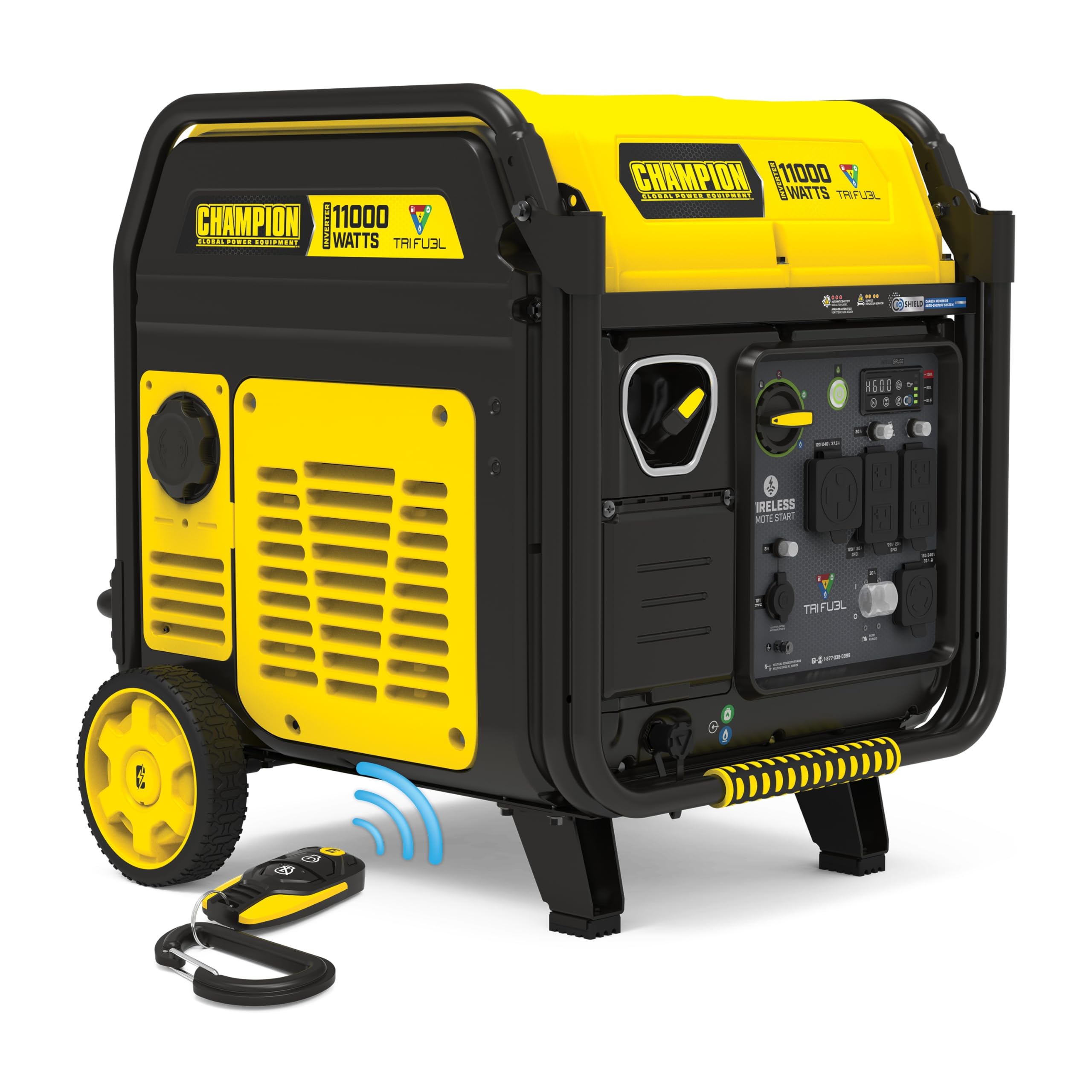
Champion 201423 11,000W Tri-Fuel Inverter — Clean Power for Electronics
Best for: Sensitive electronics and RV use
If you need clean power for a laptop, TV, or medical device, the Champion 201423 is the tri-fuel inverter to beat. It produces 9,000 running watts on gasoline and holds 7,290 watts on natural gas, all with less than 3% total harmonic distortion. The 459cc engine and remote key fob make starting simple, and CO Shield shuts the unit down if carbon monoxide rises. At 15 hours on a 6.08-gallon tank at quarter load, it sips fuel compared with open-frame rivals. The trade-off is price and weight: inverter tri-fuel units cost more and this one is not light.
- Under 3% THD protects electronics
- 15-hour runtime at 25% load
- Remote start and CO Shield included
- Costs more than open-frame rivals
- Heavy for one-person loading
4.8/5
4.9/5
4.7/5

DuroMax XP13000HXT — The Brute for Large Homes
Best for: Large homes and heavy loads
The XP13000HXT is the brute of this group. Its 500cc engine pushes 10,500 running watts on gasoline and still holds 8,500 watts on natural gas, enough to start a central AC and run a well pump at the same time. The 8.3-gallon tank gives about 8.5 hours at half load, and the remote start works from a key fob. CO Alert adds a layer of safety. The penalty for all that power is weight and noise: at 265 pounds, it needs two people and a ramp, and it is louder than inverter models.
- 8,500W on natural gas is class-leading
- Starts large AC and well pump together
- Remote start and CO Alert standard
- 265 pounds, needs two people
- Louder than inverter generators
4.8/5
4.5/5
4.8/5

Firman T07571 — Tri-Fuel Backup Without the Premium
Best for: Budget-conscious home backup
The Firman T07571 delivers the core tri-fuel feature set at a lower price than the big-name alternatives. You get 7,500 running watts on gasoline, 6,750 on propane, and 5,500 on natural gas from a 439cc engine. The 8-gallon tank runs up to 12 hours at quarter load, and the control panel includes a 50A outlet for transfer-switch hookup. It is not an inverter, so THD is higher and it is louder, but for resistive loads like heaters and fridge compressors it gets the job done. The lack of remote start is the biggest convenience gap.
- Lowest-cost entry to tri-fuel backup
- 8-gallon tank, 12-hour runtime
- 50A outlet ready for transfer switch
- No remote start
- Higher THD than inverter models
4.5/5
4.4/5
4.6/5

Champion 201537 8500W Wireless Start — Quiet Enough for a Backyard
Best for: Quiet backyard and campsite power
The Champion 201537 is the quietest tri-fuel inverter in this roundup at 64 dB, which is roughly the volume of a normal conversation. It produces 6,500 running watts on gasoline and 5,265 on natural gas, enough for a fridge, lights, and a window AC. The wireless remote starts the unit from up to 80 feet, and CO Shield provides automatic shutdown. At 13 hours on a 6-gallon tank at quarter load, it is efficient. The trade-off is output: it cannot run a central AC or a large well pump.
- 64 dB is quiet enough for campgrounds
- Wireless remote works from 80 feet
- Less than 3% THD for electronics
- 5,265W on natural gas limits big loads
- Cannot start central AC
4.5/5
4.9/5
4.8/5

Pulsar PGD170TiSRCO 17,000W — Whole-Home Muscle
Best for: Whole-home backup with heavy loads
The Pulsar PGD170TiSRCO is for the homeowner who wants to run everything, not just the essentials. Its 760cc V-twin engine produces 14,500 running watts on gasoline, and the inverter design keeps THD low enough for sensitive electronics. The built-in ATS inlet makes automatic backup possible, and the 10.6-gallon tank supports up to 10 hours at half load. CO Sentry and remote start are included. The downsides are size, weight, and fuel consumption: this is a two-person installation, and propane or natural gas output is significantly lower than gasoline.
- 14,500 running watts on gasoline
- ATS-ready for automatic backup
- Low THD inverter power
- Very heavy and bulky
- Propane and NG output drop sharply
4.4/5
4.3/5
4.7/5

Genmax GM12000XiT — Balanced Output and Clean Power
Best for: Balanced output and clean power
The GM12000XiT sits in a useful middle ground: it is an inverter with 10,000 running watts on gasoline, 9,000 on propane, and 8,000 on natural gas, so it can carry a fridge, furnace, and a few lights without the bulk of a 14,500-watt unit. The 458cc engine and electric start are straightforward, and the inverter design keeps THD low. Fuel capacity is 10.5 gallons, and runtime is competitive. The main weakness is brand support: Genmax has a smaller service network than Generac or Westinghouse, so repairs can take longer.
- 8,000W on natural gas is strong
- Inverter power protects electronics
- Large 10.5-gallon fuel tank
- Smaller service network than legacy brands
- No remote start on base model
4.6/5
4.4/5
4.5/5

Westinghouse iGen8200TFc — Clean Power for the Campsite
Best for: RV trips and tailgating
The iGen8200TFc is the tri-fuel generator we would pack for an RV because it produces clean inverter power in a package that is easier to move than the big open-frame units. It delivers 6,600 running watts on gasoline, 5,940 on propane, and 5,280 on natural gas, enough for a 15,000 BTU RV air conditioner and a microwave. The 3.9-gallon tank runs up to 17 hours at quarter load, and the remote key fob starts it from inside the camper. At around 60 dBA at quarter load, it will not drown out conversation. The small tank means more refills during a long outage.
- 17-hour runtime at 25% load
- Around 60 dBA, very quiet
- Remote start and 50A outlet
- Small 3.9-gallon tank
- 5,280W on natural gas limits loads
4.5/5
4.8/5
4.8/5
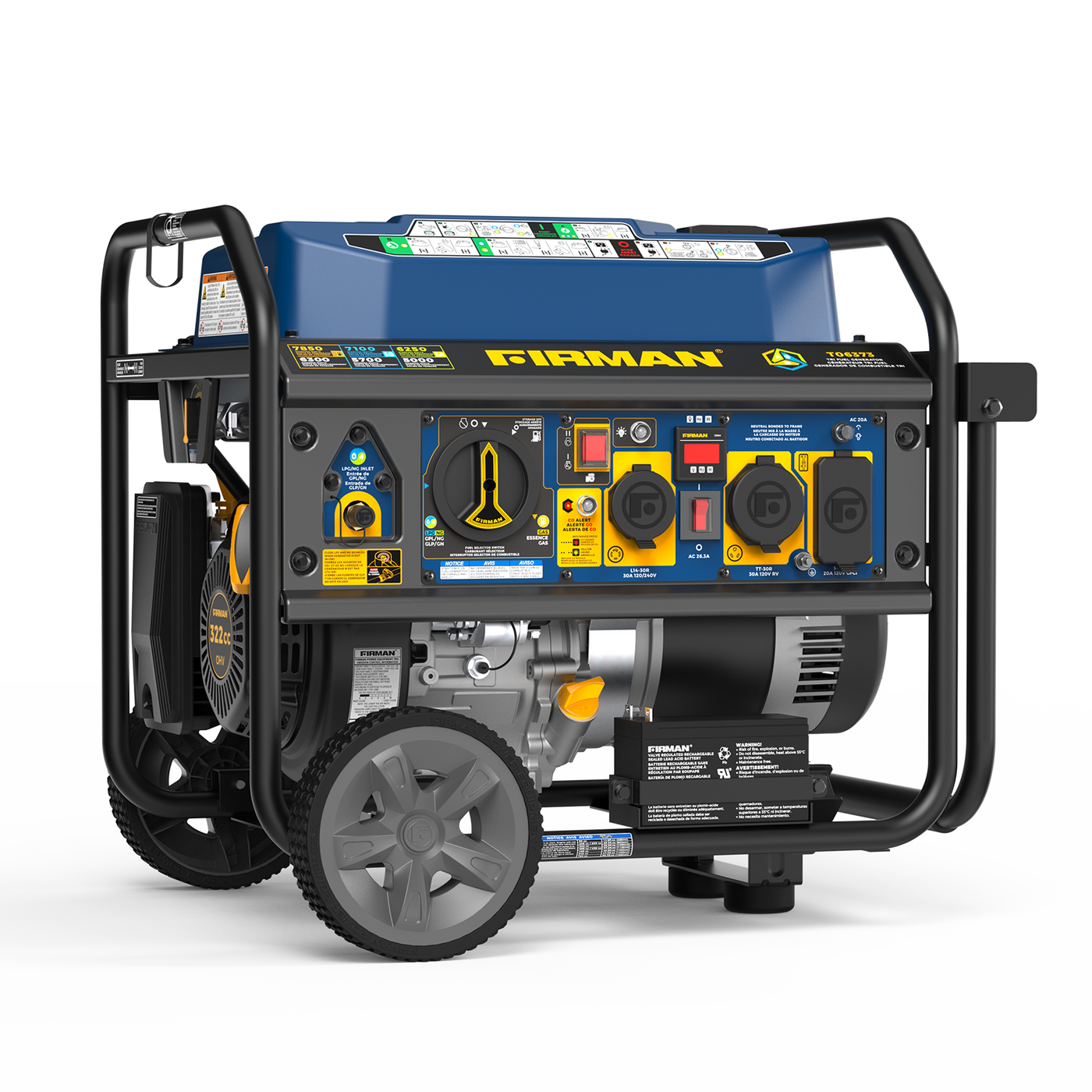
Firman T06373 — The Easiest Tri-Fuel to Move
Best for: Small homes and job sites
The Firman T06373 is the smallest unit here, and that is its appeal. At 151 pounds, it is the easiest to wheel around a garage or load into a truck, yet it still produces 6,300 running watts on gasoline and 5,000 on natural gas. CO Alert shuts the engine down if carbon monoxide rises, and the 6-gallon tank runs up to 10 hours at half load. It is not an inverter, so it is louder and less suitable for sensitive electronics. For a cabin, small home, or job site where portability matters more than clean power, it is a sensible choice.
- 151 pounds, easiest to move
- CO Alert standard
- 10-hour runtime at half load
- Not inverter power
- 5,000W on natural gas is modest
4.3/5
4.6/5
4.6/5
Top 3 Head-to-Head: Westinghouse WGen9500TFc vs Generac GP9500E vs Champion 201423
These three rise to the top for different reasons, and most readers end up choosing between them after narrowing the field. Here is how they compare on the factors that decide an outage.
| Feature | #1 Westinghouse | #2 Generac | #3 Champion |
|---|---|---|---|
| Natural gas running watts | 7,500 — Best | Lower than 7,500 | 7,290 |
| Starting convenience | Remote, electric, recoil | Electric only | Remote, electric — Best |
| Power quality for electronics | Standard THD | Standard THD | Under 3% THD — Best |
| Choose if… | You want the best all-around balance | You trust Generac’s service network | You need clean power for electronics |
Who These Tri-Fuel Generators Are NOT For
These generators solve a specific problem — portable, fuel-flexible backup — but they are the wrong tool for a few common situations.
If you live in an apartment or have no outdoor space, a portable generator is unsafe and often prohibited by lease terms. And if your only goal is charging phones and a laptop during a short outage, a battery power station is cheaper, quieter, and simpler.
Common Mistakes to Avoid
Most tri-fuel generator disappointments come from four avoidable mistakes, not from bad products.
Frequently Asked Questions About Tri-Fuel Generators
What is a tri-fuel generator and how does it work?
A tri-fuel generator is a portable generator that can run on three fuel sources: gasoline, propane, and natural gas. A fuel selector dial routes the chosen fuel to the engine, and the generator derates output on propane and natural gas because those fuels have lower energy density than gasoline. The main advantage is that you are not dependent on a single fuel supply during an outage.
Can a tri-fuel generator run on natural gas without a transfer switch?
The generator can run on natural gas without a transfer switch if you connect appliances directly with extension cords, but you cannot safely connect it to your home’s wiring without a transfer switch or interlock kit. A transfer switch prevents backfeeding and allows you to power selected circuits safely. For any connection to household wiring, hire a licensed electrician.
How many watts do I need to run a refrigerator on a tri-fuel generator?
A typical refrigerator draws 600–800 running watts and 1,200–2,000 starting watts. Any generator in this roundup can handle that, even on natural gas. The real sizing question is what else you want to run at the same time — a furnace blower, well pump, or window AC adds hundreds to thousands of watts and quickly pushes you toward a larger unit.
How long will a tri-fuel generator run on propane?
Runtime on propane depends on tank size and load. A 20-pound propane tank typically gives about 4.5 hours at half load on a large tri-fuel generator, or 8–10 hours on a smaller inverter model. A 40-pound tank roughly doubles that. For multi-day outages, natural gas is the better fuel because it does not run out, provided your home has a gas line.
Is a tri-fuel generator worth the extra cost over dual fuel?
A tri-fuel generator is worth it if your home has a natural gas connection and you want the option to run for days without refueling. If you do not have natural gas and do not plan to install a connection, a dual-fuel generator that runs on gasoline and propane is the better value. Tri-fuel units typically cost more upfront, and the premium only pays off when you actually use the natural gas option.
What size tri-fuel generator do I need for home backup?
For essential circuits — fridge, furnace, lights, and a few outlets — 5,000–7,500 running watts on natural gas is enough. If you want to run a central AC, well pump, or electric water heater, step up to 8,000–10,000 running watts on natural gas. Add up the running watts of everything you want to power simultaneously, then add the largest starting surge.
Can a tri-fuel generator power an RV air conditioner?
Yes, if the generator has enough running watts and a TT-30R outlet. A 15,000 BTU RV air conditioner draws about 1,500–2,000 running watts and needs 3,000–4,000 watts to start. Any generator in this roundup rated above 5,000 running watts can handle it, but inverter models are preferable for RV use because they produce cleaner power and run quieter in campgrounds.
Our Final Verdict
The tri-fuel generator market splits into three clear lanes: high-output open-frame units for heavy home loads, inverter models for clean power and quiet operation, and compact units for portability. Most homeowners are best served by the Westinghouse WGen9500TFc EFI because it delivers the highest natural-gas output in this group without sacrificing starting convenience or safety features. If clean power for electronics is non-negotiable, choose the Champion 201423. If natural gas is not available, save money with a dual-fuel model instead.

Hi, I’m Michael Turner. I own a generator workshop in the United States and founded HomeGeneratorBlog to share practical, hands-on guidance about generator installation, maintenance, troubleshooting, safety, and backup power solutions. My goal is to help homeowners make smarter, more confident decisions through clear and reliable information