10 Best Portable Generator for 5th Wheel 2026: RV Power
For the 10 best portable generator for 5th wheel, Westinghouse iGen11000DFc Dual Fuel Portable Inverter Generator is our top pick for 50-amp power. We evaluated 10 portable generators, scoring each on 5th-wheel power fit, runtime and fuel flexibility, and quiet RV-ready ease of use. Most generators look identical on paper but fail at AC startup — the gap this comparison exposes. Whether you need full 50-amp power, quiet single-AC camping, or dual-fuel flexibility, this guide gives you one clear answer.
Quick Comparison: All 10 Products Ranked
| # | Product | Best For | Rating | Badge | |
|---|---|---|---|---|---|
| 1 | Westinghouse iGen11000DFc Dual Fuel Portable Inverter Generator | Larger 5th wheels needing maximum power | 4.9/5 | Best Overall | Buy → |
| 2 | Predator 9500 Super Quiet Portable Inverter Generator | Full-size rigs wanting large quiet power | 4.8/5 | Best Large Inverter | Buy → |
| 3 | DuroMax XP9500iH Dual Fuel Portable Inverter Generator | Dual-fuel buyers wanting high output | 4.8/5 | Best High-Output Inverter | Buy → |
| 4 | Champion Power Equipment 4500-Watt Dual Fuel RV Ready Portable Inverter Generator | Budget-conscious owners with one main AC | 4.7/5 | Best Dual Fuel Value | Buy → |
| 5 | WEN DF450i Super Quiet Dual Fuel RV-Ready Portable Inverter Generator | Quiet camping with one AC | 4.7/5 | Best Quiet 4500W | Buy → |
| 6 | Westinghouse iGen5000 Super Quiet Portable Inverter Generator | Single-AC rigs prioritizing quiet operation | 4.6/5 | Best for Single AC | Buy → |
| 7 | Honda EU7000iS Portable Inverter Generator | Premium buyers prioritizing quiet reliability | 4.6/5 | Best Premium Quiet | Buy → |
| 8 | Generac GP8000E Portable Generator | Owners needing strong conventional power | 4.5/5 | Best Open-Frame Power | Buy → |
| 9 | Cummins Onan P4500iDF Dual Fuel Portable Inverter Generator | Compact dual-fuel camping with remote start | 4.5/5 | Best Compact Dual Fuel | Buy → |
| 10 | Briggs & Stratton P4500 PowerSmart Portable Inverter Generator | Compact gas power for lighter loads | 4.4/5 | Best Compact Gas | Buy → |
How We Chose These Portable Generators
What we compared
Published specifications for 10 models: peak and running watts, fuel type, start type, inverter output, RV outlet fit, and safety features. This is a specification comparison, not a hands-on test.
Our 3 scoring criteria
5th-Wheel Power Fit, Runtime and Fuel Flexibility, and Quiet RV-Ready Ease of Use. When overall scores tie, the higher Power Fit score ranks first, then Runtime and Fuel Flexibility.
What we did not claim
No hands-on testing period, measured noise or runtime result, and no expert interview were supplied. Scores are editorial assessments from published specifications, not measured test results.
What we cut — and why
Small 2000-watt-class models and permanently installed standby units were cut. The first usually cannot start a 5th wheel air conditioner, and the second is not a portable generator.
What to Look for When Buying a Portable Generator for a 5th Wheel
A 5th wheel is not a small camper with a plug. It often has a larger air conditioner, a residential-style fridge, a microwave, and a converter charging batteries at the same time.
Size for the loads you will actually run together, not for the biggest number on the box.
1. 50-Amp Service and Total Load
Many 5th wheels use 50-amp service, which in theory can deliver far more power than most portable generators. A portable unit with a 50-amp-style outlet does not automatically give you full, unrestricted 50-amp service.
Add up running watts for your air conditioner, fridge, converter, and any heater or microwave you plan to use together. Then check 50-amp RV generator sizing before assuming one outlet solves the whole load.
2. Air Conditioner Starting Watts
An air conditioner needs a short surge to start that is much higher than its running watts. That surge is where undersized generators fail, even if the running load looks fine on paper.
Check the starting watts for your specific air conditioner size, and leave headroom for the fridge compressor or converter starting at the same time. For sizing help, see RV air conditioner generator sizing alongside your unit manual.
3. Fuel Type and Runtime
Gasoline is easy to find, but propane stores longer and is already on many 5th wheels. Dual-fuel models let you switch when one fuel is scarce, a storm closes a station, or you want cleaner storage.
Runtime also depends on load, not just tank size. A generator at half load will run far longer than the same unit near full load, so compare runtime at a stated load level. Read dual-fuel RV generator choices if you camp away from fuel stations.
4. Noise and Clean Inverter Power
Campgrounds have quiet hours, and neighbours notice an open-frame unit at night. Closed-frame inverters are usually quieter, and inverter output is also steadier for phones, laptops, televisions, and RV control boards.
Do not judge noise from one headline number alone. Check noise at a stated load and distance, and favour a quieter closed-frame inverter for overnight use. See quiet generators for RV camping before choosing an open-frame model for a quiet site.
5. Weight, Placement, and Parallel Capability
Large 5th wheel generators are heavy. Plan how you will load one into a truck bed, use a ramp, and secure it for travel, because a unit you cannot move safely is a unit you will not use.
Parallel capability is a useful fallback: two smaller inverters can combine for more power and split the lifting weight. Compare portable RV generator options if a single large unit is too heavy for your setup.

Westinghouse iGen11000DFc Dual Fuel Portable Inverter Generator — Maximum Power, Dual-Fuel Flexibility
Best for: Larger 5th wheels needing maximum power
For a larger 5th wheel, this Westinghouse is the easiest single-unit answer in this list. Its dual-fuel design and high peak output give you headroom for air-conditioner startup, while inverter power keeps sensitive electronics steadier than a conventional open-frame unit. Remote start also makes setup simpler after a long drive, especially in rain or darkness. The trade-off is size and weight, so plan a ramp and secure truck-bed space. If you want maximum capacity without paralleling two units, this is the clear first choice for most large rigs.
- 11000 peak watts for high-demand RV loads
- Dual-fuel flexibility for gasoline or propane
- Remote start from a short distance
- Heavy to move without a ramp
- Large footprint in truck bed storage
5.0/5
4.9/5
4.8/5

Predator 9500 Super Quiet Portable Inverter Generator — Large, Quiet, Single-Fuel Power
Best for: Full-size rigs wanting large quiet power
For a full-size 5th wheel, the Predator 9500 is a strong large-inverter alternative to the top pick. Its 9500 peak watts and 7600 running watts give real headroom for an air conditioner plus everyday RV loads, while its closed-frame inverter design keeps noise lower than most open-frame models. Remote start adds convenience at a campsite, especially after dark or in bad weather. The main limits are weight and gasoline-only operation, so you will need a ramp and a fuel plan. If you do not need propane, this is a very capable large choice.
- 9500 peak watts for AC startup
- Quieter than open-frame models
- Electric start with remote control
- Heavy for one person to lift
- No propane option in this model
4.9/5
4.7/5
4.8/5

DuroMax XP9500iH Dual Fuel Portable Inverter Generator — High Output, Dual-Fuel Choice
Best for: Dual-fuel buyers wanting high output
For buyers who want large inverter power without giving up propane, the DuroMax XP9500iH is the most flexible high-output option here. It delivers 9500 peak watts and 7600 running watts, with dual-fuel operation for longer stays or uncertain gasoline supply. Electric start keeps setup simple, and inverter output suits sensitive RV electronics better than a conventional generator. It is still a heavy unit, and propane output is lower than gasoline output, so plan loads accordingly. For dual-fuel camping, it is a strong, practical third choice.
- 9500 peak watts, dual-fuel ready
- 7600 running watts for larger loads
- Electric start simplifies cold mornings
- Heavier than 4500-watt inverters
- Propane running watts lower than gasoline
4.8/5
4.9/5
4.7/5

Champion Power Equipment 4500-Watt Dual Fuel RV Ready Portable Inverter Generator — Practical Dual-Fuel Value
Best for: Budget-conscious owners with one main AC
For a 5th wheel owner who mainly needs one air conditioner and everyday charging, this Champion is a practical step down in size without giving up dual fuel. Its RV-ready design connects directly to the rig, and its open-frame inverter layout keeps the unit lighter and easier to handle than the large closed-frame models. You must manage loads carefully, turning off a second heavy appliance before starting the air conditioner. If your camping style is one AC at a time, this model offers strong value for the capability.
- Dual-fuel choice for longer stays
- RV-ready outlet for direct hookup
- Open-frame design aids airflow
- Not sized for two ACs together
- Louder than closed-frame inverters
4.6/5
4.8/5
4.7/5

WEN DF450i Super Quiet Dual Fuel RV-Ready Portable Inverter Generator — Quiet Dual-Fuel Camping
Best for: Quiet camping with one AC
For quiet campsites and a single air conditioner, the WEN DF450i is the calmest 4500-watt option in this list. Its closed-frame dual-fuel design, fuel shut-off feature, and RV-ready outlet make it easy to set up and store for seasonal trips. You will still need to manage loads, especially when the fridge or microwave starts, but that is true of every unit in this size class. If low noise matters more than maximum output, and you camp with one main AC, this WEN deserves a close look.
- 4500 peak watts in compact inverter
- Dual-fuel with fuel shut-off
- Quiet closed-frame design
- Single-AC load management required
- Shorter runtime at high load
4.5/5
4.7/5
4.9/5

Westinghouse iGen5000 Super Quiet Portable Inverter Generator — Quiet Single-AC Power
Best for: Single-AC rigs prioritizing quiet operation
For a 5th wheel with one main air conditioner, the Westinghouse iGen5000 is a quiet, straightforward inverter choice. Its 5000 peak watts cover a single AC plus lights, charging, and a fridge if you stagger other heavy loads. Remote start is genuinely useful at a campsite, letting you start power without walking to the unit in bad weather. The limits are clear: it is gasoline only, and it is not a two-AC solution. If quiet single-AC camping is your normal pattern, this model fits well.
- 5000 peak watts for single AC
- Remote start for easy setup
- Quiet inverter power for electronics
- Gasoline only, no dual fuel
- Two ACs need load management
4.6/5
4.5/5
4.7/5
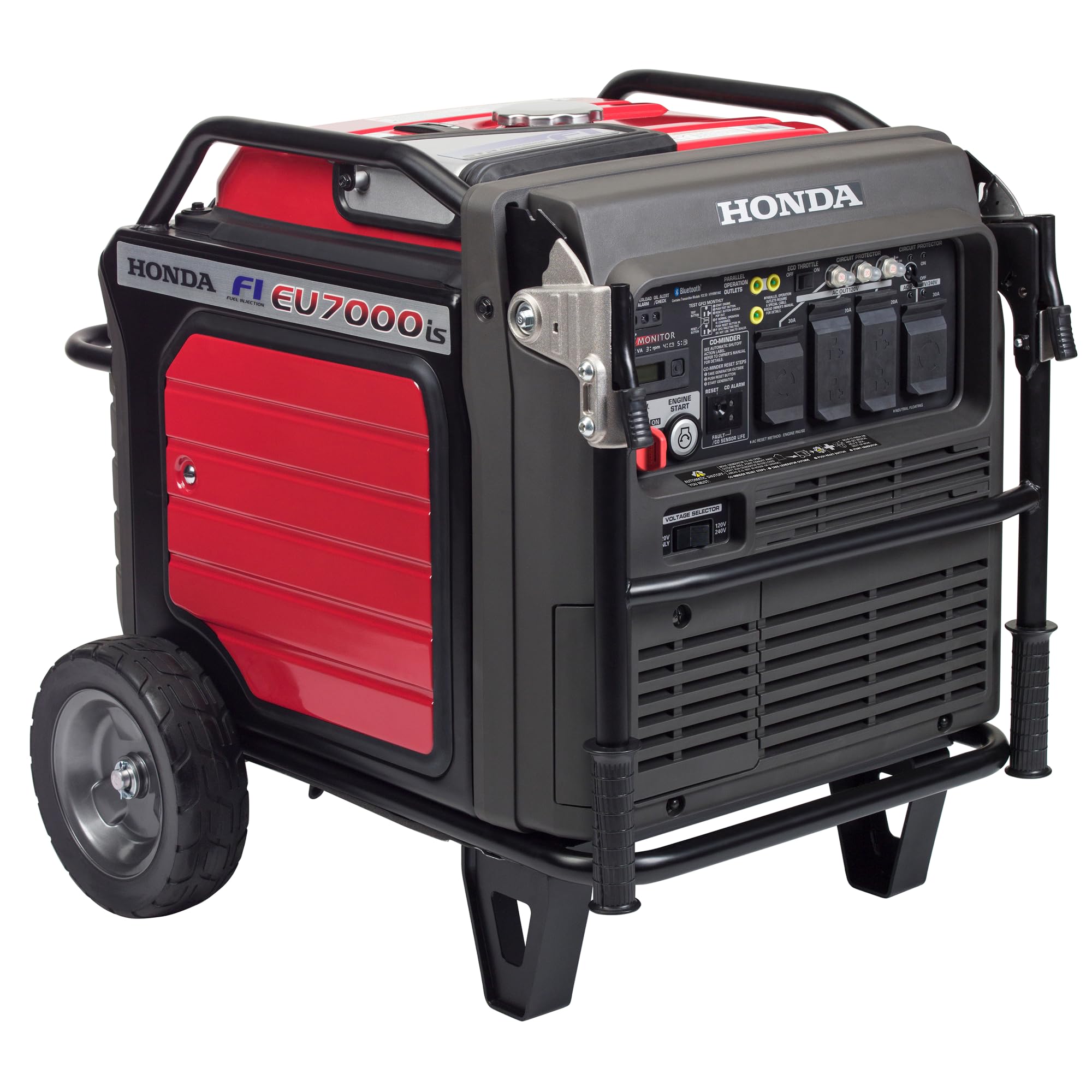
Honda EU7000iS Portable Inverter Generator — Premium Quiet Reliability
Best for: Premium buyers prioritizing quiet reliability
For buyers who value quiet operation and long-term reliability over maximum watts, the Honda EU7000iS is the premium pick here. Its fuel-injected 7000 peak watts and 5500 running watts cover a single large air conditioner and everyday RV loads, with very steady inverter power for electronics. Electric start and a closed-frame design make it easy to live with at a campsite. The trade-offs are gasoline-only operation and a premium position in this class. If you camp often and want the quietest dependable option, this Honda justifies its place.
- 7000 peak watts, fuel-injected
- Very quiet closed-frame inverter
- Clean power for sensitive electronics
- Premium cost for the class
- Gasoline only, no propane
4.5/5
4.6/5
4.7/5

Generac GP8000E Portable Generator — Strong Conventional Power
Best for: Owners needing strong conventional power
For a 5th wheel owner who needs strong, straightforward power and does not prioritise the quietest inverter output, the Generac GP8000E is a capable open-frame choice. Its 8000 peak watts and 6500 running watts handle a large air conditioner and other heavy loads, and electric start removes the hardest part of setup. The clear trade-off is noise and power quality: it is not an inverter model, so it is louder and less suited to sensitive electronics than the inverters above. Choose it for raw capacity, not for quiet campsites.
- 8000 peak watts for heavy loads
- Electric start with large tank
- Long runtime from large tank
- Not an inverter model
- Louder than closed-frame inverters
4.7/5
4.3/5
4.5/5
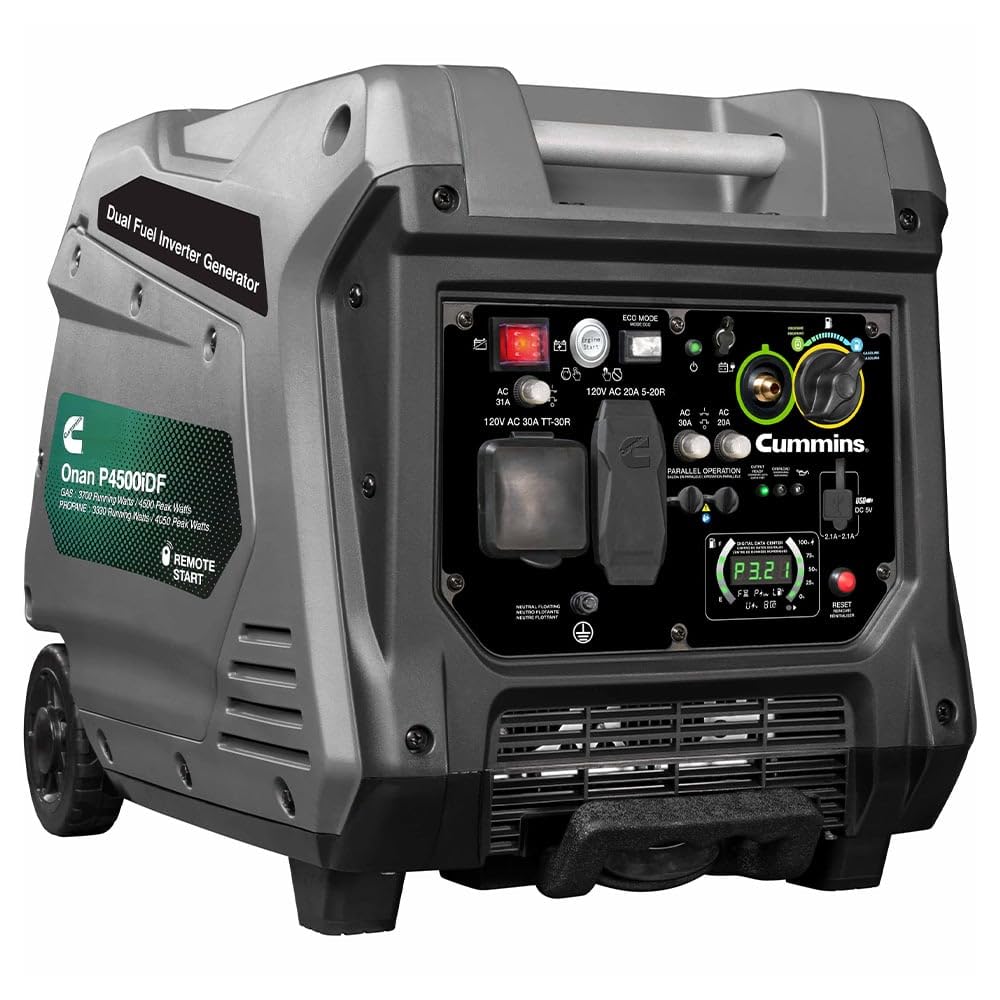
Cummins Onan P4500iDF Dual Fuel Portable Inverter Generator — Compact Dual-Fuel Convenience
Best for: Compact dual-fuel camping with remote start
For a smaller 5th wheel or a shorter trip, the Cummins Onan P4500iDF packs dual-fuel convenience into a compact inverter. Its 4500 peak watts, with 3700 running watts on gasoline and 3300 on propane, suit one air conditioner plus careful load management. Remote start and an RV-ready outlet make setup simple, especially for owners who move sites often. It is not a large-rig solution for two air conditioners or heavy simultaneous loads. If compact size and dual fuel matter most, this is a neat, travel-friendly pick.
- Dual-fuel in compact inverter
- Remote start included
- RV-ready outlet
- Single-AC load management required
- Lower output than large inverters
4.4/5
4.7/5
4.4/5

Briggs & Stratton P4500 PowerSmart Portable Inverter Generator — Compact Gas Inverter
Best for: Compact gas power for lighter loads
For lighter 5th wheel loads and short trips, the Briggs & Stratton P4500 PowerSmart is a compact gasoline inverter that is easy to store and move. Its 4500 peak watts suit a single air conditioner with careful load management, plus lights, charging, and a fridge. Inverter output is steadier for electronics than a conventional generator, and its compact size helps in a crowded truck bed. It is gasoline only and not a two-AC unit, so it belongs at the end of this list for owners whose loads are genuinely light.
- 4500 peak watts, compact inverter
- Quiet operation for campgrounds
- Easy portability for short trips
- Gasoline only, no dual fuel
- Not for two ACs together
4.3/5
4.5/5
4.4/5
Top 3 Head-to-Head: Westinghouse iGen11000DFc vs Predator 9500 vs DuroMax XP9500iH
These three are the common final choices for a larger 5th wheel because they all clear 9000 peak watts. The real difference is fuel flexibility, not just the headline number.
| Feature | #1 Westinghouse | #2 Predator | #3 DuroMax |
|---|---|---|---|
| 5th-Wheel Power Fit | 5.0/5 — Best | 4.9/5 | 4.8/5 |
| Runtime and Fuel Flexibility | 4.9/5 | 4.7/5 | 4.9/5 — Best |
| Quiet RV-Ready Ease of Use | 4.8/5 — Best | 4.8/5 | 4.7/5 |
| Choose if… | You want maximum dual-fuel power in one unit | You want large quiet power and only need gasoline | You want large power with dual-fuel flexibility |
Who These Portable Generators Are NOT For
A portable generator is not the right answer for every 5th wheel setup, even when the watts look impressive.
If you cannot safely lift, ramp, fuel, and secure a heavy unit, a smaller inverter pair or a campground with hookups may be safer. If you want a built-in, automatic home-style backup that starts itself during an outage, a portable RV generator is also the wrong category.
Common Mistakes to Avoid
Most 5th wheel generator problems come from sizing, placement, or fuel assumptions, not from the brand on the box.
Frequently Asked Questions About Portable Generators for a 5th Wheel
What size portable generator do I need for a 5th wheel?
It depends on your air conditioner and the loads you run together, but most 5th wheels need at least a 4500-watt-class inverter for one air conditioner. Larger rigs, or rigs with two air conditioners, usually need a 9000-watt-class unit or a parallel pair. Add running watts for the fridge, converter, and microwave, then size for the air conditioner starting surge.
Can a portable generator run a 5th wheel air conditioner?
Yes, if the generator covers the air conditioner starting watts and you manage other loads. A single 4500-watt-class inverter can often run one smaller air conditioner, while a larger or second air conditioner usually needs a bigger unit or a parallel setup. Turn off the microwave and water heater before starting the air conditioner to avoid an overload.
Do I need a 50 amp generator for a 5th wheel?
Not always, but it helps for larger rigs. Many 5th wheels use 50-amp service, yet a portable generator with a 50-amp-style outlet does not automatically deliver full shore-power capacity. Check peak and running watts first, and use load management if you run two air conditioners or several heavy appliances at once.
Can I run two portable generators in parallel for a 5th wheel?
Yes, if both models support parallel operation and you use the correct parallel kit. Two smaller inverters can combine for more power while splitting the lifting weight, which helps owners who cannot move one large unit. Check the manufacturer parallel rules, because not every inverter in this list is parallel-ready in every variant.
How quiet should a generator be for RV camping?
Quieter is better for campgrounds, and closed-frame inverters are usually the best choice for overnight use. Compare noise at a stated load and distance, because a headline number at light load can hide higher noise under air-conditioner load. Also follow campground quiet hours, even with a quiet inverter, and place the unit away from neighbouring rigs.
Is dual fuel better for a 5th wheel?
Dual fuel is often better for travel, because propane stores longer and is already carried by many 5th wheels. It also gives you a backup when gasoline is hard to find. The trade-off is lower running watts on propane for many models, so size the unit for propane output if propane will be your main fuel.
Where should I place a portable generator at a 5th wheel site?
Place it outdoors, on a stable surface, downwind, and well away from windows, vents, doors, and slide seals. Never run it inside the RV, in an enclosed truck bed, or under an awning where exhaust can collect. Keep it dry, allow airflow for cooling, and use a working carbon monoxide alarm inside the rig as a second layer of protection.
Our Final Verdict
For most larger 5th wheels, maximum dual-fuel inverter capacity wins, because air-conditioner startup and total load matter more than saving weight. Smaller rigs can choose a quiet 4500-watt inverter and manage loads carefully instead.

Hi, I’m Michael Turner. I own a generator workshop in the United States and founded HomeGeneratorBlog to share practical, hands-on guidance about generator installation, maintenance, troubleshooting, safety, and backup power solutions. My goal is to help homeowners make smarter, more confident decisions through clear and reliable information