What Does the Alternator Do in an Inverter Generator?
The alternator turns the engine’s spinning motion into raw alternating current (AC) electricity. That raw power is not sent straight to your outlets. It is first changed to direct current (DC), then rebuilt by the inverter into clean, stable 120-volt power.
In an inverter generator, the alternator is the part that actually makes electricity. Everything else in the machine either spins it, cleans up what it makes, or delivers that cleaned-up power safely to your appliances. If you understand the alternator, the rest of the inverter design starts to make sense.
Think of it this way. The engine burns fuel and spins a shaft. The alternator sits on that shaft. As it spins, magnets and wire coils inside it work together to push electrons around a circuit. That push is electricity.
What the Alternator Does, in One Job Description
An alternator is a device that converts mechanical energy into electrical energy. Mechanical energy is the spinning shaft. Electrical energy is the current that leaves the alternator and heads toward the rectifier.
In an inverter generator, that job has a specific limit. The alternator makes power, but it does not finish it. It does not decide the final voltage your laptop sees. It does not hold the frequency at exactly 60 hertz on its own. And it does not smooth out every spike and dip by itself.
That unfinished quality is deliberate. By letting the alternator make rough, high-voltage power first, the generator can use smaller, lighter parts and let the electronics do the fine control later. The result is the clean output inverter generators are known for, without forcing the engine to hold one rigid speed all day.
Inside the Alternator: Rotor and Stator
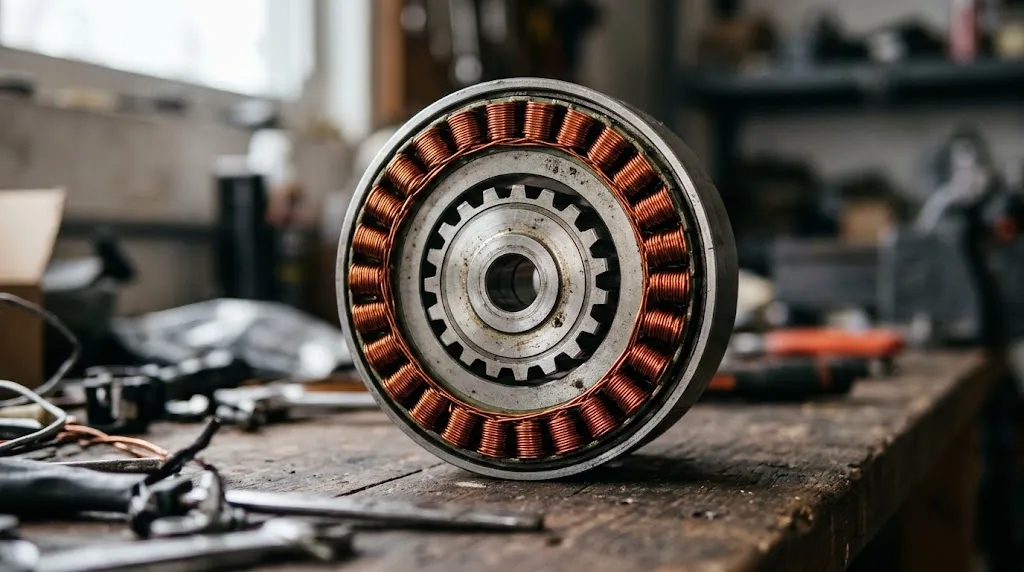
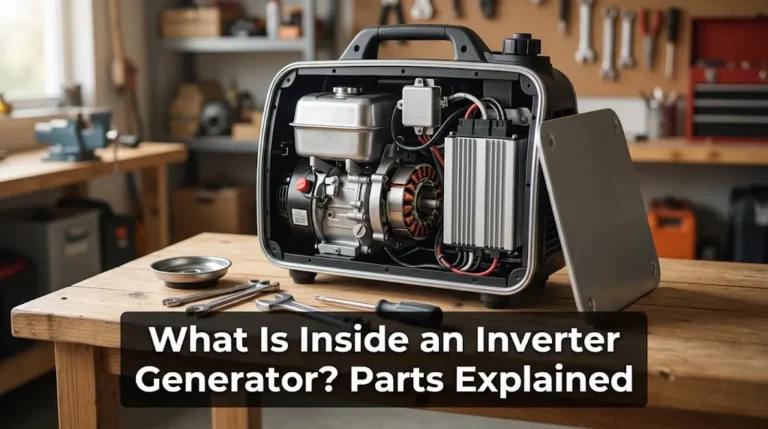
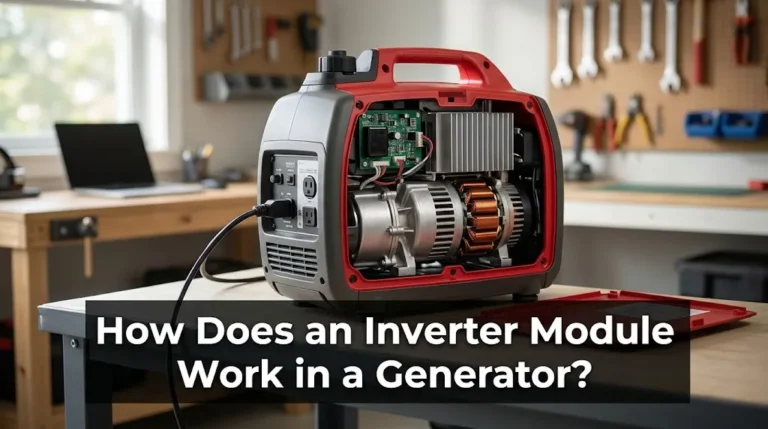
Most inverter generator alternators have two main parts. Knowing them helps when you read a manual or hear a repair shop talk about a winding fault.
The rotor: the spinning magnet
The rotor is the part that turns with the engine shaft. In many modern inverter units it carries strong permanent magnets, often rare-earth magnets. No brushes, no separate exciter winding, and no sliding contact are needed in a typical brushless design.
As the rotor spins, its magnetic field sweeps past the stationary coils again and again. Each pass pushes current one way, then the other. That back-and-forth push is why the output is called alternating current.
The stator: the stationary coils
The stator is the part that stays still. It holds copper windings arranged around the rotor. When the rotor’s magnetic field moves past those windings, a voltage is induced in them. This is electromagnetic induction, the same basic principle behind large power-station generators, just shrunk to fit a portable frame.
In many inverter designs the stator is wound for three phases. Three sets of coils, spaced around the circle, each produce power slightly out of step with the others. Combined, they give a steadier flow of raw power than a single coil could, and they let the alternator produce higher voltage and higher frequency in a compact package.
The first time I opened a small inverter unit after a long outage, the thing that surprised me was how light the alternator end felt compared with an old open-frame machine I had wrestled onto a truck years earlier. Same basic job, far less iron and copper, because the electronics downstream did not need the alternator to hold 60 hertz by brute mechanical force.
The Full Power Path, Step by Step
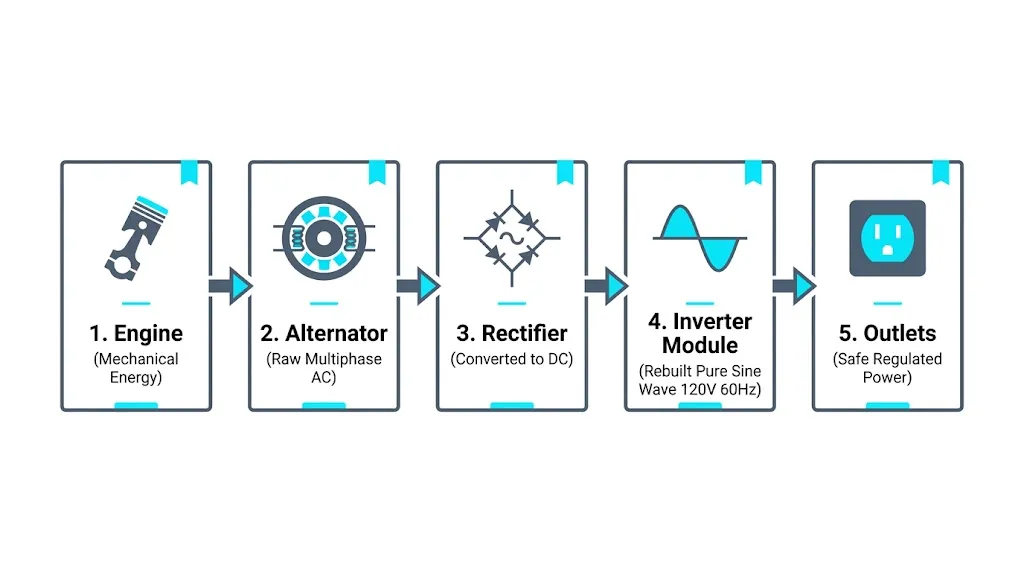
The alternator is step two in a short chain. No step works on its own, and skipping one changes what comes out of the outlets.
| Step | Part | What happens |
|---|---|---|
| 1 | Engine | Fuel burns and spins a shaft. Gasoline and propane are the most common fuels in portable inverter units. |
| 2 | Alternator | The spinning rotor induces raw, high-voltage, multiphase AC in the stator windings. |
| 3 | Rectifier | Raw AC is converted to DC. Filtering helps smooth the worst of the ripple at this stage. |
| 4 | Inverter module | DC is switched rapidly and rebuilt as a pure sine wave, normally 120 volts at 60 hertz in the United States. |
| 5 | Control board and outlets | A microprocessor watches voltage, frequency, and load, and protection circuits cut output on overload or low oil. |
Honda describes this same sequence in plain terms: the alternator produces high-voltage multiphase AC, that AC is converted to DC, and the inverter converts it back to AC while smoothing and cleaning it. A microprocessor controls the process and the engine speed. You can read that explanation on Honda’s inverter generator advantages page.
Notice what the alternator is not doing in that chain. It is not storing power like a battery. It is not charging your phone directly. It is feeding the next stage, and the quality of its raw output still matters, because a damaged winding or a weak magnet gives the inverter a worse starting point.
Why the Alternator’s Power Is Not Sent Straight to Your Outlets
Raw alternator power follows the engine. Speed up the engine, and voltage and frequency rise. Slow it down, and they fall. Put a heavy load on it, and the engine sags for a moment before it recovers.
That is fine for a resistive heater or an old incandescent bulb. It is a problem for a laptop charger, a modern furnace control board, a CPAP machine, or a variable-speed refrigerator compressor. Those devices expect power close to what comes from a wall outlet: steady voltage, a smooth sine wave, and low distortion.
Total harmonic distortion, or THD, is the usual shorthand for how far a waveform strays from a perfect sine wave. Inverter generators are typically built to keep THD under 3 percent, which is why they are routinely described as safe for sensitive electronics. Generac, for example, states that all of its portable inverters produce clean power with THD under 3 percent, and explains that low THD keeps output close to a pure sine wave. See Generac’s guide to portable generators for sensitive electronics for how that standard is defined.
The rectifier and inverter exist to break the link between engine speed and outlet frequency. Once raw AC becomes DC, engine speed no longer sets the output frequency. The inverter can rebuild 60-hertz power whether the engine is idling lightly or working hard. That decoupling is the whole trick, and it starts with the alternator making power in a form the electronics can reshape.
For a broader look at choosing a unit for home use, where that clean output matters most, see the guide to the best portable generator for home. When you are comparing models, a portable inverter generator is the category to filter for first, because its low-THD output is the feature that protects those devices.
How an Inverter Alternator Differs From a Conventional One
A conventional open-frame generator also has an alternator. The difference is what that alternator is asked to do, and how tightly it is tied to the outlets.
| Feature | Inverter alternator | Conventional alternator |
|---|---|---|
| Output sent to | Rectifier, then inverter, then outlets | Outlets, more or less directly |
| Engine speed | Varies with load, often much slower at light load | Locked near 3,600 RPM to hold 60 hertz |
| Typical design | Compact, multiphase, often brushless with permanent magnets | Larger, single-phase, built to hold frequency mechanically |
| Final frequency control | Electronics in the inverter module | Engine governor holding speed |
| Size and weight | Smaller and lighter for the same running watts, in general | Heavier, partly because of the larger alternator and frame |
| Output quality | Usually under 3 percent THD after inversion | Often higher, and it rises as speed and load waver |
On some Honda models the alternator is even integrated with the engine flywheel. That integration is one reason those units can be so compact. Less separate hardware, less weight to carry to a campsite or around a yard, and fewer parts rattling loose on a rough road.
None of this means a conventional alternator is badly made. It is built for a different job: make usable 120-volt, 60-hertz power directly, and hold it by holding speed. An inverter alternator is built for a different job: make plenty of raw power efficiently, and let the electronics finish it.
What the Alternator Does Not Do
Clearing up a few common mix-ups saves a lot of misdiagnosis later.
- It does not clean the power by itself. Cleaning happens after the rectifier, in the inverter module. A healthy alternator feeding a failed inverter still gives you bad output, or no output at all.
- It does not store energy. Stop the engine, and the alternator stops making power within seconds. There is no battery reserve inside the alternator itself, even if the unit has a separate electric-start battery.
- It does not set the final outlet frequency alone. Engine speed influences the raw frequency, but the inverter rebuilds the final 60 hertz. That is why eco mode can slow the engine without dropping your lights to a flicker.
- It does not regulate load for you. Overload protection, low-oil shutdown, and voltage control live in the control board and inverter electronics. The alternator will keep trying to supply what the engine can spin it to supply, until protection steps in.
- It is not the same thing as the inverter module. People use the words interchangeably in conversation, but on a parts diagram they are separate assemblies with separate failure modes and separate replacement costs.
If your generator runs but produces no power, the alternator is one suspect. So is the inverter module, a tripped breaker, a blown fuse, or a loose connection. Do not replace an alternator on a guess. Test in order, and check your manual’s troubleshooting sequence first.
Why This Design Makes Inverter Generators Smaller, Quieter, and More Efficient
Three practical benefits trace back to the alternator’s role, even though the inverter gets most of the credit.
Smaller size
A high-frequency, multiphase alternator can make the same electrical power from a smaller magnetic core than a low-frequency, single-phase alternator. Higher frequency means the magnetic field reverses more often, so each cycle needs less iron to transfer the same energy. Add flywheel integration on some models, and the whole generator shrinks.
Quieter running
Because outlet frequency no longer depends on holding 3,600 RPM, the engine can slow down when the load is light. A slower engine is a quieter engine, and it vibrates less. Enclosed inverter units add sound-dampening panels on top of that, but the variable-speed freedom is what makes the enclosure practical in the first place.
That matters on a campsite or in a quiet neighborhood at night. A quiet generator for RV use is not quiet only because of its muffler. It is quiet because its alternator and inverter let the engine loaf along at low load.
Better fuel use at light load
A conventional unit burns fuel to hold full speed even when you are only charging a phone. An inverter unit can drop engine speed to match demand. Honda’s Eco-Throttle system is one well-known example, and Honda states it can cut fuel consumption by up to 40 percent compared with running at full speed constantly.
Your savings will vary with load, fuel, altitude, and how often heavy appliances cycle on. The direction is consistent, though: light load, slower engine, less fuel burned, longer runtime per tank. That is a direct consequence of freeing the alternator from the 60-hertz speed lock.
Does the Alternator Limit How Much Power You Get?
Yes, in practice. The alternator’s size, winding, and cooling set a ceiling on raw power. The inverter cannot create watts the alternator never made. It can only shape what it receives, minus its own small losses.
That is why running watts and starting watts are both listed on a spec sheet. Running watts, sometimes called rated watts, are what the unit can sustain. Starting watts, or surge watts, are the brief extra output it can supply when a motor starts, such as a refrigerator compressor or a well pump. Both numbers start at the alternator and engine together.
A worked example helps. Suppose you run a refrigerator that needs 700 running watts and 2,200 starting watts, plus a few lights and a router drawing 200 watts combined. Your steady load is 900 watts. Your momentary peak, when the compressor kicks on, is 2,400 watts. A unit rated for 2,200 running watts and 2,800 starting watts covers both, with headroom. A unit rated for only 2,000 starting watts may trip or stall at that compressor start, even though it handles the steady 900 watts easily.
Parallel capability is the usual workaround when one alternator is not enough. Two compatible inverter units can be linked to share a larger load. If that route interests you, the guide to a portable generator with parallel capability explains what to check before buying a second unit.
Do not judge an alternator by peak watts alone. Cooling, duty cycle, and the inverter’s own rating all cap sustained output. A unit that can surge to a big number for three seconds is not a unit that can hold that number all evening.
What Happens When the Alternator Goes Wrong
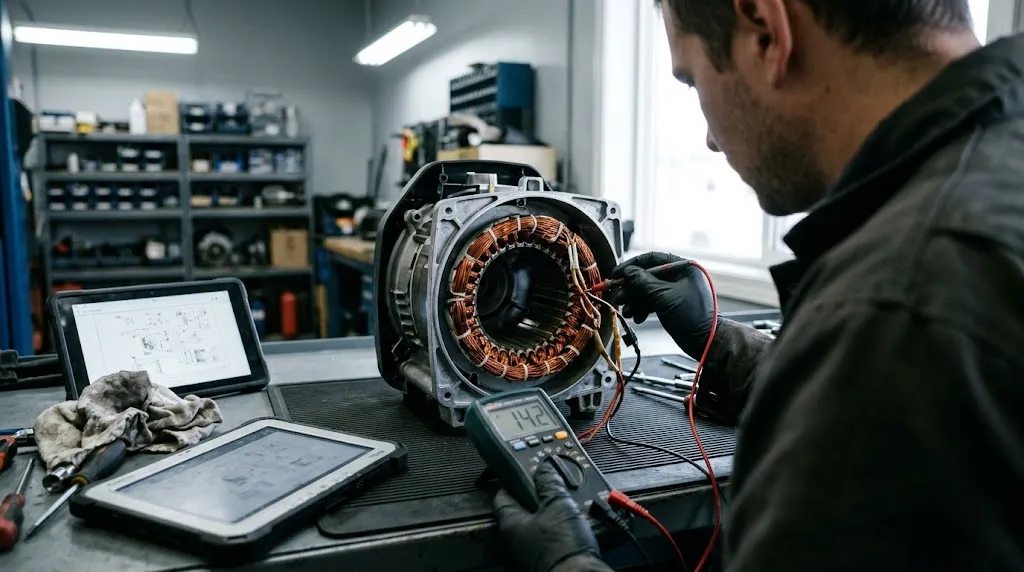
Alternators are generally durable, especially brushless designs with no brushes to wear out. When they fail, the symptoms tend to be electrical rather than noisy, which can make them easy to misread as an inverter fault.
| Symptom | Possible alternator cause | First check |
|---|---|---|
| Engine runs, no output at all | Open winding, failed magnet, or broken connection | Breakers, fuses, GFCI outlet reset, and outlet connections before assuming a part has failed |
| Voltage sags badly under load | Weak winding, overheating, or partial short | Reduce load, check ventilation, and confirm you are within running watts |
| Output cuts out, then returns | Loose winding connection or heat-related fault | Overload light, cooling airflow, and whether the fault follows a specific appliance |
| Burning smell or visible damage | Overheated or shorted winding insulation | Stop the unit, let it cool, and do not restart it until it has been inspected |
Moisture is a quiet enemy here. A generator left uncovered in rain, or stored damp, can develop corrosion on windings and connections. That is one reason a proper cover matters when the unit is not running. See the guide to inverter generator covers for sizing and ventilation points that keep a cover from trapping moisture against the machine.
Stop DIY diagnosis at the point where the manual tells you to, or where you would need to open the alternator housing, test live windings, or bypass a protection circuit. Those steps belong to a qualified repair shop. A miswired test can damage the inverter module, which is often the more expensive part.
How to Look After the Alternator
You cannot service a sealed, brushless alternator the way you change oil or clean an air filter. You can, however, avoid the conditions that shorten its life.
- Keep it dry and ventilated. Run the unit outdoors, away from rain splash, and never cover the cooling vents while it is running. Store it dry, with airflow, not sealed in a damp shed.
- Do not overload it repeatedly. Occasional surge is normal. Running at or above rated watts for hours heats windings and shortens insulation life.
- Let it cool before covering or storing. Trapping heat and moisture right after shutdown is a common storage mistake.
- Exercise it. A short run under moderate load every month or so keeps connections clean, burns off moisture, and reveals a problem before an outage does.
- Use clean, fresh fuel and follow the oil schedule. An engine that surges, stalls, or runs rough spins the alternator unevenly, and that rough input shows up downstream.
Safety note: Run any fuel-burning generator outdoors, at least 20 feet from doors, windows, and vents, with exhaust pointed away from the house. Never run one in a garage, basement, or shed, even with a door open. Carbon monoxide (CO) is odorless, and a CO shutoff sensor is a backup, not a substitute for distance and fresh air. For any connection to house wiring, use a transfer switch or interlock kit installed by a licensed electrician, and check local code. Never backfeed through a household outlet.
For home backup, that transfer-switch point matters more than alternator specs. A clean inverter output still needs a safe path into your panel. An electrician can confirm grounding, neutral bonding, and the correct inlet for your unit.
Conclusion
The alternator makes the raw power. The rectifier and inverter finish it. That division of labor is why an inverter generator can be small, quiet, and gentle on sensitive electronics, all at once.
If you remember one thing, make it this: a healthy alternator gives the inverter good material to work with, and no inverter can fix a badly damaged one. Keep the unit dry, within its ratings, and serviced on schedule, and it will do its quiet job in the background. That is the practical takeaway I would leave you with, from Michael Turner.
If you are shopping for a unit where the alternator and inverter work together for clean, quiet power, a portable inverter generator is the category to compare first. It is the right starting point for laptops, phones, CPAP machines, and other sensitive gear during an outage.
Frequently Asked Questions
Does an inverter generator have an alternator?
Yes. Every fuel-burning inverter generator has an alternator. The engine spins it, and it produces raw AC power. The difference from a conventional generator is what happens next, not whether an alternator is present.
Is the alternator the same as the inverter?
No. The alternator is the spinning electrical machine that makes raw AC. The inverter is an electronic module that converts DC back into clean AC. They are separate parts, with separate jobs and separate failure modes.
Why is inverter generator power cleaner than conventional generator power?
Conventional power goes from alternator to outlet with only mechanical speed control. Inverter power goes through a rectifier and an inverter module, which rebuild it as a smooth sine wave. That extra electronic step is what keeps THD low, often under 3 percent, even when engine speed varies.
Can the alternator produce 120-volt power directly?
In an inverter design, the alternator typically produces higher-voltage, multiphase raw AC, not finished 120-volt outlet power. The rectifier and inverter convert and regulate that raw power down to the stable 120 volts at 60 hertz your appliances expect.
What should I do if my inverter generator runs but has no power output?
Check breakers, fuses, GFCI resets, and connections first, then reduce the load and check for an overload warning. If those checks do not restore output, stop and follow your manual’s troubleshooting steps. An alternator or inverter fault needs proper testing, and opening live electrical parts is not a safe DIY step.

Hi, I’m Michael Turner. I own a generator workshop in the United States and founded HomeGeneratorBlog to share practical, hands-on guidance about generator installation, maintenance, troubleshooting, safety, and backup power solutions. My goal is to help homeowners make smarter, more confident decisions through clear and reliable information