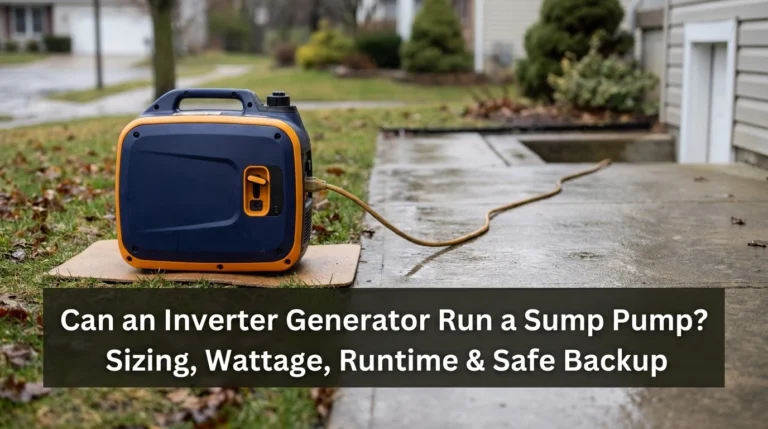
What Can an Inverter Generator Power? Home, RV, Camping & Work Loads Explained
Quick Answer
An inverter generator can power fridges, freezers, lights, phones, laptops, CPAP machines, fans, TVs, small kitchen tools, RV air conditioners, and many power tools, as long as the total running watts stay under its rated output and the starting watts stay under its surge limit. The right size depends on what you run at the same time, so start with what size inverter generator you need before you buy.
What it handles best
- Home essentials: A fridge, freezer, lights, phone chargers, and a CPAP often fit on a 2,000 to 3,000-watt model.
- RV comfort: A 3,000 to 4,500-watt model can run a small RV air conditioner, lights, and charging, with careful load order.
- Camping gear: Lights, fans, phones, laptops, and small cooking tools suit a 1,000 to 2,200-watt model.
- Work tools: Drills, saws, and chargers work well when you respect starting watts and avoid two big motors at once.
- Sensitive electronics: Clean sine wave power suits laptops, phones, and medical gear, but always check the manual first.
Fast rule to remember
- Add running watts first, then add the largest starting watts once, and keep the total under the rated watts.
- Start the biggest motor first, then add small loads one at a time.
I’ve run a fridge and a CPAP through a multi-day outage, and I’ve also watched a small generator trip when a window AC kicked on at the wrong moment.
That gap between hope and math is why this guide goes deep. You’ll get real wattage ranges, load examples, size tables, and clear limits, so you can match an inverter generator to your home, RV, campsite, or job site in 2026.
In This Guide
- What Is an Inverter Generator?
- How Much Power Do Inverter Generators Provide?
- What Can an Inverter Generator Power at Home?
- What Can an Inverter Generator Power in an RV?
- What Can an Inverter Generator Power While Camping?
- What Can an Inverter Generator Power for Work?
- What Can an Inverter Generator Not Power?
- How Do You Calculate What You Can Power?
- Frequently Asked Questions
What Is an Inverter Generator?
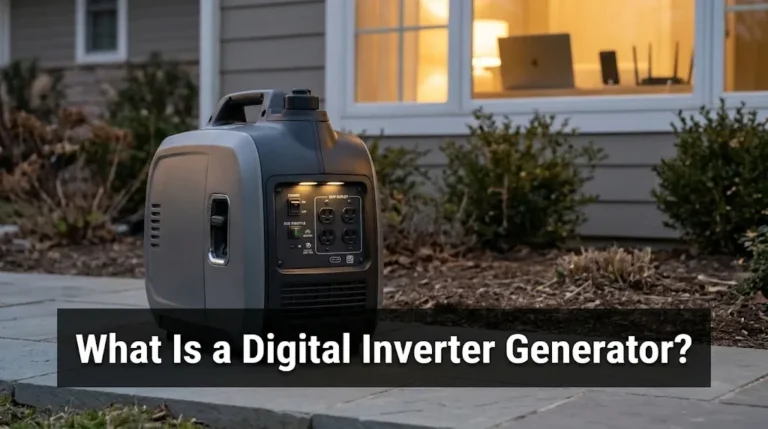
An inverter generator is a portable generator that makes clean, stable power by creating raw AC power, changing it to DC, then changing it back to clean AC power.
That extra step matters for modern gear. It keeps voltage and frequency steady, so laptops, phones, TVs, and CPAP machines get power closer to what a wall outlet gives.
How is it different from a conventional generator?
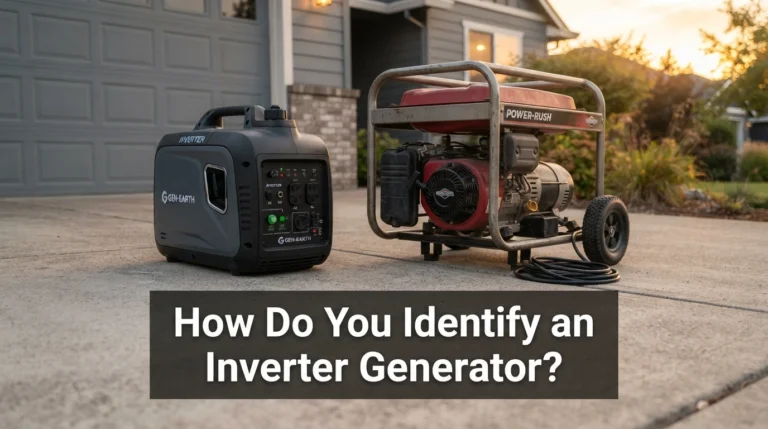
A conventional generator, also called an open-frame generator, runs at a fixed speed and makes power in one step.
An inverter generator changes engine speed to match the load. It runs slower and quieter at light loads, and it saves fuel in eco mode.
That design also makes most inverter models smaller and lighter. A 2,000-watt inverter unit often weighs 40 to 50 pounds, while a similar open-frame unit weighs far more.
What does clean sine wave power mean?
Clean sine wave power means the electrical wave stays smooth and steady, with low total harmonic distortion, often called THD.
Low THD matters for sensitive electronics. Many inverter generators list THD under 3%, but you should check the spec sheet for your exact model.
I learned this the hard way at a campsite years ago. My old open-frame unit ran lights fine, yet it made a small fan hum and a laptop charger run warm.
The inverter unit I switched to ran the same gear with no hum and no heat. That was the moment the difference stopped being theory for me.
Section Takeaway: An inverter generator trades raw size for clean, quiet, fuel-smart power, and that makes it the best fit for homes, RVs, and campsites where electronics matter.
How Much Power Do Inverter Generators Provide?
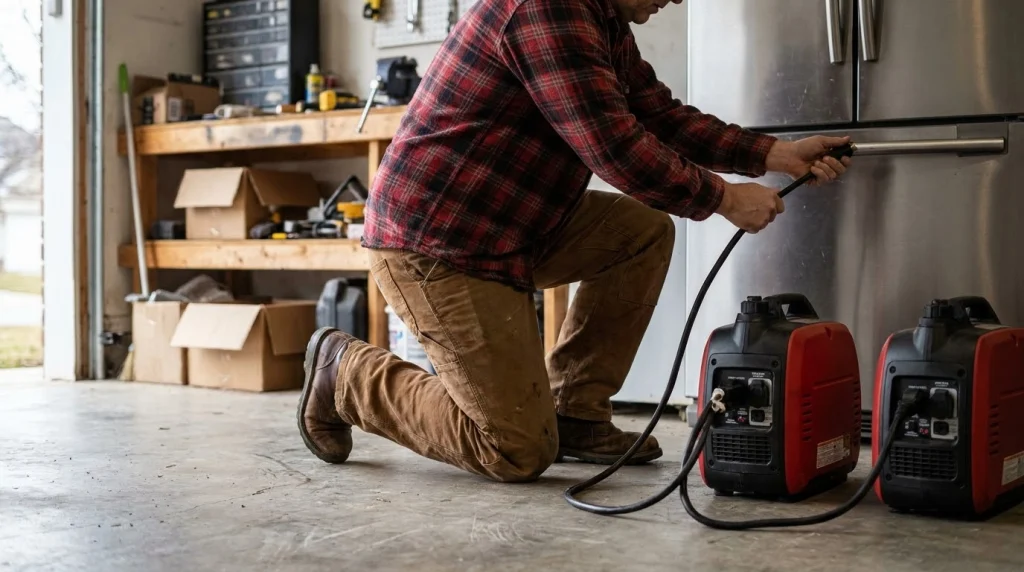
Inverter generators range from about 1,000 watts to over 9,000 watts, with the most common home and RV sizes sitting between 2,000 and 4,500 watts.
Small suitcase models suit phones, lights, and laptops. Mid-size models suit fridges and RV air conditioners. Large models can support more home circuits, but they still have limits.
What do running watts and starting watts mean?
Running watts, also called rated watts, are the steady power a generator can supply for hours.
Starting watts, also called surge watts, are the short burst a motor needs to start. A fridge may run at 150 watts yet need 1,200 watts for a second to start its compressor.
That burst is why a generator can trip even when the steady load looks small. You can learn the full split in this guide to the difference between running watts and starting watts.
Which size fits which use?
| Generator size | Best for | Typical loads |
|---|---|---|
| 1,000–2,200 watts | Camping and light charging | Phones, laptops, lights, fan, small TV |
| 2,000–3,000 watts | Home essentials | Fridge, freezer, lights, CPAP, phone and laptop charging |
| 3,000–4,500 watts | RV and larger home loads | Small RV AC, microwave in short bursts, fridge, lights |
| 5,000–9,000 watts | Heavy home backup and work | Larger AC, well pump, sump pump, furnace blower, tools |
These are typical ranges, not promises for one model. Always check the rated watts and surge watts on the spec sheet.
Parallel capability can help when one unit is not quite enough. Two matching inverter generators can link with a parallel kit to double the available power, though you still need the right kit and outlets.
Section Takeaway: Size is not about the biggest number on the box, it is about running watts for steady loads plus starting watts for the largest motor you will start.
What Can an Inverter Generator Power at Home?
At home, an inverter generator works best as a bridge through an outage, not as a full replacement for grid power.
It can keep food cold, lights on, phones charged, and key medical gear running. It can also run a furnace blower, a sump pump, or a window AC, if you size it right and stagger the starts.
Can it power a refrigerator and freezer?
Yes, in most cases a 2,000 to 3,000-watt inverter generator can run a modern fridge and a chest freezer, though not always at the same instant they both start.
A typical fridge runs at 100 to 200 watts and needs 800 to 1,200 watts to start. A chest freezer runs at 100 to 150 watts and needs 600 to 1,000 watts to start.
Start one, wait a minute, then start the other. That simple order has saved me from overload trips more than once.
For a deeper fridge-specific guide, see the best portable generator for refrigerator picks and sizing notes.
What about lights, phones, laptops, and a CPAP?
These are light loads, and they are where inverter generators shine.
- LED lights: 5 to 20 watts each, so a whole room costs less than a toaster.
- Phone charging: 5 to 20 watts per phone, depending on fast charging.
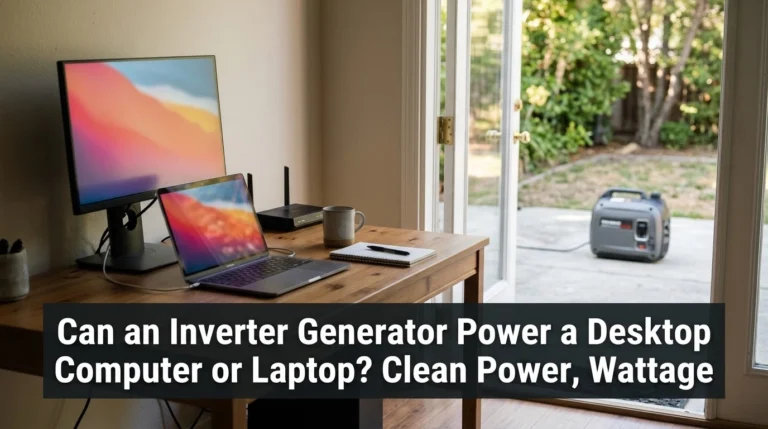
- Laptop: 45 to 90 watts while charging and working.
- CPAP machine: 30 to 90 watts without a heated humidifier, more with heat on.
- Wi-Fi router: 5 to 20 watts, so you can stay online if your internet service still works.
- TV: 80 to 200 watts for most LED models.
During a three-day outage, I ran a fridge, a CPAP, lights, and phone charging on a 3,000-watt inverter unit. I kept the microwave off, and I ran the freezer in short shifts.
The fridge stayed cold, I slept well, and the fuel lasted far longer than I expected. Eco mode helped, because the engine slowed when the load dropped at night.
Can it run a furnace, sump pump, or window AC?
Yes, with the right size and a safe connection.
A gas furnace blower often needs 300 to 800 running watts and 1,000 to 1,500 starting watts. A sump pump often needs 800 to 1,200 running watts and 1,500 to 2,500 starting watts.
A small window AC often needs 500 to 1,000 running watts and 1,500 to 2,500 starting watts. That start surge is why my window AC once tripped a small unit when the fridge compressor kicked on at the same time.
Safety note: Run generators outdoors and well away from windows, doors, and vents. Use a transfer switch or interlock installed by a licensed electrician for home circuits, and check your owner’s manual before use.
For home safety guidance, the CDC and CPSC publish clear carbon monoxide guidance for portable generators.
| Home appliance | Running watts | Starting watts |
|---|---|---|
| Refrigerator | 100–200 | 800–1,200 |
| Chest freezer | 100–150 | 600–1,000 |
| CPAP, no heat | 30–90 | 30–90 |
| Furnace blower | 300–800 | 1,000–1,500 |
| Sump pump, 1/3 HP | 800–1,200 | 1,500–2,500 |
| Window AC, 8,000 BTU | 500–700 | 1,500–2,200 |
| Microwave, 1,000W | 1,000–1,500 | 1,000–1,500 |
These are typical ranges from common appliance labels and sizing guides. Your model may differ, so check the nameplate on each appliance.
Section Takeaway: A mid-size inverter generator can cover the home loads that matter most in an outage, if you start motors one at a time and leave heavy heat loads off.
What Can an Inverter Generator Power in an RV?
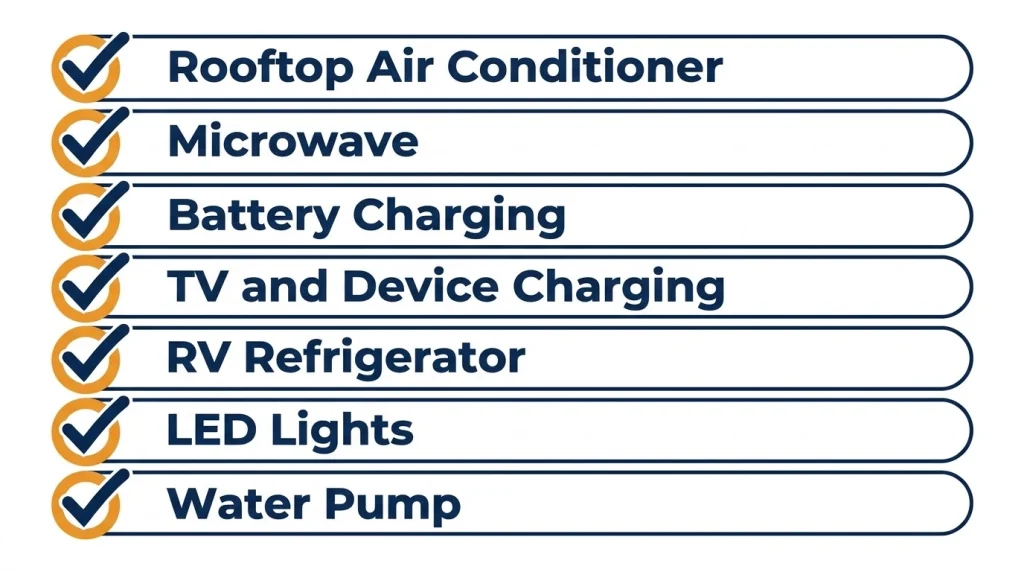
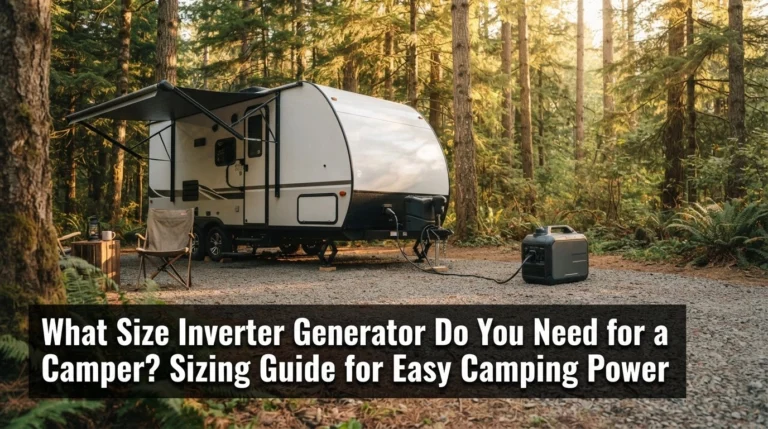
An inverter generator is a natural fit for RV life, because it is quiet, portable, and clean enough for RV electronics.
It can power lights, fans, phone and laptop charging, a TV, a small fridge, a water pump, and, with the right size, a rooftop air conditioner.
Can it run an RV air conditioner?
Yes, but size and start order matter more here than anywhere else.
A 13,500 BTU RV air conditioner often runs at 1,200 to 1,500 watts and needs 2,800 to 3,500 watts to start. A 15,000 BTU unit often runs at 1,500 to 1,800 watts and needs 3,200 to 4,000 watts to start.
A 3,000-watt inverter generator may run a 13,500 BTU unit alone, yet struggle if the fridge and converter also draw power at start-up. A 4,500-watt model gives far more headroom.
A soft-start kit can lower that start surge, and many RV owners add one for this reason. Check your AC and generator manuals before you add any kit.
What else can it run in an RV?
- RV fridge: 100 to 300 watts on AC, more on some larger models.
- Water pump: 50 to 100 watts when it cycles on.
- LED lights: 5 to 20 watts each, so lighting is a light load.
- TV and charging: 100 to 300 watts combined for a TV, phones, and a laptop.
- Microwave: 1,000 to 1,500 watts, best run alone in short bursts.
- Battery charging: 200 to 800 watts through the RV converter, depending on battery state.
Use the RV 30-amp outlet when your generator has one. It gives a clean, direct link and avoids a pile of adapters.
If you are still choosing a size, this real-load example helps: a 2,000-watt inverter generator suits light RV loads, but it will not run a rooftop AC on its own.
Safety note: Place the generator outside, downwind, and away from RV windows, doors, and slide-outs. Never run it in a storage bay or under an awning.
Section Takeaway: An RV inverter generator can run comfort loads and a small AC, but you need 3,000 watts or more for reliable AC starts, and you should run the microwave alone.
What Can an Inverter Generator Power While Camping?
Camping is where a small inverter generator earns its keep.
It can power lights, fans, phone and camera charging, a small fridge or cooler, a portable speaker, and a coffee maker in short bursts.
What is a good camping load list?
- String lights: 10 to 40 watts, and they change a campsite at night.
- Fan: 30 to 75 watts, useful in a tent or trailer.
- Phone and camera charging: 10 to 40 watts combined.
- Laptop: 45 to 90 watts for work or movies.
- Small electric cooler: 40 to 80 watts while running.
- Coffee maker: 600 to 1,200 watts, so run it alone and turn it off fast.
A 1,000 to 2,200-watt model covers most of this list with ease. A coffee maker is the one item that can push a small unit near its limit, so I brew first, then plug the cooler back in.
How do you keep noise down at a campsite?
Noise is a real campsite issue, and inverter generators help because eco mode slows the engine at light loads.
Many small models run near 50 to 60 dB at 25% load from about 23 feet away, though you should check the spec sheet for your model. Place the unit away from tents, point the exhaust away from people, and use a long, outdoor-rated cord.
Follow quiet hours, and turn the unit off when you do not need it. A small power bank can cover phone charging overnight, so the generator can rest.
For a step up in size, a 3,000-watt inverter generator adds room for a larger cooler, a fan, and lights at once, without jumping to a heavy open-frame unit.
Section Takeaway: Camping power is light, so a small inverter generator covers it well, and eco mode plus good placement keeps the campsite quiet.
What Can an Inverter Generator Power for Work?
An inverter generator can power a surprising amount of job-site and outdoor-event gear.
It can run drills, saws, sanders, air compressors in short cycles, work lights, battery chargers, and small food-service tools.
Which power tools work well?
- Drill and driver: 300 to 600 watts, easy for a mid-size unit.
- Circular saw: 1,200 to 1,800 running watts, with a higher start surge.
- Miter saw: 1,200 to 1,800 running watts, best run alone.
- Angle grinder: 800 to 1,200 watts, depending on size.
- Work lights: 50 to 200 watts for LED models.
- Battery chargers: 50 to 300 watts, a light and steady load.
Start the saw first, let it reach speed, then cut. Do not start two saws at once, and do not run a large compressor and a saw on the same small unit.
What about tailgating and outdoor events?
Tailgating loads look a lot like camping loads, with a few extra treats.
A small TV, a speaker, phone charging, lights, and a slow cooker in short bursts fit a 2,000 to 3,000-watt unit. A full electric grill or a large fryer will not fit, so use propane for heat and the generator for power.
Safety note: Keep the generator outdoors, away from crowds, tents, and food tables. Use GFCI outlets where fitted, keep cords out of walkways, and check the EPA and OSHA job-site guidance for fuel and exhaust safety.
Section Takeaway: Work and event loads are doable on an inverter generator, but one big motor at a time is the rule, and heat loads belong on gas, not on the generator.
What Can an Inverter Generator Not Power?
Every generator has a hard limit, and knowing it saves you from trips, stalls, and damage.
An inverter generator cannot power everything at once, and it should not power whole-home heat loads on a small unit.
Which loads are too big?
- Electric water heater: 3,000 to 4,500 watts, too much for most portable units.
- Central AC: 3,000 to 5,000 running watts, with a much higher start surge.
- Electric range or oven: 2,000 to 5,000 watts per element, far beyond a small unit.
- Electric dryer: 4,000 to 5,000 watts, not a portable-generator load.
- Well pump, large: 1,000 to 2,000 running watts, with a start surge that can exceed 4,000 watts.
- Whole house at once: Lights, AC, heat, cooking, and laundry together will overload a portable unit.
A large 7,000 to 9,000-watt inverter generator can handle some of these loads one at a time. It still cannot run them all at once.
What should you never plug in?
Never plug a generator into a wall outlet to backfeed a house. That is unsafe, illegal in many places, and it can hurt utility workers.
Never run a generator indoors, in a garage, or in a tent. Carbon monoxide is colorless and odorless, and it can build up fast in a closed space.
Never plug in damaged cords, wet tools, or gear with a broken plug. Use a transfer switch or interlock for home circuits, and use outdoor-rated cords for portable loads.
For more on safe home power, the U.S. Department of Energy shares practical backup-power and generator safety guidance.
Section Takeaway: Heat and whole-home loads are the line in the sand, and safe connection matters as much as wattage.
How Do You Calculate What You Can Power?
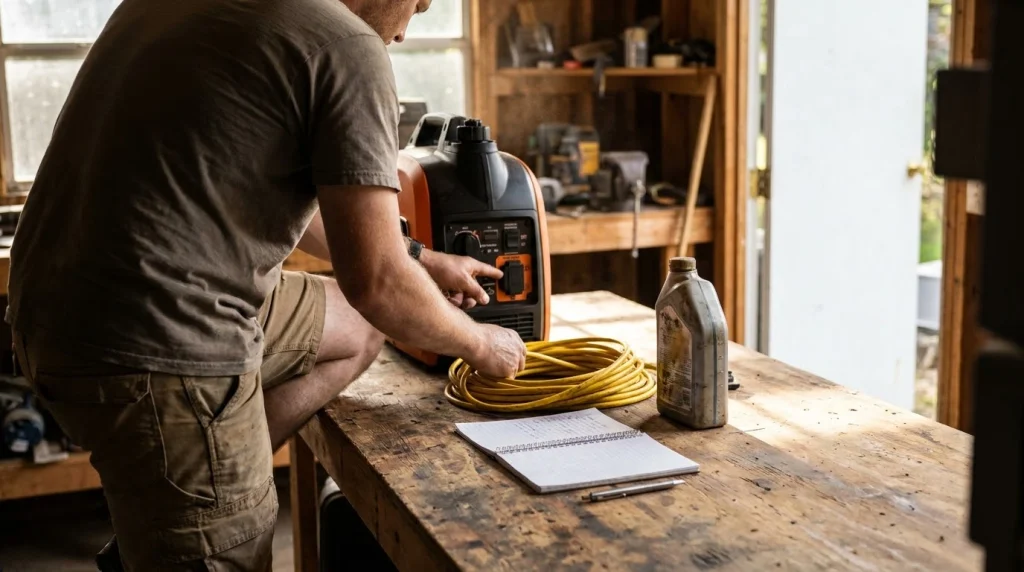
Good sizing takes five minutes, and it saves you from a tripped breaker at 2 a.m.
Use the simple math below, then test the load in daylight before an outage hits.
What is the 5-step wattage math?
- List loads: Write down each item you want to run at the same time.
- Find running watts: Use the nameplate, manual, or a plug-in watt meter.
- Add running watts: Add all the steady loads together.
- Add one start surge: Add the largest starting watts once, not for every motor.
- Compare and add headroom: Keep the total under rated watts, with 20% headroom if you can.
Here is a real example. A fridge at 150 running watts, lights at 40 watts, a CPAP at 60 watts, and phone charging at 20 watts add up to 270 running watts.
Add the fridge start surge of about 1,000 watts once, and the peak is about 1,270 watts. A 2,000-watt generator handles that with room to spare.
Now add a window AC at 600 running watts and 1,800 starting watts. The peak jumps, and a 2,000-watt unit will trip if both motors start near the same time.
That is why load order matters. Start the AC first, let it settle, then start the fridge.
You can walk through the full method in this guide on how to calculate the generator wattage you need.
How long will it run?
Runtime depends on tank size, load, and eco mode.
Many 2,000-watt models run 8 to 12 hours at 25% load on a small tank, while larger models run longer at light loads. Check the spec sheet for runtime at 25% and 50% load, not just the headline number.
Eco mode helps a lot at night, when lights and charging are the only loads. It slows the engine, cuts noise, and stretches fuel.
Keep fuel fresh, change oil per your manual, and run the unit for 20 to 30 minutes every month or two. Stale fuel is the most common reason a generator will not start when you need it.
Section Takeaway: Add running watts, add the biggest start surge once, keep 20% headroom, and test the load before you need it in the dark.
Frequently Asked Questions
Can an inverter generator power a whole house?
No, a portable inverter generator cannot power a whole house at once. It can power key circuits through a transfer switch, such as a fridge, lights, a furnace blower, and charging, but heat, central AC, and laundry need a much larger standby system.
Can an inverter generator run a refrigerator and freezer together?
Yes, a 2,000 to 3,000-watt model often can, if you start them one at a time. Add the running watts together, add the largest start surge once, and keep the total under the rated watts for safe, steady power.
Can an inverter generator power a CPAP machine?
Yes, most CPAP machines need only 30 to 90 watts without heated humidity. An inverter generator gives clean power for overnight use, but place it outdoors, use a long outdoor-rated cord, and check your CPAP manual first.
Can an inverter generator run an RV air conditioner?
Yes, a 3,000 to 4,500-watt model can run a small RV air conditioner, often a 13,500 BTU unit. Start the AC first, turn other large loads off, and consider a soft-start kit if your AC needs a high surge to start.
Can an inverter generator charge phones and laptops?
Yes, and this is one of its best uses. Clean sine wave power suits phones, laptops, cameras, and tablets, and the load is light, often under 100 watts for several devices at once.
How long can an inverter generator run?
Runtime varies by tank size and load, but many small models run 8 to 12 hours at 25% load. Eco mode extends runtime at light loads, and you should refuel only after the unit cools, outdoors and away from flames.
Start with your must-run list, not the biggest generator you can find. Add the running watts, add the largest start surge once, and pick a size with headroom.
Then test it in daylight, with the loads you will use in an outage. That one test tells you more than any spec sheet ever will.

Hi, I’m Michael Turner. I own a generator workshop in the United States and founded HomeGeneratorBlog to share practical, hands-on guidance about generator installation, maintenance, troubleshooting, safety, and backup power solutions. My goal is to help homeowners make smarter, more confident decisions through clear and reliable information