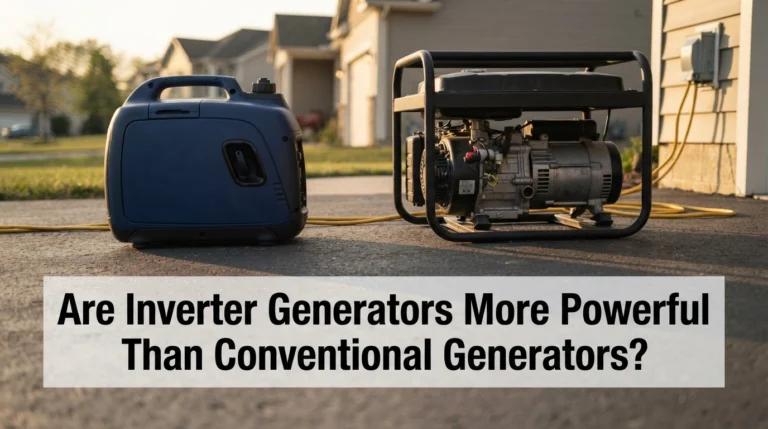
What Is a Digital Inverter Generator? Explained
Quick Answer
A digital inverter generator is a portable generator that makes steady, clean power by creating raw AC power, changing it to DC, then rebuilding it as a stable sine wave with a microprocessor-controlled inverter. That extra step keeps voltage and frequency steady when loads change, so it suits phones, laptops, CPAP machines, and other sensitive electronics. Learn how inverter generator technology works in more detail before you shop.
What makes it digital
- Three-stage power: The engine makes AC power, a rectifier changes it to DC, and the inverter rebuilds clean AC power.
- Steady output: A microprocessor watches the output many times per second and corrects small changes fast.
- Clean sine wave: Good inverter models aim for low total harmonic distortion, often under 3% THD, so check the spec sheet.
- Variable speed: The engine can slow down at light loads instead of holding one fixed speed.
- Quieter running: A closed case, slower engine speed, and smaller size often mean less noise than an open-frame unit.
Quick check before you buy
- Add up running watts first, then check starting watts for motors.
- Match the outlet type to your RV plug or extension cord plan.
- Check THD, noise in dB, runtime, and parallel capability on the spec sheet.
I’ve used portable power in outages, at campsites, and on small job sites for years.
I’ve also seen the same confusion again and again: a buyer hears “digital inverter generator” and wonders if it is a new fuel type, a battery, or just marketing.
It is none of those things. It is a different way to shape the power a small engine makes.
In This Guide
- What Is a Digital Inverter Generator?
- How Does a Digital Inverter Generator Work?
- Digital Inverter Generator vs Conventional Generator: What’s the Difference?
- What Can a Digital Inverter Generator Power?
- How Much Power Do You Need?
- Noise, Fuel Use, and Eco Mode: What to Expect in Real Life
- How Do You Use a Digital Inverter Generator Safely?
- Is a Digital Inverter Generator Worth It?
- Frequently Asked Questions
What Is a Digital Inverter Generator?
An inverter generator is a portable generator that uses an electronic inverter and a microprocessor to produce stable, clean sine wave power.
The word “digital” points to that electronic control, not to a digital fuel or a battery pack.
A conventional generator ties its output directly to engine speed. An inverter generator breaks that link.
Its engine can run faster or slower as the load changes. The inverter still holds the output close to 120 volts and 60 Hz in the United States.
That control matters most for sensitive electronics. Laptops, phones, routers, CPAP machines, and modern furnace controls all prefer a smooth sine wave.
What does “clean power” actually mean?
Clean power means a smooth sine wave with low total harmonic distortion, or THD.
THD measures how far the wave strays from a pure sine shape. Lower is better for electronics.
Many inverter generators list less than 3% THD. Some list less than 5%.
Section Takeaway: A digital inverter generator is a fuel-powered portable generator with electronic, microprocessor-controlled power shaping, and that control is what makes its output cleaner and steadier than a basic conventional unit.
How Does a Digital Inverter Generator Work?
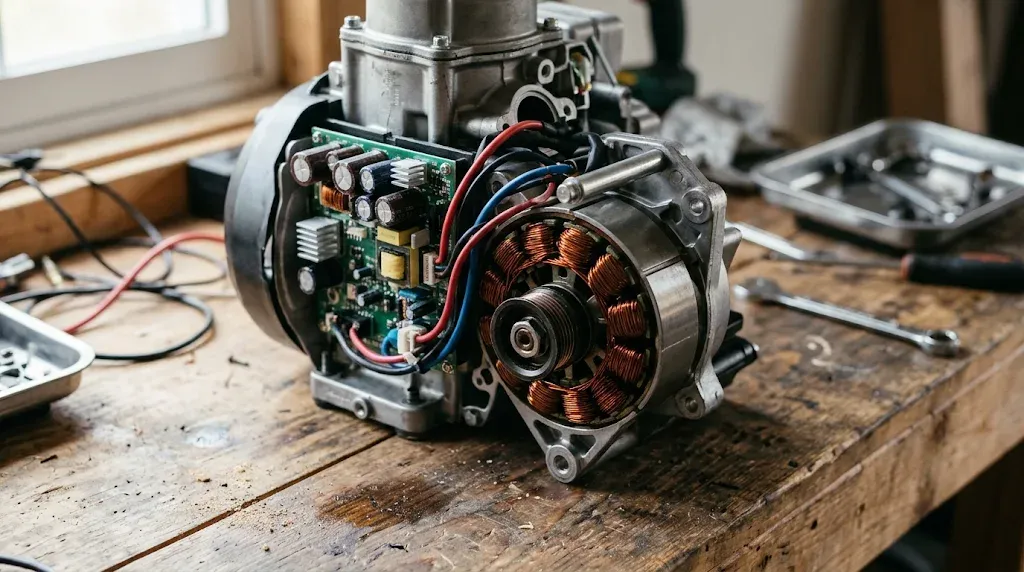
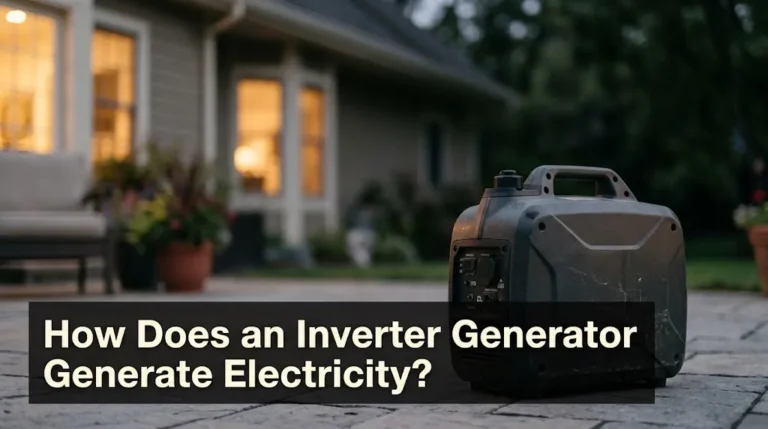
It follows three steps: the engine makes raw AC power, a rectifier changes that power to DC, and the inverter rebuilds it as clean AC power.
The engine still burns fuel and spins an alternator. That first AC output is rough because engine speed varies with load.
The rectifier smooths that rough output into DC power. DC is easier to store and reshape in this design.
Then the inverter module switches the DC back to AC at a steady frequency. A microprocessor controls that switching.
Why does the microprocessor matter?
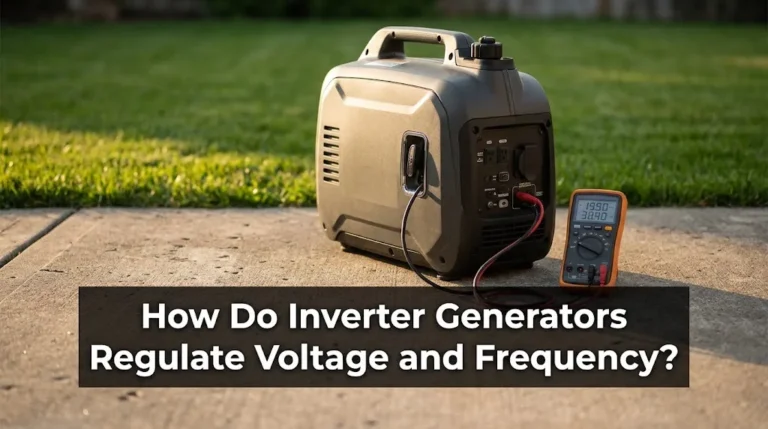
The microprocessor watches voltage and frequency and makes rapid corrections.
When you plug in a fridge, the load jumps. The control system responds faster than a simple mechanical governor can.
That is why inverter output stays steadier when a motor starts or stops.
For a deeper look at that control loop, read how inverter generators regulate voltage and frequency.
What is eco mode, and how does it help?
Eco mode, also called eco-throttle or economy mode, lets the engine slow down at light loads.
At a light load, you may only need a few hundred watts. The engine does not need full speed for that.
Slower running can cut fuel use and noise. It can also stretch runtime on one tank.
Turn eco mode off for a large motor start, such as a window AC or a sump pump. The engine needs full speed ready when that surge hits.
Safety note: Never run a generator indoors, in a garage, or near open windows, doors, or vents. Run it outdoors, well away from the house, with exhaust pointed away from people.
Section Takeaway: The three-stage path, AC to DC to clean AC, plus fast microprocessor control, is the whole trick, and eco mode is simply a way to let the engine slow down when the load is light.
Digital Inverter Generator vs Conventional Generator: What’s the Difference?
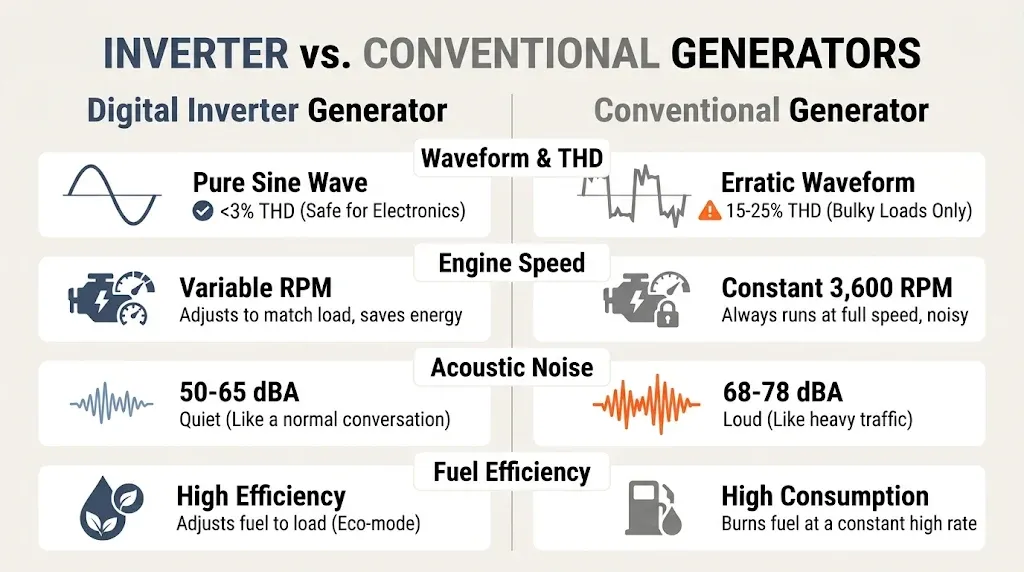
A digital inverter generator gives cleaner, steadier power at variable engine speed, while a conventional generator gives raw power at a fixed engine speed.
That one difference drives almost every other trade-off.
A conventional open-frame generator must hold about 3,600 RPM to hold 60 Hz. It stays loud and thirsty even at a light load.
An inverter generator can slow down, so it often runs quieter and uses less fuel at partial load. It also costs more per watt.
| Feature | Digital Inverter Generator | Conventional Generator |
|---|---|---|
| Power quality | Clean sine wave, often under 3% THD | Rougher wave, often 15% to 25% THD |
| Engine speed | Varies with load | Fixed, near 3,600 RPM |
| Noise | Often 50 to 65 dBA at rated load, quieter at light load | Often 68 to 78 dBA, louder at all loads |
| Fuel use | Lower at light load with eco mode | Higher at light load |
| Size and weight | Smaller and lighter in the 1,000 to 4,500-watt range | Larger and heavier for the same watts |
| Parallel use | Common on many models with a parallel kit | Less common, and less simple |
| Best for | Electronics, camping, RV use, and quiet backup | High-watt tools, whole-home backup, and low cost per watt |
| Cost | Higher per watt | Lower per watt |
Section Takeaway: Choose an inverter for clean, quiet, variable-speed power, and choose a conventional unit when raw watts per dollar matter more than wave quality or noise.
What Can a Digital Inverter Generator Power?
It can power most small and medium loads, from phones and laptops to a fridge, a CPAP machine, lights, and a small RV air conditioner, if the watts fit.
The limit is watts, not the word “digital.”
What loads work well?
- Phones, laptops, and routers: Low watts, high need for clean power.
- CPAP machine: Low watts, steady power matters overnight.
- Refrigerator or freezer: Moderate running watts, higher starting watts.
- LED lights and fans: Low watts, easy to stack.
- TV and small appliances: Check the label watts first.
- RV air conditioner: Needs a larger inverter or a parallel pair, plus a soft start in some cases.
Can it run sensitive electronics safely?
Yes, if the model lists low THD and you stay inside its watt limit.
That is the main reason buyers choose an inverter for sensitive electronics.
Still, use a surge protector where it makes sense. Clean power helps, but it does not fix a bad cord or a wet outlet.
For a quick check, read what an inverter generator does in everyday use.
Safety note: Use outdoor-rated extension cords, keep connections dry, and never backfeed your home through a wall outlet. Use a transfer switch or interlock installed by a licensed electrician for home circuits.
Section Takeaway: Match the load list to the watt limit, start motors one at a time, and an inverter generator will cover most outage, camping, and RV essentials without drama.
How Much Power Do You Need?
Start with running watts, then add starting watts for the largest motor you will start.
Running watts are what a device uses while it runs. Starting watts are the short surge it needs to start.
Mixing those two numbers up is the most common sizing mistake. It leads to overloads, tripped breakers, and a generator that shuts down at the worst time.
How do you do the watt math?
List every device you want to run at the same time. Write its running watts next to it.
Add those running watts together. That is your base load.
Then add the highest starting watts from any one motor in the list. That is your peak need.
Pick a generator whose running watts cover the base load and whose starting watts cover the peak. Leave a margin of about 20% if you can.
What size fits common uses?
- 1,000 to 2,200 watts: Phones, laptops, lights, CPAP, and a small fridge.
- 2,500 to 4,500 watts: Fridge, freezer, microwave, TV, and small window AC.
- 5,000 to 7,500 watts: Larger RV AC, sump pump, furnace blower, and more circuits.
- 9,000 watts and up: Heavier home backup, often with a transfer switch.
For the full method, see running watts vs starting watts.
Section Takeaway: Add running watts, add the largest starting surge once, leave a margin, and you will size an inverter generator without guessing.
Noise, Fuel Use, and Eco Mode: What to Expect in Real Life
Expect less noise and better fuel use at light loads than a conventional unit, but do not expect silence.
Noise is measured in dBA, and the distance matters. A rating at 23 feet will sound different at 7 feet.
Many small inverter models list 50 to 60 dBA at a quarter load. Larger models list more, especially at full load.
How long will it run on one tank?
Runtime depends on tank size, load, and eco mode. A small unit may run 8 to 12 hours at a quarter load on a gallon or two.
A larger unit may run 10 to 18 hours at a quarter load on a bigger tank. Check the spec sheet for runtime at 25% and 50% load.
Safety note: Let the engine cool before refuelling, refuel outdoors, and never store fuel near a running generator or an open flame.
Section Takeaway: Eco mode saves fuel and noise at light loads, but runtime and noise still depend on load, tank size, and the distance in the dB rating.
How Do You Use a Digital Inverter Generator Safely?
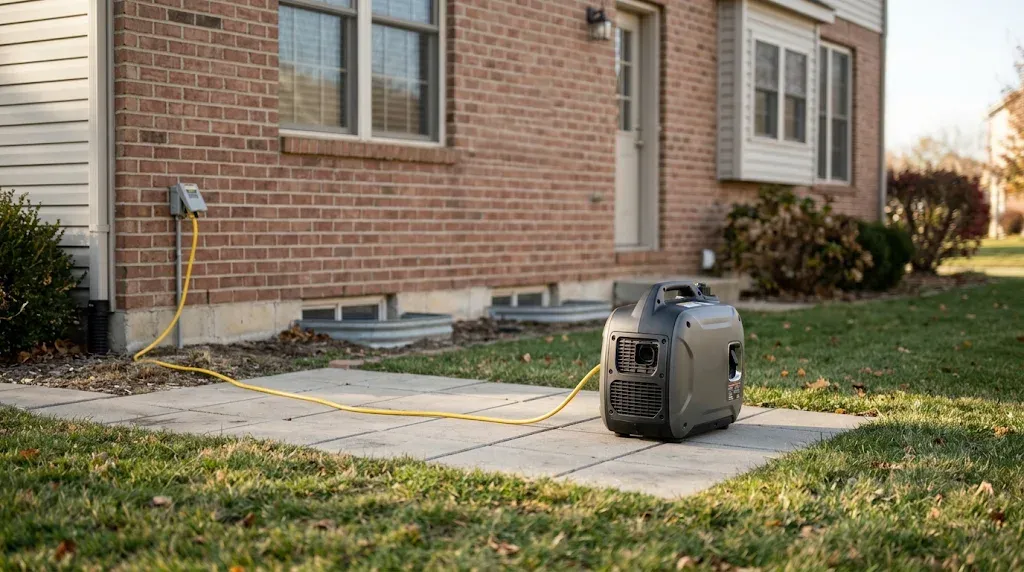
Run it outdoors, far from the house, and connect it to your home only through a transfer switch or interlock installed by a licensed electrician.
Carbon monoxide is colourless and odourless. It can build up fast in a garage, even with the door open.
The CDC explains the risks of carbon monoxide and the need for working CO alarms in the home. Read the CDC guidance before your first outage use.
The CPSC also publishes generator safety guidance for portable units. See the CPSC site for its current safety advice.
Where should you place it?
- Outdoors only: Never inside a house, garage, shed, or tent.
- Far from openings: Keep it at least 20 feet from windows, doors, and vents when you can.
- Exhaust away: Point exhaust away from people, pets, and the house.
- Level and dry: Place it on firm, level ground and keep it out of standing water.
- CO alarm on: Keep battery-powered CO alarms in the home, and check them often.
How do you connect it to a house?
Do not plug a generator into a wall outlet. That is backfeeding, and it can kill a utility worker.
Use a transfer switch or an interlock kit with a proper inlet. A licensed electrician should install it.
That setup lets you power chosen circuits safely. It also keeps generator power separate from grid power.
For extension cords, use outdoor-rated cords in good shape. Keep them short, dry, and out of walkways.
Safety note: Check your owner’s manual before use, and follow local codes for transfer switches, inlets, and grounding. When in doubt, ask a licensed electrician.
Section Takeaway: Safe use is simple but strict: outdoors, far from openings, no backfeeding, and a proper transfer switch for home circuits.
Is a Digital Inverter Generator Worth It?
Yes, if you power electronics, camp, use an RV, or want quiet backup, and no, if you only need cheap raw watts for tools.
For a family outage kit, an inverter in the 2,200 to 4,500-watt range covers the essentials well. It is quiet enough to run overnight, and it sips fuel at light load.
If you are still comparing models, start with the best portable inverter generator guide for the current shortlist.
Who should buy one?
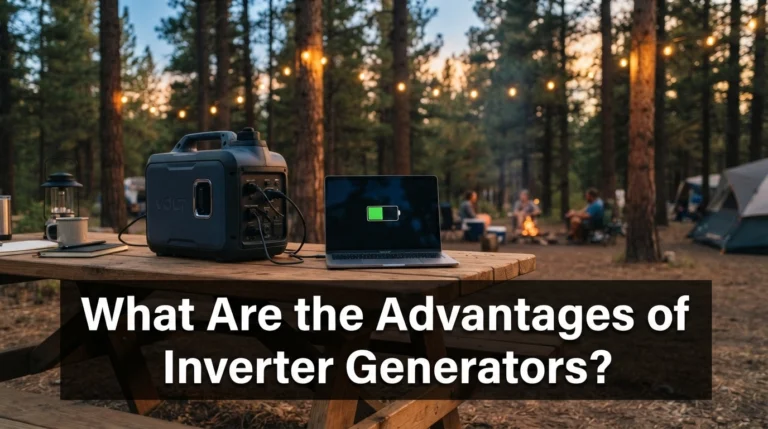
- Campers and RVers: Quiet power, light weight, and clean output for electronics.
- Homeowners: Fridge, freezer, lights, phones, and a CPAP during an outage.
- Remote workers: Steady power for a laptop, router, and monitor.
- Tailgaters: Small, portable power for a TV, lights, and charging.
The U.S. Department of Energy also offers general energy and backup-power guidance. See Energy.gov for its home energy resources.
Section Takeaway: Buy an inverter when clean, quiet power matters, and buy a conventional unit when cheap, high watts matter more.
Frequently Asked Questions
Is a digital inverter generator the same as a regular inverter generator?
Yes, in most listings they are the same thing. “Digital” usually points to the microprocessor control and digital display, not a different power type.
Can a digital inverter generator run a refrigerator?
Yes, if the watts fit. Most fridges run at 100 to 200 watts but need 600 watts or more to start, so check both numbers.
How quiet is a digital inverter generator?
Many small models list 50 to 60 dBA at a quarter load, measured at a set distance. Check the distance in the spec sheet before you compare models.
Do I need a transfer switch for an inverter generator?
Yes, for home circuits. Use a transfer switch or interlock installed by a licensed electrician, and never backfeed through a wall outlet.
Can a digital inverter generator run a CPAP machine overnight?
Yes, if the watts and runtime fit. Most CPAP machines use low watts, so a small inverter can run one overnight on a full tank. Check the CPAP label and the generator runtime at 25% load first.
It is a small engine with a smart inverter that shapes rough power into a steady sine wave. That shaping is what makes it quiet, fuel-efficient at light loads, and safe for sensitive electronics.
Pick your size by watts, check THD and noise on the spec sheet, and run it outdoors with a proper connection. Do that, and it will cover most outage, camping, and RV needs without fuss.
For independent buying research, see Consumer Reports and the EPA for emissions and safety context before you choose a model.

Hi, I’m Michael Turner. I own a generator workshop in the United States and founded HomeGeneratorBlog to share practical, hands-on guidance about generator installation, maintenance, troubleshooting, safety, and backup power solutions. My goal is to help homeowners make smarter, more confident decisions through clear and reliable information