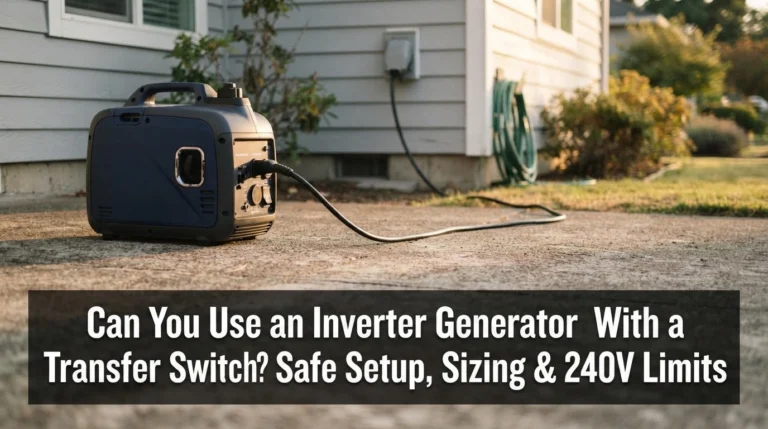
Can an Inverter Generator Provide 240V Power for Household Circuits? Sizing, 240V Outlets & Safe Hookup
Quick Answer
Yes, some inverter generators can provide 240V power for household circuits, but only if the model has a true 240V outlet, enough running watts for the load, and a safe connection through a transfer switch or interlock. Most small inverter generators are 120V only, so check the outlet panel before you buy. Start with a portable generator with a 240V outlet if household circuits are your goal.
What makes 240V possible
- True 240V outlet: Look for a 240V twist-lock or 14-50R outlet, not just a 120V duplex.
- Enough watts: Most 240V loads need 5,000 running watts or more, plus starting watts.
- Split-phase output: The generator must produce two 120V legs that combine to 240V.
- Safe hookup: Use a transfer switch or interlock installed by a licensed electrician.
- Right cord: Use a heavy-duty, outdoor-rated cord matched to the outlet and amperage.
Do this first
- List your 240V loads, add their running and starting watts, then compare the total with the generator nameplate.
- Never backfeed your panel through a dryer outlet or a suicide cord.
I’ve stood in a dark kitchen during a winter outage, flashlight in one hand and a generator manual in the other, wondering if my inverter generator could run more than the fridge.
That night taught me a simple lesson. A 120V inverter generator is great for portable power, but household circuits ask for more.
This guide explains 240V in plain terms, shows which inverter generators can do it, and walks through sizing and safe hookup in 2026.
In This Guide
- What Does 240V Power Mean for a House?
- Can an Inverter Generator Provide 240V Power?
- Which Inverter Generators Have a 240V Outlet?
- How Much Power Do 240V Household Circuits Need?
- How Do You Connect a 240V Inverter Generator to Your House?
- What Can You Run — and What Should You Skip?
- What Are the Risks and Mistakes to Avoid?
- Frequently Asked Questions
- The Bottom Line
What Does 240V Power Mean for a House?
An inverter generator is a portable generator that makes clean, stable power by converting raw AC to DC, then back to AC through an inverter. That clean sine wave protects phones, laptops, and furnace controls.
Most homes in the United States use split-phase power. Two 120V legs arrive at the panel, and together they make 240V.
Your lights, fridge, and phone chargers run on one 120V leg. Larger loads use both legs at once for 240V.
Which household circuits are 240V?
Not every circuit needs 240V. The heavy ones do, and they draw far more power than a lamp or a TV.
- Well pump, usually 240V and hard to start
- Electric water heater, often 4,500 running watts
- Central air conditioner or large heat pump
- Electric range, oven, or clothes dryer
- Some larger window AC units and air compressors
- EV charger on a 240V circuit, a very heavy load
A 240V circuit is not just a bigger plug. It needs both hot legs, a proper breaker, and enough generator capacity.
If your panel has double-pole breakers, those circuits are likely 240V. Check the breaker label and the appliance nameplate before you plan anything.
Learn the difference between 120V vs 240V generator output before you size a unit, because voltage and watts work together.
Section Takeaway: 240V means both 120V legs working together, and only the larger household loads need it.
Can an Inverter Generator Provide 240V Power?
Yes, some can. Others cannot, no matter what adapter you buy.
The difference sits on the outlet panel. A true 240V inverter generator has a 240V outlet and split-phase output built in.
A small 2,000-watt inverter generator almost never has that outlet. It makes 120V only, and an adapter cannot create a second leg.
How does split-phase 240V work?
Think of it as two 120V halves. Each half powers one side of your panel, and a 240V load uses both halves at once.
A single 120V generator gives you only one half. That is why it can run a fridge but not a well pump.
Some large inverter generators make true split-phase 240V from one unit. Others need two units in parallel with a special parallel kit.
Can two 120V generators make 240V?
Sometimes, but only with a parallel kit designed for 240V. A standard parallel kit for 120V doubles the watts, not the voltage.
Check the manual for the exact kit and outlet. If the maker does not list 240V parallel operation, do not assume it works.
I learned this the hard way at a job site. Two small units ran tools fine, yet neither could start a 240V compressor.
Size matters here too. Use this guide to choose the right inverter generator size for your home loads before you shop for a 240V model.
Section Takeaway: A 240V inverter generator can power household circuits, but only a model built for split-phase 240V output will do it.
Which Inverter Generators Have a 240V Outlet?
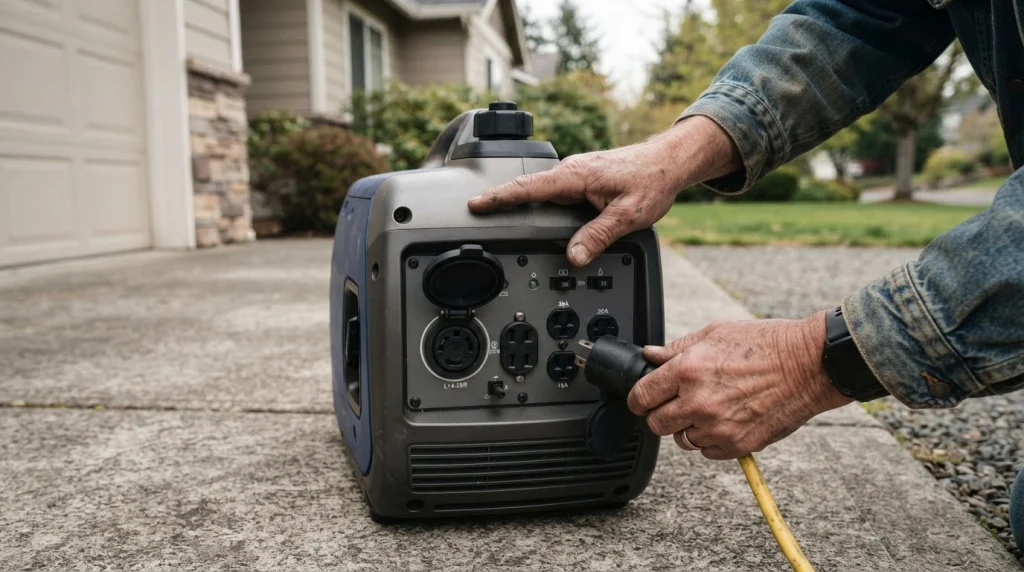
Look for size first. In my testing, true 240V inverter generators usually start around 5,000 running watts.
Smaller models may list a 30-amp outlet, yet that outlet is still 120V. Read the voltage printed next to the outlet, not just the amps.
Brands such as Honda, Yamaha, Champion, Westinghouse, DuroMax, and Generac make larger inverter models, and some offer 240V versions. Check the spec sheet for each model, because the same brand can sell both 120V and 240V units.
What outlets should you look for?
- L14-30R: 240V, 30-amp twist-lock, common for transfer-switch cords
- 14-50R: 240V, 50-amp outlet, common on larger units and RV hookups
- 120/240V selector: Some models let you switch voltage, so confirm the setting before use
- GFCI outlets: Standard 120V outlets for extension cords and small loads
Dual fuel and tri-fuel models can also offer 240V. Fuel type does not create voltage, so focus on the outlet and the wattage rating.
Parallel-capable models add a choice. Two compatible units with a 240V parallel kit can reach higher watts, yet the kit, the cord, and the transfer switch must all match.
| Generator option | 240V? | Typical running watts | Best for |
|---|---|---|---|
| Small inverter, 2,000W | No | 1,600-1,800 | Fridge, lights, phones, CPAP |
| Mid-size inverter, 3,500W | Usually no | 3,000-3,500 | Fridge, furnace blower, window AC |
| Large inverter, 240V model | Yes | 5,000-7,500 | Well pump, water heater, selected 240V circuits |
| Parallel pair, 240V kit | Yes, if kit supports it | 6,000-9,000 combined | Higher 240V loads, flexible use |
| Conventional portable, 240V | Yes | 6,500-10,000 | Heavy loads, louder and higher THD |
| Standby / whole-home | Yes | 10,000 and up | Whole house, automatic start |
Use the spec sheet, not the box art. If it does not list 240V and a 240V outlet, treat it as 120V only.
Section Takeaway: Shop by the outlet panel and the nameplate, and expect a true 240V inverter generator to start near 5,000 running watts.
How Much Power Do 240V Household Circuits Need?
Watts decide what runs. Voltage alone does not run a water heater if the watts are too low.
Running watts keep a load going. Starting watts cover the short surge when a motor starts, and that surge can be two to three times the running watts.
A well pump is a good example. It may need 1,000 running watts, yet it can demand 2,000 to 3,000 watts for a second at startup.
Typical 240V load ranges
These are general ranges, not model specs. Always check the nameplate on your own appliance.
| 240V load | Running watts | Starting watts |
|---|---|---|
| Well pump, 1/2 HP | 1,000 | 2,000-3,000 |
| Well pump, 1 HP | 2,000 | 4,000-6,000 |
| Electric water heater | 4,500 | 4,500 |
| Central AC, 2-ton | 2,500-3,500 | 5,000-7,500 |
| Electric dryer | 5,000-5,500 | 5,000-5,500 |
| Electric range, one burner | 1,500-2,500 | 1,500-2,500 |
Add the running watts for every load you plan to run at once. Then add the largest starting watts on top of that total.
Keep a safety margin of about 20 percent. A generator running at full load all day will be loud, hot, and short on fuel.
Work through the math with this guide on how to calculate the generator wattage you need, and test the total with a clamp meter if you can.
The U.S. Department of Energy offers general guidance on home energy use and backup power planning at energy.gov.
Section Takeaway: Add running watts, add the biggest starting surge, then keep a margin — that total is your real 240V size.
How Do You Connect a 240V Inverter Generator to Your House?
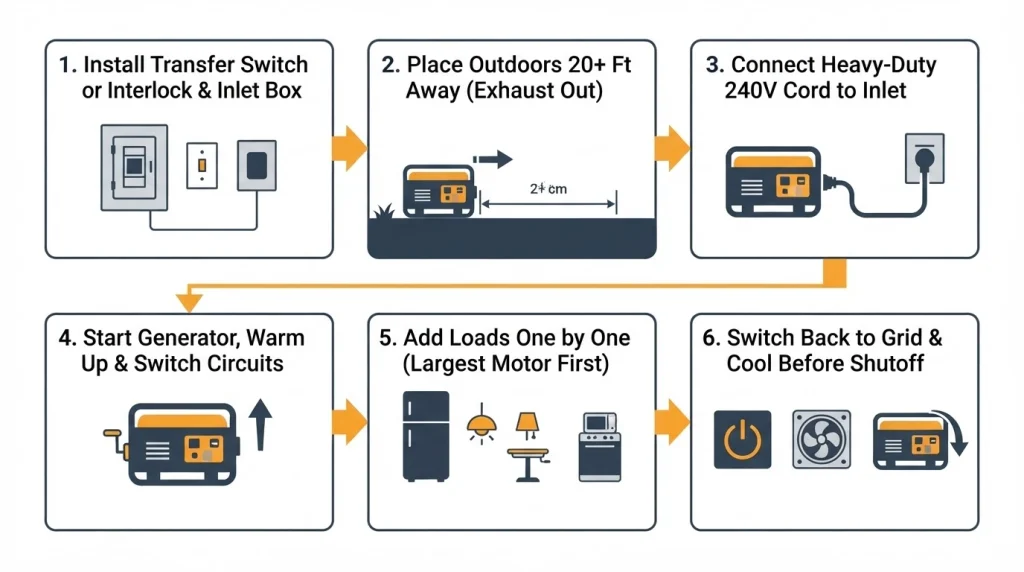
You have two safe paths for household circuits. Both need a licensed electrician to install the hardware.
A transfer switch connects the generator to selected circuits. It isolates your home from the grid, so power cannot backfeed to utility workers.
An interlock kit does a similar job on your main panel. It blocks the main breaker when the generator breaker is on, and it costs less in many homes.
What is the safe setup, step by step?
- Have an electrician install a transfer switch or interlock and an outdoor inlet box.
- Place the generator outdoors, at least 20 feet from the house, with exhaust pointed away.
- Connect the 240V cord from the generator to the inlet box.
- Start the generator, let it warm up, then switch the selected circuits to generator power.
- Add loads one at a time, starting with the largest motor load first.
- When grid power returns, switch back, then shut the generator down and let it cool.
Safety note: Run generators outdoors and well away from windows, doors, and vents. Use a transfer switch or interlock installed by a licensed electrician, and check your owner’s manual before use.
Extension cords work for 120V appliances only. They do not power a panel, and they do not make a 120V generator into a 240V source.
Never use a double-male cord, often called a suicide cord. It can energize the plug ends, backfeed the grid, and put utility workers at risk.
If you are weighing options, read about using a generator without a transfer switch to see the safe limits of extension-cord use.
Electrical codes vary by area, and the National Fire Protection Association publishes the code many local rules follow at nfpa.org.
Section Takeaway: A transfer switch or interlock, installed by an electrician, is the safe way to feed household circuits from a 240V inverter generator.
What Can You Run — and What Should You Skip?
A 7,500-watt 240V inverter generator can run a useful set of circuits. It cannot run a whole house at full load.
Pick essentials first. Water, heat, food, and lights beat comfort loads during an outage.
I run the well pump, fridge, freezer, furnace blower, and a few lights on one setup. The water heater waits its turn, and the dryer stays off.
Good 240V candidates
- Well pump: Short runs, high starting watts, plan for the surge
- Water heater: Run it alone, then switch it off before other loads
- Window AC: Some larger units are 240V, check the nameplate
- Furnace or heat pump: Blower and controls need clean power, watch the surge
Loads to skip or stagger
- Electric dryer: Uses 5,000 watts or more for a long cycle
- Electric range: Use one burner at a time, or use a smaller cooker
- Central AC plus water heater: Together they can overload most portable units
- EV charging: A heavy, long load that can drain fuel fast
Staggering works well. Run the water heater for 30 minutes, switch it off, then run the well pump and fridge.
Understand the difference between running watts and starting watts before you stack loads, because the surge is what trips most overloads.
Section Takeaway: Run essentials first, stagger heavy 240V loads, and skip the dryer and EV charger on a portable inverter generator.
What Are the Risks and Mistakes to Avoid?
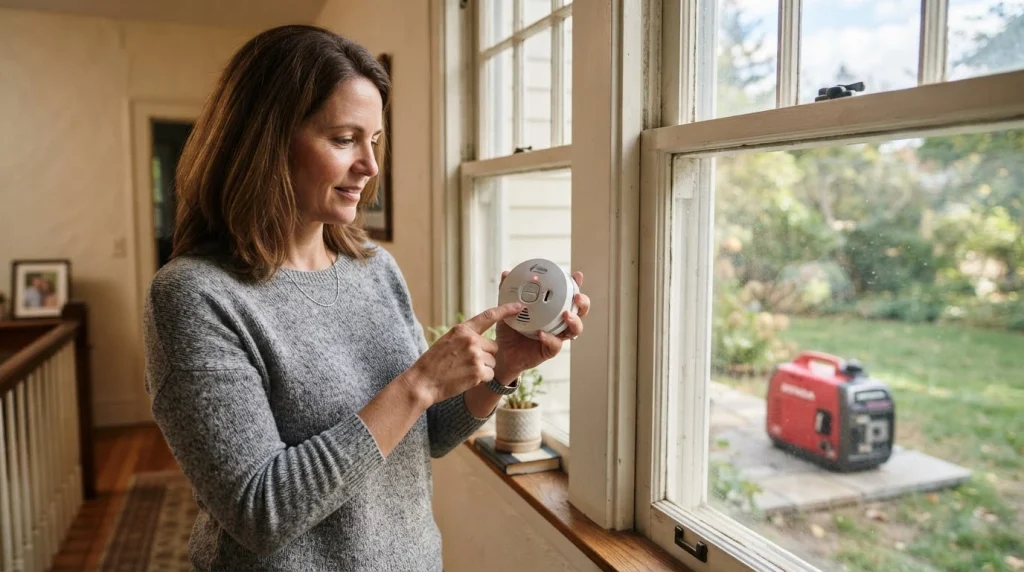
Carbon monoxide is the biggest risk with any generator. It is colorless and odorless, and it can build up fast near a house.
Place the generator outdoors, at least 20 feet from the home, with exhaust pointed away from windows and doors. Install battery-powered CO alarms inside, and test them before storm season.
The CDC shares carbon monoxide safety guidance at cdc.gov, and the Consumer Product Safety Commission covers generator safety at cpsc.gov.
Common 240V mistakes
- Buying 120V only: Assuming any large generator has 240V
- Ignoring starting watts: Sizing for running watts alone, then tripping on startup
- Backfeeding: Plugging into a dryer outlet without a transfer switch or interlock
- Wrong cord: Using a light cord for a 30-amp or 50-amp 240V load
- Running indoors: Placing a generator in a garage, even with the door open
- Overloading one leg: Loading one 120V side far more than the other
Safety note: Never run a generator indoors, in a garage, or near an open window. Fuel it outdoors after it cools, and store fuel away from living space.
Balance matters on split-phase panels. If most of your load sits on one leg, that leg can overload while the other stays light.
Watch for signs of overload, such as the generator surging, the overload light, or breakers tripping. Drop a load, let the unit recover, then restart the load alone.
Section Takeaway: CO safety, correct sizing, and a proper transfer switch or interlock prevent the most serious 240V mistakes.
Frequently Asked Questions
Can a 2000-watt inverter generator provide 240V power?
No, almost never. Most 2,000-watt inverter generators are 120V only, with no 240V outlet or split-phase output. They can run a fridge, lights, and small electronics, but they cannot power 240V household circuits.
Can a 5000-watt inverter generator provide 240V power?
Some can, and some cannot. Check for a 240V outlet and split-phase output on the spec sheet. A 5,000-watt 240V model can run a well pump or water heater alone, but it may struggle with both at once.
Do I need a transfer switch for 240V power?
Yes, for household circuits. Use a transfer switch or interlock installed by a licensed electrician. It isolates your home from the grid and prevents backfeed, which protects utility workers and your home.
Can I use an adapter to get 240V from a 120V generator?
No. An adapter cannot create a second 120V leg or split-phase output. It may fit the plug, yet the voltage will still be 120V, and the load will not run as intended.
Can two inverter generators in parallel make 240V?
Sometimes, with a parallel kit made for 240V. A standard 120V parallel kit doubles watts only. Check the manual for the exact kit, because the wrong kit will not give you 240V.
What size inverter generator do I need for a well pump?
It depends on the pump size and starting watts. A 1/2 HP pump may need 2,000 to 3,000 starting watts, while a 1 HP pump may need 4,000 to 6,000. Add the pump surge to your other running loads, then keep a margin.
The Bottom Line
Yes, an inverter generator can provide 240V power for household circuits, but only the right model can do it safely.
Buy a unit with a true 240V outlet, enough running and starting watts, and clean sine-wave output. Then have an electrician install a transfer switch or interlock.
Start with your essential 240V loads, stagger the heavy ones, and keep the generator outdoors and far from the house. That plan gives you real backup power without the risks that come with a shortcut.

Hi, I’m Michael Turner. I own a generator workshop in the United States and founded HomeGeneratorBlog to share practical, hands-on guidance about generator installation, maintenance, troubleshooting, safety, and backup power solutions. My goal is to help homeowners make smarter, more confident decisions through clear and reliable information