What Size Inverter Generator Do You Need for a Camper? Sizing Guide for Easy Camping Power
Quick Answer
Most campers need a 2,000 to 3,500-watt inverter generator for lights, charging, and a small fridge. If you run a 13,500 BTU air conditioner, you need 3,000 to 4,500 starting watts. Check the best portable generators for RV camping once you know your total watts.
Size it by your camper, not by a guess
- No AC, light use: A 2,000-watt generator covers lights, phones, a laptop, and a small fan.
- Small AC or microwave: A 3,000 to 3,500-watt generator handles one big load at a time.
- 13,500 BTU AC plus extras: A 4,000 to 4,500-watt generator gives you real breathing room.
- 15,000 BTU AC: Plan for 4,500 watts or more, or add a soft-start kit.
- Always size by starting watts: Motors need a short surge to start, and that surge decides the size.
Do this before you buy
- List every item you will run at the same time, then add running watts and the largest starting watts.
- Add a 20% buffer so the generator is not running flat out all day.
- Check your camper’s AC BTU rating and your shore-power plug, 30-amp or 50-amp, before you shop.
I’ve helped friends size generators for pop-ups, travel trailers, and truck campers, and the same mistake shows up every time. They buy for the quiet nights, then the air conditioner trips the generator on the first hot afternoon.
This guide fixes that. You’ll learn how to add up your real loads, what each camper type needs, and when a 2,000-watt unit is enough.
In This Guide
- What Size Inverter Generator Does a Camper Need?
- How to Calculate Your Camper’s Watts in 4 Steps
- Camper Appliance Wattage Chart: Running vs Starting Watts
- What Size Generator for Each Type of Camper?
- Can a 2,000-Watt Generator Run a Camper AC?
- 2,000 vs 3,000 vs 4,500 Watts: Which Is Right for You?
- What to Look for When You Buy a Camper Inverter Generator
- 7 Mistakes That Leave Campers Without Power
- Frequently Asked Questions
What Size Inverter Generator Does a Camper Need?
A small camper without air conditioning usually needs 2,000 watts. A mid-size travel trailer with a 13,500 BTU AC usually needs 3,500 to 4,500 watts.
Your answer depends on three things. Your AC size, your other loads, and whether you run them at the same time.
What is an inverter generator?
An inverter generator is a portable generator that makes clean, stable power for sensitive electronics. It converts raw power to DC, then back to clean AC power.
That clean power matters in a camper. It protects phones, laptops, TVs, and modern RV control boards from voltage swings.
Inverter models also run quieter than open-frame models. They slow down under light loads, which saves fuel and keeps campsite noise down.
The short sizing rule I use in the field
Start with your biggest motor load, usually the AC. Then add the running watts of everything else you will use with it.
Use starting watts for that one big motor, not running watts. A 13,500 BTU AC may run at 1,200 to 1,500 watts, but it can need 2,800 to 3,000 watts to start.
- 2,000 watts: Best for pop-ups, teardrops, and tent campers without AC.
- 3,000 watts: Best for small trailers that run a microwave or a small AC, one at a time.
- 3,500 watts: Best for most travel trailers with a 13,500 BTU AC and light extras.
- 4,500 watts: Best for larger trailers, 15,000 BTU AC units, and families who run more at once.
Section Takeaway: Size for your AC start-up surge first, then add your other loads, and you will not buy a generator that trips on a hot afternoon.
How to Calculate Your Camper’s Watts in 4 Steps

You do not need an electrician to size a camper generator. You need a list, a label check, and ten minutes.
I do this on paper before every trip. It takes less time than one trip back to the store.
Step 1: List what you will run together
Write down only the items that run at the same time. A coffee maker at 7 a.m. and a TV at 9 p.m. do not add together.
Include lights, fridge, water pump, fan, phone chargers, laptop, TV, microwave, and AC. Leave out items you never use off-grid.
Step 2: Find running watts and starting watts
Check the label on each item or your owner’s manual. Running watts are the steady draw, and starting watts are the short surge for motors and compressors.
Use this formula when only amps are listed: watts = volts x amps. A 120-volt item drawing 10 amps uses about 1,200 watts.
Step 3: Add running watts, then add the biggest start-up surge
Add the running watts of all items in your list. Then add only the largest starting-watts extra, not every surge at once.
Example: AC runs at 1,300 watts and starts at 2,800 watts, so the extra is 1,500 watts. Add that extra once to your running total.
Step 4: Add a 20% buffer
Multiply your total by 1.2. That buffer covers heat, altitude, and loads you forgot.
A generator running at 100% all day is loud, hot, and short-lived. A generator running at 70% to 80% is quieter and lasts longer.
Safety note: Never run a generator inside a camper, tent, or enclosed awning. Keep it outdoors, downwind, at least 20 feet from doors and windows, and use a working carbon monoxide alarm inside the camper.
Section Takeaway: List simultaneous loads, add running watts plus the largest start-up surge, then add 20% — that number is your minimum generator size.
Camper Appliance Wattage Chart: Running vs Starting Watts
Use these ranges as a planning guide, not as exact specs. Your model may draw more or less, so check its label before you buy.
Starting watts matter most for AC units, fridges, water pumps, and microwaves with fans. Electronics and LED lights have almost no surge.
| Camper item | Running watts | Starting watts | Notes |
|---|---|---|---|
| 13,500 BTU rooftop AC | 1,200-1,500 | 2,800-3,000 | Biggest load in most campers |
| 15,000 BTU rooftop AC | 1,500-1,800 | 3,300-3,500 | Needs a larger generator or soft start |
| Microwave, 900-1,000W | 1,000-1,200 | 1,000-1,200 | Short, heavy draw |
| RV fridge, AC mode | 300-600 | 600-1,200 | Use propane mode to save watts |
| Water pump | 50-100 | 150-300 | Cycles on and off |
| LED lights, whole camper | 50-150 | 50-150 | Very light load |
| TV, 32-inch LED | 50-100 | 50-100 | Safe on inverter power |
| Laptop + phone charging | 65-150 | 65-150 | Low, steady draw |
| Coffee maker | 800-1,200 | 800-1,200 | Do not run with AC on a small unit |
| Hair dryer, low | 800-1,200 | 800-1,200 | High setting can hit 1,800 watts |
Now try a real example. AC running at 1,300 watts, fridge at 400 watts, lights at 100 watts, and phone charging at 50 watts gives 1,850 running watts.
Add the AC start-up extra of 1,500 watts, and you need 3,350 watts at start-up. Add 20%, and your target is about 4,000 watts.
That is why a 3,500-watt unit feels tight here, and a 4,000 to 4,500-watt unit feels right. See what a 3,000-watt inverter generator can run before you assume it will cover AC plus extras.
Section Takeaway: AC start-up watts drive the whole decision, so check your AC label first and build the rest of your list around it.
What Size Generator for Each Type of Camper?
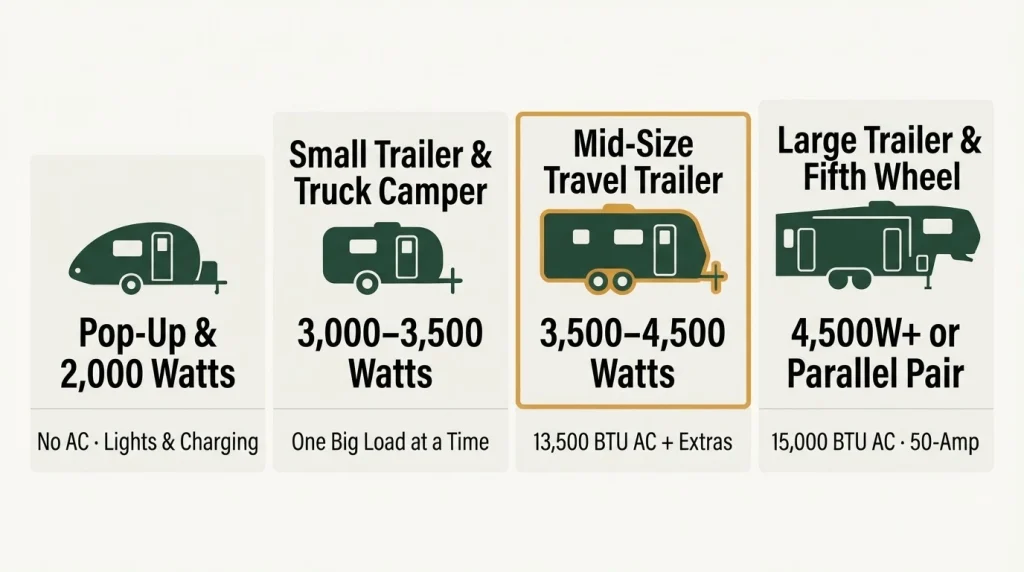
Camper type is a useful shortcut, but your AC and habits still decide the final size. Use these ranges as a starting point, then run the math above.
A teardrop and a 30-foot travel trailer do not live in the same power world. Their loads, space, and plug types are very different.
Pop-up, teardrop, and tent camper: 2,000 watts
These campers usually have no rooftop AC. Lights, charging, a small fan, and a portable fridge are the main loads.
A 2,000-watt inverter generator is light, quiet, and easy to carry. It also sips fuel on eco mode overnight.
Small travel trailer and truck camper: 3,000 to 3,500 watts
Small trailers often have a 13,500 BTU AC or a microwave, but not both at once. A 3,000 to 3,500-watt unit covers one big load plus lights and charging.
You will need to manage loads. Turn the AC off for two minutes while you microwave lunch, then turn it back on.
Mid-size travel trailer: 3,500 to 4,500 watts
This is the sweet spot for most families in 2026. A 3,500-watt unit works with careful load management, and a 4,500-watt unit works with far less stress.
If you camp in summer heat, go bigger. AC cycling, a fridge on AC mode, and a coffee maker add up fast.
Large travel trailer and fifth wheel: 4,500 watts or parallel pair
Large rigs may have a 15,000 BTU AC, a second AC, or a 50-amp service. One small generator will not cover that comfortably.
Two 2,000 to 2,500-watt inverter generators in parallel give you 4,000 to 5,000 watts with easier lifting. A single 4,500-watt unit is simpler, but heavier.
Section Takeaway: Match the generator to your camper size and AC, not to the smallest unit on sale — a pop-up can live on 2,000 watts, while a family trailer usually needs 3,500 watts or more.
Can a 2,000-Watt Generator Run a Camper AC?
Usually, no, not a standard 13,500 BTU rooftop AC on its own. The start-up surge is higher than the generator’s peak output.
Some owners make it work with a soft-start kit and nothing else running. That is the exception, not the rule.
What a soft-start kit does
A soft-start kit lowers the AC start-up surge by ramping the compressor up slowly. It can cut the surge by 50% to 70% in many installs.
That can let a 2,200 to 2,500-watt generator start a 13,500 BTU AC in mild weather. It does not add running watts, so you still cannot run the microwave at the same time.
Check your AC manual and warranty before you install one. Some brands approve specific kits, and a poor install can void coverage.
What a 2,000-watt generator can run well
A 2,000-watt unit is excellent for everything except a big AC. It runs lights, fans, charging, a TV, a laptop, and a small 12-volt fridge with ease.
It can also run a small window AC or a portable AC in some cases. Check what a 2,000-watt inverter generator can run to compare those smaller loads side by side.
I once watched a neighbour try to start his AC on a 2,000-watt unit at noon in July. The generator stalled, the AC fan spun, and the compressor never caught.
He added a soft-start kit the next season. It worked, but only when the fridge was on propane and the microwave stayed off.
Section Takeaway: A 2,000-watt generator is a great light-use camper unit, but do not count on it for a standard rooftop AC unless you add a soft start and manage every other load.
2,000 vs 3,000 vs 4,500 Watts: Which Is Right for You?
These three sizes cover most camper trips. The right pick is the one that starts your AC, runs your must-haves, and still leaves headroom.
Weight, noise, fuel use, and price all rise with watts. Do not buy extra power you will never use, but do not buy a unit that stalls every afternoon.
| Size | Best for | Can run | Watch out for |
|---|---|---|---|
| 2,000W | Pop-ups, teardrops, no AC | Lights, charging, fan, TV, small fridge | Will not start a 13,500 BTU AC |
| 3,000W | Small trailers, one big load | 13,500 BTU AC alone, or microwave alone | Tight with AC plus fridge on AC mode |
| 3,500W | Most travel trailers | AC plus lights, charging, and fan | Microwave needs load management |
| 4,500W | Larger trailers, hot climates | 15,000 BTU AC plus light extras | Heavier, louder, uses more fuel |
Running watts and starting watts are different numbers on the box. Always compare the starting watts first, because that is the number that trips breakers.
A 3,500-watt generator may list 3,500 starting watts and only 3,000 running watts. That running number is the one that matters after the AC starts.
Paralleling is another option worth knowing. Two small inverter generators linked with a parallel kit can share the load and give you more total watts.
That setup is easier to lift and store than one large unit. It costs more, and you need the right kit for your models, so check compatibility first.
Section Takeaway: Pick 2,000 watts for light camping, 3,500 watts for a typical trailer with AC, and 4,500 watts when you want AC plus extras without constant load juggling.
What to Look for When You Buy a Camper Inverter Generator
Watts get you in the door, but features decide whether camping stays easy. A quiet, light unit you can lift alone beats a powerful unit you dread moving.
Check these features before you pay, not after your first trip.
How do I choose the right outlets and plug type?
Match the generator to your camper plug. A 30-amp camper needs a 30-amp RV outlet, usually a TT-30R, or a proper adapter.
Using a household 15-amp outlet with an adapter works for light loads. It does not magically give you 30 amps, and it can trip sooner.
Look for a 120-volt AC outlet set, a 12-volt DC outlet, and USB ports if you charge devices often. A parallel-ready design is a bonus if you may add a second unit later.
How loud is too loud for a campsite?
Look for a rated noise level under 60 decibels at a quarter load. Many good inverter models sit near 52 to 58 decibels at that load.
That is about the level of normal conversation. Open-frame generators can hit 70 decibels or more, which carries across a quiet campground.
Check campground quiet hours too. Some sites limit generator hours, and a loud unit can cut your power window short.
What about fuel, runtime, and weight?
Check runtime at 25% load, not just peak watts. A 2,000-watt unit may run 8 to 10 hours on a gallon, while a 4,500-watt unit may run 12 to 15 hours on a larger tank.
Dual-fuel models run on gasoline or propane. Propane stores well and burns cleaner, but it usually gives you about 10% less power than gasoline.
Weight matters more than most buyers expect. A 2,000-watt unit weighs about 45 to 55 pounds, while a 4,500-watt unit can weigh 90 to 110 pounds.
Learn how an inverter generator works before you compare brands, because clean power, eco mode, and overload protection all affect real camping use.
Section Takeaway: Buy for your plug type, noise limit, runtime, and lift weight — not just the biggest watt number on the box.
7 Mistakes That Leave Campers Without Power
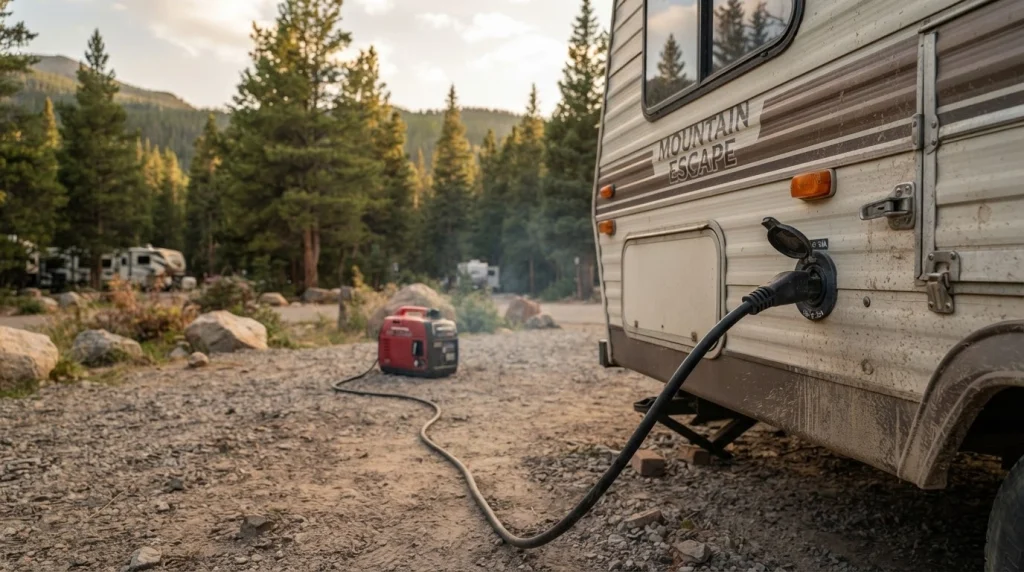
Most camper power failures are not bad generators. They are small planning mistakes that stack up on a hot day.
Fix these before you leave home, and your trips get much quieter.
- Sizing by running watts only: Starting watts trip the generator, so size for the surge.
- Running AC and microwave together: Stagger big loads by two minutes to avoid an overload.
- Forgetting altitude: Power drops about 3% to 3.5% per 1,000 feet above sea level, so size up for mountain trips.
- Using a long, thin extension cord: A long 16-gauge cord drops voltage, so use a short, heavy RV cord.
- Skipping the eco-mode test: Eco mode saves fuel, but it can lag on a sudden AC start, so test it at home first.
- Running the fridge on AC mode: Switch the fridge to propane when power is tight to free up 300 to 600 watts.
- Ignoring CO safety: Place the generator outdoors and downwind, and keep a CO alarm working inside the camper.
Altitude caught me once in Colorado. My generator ran fine at home, then struggled to start the AC at 8,000 feet.
The fix was simple. I sized up on the next trip, ran the fridge on propane, and the AC started cleanly.
You can also run multiple appliances at once safely when you plan the order, but you cannot run them all at once on a small unit.
For safety basics, the U.S. Consumer Product Safety Commission explains carbon monoxide risks from portable generators. Consumer Reports also tests generator noise, runtime, and power quality across brands.
Safety note: Never refuel a hot generator, and let it cool before you add gasoline. Store fuel in an approved container, away from the camper and any flame.
Section Takeaway: Plan your load order, respect altitude, use a proper RV cord, and keep the generator outdoors — those four habits prevent most camper power failures.
Frequently Asked Questions
What size inverter generator do I need for a camper with no AC?
A 2,000-watt inverter generator is usually enough for a camper with no AC. It covers lights, charging, a fan, a TV, and a small fridge, with power to spare for a laptop.
What size generator do I need for a 13,500 BTU camper AC?
Plan for 3,500 to 4,500 starting watts for a 13,500 BTU AC. A 3,500-watt unit works with careful load management, while a 4,000 to 4,500-watt unit gives you more headroom for lights and charging.
Can I run my camper AC and microwave at the same time?
Only on a larger generator, usually 4,500 watts or more, and only if your total running watts stay under the limit. On a 3,000 or 3,500-watt unit, turn the AC off while you run the microwave.
Is a 3,000-watt inverter generator enough for a camper?
Yes, for many small trailers, if you run one big load at a time. It can start a 13,500 BTU AC alone, but it will struggle if you add a microwave, hair dryer, or coffee maker at the same moment.
Do I need a 30-amp or 50-amp generator for my camper?
Match your camper’s shore-power plug. A 30-amp camper needs a generator with a 30-amp RV outlet or a safe adapter, while a 50-amp camper usually needs a larger unit or a parallel pair.
How long will an inverter generator run a camper?
Runtime depends on tank size, load, and eco mode. A 2,000-watt unit may run 8 to 10 hours on a gallon at light load, while a larger unit may run 12 to 18 hours on a full tank at a quarter load.
Can I parallel two small inverter generators for my camper?
Yes, if both models are parallel-ready and you use the correct parallel kit. Two 2,000-watt units can give you about 4,000 watts total, with easier lifting and more flexibility than one large unit.
Your camper trips should feel easy, not like a math test at every campsite. Add up your real loads once, buy with a 20% buffer, and test the AC at home before your first hot trip.
If you camp without AC, a quiet 2,000-watt unit will serve you well. If you camp with AC in summer, go 3,500 to 4,500 watts and enjoy the cool air without the trips and stalls.

Hi, I’m Michael Turner. I own a generator workshop in the United States and founded HomeGeneratorBlog to share practical, hands-on guidance about generator installation, maintenance, troubleshooting, safety, and backup power solutions. My goal is to help homeowners make smarter, more confident decisions through clear and reliable information