What Is an RV-Ready Inverter Generator? The Guide to Plugging In Safely
Quick Answer
An RV-ready inverter generator is a quiet inverter generator built to plug straight into an RV. It has a TT-30 RV outlet, clean power for sensitive electronics, and enough starting watts for an air conditioner. See the best portable generators for RV camping to compare models made for this job.
What makes it RV-ready
- TT-30 outlet: A 120-volt, 30-amp RV plug that fits your shore-power cord without a risky adapter chain.
- Clean power: Low total harmonic distortion, usually under 3%, protects TVs, laptops, and RV control boards.
- Starting watts: Enough surge power to start a 13,500 BTU air conditioner, often 3,000 watts or more.
- Quiet operation: Most RV-ready models run at 52 to 62 decibels at a quarter load, so they suit campgrounds.
- Parallel ready: A parallel kit lets you link two matching units for more power when you need it.
- Safe grounding: Clear grounding instructions and a neutral setup that matches RV use, as stated in the manual.
Fast check before you buy
- Match the outlet to your RV: TT-30 for 30-amp rigs, and a true 240-volt 50-amp outlet for most 50-amp rigs.
- Add up running watts, then add the largest starting watts, and leave a 10 to 20% margin.
- Check the weight, fuel type, runtime, and campground noise rules before you commit.
I’ve plugged generators into RVs on hot driveways, dusty campsites, and quiet forest roads. The difference between a smooth trip and a tripped breaker usually comes down to one thing.
That thing is fit. An RV-ready generator fits your RV’s plug, power needs, and noise limits from the start.
This guide explains the term in plain English. You’ll learn what to look for, how much power you need, and how to connect it safely in 2026.
In This Guide
- What Is an RV-Ready Inverter Generator?
- What Makes a Generator RV-Ready?
- How Much Power Do You Need for Your RV?
- TT-30 vs 50-Amp RV Outlets: Which One Do You Need?
- RV-Ready vs Regular Inverter Generator: What’s the Difference?
- How to Connect an RV-Ready Generator Safely
- What Can an RV-Ready Generator Run?
- How to Choose the Right RV-Ready Generator
- Frequently Asked Questions
What Is an RV-Ready Inverter Generator?
An RV-ready inverter generator is an inverter generator designed for direct RV use. It delivers stable, clean power through an RV-style outlet.
The term is not a strict legal standard. Brands use it to mean the generator has the plug, power, and controls an RV owner needs.
That matters because a normal inverter generator may only have household 120-volt outlets. You can adapt those, but adapters add weak points and confusion.
An RV-ready model removes that friction. You plug your shore-power cord straight in, start the unit, and manage your loads.
The simple definition
An RV-ready inverter generator is a quiet, fuel-efficient inverter generator with a TT-30 or 50-amp RV outlet, low-distortion clean power, and enough starting watts to run RV loads like an air conditioner.
It also runs at a noise level most campgrounds accept. It starts reliably, sips fuel at light loads, and protects sensitive RV electronics.
I learned this the hard way on a summer trip. My first small generator had plenty of watts on paper, but no TT-30 outlet.
I used two adapters and a long cord. The air conditioner tripped the breaker every time the compressor kicked on.
Why inverter power matters for an RV
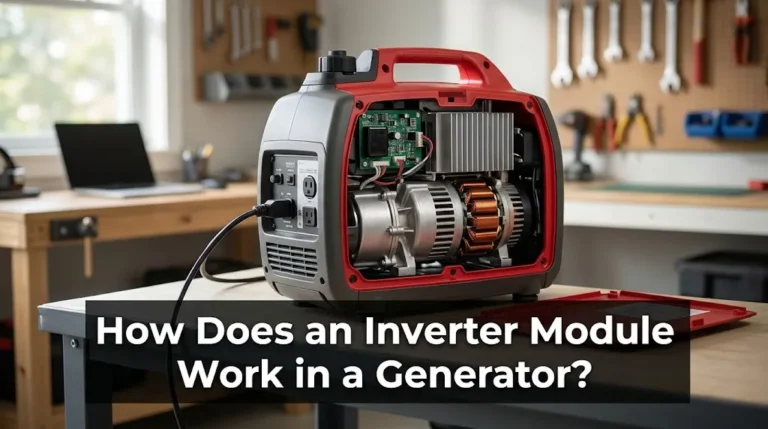
An inverter generator makes raw AC power, converts it to DC, then rebuilds it as clean AC. That process holds voltage and frequency steady.
Steady power protects your RV converter, fridge control board, microwave controls, and TV. A conventional open-frame generator can swing more under load.
Clean power is often measured as total harmonic distortion, or THD. Look for under 3% THD for sensitive electronics.
Check the spec sheet, not just the box. Some listings say “clean power” without giving a THD number.
Section takeaway: RV-ready means the right RV outlet, clean power, and enough starting watts in one quiet package.
What Makes a Generator RV-Ready?
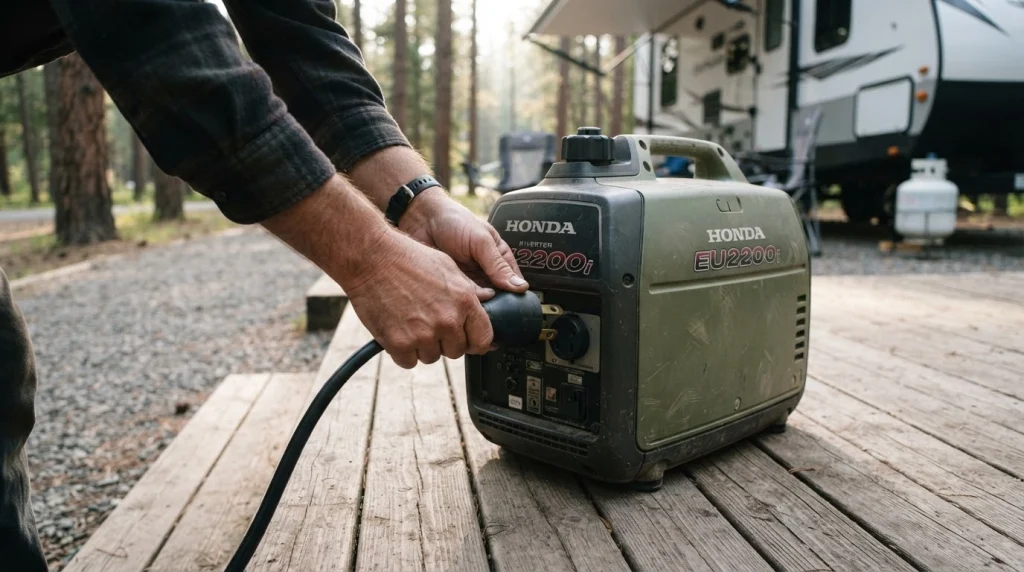
Five features separate a true RV-ready unit from a general-purpose inverter generator. Check all five before you buy.
Missing one can still work, but it adds adapters, limits, or noise. Missing two usually means the wrong generator for RV life.
1. The right RV outlet
A 30-amp RV uses a TT-30 outlet. It is a 120-volt, 30-amp receptacle with a round ground pin and two angled slots.
A 50-amp RV uses a larger 14-50 outlet. It supplies 120/240 volts and up to 50 amps per leg, for much more total power.
Do not assume a “50-amp ready” label means a true 14-50 outlet. Some models only offer a 50-amp twist-lock that needs a special adapter.
Read the outlet list in the manual. Match it to the plug on your shore-power cord.
2. Clean, stable power
RV electronics are more sensitive than a work light. Your converter charges batteries, your fridge switches modes, and your thermostat calls for cooling.
Low THD and tight voltage control keep those systems happy. Look for pure sine wave output, not modified sine wave.
Pure sine wave power matches grid power more closely. It runs motors smoothly and avoids buzzing or overheating in electronics.
3. Enough starting and running watts
Running watts keep a load going. Starting watts, also called surge watts, handle the short spike when a motor starts.
An RV air conditioner is the hardest common load. A 13,500 BTU unit may need 2,800 to 3,000 starting watts, then 1,200 to 1,500 running watts.
A 15,000 BTU unit needs more. Add a soft start kit if your generator is close to the limit, and check your AC manual first.
4. Quiet, campground-friendly sound
Most campgrounds set quiet hours and noise limits. A loud open-frame generator can draw complaints fast.
RV-ready inverter models often list 52 to 62 decibels at a quarter load, measured at 23 feet. That is close to normal conversation.
Eco mode helps too. It slows the engine at light loads, which cuts noise and fuel use.
Test the sound level in the spec sheet, and read independent tests when you can. Consumer Reports publishes generator noise and performance notes that help you compare real-world results.
5. Parallel capability and useful controls
Parallel capability lets you connect two matching inverter generators with a kit. You get more watts without buying one huge, heavy unit.
This is useful for 50-amp RVs and hot climates. One 2,200-watt unit may run lights and charging, but two can run the AC.
Useful controls include electric start, remote start, a fuel gauge, and a digital display. They are not required, but they make campsite life easier.
Remote start is handy on cold mornings. You can warm the generator and charge batteries before you step outside.
Section takeaway: Check the outlet, THD, starting watts, noise level, and parallel option before you call any generator RV-ready.
How Much Power Do You Need for Your RV?
Start with your air conditioner. It sets the size of your generator more than any other load.
Then add the loads you will run at the same time. Lights, phone charging, and a water pump are small, but they still count.
How do I size an RV-ready generator?
Add the running watts of everything you plan to run together. Then add the highest starting watts from one motor load, usually the AC.
Leave a 10 to 20% margin. That margin handles heat, altitude, and older AC compressors that start harder.
Altitude matters. Many generators lose about 3% of rated power per 1,000 feet above sea level, so check your manual.
- 13,500 BTU AC: About 1,200 to 1,500 running watts and 2,800 to 3,000 starting watts.
- 15,000 BTU AC: About 1,500 to 1,800 running watts and 3,200 to 3,500 starting watts.
- Microwave: About 1,000 to 1,500 running watts, with a short start spike.
- RV fridge on AC: About 300 to 600 running watts, depending on size and mode.
- Converter and charging: About 300 to 800 watts when batteries are low.
- Lights and small electronics: About 100 to 300 watts combined in most rigs.
These are typical ranges, not exact specs. Check the label on each appliance and your RV owner’s manual.
Common RV sizing examples
A small travel trailer with no AC, or a 13,500 BTU AC used alone, often works with a 3,000-watt inverter generator. It can run the AC, lights, and charging if you stagger other loads.
A larger trailer with a 15,000 BTU AC, microwave, and TV usually needs 3,500 to 4,500 watts. That size gives you room to cook while the AC cycles.
A 50-amp fifth wheel with two AC units often needs 5,500 watts or more, or two paralleled units. One small generator will not run both ACs at once.
See what a 3000-watt inverter generator can run for a clear load list before you size up or down.
Section takeaway: Size for your AC first, add your simultaneous loads, then keep a 10 to 20% margin.
TT-30 vs 50-Amp RV Outlets: Which One Do You Need?
Your RV service type decides the outlet. Look at your shore-power plug before you shop.
A 30-amp plug has three prongs and a round TT-30 shape. A 50-amp plug has four prongs and a larger 14-50 shape.
What is a TT-30 outlet?
A TT-30 outlet supplies 120 volts at up to 30 amps. That is about 3,600 watts at most, and you should stay below that in real use.
Most 30-amp RVs have one AC, a smaller microwave, and one main power leg. A 3,000 to 4,500-watt RV-ready generator fits well.
Plug your 30-amp shore cord straight into the TT-30 outlet. Use a short, heavy-duty RV cord and keep connections dry.
What is a 50-amp RV outlet?
A 50-amp RV outlet, usually a 14-50, supplies 120/240 volts. It has two 120-volt legs at 50 amps each, for up to 12,000 watts total.
Most 50-amp RVs have two AC units, a larger fridge, and more circuits. They need more power than a single small inverter generator can give.
Some large inverter generators offer a true 14-50 outlet. Others offer a 240-volt twist-lock that needs an adapter to reach a 14-50 plug.
Check the generator’s 240-volt rating, not just the outlet shape. A 50-amp outlet on a 4,500-watt generator still only gives you 4,500 watts.
For a deeper comparison, see the best portable generators with a 50-amp outlet and match the wattage to your RV, not just the plug.
Can I use an adapter?
Yes, in many cases, but adapters do not add power. A 50-amp RV plugged into a 30-amp generator still gets 30 amps at most.
Use only a listed RV adapter made for that exact plug change. Avoid stacking adapters or using a household extension cord as a substitute.
Keep adapter connections off wet ground. Check them for heat after the first 15 minutes of use.
Safety note: Never backfeed your RV or a house through a modified plug, and never run a generator inside a garage, RV, or enclosed space. Carbon monoxide can build up fast, so run it outdoors, downwind, and at least 20 feet from doors and windows.
Section takeaway: Match the outlet to your RV service, then match the watts to your loads. The plug alone does not make a generator big enough.
RV-Ready vs Regular Inverter Generator: What’s the Difference?
A regular inverter generator can power an RV with adapters. An RV-ready model is built for that job from the start.
The table below shows the practical differences. Use it to decide if the RV-ready premium is worth it for your trips.
| Feature | RV-ready inverter generator | Regular inverter generator |
|---|---|---|
| RV outlet | TT-30 or 14-50 built in | Household outlets only, adapter needed |
| Starting watts | Sized for RV AC, often 3,000 watts or more | Varies widely, many are under 2,500 watts |
| Clean power | Pure sine wave, usually under 3% THD | Often clean, but check the spec sheet |
| Noise | 52 to 62 decibels at quarter load | Can be quiet or loud, depending on model |
| Parallel ready | Common, with a matched kit | Sometimes, sometimes not |
| Weight and size | Heavier at 3,000 watts and up, often 60 to 130 pounds | Lighter at 2,000 watts, often 40 to 55 pounds |
| Best for | Dry camping, boondocking, and AC use | Light charging, tailgating, and small loads |
A regular 2,000-watt inverter generator is great for charging batteries and running a fan. It is not RV-ready for AC in most cases.
That does not make it a bad generator. It makes it the wrong tool for a hot afternoon with the AC on.
I keep a small unit for light trips and a larger RV-ready unit for summer travel. The small one is easier to lift, but the larger one is the one I trust for cooling.
Section takeaway: RV-ready is a package, not one outlet. The plug, power, noise, and parallel option work together.
How to Connect an RV-Ready Generator Safely
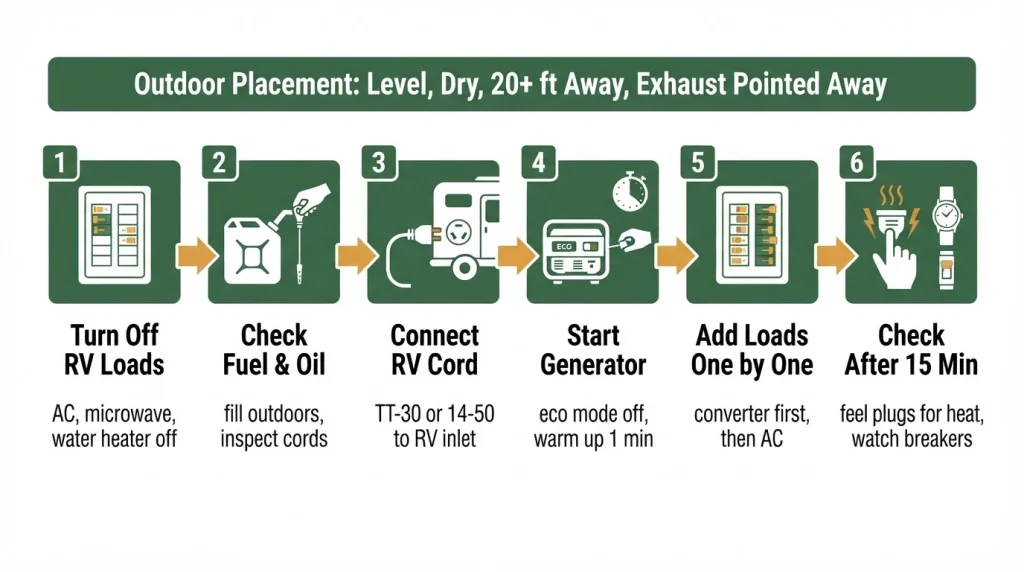
Safe setup takes five minutes. Rushed setup can damage your RV or create a shock risk.
Follow your generator and RV manuals first. The steps below are a general safe routine, not a replacement for those manuals.
How do I hook up an RV-ready generator?
Place the generator outdoors, level, and at least 20 feet from your RV. Point the exhaust away from doors, windows, and people.
Keep it dry and off wet grass if you can. Use a firm, flat surface and leave space for airflow on all sides.
- Turn off RV loads: Switch the AC, microwave, and water heater to off before you connect.
- Check fuel and oil: Fill fuel outdoors, check oil, and look for leaks or damaged cords.
- Connect the cord: Plug your RV shore-power cord into the TT-30 or 14-50 outlet, then into the RV inlet.
- Start the generator: Start it with eco mode off for the first load, then let it warm up for a minute.
- Add loads one by one: Turn on the converter first, then the AC, then other loads with a short pause between each.
- Watch for heat or trips: Feel plugs after 15 minutes, and check the breaker if a load drops out.
Use a heavy-duty RV extension cord if you need more length. A thin household cord can overheat under RV loads.
Keep the cord out of walkways and puddles. Coil excess cord loosely, never tight around a hot exhaust.
Grounding, bonding, and surge protection
Grounding confuses many RV owners. Most portable inverter generators have a floating neutral, which can trip some RV surge protectors.
Some RV surge guards need a bonded neutral to pass power. Your generator manual may offer a bonding plug or a grounding terminal for this case.
Do not make a bonding plug unless your manual and RV manual allow it. A wrong bond can create a shock risk.
Use a quality RV surge protector made for generator use. It can catch low voltage, open ground, and reverse polarity before they reach your RV.
Safety note: Disconnect the battery before electrical work inside the RV, and follow your owner’s manual and torque specs. If you are unsure about grounding or bonding, have a qualified RV technician check the setup.
For emissions and safe outdoor use, the EPA offers general guidance on portable generator emissions and outdoor operation. It is a useful check before a long dry-camping trip.
Section takeaway: Place it outdoors, connect with the right cord, start it first, then add loads one at a time.
What Can an RV-Ready Generator Run?
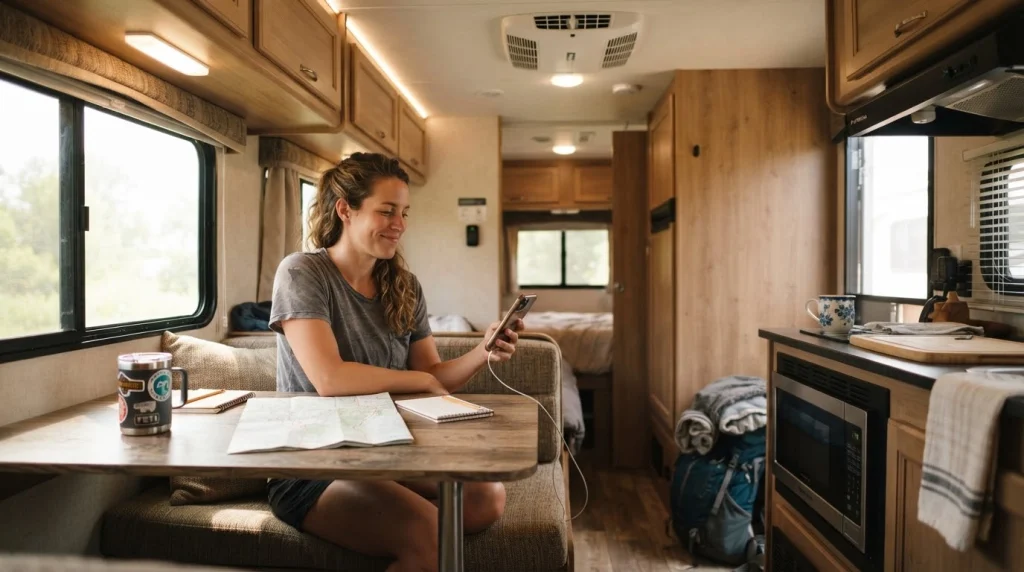
It depends on watts, not just the outlet. A 3,000-watt unit and a 5,000-watt unit both plug into an RV, but they run very different load lists.
Think in groups, not single appliances. The AC plus microwave is a big group, while lights plus charging is a small group.
What a 3,000-watt RV-ready generator can run
A 3,000-watt unit can usually run one 13,500 BTU AC, plus lights, phone charging, and battery charging. It may struggle if you add a microwave at the same time.
Stagger the big loads. Run the microwave after the AC compressor has settled, then turn the microwave off before the AC cycles again.
See what a 5000-watt inverter generator can run if you want more headroom for cooking and cooling together.
What a 4,500 to 5,500-watt unit can run
A larger unit can run a 15,000 BTU AC, a microwave, a TV, and battery charging together in many rigs. It still has limits with two ACs.
Two ACs need careful load management or a parallel setup. Start one AC, wait for it to settle, then start the second.
Electric water heaters and electric space heaters are heavy loads. Use propane for water heating when you can, and save generator watts for cooling.
What it usually cannot run at once
- Two large ACs: Most single 3,000 to 4,500-watt units cannot start both at once.
- AC plus microwave plus water heater: That trio often exceeds running watts on a mid-size unit.
- Electric heaters: A 1,500-watt heater eats a large share of a small generator’s output.
- Air compressor or large tools: High starting watts can trip the breaker, even if running watts look fine.
Learn to run multiple appliances at once by staggering starts and watching your total load. That skill matters more than buying the biggest generator.
Section takeaway: A 3,000-watt unit handles one AC and basics, while a 5,000-watt unit handles one AC plus cooking. Two ACs need more power or a parallel pair.
How to Choose the Right RV-Ready Generator
Choose by your RV, not by a sale price. A cheap generator that cannot start your AC is not a bargain.
Start with the outlet and watts, then check noise, weight, fuel, and runtime. Those four decide whether you will actually use it.
Match it to your RV type
A teardrop or small travel trailer may only need 2,200 to 3,000 watts for charging and a fan. A 13,500 BTU AC pushes that need to 3,000 watts or more.
A mid-size travel trailer with a 15,000 BTU AC usually needs 3,500 to 4,500 watts. A fifth wheel with two ACs often needs a parallel pair or a 5,500-watt unit.
Check the best portable generator for a 5th wheel if you have a large rig with two ACs and a residential fridge.
Fuel, runtime, and weight
Gasoline is common and easy to find. Propane burns cleaner and stores longer, but it often gives 10% less power than gasoline.
Dual-fuel models let you switch. That flexibility helps on long trips where one fuel is easier to find.
Runtime matters at night. Look for runtime at a quarter load, not just at full load, and check the fuel tank size.
Weight matters too. A 3,000-watt unit can weigh 60 to 80 pounds, while a 5,000-watt unit can weigh 100 to 130 pounds.
Can you lift it alone? If not, look for wheels, a handle, or a parallel pair of lighter units.
Noise, warranty, and support
Check the decibel rating at a quarter load and at full load. A 3-decibel rise sounds about twice as loud to the ear.
Check the warranty length and what it covers. A three-year warranty with local service beats a five-year warranty with no support.
Read the manual for oil type, break-in, and maintenance intervals. A generator that is easy to service gets serviced.
For trip planning and roadside help, AAA offers RV travel and roadside resources that pair well with a generator checklist. Keep your generator manual and RV manual together in the rig.
Mistakes to avoid
- Buying by running watts only: Starting watts decide whether the AC starts.
- Ignoring the outlet: A great generator with the wrong outlet still needs adapters.
- Skipping a test run: Test the AC, microwave, and charging at home before a remote trip.
- Running it too close: Place it at least 20 feet away, downwind, and never inside.
- Forgetting fuel storage: Carry fuel in an approved container, away from heat and living space.
Section takeaway: Match watts and outlet to your RV first, then choose fuel, weight, noise, and warranty that fit how you camp.
Frequently Asked Questions
What size RV-ready inverter generator do I need?
Most 30-amp RVs with a 13,500 BTU AC need at least 3,000 starting watts. A 15,000 BTU AC usually needs 3,500 to 4,500 watts, and a 50-amp rig with two ACs needs 5,500 watts or a parallel pair.
Can any inverter generator power an RV?
Any inverter generator can power some RV loads with the right adapter. Only a larger, quiet unit with the right outlet and starting watts can run an AC reliably.
Is a TT-30 outlet the same as a 30-amp household outlet?
No. A TT-30 is a 120-volt RV outlet with a specific pin shape. A 30-amp household dryer outlet is 240 volts and must never be used as an RV plug.
Can I run my RV AC on a 2,000-watt generator?
Usually not, unless you add a soft start kit and run nothing else. Most 13,500 BTU ACs need more starting watts than a 2,000-watt unit can give.
Do I need a special cord for an RV-ready generator?
Use your RV shore-power cord or a heavy-duty RV extension cord rated for 30 or 50 amps. Do not use a thin household extension cord for RV loads.
How far away should I place the generator?
Place it at least 20 feet from your RV, with the exhaust pointed away from doors and windows. Keep it outdoors, level, and dry, and never run it inside a garage or RV.
An RV-ready inverter generator is not a marketing label to ignore. It is a short way to say the generator fits your RV’s plug, power, and noise needs.
Check your RV service type, add up your loads, and test the setup at home. That one test run will save you a hot, noisy night at a campsite in 2026.

Hi, I’m Michael Turner. I own a generator workshop in the United States and founded HomeGeneratorBlog to share practical, hands-on guidance about generator installation, maintenance, troubleshooting, safety, and backup power solutions. My goal is to help homeowners make smarter, more confident decisions through clear and reliable information