10 Best CARB Compliant Inverter Generators 2026: Top Picks
The best CARB compliant inverter generator right now is the Honda EU2200i — the quietest 2,200-watt model in this list at 48 dBA. We assessed 10 models from manufacturer specifications, scoring each on CARB compliance, runtime, and noise. Most models look identical on paper but fail on model numbers, runtime, or noise — and that gap is what this guide exposes. Whether you need camping power, RV backup, or home essentials, this guide gives you one clear answer.
Quick Comparison: All 10 Products Ranked
| # | Product | Best For | Rating | Badge | |
|---|---|---|---|---|---|
| 1 | Honda EU2200i | Quiet camping and electronics | 4.9/5 | Best Overall | Buy → |
| 2 | Honda EU3200i | Premium mid-size RV power | 4.8/5 | Best Premium | Buy → |
| 3 | Generac iQ5200 DF | Dual-fuel California use | 4.7/5 | Best Dual-Fuel | Buy → |
| 4 | Westinghouse iGen4500 | RV air conditioning | 4.6/5 | Best for RV | Buy → |
| 5 | Yamaha EF2000iSv2 | Light portable power | 4.5/5 | Best Portable | Buy → |
| 6 | Champion 2500-Watt Dual Fuel Inverter | Light dual-fuel camping | 4.4/5 | Best Budget | Buy → |
| 7 | Generac GP3300i | 3,000-watt class value | 4.3/5 | Best Value 3000W | Buy → |
| 8 | Honda EU7000iS | Home backup power | 4.2/5 | Best Home Backup | Buy → |
| 9 | Predator 5000 Super Quiet Dual Fuel | Large dual-fuel value | 4.1/5 | Best Large Value | Buy → |
| 10 | WEN 56225i | Budget small power | 4.0/5 | Best Budget Small | Buy → |
How We Chose These Inverter Generators
What we assessed
10 models from manufacturer specifications and retailer listings checked on 2026-11-08. No hands-on testing is claimed. CARB status was checked by model number, not by brand name alone.
Our 3 scoring criteria
CARB compliance and clean power, runtime and fuel efficiency, and noise and portability. Each score is out of 5 and is an editorial judgment.
Expert consulted
No outside expert was consulted. Ratings use published manufacturer figures for watts, runtime, noise, weight, THD, and CO shutoff.
What we cut — and why
The Westinghouse iGen5000DFc was cut because a source lists it as not CARB compliant for California. DuroMax models were cut because many variants are not CARB compliant.
What to Look for When Buying a CARB Compliant Inverter Generator
CARB compliance is a model-number question, not a brand promise. Start with the exact model you will receive, then match watts, clean power, and runtime to the loads you will actually run.
1. Verify the CARB and 50-state model number
Many generators sell in a 49-state version and a separate 50-state version. The Honda EU3200iAC is the CARB version, while the EU3200iAN is 49-state. The Generac iQ5200 DF 50-state model is G0089470, while G0089450 is 49-state. Check the listing, the box, and the manual before you buy, and keep the model number in your order notes.
2. Plan around running watts, not starting watts
Starting watts last only a few seconds for motor surge. Running watts are what your fridge, lights, and chargers can use together for hours. Add up the running watts of everything you want on at once, then add a margin for the largest starting load. If you are comparing models, use our best portable inverter generator guide to see how size classes differ.
3. Check clean power and CO shutoff
Inverter generators in this list keep THD under 3% in most cases, which is the level that protects laptops, phones, and medical devices. The WEN 56225i is even lower, under 1.2% THD at full load. CO shutoff is also essential: it stops the generator when carbon monoxide builds up. Read our guide to the best portable generator for sensitive electronics before you plug in anything delicate.
4. Match noise, runtime, and weight to your use
A 48 dBA generator at quarter load is far easier to live with at a campsite than a 61 dBA model at the same load. Runtime also varies widely: the Generac GP3300i runs about 7 hours at 25% load on 1.06 gallons, while the Westinghouse iGen4500 runs up to 18 hours at 25% load on 3.4 gallons. Weight matters too — a 39 lb model is a one-hand carry, while a 263 lb model needs wheels. For a cheaper shortlist, see the best affordable inverter generator guide.
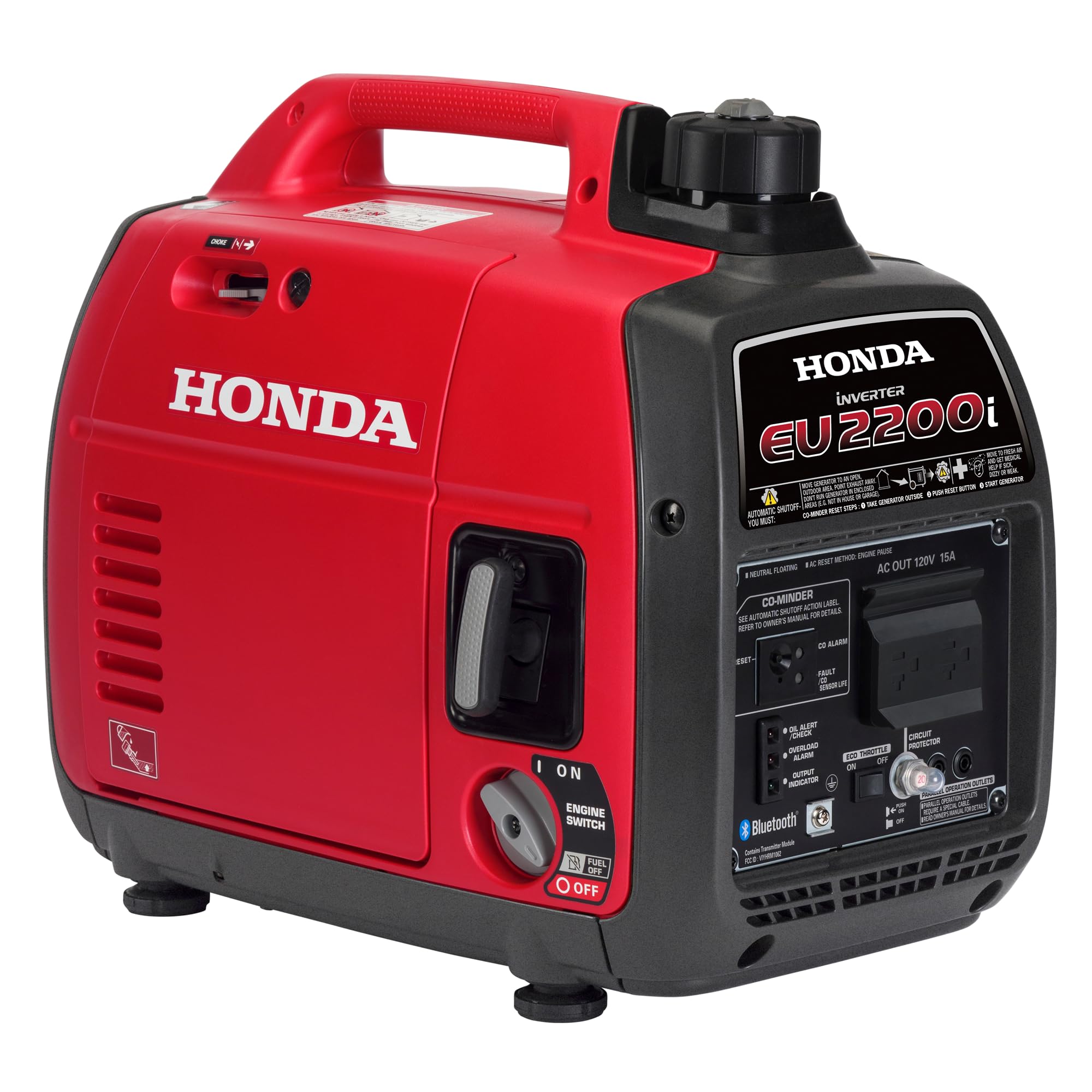
Honda EU2200i — Quietest CARB pick
Best for: quiet camping and sensitive electronics
If you want one generator that works almost anywhere in California, start here. The EU2200i delivers 1,800 running watts and 2,200 starting watts from a 121cc engine, runs up to 8.1 hours at 25% load on 0.95 gallons, and stays at 48 dBA at quarter load. Its clean power under 3% THD protects laptops and phones, Eco-Throttle saves fuel at light loads, and parallel capability doubles output when you add a second unit. The trade-off is clear: it cannot run a large RV air conditioner or a whole house on its own.
- 48 dBA at quarter load
- THD under 3% for electronics
- 47.4 lb, easy one-person carry
- 8.1 hours at 25% load
- Only 1,800 running watts
- No electric start
- Premium price for its size
5.0/5
4.8/5
4.9/5
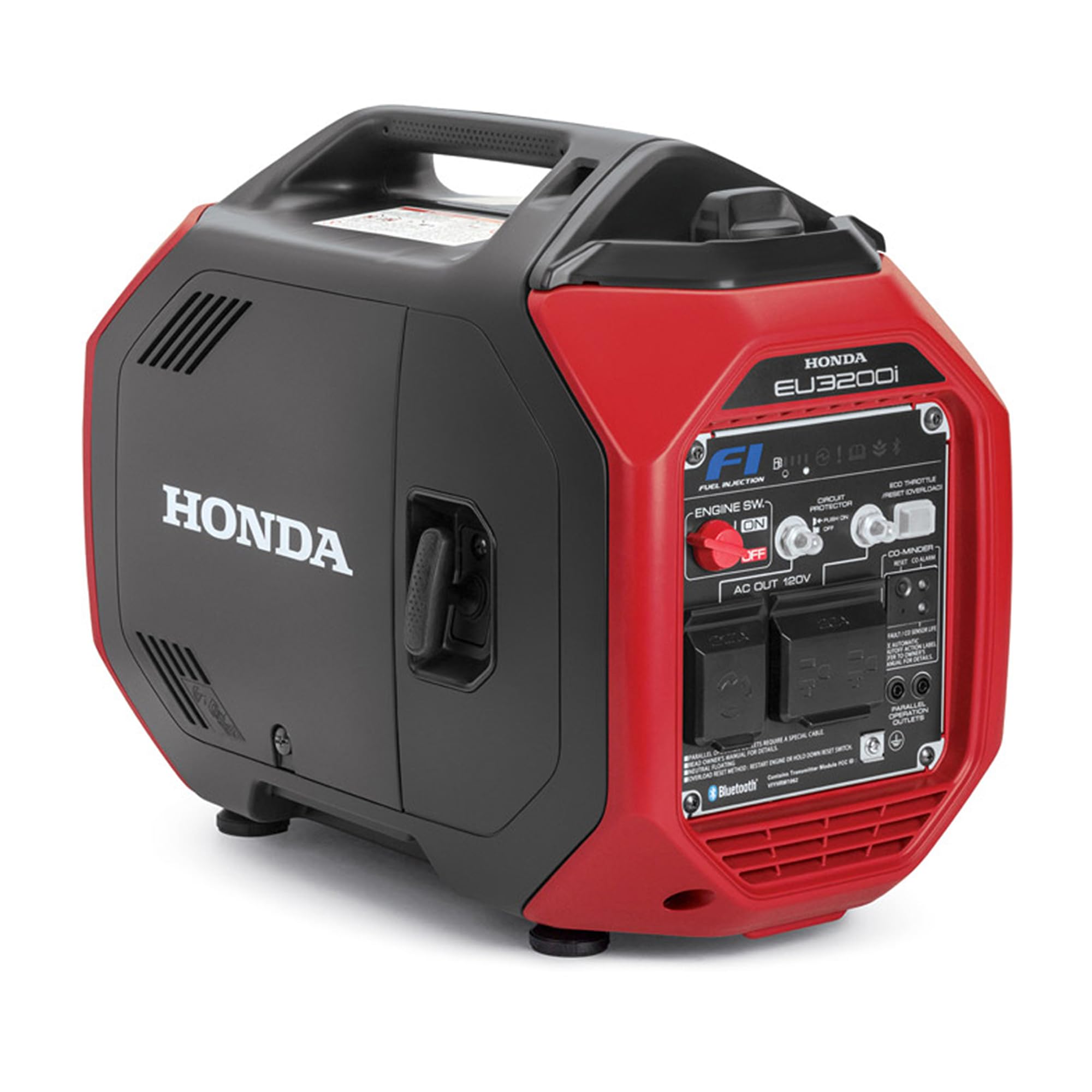
Honda EU3200i — Fuel-injected 3,200-watt step up
Best for: premium mid-size RV power
If the EU2200i is slightly too small, this is the next Honda to consider. The EU3200i delivers 2,600 running watts and 3,200 starting watts from a fuel-injected 130cc engine, runs up to 8.6 hours at 25% load on 1.2 gallons, and stays at 54 dBA at quarter load. It can run a 13,500 BTU RV air conditioner plus lights and a fridge, and CO-MINDER adds carbon monoxide shutoff. Buy the EU3200iAC version for California; the EU3200iAN version is 49-state only. Its only real drawback is recoil-only starting.
- 2,600 running watts, fuel injected
- 54 dBA at quarter load
- Runs 13,500 BTU RV AC
- 59.1 lb, still portable
- Recoil start only
- Check AC model number carefully
- Premium price for mid-size
5.0/5
4.7/5
4.8/5

Generac iQ5200 DF — CARB dual-fuel workhorse
Best for: dual-fuel California use
If you want dual-fuel flexibility without losing California compliance, this is the clearest choice in this list. The iQ5200 DF delivers 3,900 running watts and 5,200 starting watts on gasoline, and 3,500 running watts on propane. It runs up to 15 hours at 25% load on gasoline and up to 20 hours on a 20 lb propane tank. Electric start, Economy Mode, and COsense shutoff make long outages easier to manage. Buy the 50-state model G0089470; the G0089450 version is 49-state only. At 107 lb, it is not a carry model.
- 3,900 running watts on gasoline
- 15 hours at 25% load
- Propane runtime up to 20 hours
- Electric start and COsense
- 107 lb, heavy to move
- No published noise figure
- Check 50-state model number
4.9/5
4.7/5
4.4/5

Westinghouse iGen4500 — Long-runtime RV pick
Best for: RV air conditioning
If your main job is a 13,500 BTU RV air conditioner, the iGen4500 is built for it. It delivers 3,700 running watts and 4,500 starting watts, runs up to 18 hours at 25% load on 3.4 gallons, and stays at 52 dBA at quarter load. A built-in TT-30R RV outlet, remote start with a key fob, and a telescoping handle with wheels make campsite setup simple. Most listings describe it as EPA and CARB compliant, but one retailer listing says CARB Compliant No, so verify the exact unit before you buy. It is gasoline only.
- 18 hours at 25% load
- 52 dBA, RV-ready TT-30R
- Remote start with key fob
- THD under 3% for electronics
- 98 lb, wheels help only
- Gasoline only, no propane
- CARB listing conflicts, verify first
4.6/5
4.8/5
4.4/5

Yamaha EF2000iSv2 — Lightest carry in this list
Best for: light portable power
If weight is your first filter, the Yamaha wins this list at 44.1 lb. It delivers 1,600 running watts and 2,000 starting watts from a 79cc engine, runs up to 10.5 hours at 25% load on 1.1 gallons, and stays at 51.5 dBA at quarter load. Smart Throttle adjusts engine speed to the load, a USFS-approved spark arrestor suits wooded sites, and Twin Tech lets you pair two units for more power. The trade-off is output: it is best for lights, chargers, and small appliances, not for an RV air conditioner alone.
- 44.1 lb, lightest here
- 10.5 hours at 25% load
- 51.5 dBA at quarter load
- USFS spark arrestor included
- Only 1,600 running watts
- No electric start
- 61 dBA at full load
4.8/5
4.4/5
4.6/5

Champion 2500-Watt Dual Fuel Inverter — Lightest dual-fuel option
Best for: light dual-fuel camping
If you want propane backup in a bag-sized generator, this Champion is the lightest dual-fuel model here. It delivers 1,850 running watts and 2,500 starting watts on gasoline, and 1,665 running watts on propane. It runs up to 11.5 hours at 25% load on gasoline and up to 34 hours on a 20 lb propane tank at 25% load, at 53 dBA. CO Shield adds carbon monoxide shutoff, and Economy Mode saves fuel at light loads. CARB status needs care: some listings for this dual-fuel model say CARB compliant, while another says not for sale in California, so verify the exact model before you buy.
- 39 lb, ultralight dual-fuel
- 53 dBA, quiet for camp
- 34 hours on propane at 25%
- CO Shield shutoff included
- CARB listings conflict, verify first
- Only 1,850 running watts gas
- Not for emergency home backup
4.2/5
4.6/5
4.7/5

Generac GP3300i — Value 3,300-watt inverter
Best for: 3,000-watt class value
If you want 3,000-watt power without a premium price, the GP3300i is the trusted value pick here. It delivers 2,500 running watts and 3,300 starting watts from a 149cc engine, with PowerRush for extra starting capacity and THD under 3% for sensitive electronics. It weighs 59.5 lb, runs about 7 hours at 25% load on 1.06 gallons, and includes COsense shutoff and USB ports. Generac sells both 49-state and 50-state versions, so confirm the 50-state model number for California. Short runtime is the main trade-off.
- 2,500 running watts, PowerRush
- 59.5 lb, easy to carry
- COsense shutoff included
- THD under 3% for electronics
- Only 7 hours at 25% load
- About 58 dBA, louder here
- Check 50-state version first
4.6/5
4.0/5
4.3/5
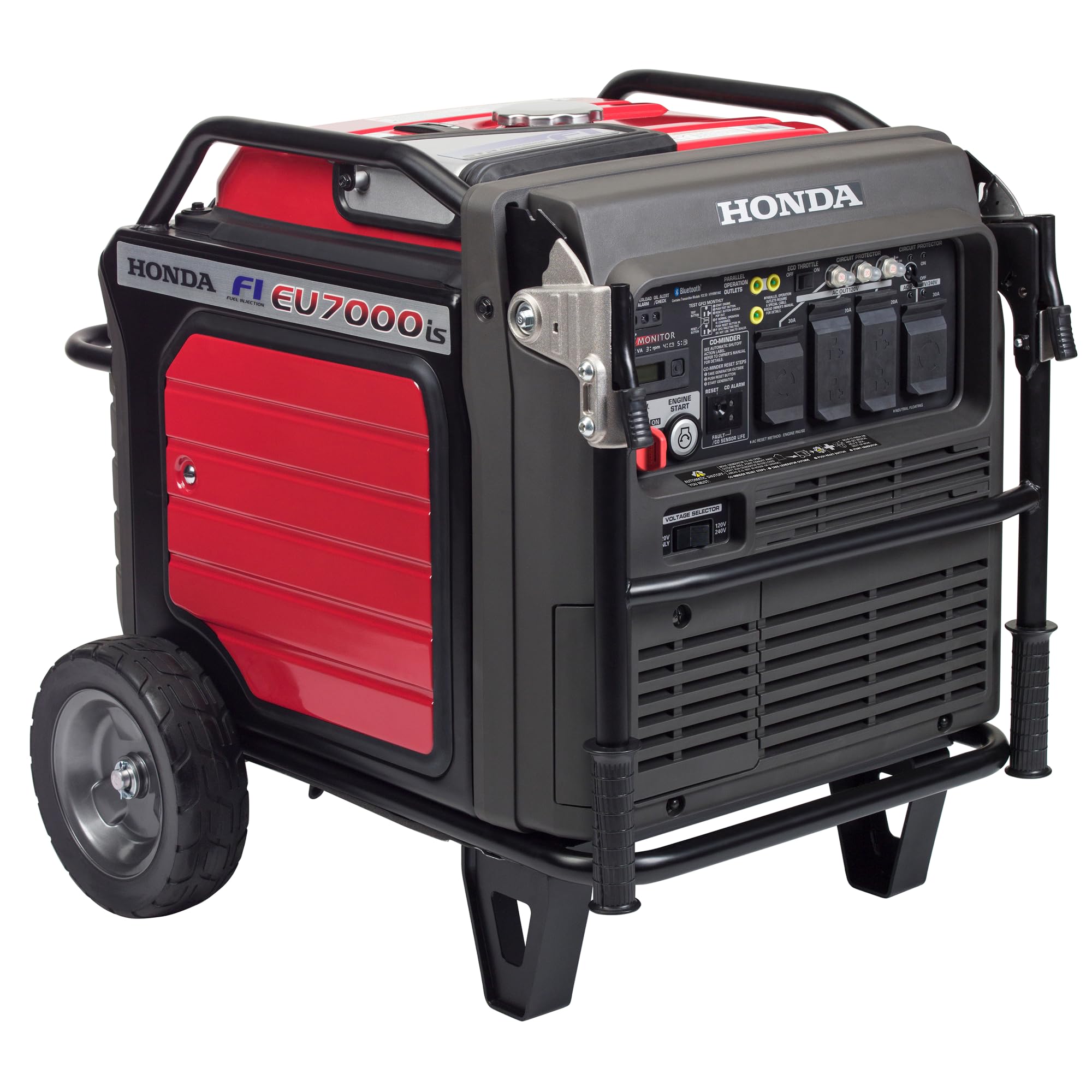
Honda EU7000iS — Largest CARB power here
Best for: home backup power
If you need to run a fridge, freezer, furnace fan, lights, and internet together, this is the only model here built for that load. The EU7000iS delivers 5,500 running watts and 7,000 starting watts at 120/240V, runs up to 16 hours at 25% load on 5.1 gallons, and stays at 52 dBA at quarter load. Fuel injection, electric start, Bluetooth monitoring, and CO-MINDER make long outages easier to manage. Buy the EU7000iSNAC version for California; the EU7000iSNAN version is 49-state only. At 263.2 lb, it needs wheels and a firm path.
- 5,500 running watts, 120/240V
- 16 hours at 25% load
- 52 dBA at quarter load
- Fuel injection and Bluetooth
- 263.2 lb, not portable alone
- Check SNAC model number first
- Premium price for home backup
4.9/5
4.6/5
3.6/5

Predator 5000 Super Quiet Dual Fuel — RV value with remote start
Best for: large dual-fuel value
If you want 3,900 running watts and dual-fuel flexibility at a lower cost than the Generac, the Predator 5000 is the value choice. It delivers 3,900 running watts and 5,000 starting watts on gasoline, and 3,600 running watts on propane. The California-compliant EFI version is item 71424, while item 71367 is the 49-state version, so check the item number first. Remote start, a TT-30R RV outlet, and CO SECURE shutoff suit RV trips and outages. At 61 dBA at 25% load and 115 lb, it is louder and heavier than the smaller models here.
- 3,900 running watts on gasoline
- Remote start included
- TT-30R RV outlet included
- CO SECURE shutoff included
- 61 dBA at 25% load
- 115 lb, heavy to move
- Check 71424 item number first
4.5/5
4.4/5
3.8/5

WEN 56225i — Cleanest budget power here
Best for: budget small power
If budget is your first filter, the WEN 56225i gives you CARB compliance and very clean power for less than the premium brands. It delivers 1,800 running watts and 2,250 starting watts from a 79.7cc engine, runs over 6 hours at half load on 1 gallon, and stays at 53 dBA at quarter load. Its THD is under 0.3% at no load and under 1.2% at full load, which is the cleanest figure in this list. A fuel shutoff drains the carburetor for storage. Short runtime and 1,800 running watts are the limits to accept.
- THD under 1.2% at full load
- 53 dBA at quarter load
- 48.5 lb, easy to carry
- Fuel shutoff for storage
- Only 6 hours at half load
- Only 1,800 running watts
- No electric start
4.7/5
3.8/5
4.4/5
Top 3 Head-to-Head: Honda EU2200i vs Generac iQ5200 DF vs Westinghouse iGen4500
These three cover the three most common final choices: a quiet small generator, a dual-fuel large generator, and a long-runtime RV generator.
| Feature | #1 Honda EU2200i | #3 Generac iQ5200 DF | #4 Westinghouse iGen4500 |
|---|---|---|---|
| CARB and Clean Power | 5.0/5 — Best | 4.9/5 | 4.6/5 |
| Runtime at 25% load | 8.1 hours | 15 hours | 18 hours — Best |
| Noise and Portability | 4.9/5, 48 dBA — Best | 4.4/5, 107 lb | 4.4/5, 52 dBA |
| Choose if… | You want quiet, light power | You want dual-fuel and more watts | You want RV AC and long runtime |
Who These Inverter Generators Are NOT For
These models are built for portable, clean power, not for whole-house backup at any load.
They are also not for indoor use. Every generator here must run outdoors, at least 20 feet from your home, with exhaust pointed away. If you need silent overnight power indoors, a battery power station is a better fit.
Common Mistakes to Avoid
Four mistakes cause most CARB-compliant generator returns and disappointments.
Frequently Asked Questions About CARB Compliant Inverter Generators
What does CARB compliant mean for a generator?
CARB compliant means the engine is certified by the California Air Resources Board and meets California emission standards. A CARB-compliant generator can be sold and used in California, while a 49-state model cannot. Always check the exact model number, because the same product name can have both versions.
Can I use a CARB compliant inverter generator in California?
Yes, if the exact model you buy is the CARB-certified version. Look for 50-state or CARB-compliant wording on the listing and the box, and confirm the model number against the manufacturer page. A brand name alone does not prove compliance, and some dual-fuel listings differ by model.
Are all inverter generators CARB compliant?
No. Many inverter generators are sold in both 49-state and 50-state versions, and some models are not CARB compliant at all. In this list, the Westinghouse iGen5000DFc was excluded because a source lists it as not CARB compliant. Check each model before you buy, even if another model from the same brand is compliant.
How do I check if a generator is CARB compliant?
Check the exact model number on the manufacturer page, the retailer listing, and the product manual. Look for CARB, 50-state, or California-compliant wording tied to that model number. For example, the Honda EU3200iAC is CARB, the EU3200iAN is not, and the Generac iQ5200 DF 50-state model is G0089470.
What size CARB compliant inverter generator do I need for an RV?
For lights and chargers only, a 2,000-watt model is often enough. For a 13,500 BTU RV air conditioner, choose at least 3,700 running watts, such as the Westinghouse iGen4500, or a dual-fuel model such as the Generac iQ5200 DF. Check the air conditioner starting watts first, and use our best dual-fuel portable generator guide if you want propane backup.
Can a CARB compliant generator power sensitive electronics?
Yes, if it is an inverter generator with low THD. Most models in this list keep THD under 3%, which protects laptops, phones, and medical devices. The WEN 56225i is even lower, under 1.2% THD at full load. Avoid conventional open-frame generators for sensitive electronics, because their THD is usually much higher.
Do CARB compliant generators need special maintenance?
No special maintenance is required beyond normal generator care. Change the oil on schedule, use fresh fuel or a stabiliser, and run the carburetor dry before storage if your model has a fuel shutoff. Store the generator outdoors or in a ventilated shed, never indoors, and test it before storm season.
Our Final Verdict
For most California buyers, the Honda EU2200i is the safest first choice: quiet, light, and clean enough for electronics. If you need more watts or propane backup, step up to the Generac iQ5200 DF or the Westinghouse iGen4500, and always verify the CARB model number first.

Hi, I’m Michael Turner. I own a generator workshop in the United States and founded HomeGeneratorBlog to share practical, hands-on guidance about generator installation, maintenance, troubleshooting, safety, and backup power solutions. My goal is to help homeowners make smarter, more confident decisions through clear and reliable information