What Should You Look for in a Campground-Friendly Inverter Generator? Quiet, Light & Safe Picks That Won’t Get You Kicked Out
Quick Answer
What should you look for in a campground-friendly inverter generator? Look for under 60 dBA at 25% load, 2,000 to 3,500 running watts for most campers, under 60 lbs, a CO sensor, and clean pure sine wave power. If you are new to this, start with whether you can use an inverter generator for camping and the campground’s own quiet-hours rules.
The 6 Campground Non-Negotiables
- Quiet rating: 52-58 dBA at 25% load from 23 feet is ideal for tent loops and close RV sites.
- Right size: 2,000W for tents and vans, 3,000-3,500W if you need to start a 13,500 BTU RV air conditioner.
- Clean power: Pure sine wave with under 3% THD protects CPAPs, laptops, and phone chargers.
- Portability: Under 50 lbs for tent camping, under 70 lbs with wheels for camper use.
- Runtime: 8-12 hours at 25% load on one tank so you are not refueling at midnight.
- Safety shutoffs: CO sensor, low-oil shutoff, and overload protection are must-haves in 2026.
My Fast Rule
- If the spec sheet does not list noise at 25% load, weight without fuel, and runtime at 25% load, skip it and check the next model.
I’ve learned this the hard way on a packed loop in the Smokies. My first generator was cheap, loud, and heavy enough to hurt my back.
It ran fine. My neighbors hated it, and I hated starting it after 8 p.m. That trip taught me what campground-friendly actually means.
This guide goes deeper than a spec sheet. I’ll walk you through noise, size, outlets, fuel, and safety so you buy once and camp in peace.
What should you look for in a campground-friendly inverter generator comes down to respect. Respect for quiet hours, for clean air, and for the people ten feet away.
In This Guide
- What Does Campground-Friendly Actually Mean?
- How Quiet Does a Campground Generator Need to Be?
- What Size Inverter Generator Do You Need for Camping?
- Weight, Portability, and Runtime That Actually Work
- Outlets and Clean Power for CPAPs, Fridges, and Phones
- Gas vs Dual Fuel: Which Is Better for Campgrounds?
- Safety Features and Campground Rules You Can’t Ignore
- My Pre-Trip Buying Checklist
- Frequently Asked Questions
What Does Campground-Friendly Actually Mean?
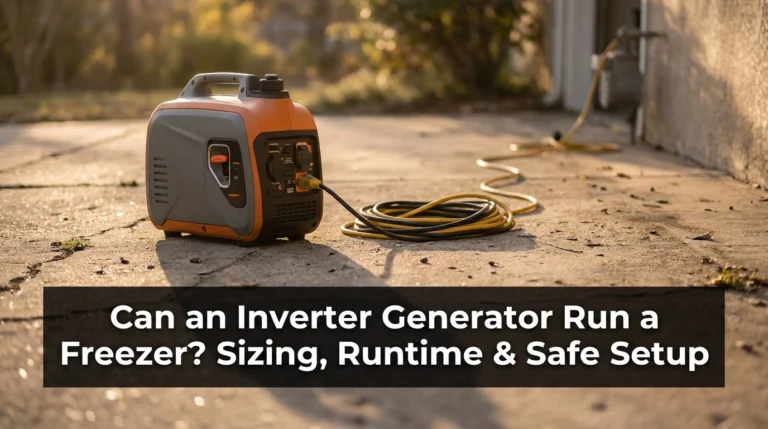
A campground-friendly inverter generator is a quiet, enclosed, pure sine wave generator that meets park noise limits and runs long on little fuel. It is built for close neighbors, not job sites.
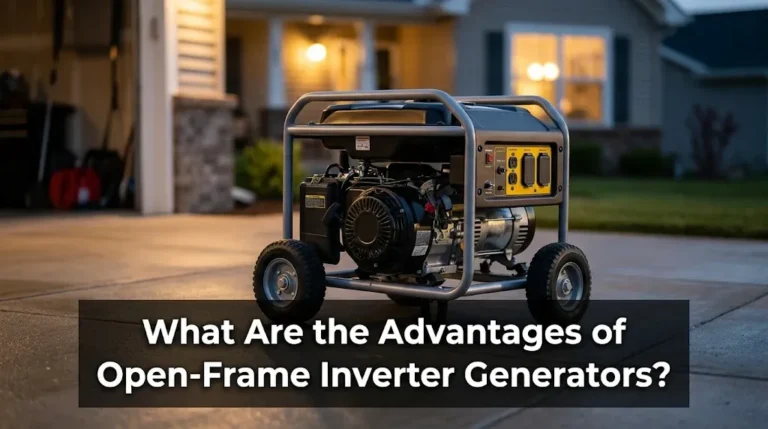
Open-frame generators are louder and heavier. They belong on a work site, not a tent loop.
An inverter generator makes AC power, converts it to DC, then back to clean AC. That process lets the engine slow down at light load.
Slower engine means less noise. It also means better fuel use.
- Enclosed case: Foam and a muffler cut high-frequency noise.
- Eco mode: Throttles down when you only charge phones.
- Spark arrestor: Required in most national and state forests.
- Parallel ready: Lets you link two small units instead of buying one huge unit.
I now test every unit the same way. I run it at my picnic table distance and hold a normal conversation.
If I have to raise my voice, it’s not campground-friendly. Simple test, honest answer.
Section Takeaway: Campground-friendly means quiet, clean, light, and long-running — not just small. If it fails any one of those, it will frustrate you or your neighbors.
How Quiet Does a Campground Generator Need to Be?
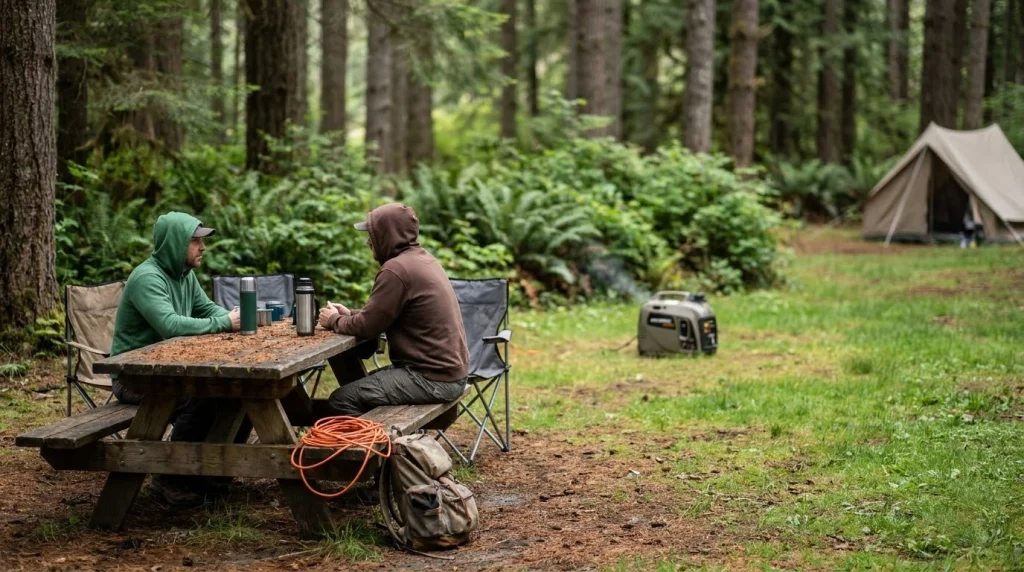
Most campgrounds want 60 dBA or less at 50 feet during the day, and many ban generator use during quiet hours at night. Aim for 52 to 58 dBA at 25% load, measured at 23 feet.
That number matters more than the headline. Brands measure at different loads and distances.
Always compare the 25% load figure. That’s how you’ll actually camp most of the time.
How to Read a Noise Rating Honestly
A rating without distance is useless. A rating without load is marketing.
Look for all three together. For example, 53 dBA at 25% load at 23 feet is a real, comparable spec.
- 48-55 dBA: Library to quiet conversation, best for tent loops.
- 56-60 dBA: Normal conversation, fine for most RV parks.
- 61-68 dBA: Noticeably loud, risky in crowded campgrounds.
- 69+ dBA: Open-frame territory, expect complaints.
Placement helps, but it doesn’t fix a loud unit. Put it on grass, point the exhaust away, and never box it in.
The National Park Service publishes park-specific generator hours, so check your park before you pack. Rules vary by loop.
Safety note: Never run a generator inside a tent, camper, or enclosed vestibule. Keep it at least 20 feet from sleeping areas and point exhaust away from people.
Section Takeaway: Buy on the 25% load dBA at 23 feet, not the big number on the box. Under 58 dBA keeps you welcome in almost any loop.
What Size Inverter Generator Do You Need for Camping?
Most tent and van campers need 2,000 to 2,500 running watts. Most camper and RV users who run AC need 3,000 to 3,500 running watts with higher starting watts.
Starting watts are the surge. Running watts are what it can hold for hours.
Undersize it and the overload light trips. Oversize it and you haul weight and burn fuel for nothing.
If you haven’t sized your rig yet, work through what size inverter generator you need for a camper with your actual appliance list. Five minutes there saves a return.
| Camping Style | Running Watts | Typical Loads | Weight Range |
|---|---|---|---|
| Tent / Car Camping | 1,800 – 2,200W | Phones, lights, CPAP, small fan, laptop | 38 – 48 lbs |
| Van / Small Camper, No AC | 2,200 – 2,800W | Fridge, coffee maker (one at a time), CPAP | 48 – 60 lbs |
| Camper / RV With 13,500 BTU AC | 3,000 – 3,500W | AC + fridge + lights, microwave briefly | 58 – 75 lbs |
| Two Small Units in Parallel | 3,600 – 4,400W combined | AC when needed, one unit alone otherwise | 40 lbs each |
Check what a smaller unit actually handles before you upsell yourself. The list of appliances a 2000-watt inverter generator can run surprises most tent campers.
Need AC headroom? Compare that to what a 3000-watt inverter generator can run at the same time, not one by one.
My own sweet spot is parallel-ready 2,200W units. I take one for a weekend tent trip.
I take both for a hot RV week. Flexibility beats one heavy box.
Section Takeaway: Size to your biggest simultaneous load, especially AC starting watts. When in doubt, parallel-ready small units give you options without the weight penalty every trip.
Weight, Portability, and Runtime That Actually Work
A campground generator you can’t lift alone will stay home. Keep tent units under 50 lbs dry, and look for 8 to 12 hours of runtime at 25% load.
Dry weight is without fuel and oil. Add about 6 lbs per gallon of gas.
That 47 lb unit is 53 lbs ready to go. Plan for the real number.
Handles, Wheels, and Tank Size
- Suitcase handle: Best for 2,000W class, one-hand carry for short walks.
- Telescoping handle + wheels: Worth it above 60 lbs or on gravel sites.
- Tank size: 1 to 1.5 gallons for small units, 2+ gallons for 3,500W class.
- Fuel gauge: Small thing, huge help at dusk.
Runtime claims need the same honesty as noise. Check runtime at 25% load, not at idle.
Eco mode stretches a tank on light loads. It will rev up when the fridge or AC kicks on, and that’s normal.
I once chose a 1-gallon tank to save weight. I refueled in the dark on night two and never made that trade again.
Section Takeaway: Weight and runtime are campground features, not footnotes. If you dread carrying it or feeding it, you won’t use it well.
Outlets and Clean Power for CPAPs, Fridges, and Phones
Look for at least two 120V household outlets, USB ports, and — for campers — a 30-amp TT-30 RV outlet. Power should be pure sine wave with under 3% total harmonic distortion.
That clean power claim matters. Cheap modified sine wave power can buzz, overheat chargers, and trouble CPAPs.
Inverter generators solve that by design. Still, confirm THD on the spec sheet.
Which Outlets Do You Actually Need?
- 120V 20A duplex: Fridge, coffee maker, power tools, chargers.
- TT-30 RV outlet: Direct camper plug-in, no adapter dongle hunt.
- USB-A / USB-C: Phones and lanterns without wasting an AC outlet.
- 12V DC: Useful for some air pumps and older gear, not essential.
- Parallel ports: Required if you plan to link two units later.
If you plan to plug a camper straight in, read what an RV-ready inverter generator is before you buy. TT-30 on the panel is the tell.
Running several loads at once is about sequencing, not just watts. See how to run multiple appliances at once without tripping overload when the AC starts.
Use Recreation.gov to check if your site has electric hookups at all. Some campers buy a generator for a loop that already has power, or one that bans generators entirely.
Safety note: Use outdoor-rated extension cords, keep connections dry and off the ground, and never backfeed a camper or cabin panel. Plug appliances in directly or via the RV outlet as the manual directs.
Gas vs Dual Fuel: Which Is Better for Campgrounds?
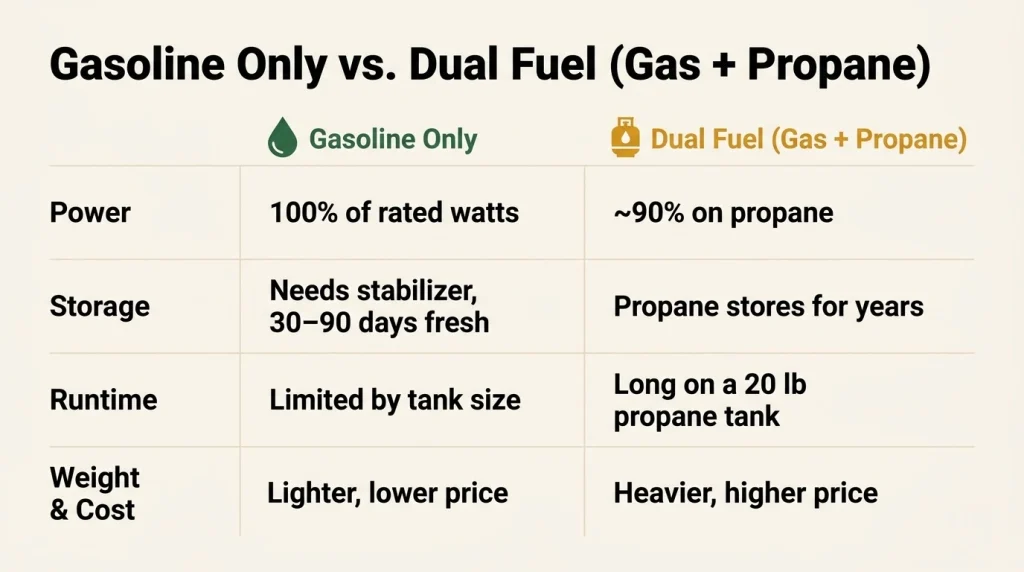
Gasoline gives you full rated watts and easy refueling on the road. Dual fuel adds propane, which stores longer, burns cleaner, and runs a bit quieter, but gives about 10% fewer watts.
Neither is wrong. Your storage and trip length decide.
I keep gas for summer RV trips. I prefer propane for winter storage because it doesn’t go stale.
| Factor | Gasoline Only | Dual Fuel (Gas + Propane) |
|---|---|---|
| Power | 100% of rated watts | ~90% on propane |
| Storage | Needs stabilizer, 30-90 days fresh | Propane stores for years |
| Runtime | Limited by tank size | Long on a 20 lb propane tank |
| Weight / Cost | Lighter, lower price | Heavier, higher price |
Carry fuel safely, outside the passenger cabin. The EPA guidance on portable fuel containers is worth a quick read before a long haul.
Never refuel hot. Let it cool, move away from campfires, and keep a small funnel in your kit.
Section Takeaway: Buy dual fuel if you hate stale gas and want long propane runtime. Buy gas-only if you want max watts for the weight and price.
Safety Features and Campground Rules You Can’t Ignore
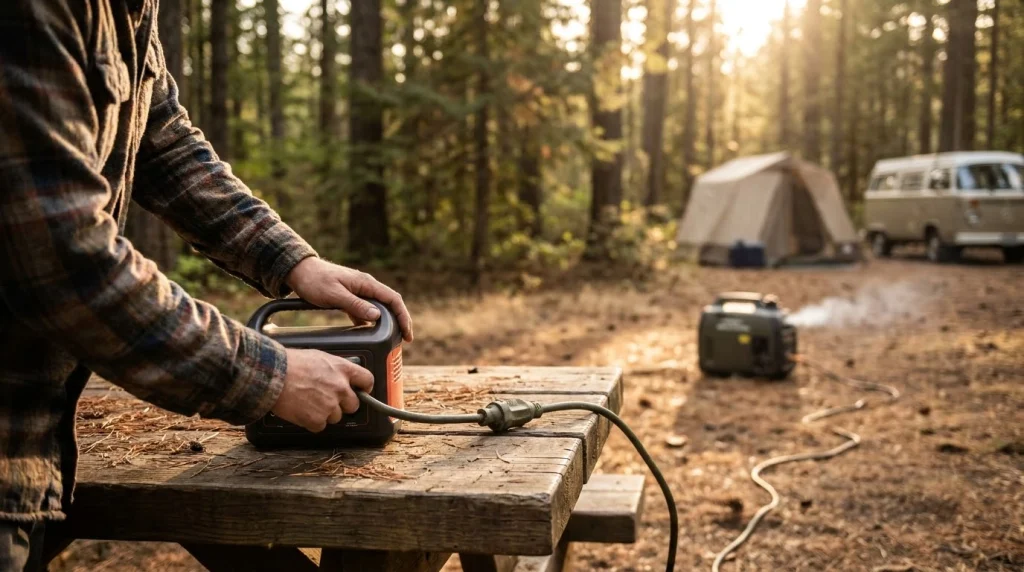
A CO sensor that shuts the unit down, low-oil shutoff, and a USDA-qualified spark arrestor are the safety trio for 2026. Without them, I won’t camp with it.
Carbon monoxide is odorless. Distance and wind direction are your first protection, the sensor is your backup.
The U.S. Consumer Product Safety Commission warns to keep portable generators outdoors and at least 20 feet from any dwelling. That applies at camp too — tents count.
- CO shutoff: Look for CO-Minder, CO Shield, or equivalent labeling.
- Low-oil shutoff: Protects the engine when oil dips on uneven ground.
- Overload + GFCI: Trips safely instead of damaging gear.
- Quiet hours: Many parks ban generators 10 p.m. to 6 a.m., some ban them in tent-only loops all day.
- Run windows: Some parks allow only 2 hours morning and 2 hours evening — plan charging around that.
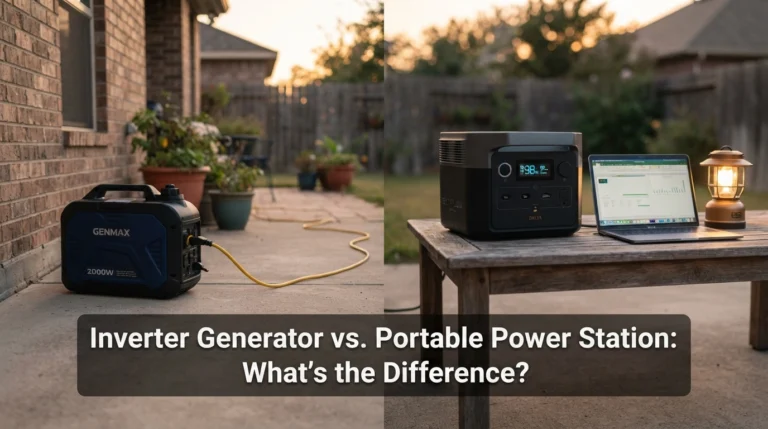
Charge a power bank during allowed hours. Run CPAP overnight on battery if quiet hours ban the generator.
That workaround has saved me more than once. It’s also just good manners.
Safety note: Place the generator on a flat, dry surface at least 20 feet from tents, campers, and openings, exhaust pointed away. Never run it in rain without a proper generator tent rated for use while running, and follow the manual.
Section Takeaway: Safety features and park rules shape your real runtime more than tank size does. Check both before you buy and before every trip.
My Pre-Trip Buying Checklist
Run this list in order and you’ll avoid 90% of bad buys. It takes ten minutes with a spec sheet open.
- List every load you will run at the same time, with running and starting watts.
- Pick size with 20% headroom — don’t camp at 100% load all day.
- Confirm noise at 25% load and distance, under 60 dBA.
- Confirm dry weight, then add fuel weight honestly.
- Confirm TT-30 if you have a camper, USB if you tent camp.
- Confirm CO sensor, spark arrestor, low-oil shutoff, and warranty length.
- Check your campground’s generator hours on its official page.
As of 2026, remote and electric start are nice, not essential. They add weight and a battery to maintain.
Recoil start is fine on a 2,000W unit. Electric start earns its keep above 3,000W, especially in cold weather.
Don’t pay for Bluetooth you won’t open. Do pay for a better muffler and a longer warranty.
Section Takeaway: A good campground generator passes on paper and in the parking lot — lift it, listen to a video at 25% load if you can, and picture carrying it to your actual site.
Frequently Asked Questions
What is the quietest size for tent camping?
A 2,000 to 2,200W enclosed inverter at 48 to 55 dBA at 25% load is the quietest practical choice for tent camping. It handles CPAP, lights, and charging without the weight of an RV-sized unit.
Can I run a generator all night in a campground?
Usually no. Most public campgrounds enforce quiet hours, often 10 p.m. to 6 a.m., and ban overnight generator use. Charge batteries during allowed hours and run a CPAP on a battery overnight.
Do I need a TT-30 outlet for my camper?
If your camper has a 30-amp plug, a built-in TT-30 saves adapters and voltage drop. You can use an adapter on a household outlet, but direct TT-30 is cleaner and safer for AC loads.
Is dual fuel worth it for camping?
Yes if you store the generator for months or want long runtime from a 20 lb propane tank. Remember propane gives about 10% fewer watts, so size up if you need every watt for AC.
How far should a generator be from my tent?
At least 20 feet, outdoors, with exhaust pointed away from tents and camper windows. Follow CPSC distance guidance and your campground’s placement rules, and never run it inside any shelter.
Can two small generators really replace one big one?
Yes, with a parallel kit from the same brand and compatible models. Two 2,200W units give you AC power when linked and a light single unit when they’re not, which suits varied trips.
What maintenance does a campground generator need?
Check oil before each trip, run it monthly under load, use fresh or stabilized fuel, and clean the spark arrestor screen as the manual directs. Store it dry with the fuel valve off.
Pick quiet first, size second, and weight third — in that order — and you’ll be the neighbor everyone is glad camped next to them. Start with your actual load list tonight, match it to the table above, and choose the smallest, quietest unit that covers it with headroom.

Hi, I’m Michael Turner. I own a generator workshop in the United States and founded HomeGeneratorBlog to share practical, hands-on guidance about generator installation, maintenance, troubleshooting, safety, and backup power solutions. My goal is to help homeowners make smarter, more confident decisions through clear and reliable information