Can You Run Two Inverter Generators in Parallel? Double the Watts, Run an RV AC & Skip a Bigger Unit
Quick Answer
Can you run two inverter generators in parallel? Yes, if both units are parallel-capable and you use the correct parallel kit for them. The kit syncs the two inverters so they act as one source, which is ideal when you need to run multiple appliances at once without buying a heavier generator.
What paralleling gives you
- Nearly double power: Two 2,200-watt units give about 3,600 running watts through the kit outlet.
- Same voltage: Paralleling adds amps and watts at 120V, it does not create 240V.
- Flexible use: Run one unit for light loads and both when the AC or microwave starts.
- Kit required: You need a brand-matched parallel kit or cord, not a homemade double-ended cord.
- Same setup rules: Both units run outdoors, grounded as the manual directs, with loads plugged into the kit.
Do this first
- Check both manuals for the words parallel capable and the exact kit model listed for your units.
I’ve paralleled two small inverters at a campsite more times than I can count. One unit hummed along fine for lights and the fridge, then stalled the moment the roof AC tried to start.
Hooking up the second unit fixed that problem in about two minutes. This guide shows you when paralleling works, when it doesn’t, and how to do it safely in 2026.
In This Guide
- What does paralleling an inverter generator mean?
- Can you run two inverter generators in parallel with any models?
- How much power do you get from two generators in parallel?
- What do you need to parallel two inverter generators?
- How to connect two inverter generators in parallel, step by step
- Can you parallel different brands or different sizes?
- Parallel pair vs one bigger generator: which is better?
- Is paralleling safe, and can it give you 240V?
- Common parallel mistakes and troubleshooting
- Frequently asked questions
What does paralleling an inverter generator mean?
Paralleling means linking two inverter generators with a special kit so they share one load as a single power source. The kit syncs their sine waves before any power reaches your plugs.
An inverter generator makes raw AC power, converts it to DC, then inverts it back to clean AC. That electronic control is what makes syncing possible.
A conventional open-frame generator has no such syncing ports. You cannot parallel a conventional unit this way unless the manufacturer built it for that job.
Why the sync matters
If two unsynced sources feed the same outlet, their waves fight each other. That can trip breakers, damage inverter boards, and ruin sensitive electronics.
The parallel kit solves this before you plug anything in. One generator follows the other’s frequency and voltage automatically.
- Parallel ports: Small covered sockets on the front panel, usually two round ports plus a ground terminal.
- Parallel kit: A box or cord set with the matching plugs and a larger outlet in the middle.
- Shared load: Both engines carry the load together instead of one doing all the work.
Section Takeaway: Paralleling is a manufacturer-designed feature, not a trick. If the ports and kit are not listed for your model, do not try to improvise it.
Can you run two inverter generators in parallel with any models?
No, both generators must be parallel-capable, and the safest pairing is two identical models from the same brand. Check the manual and the front panel before you buy a kit.
I learned this the hard way with a borrowed unit years ago. It looked identical on the outside, but it had no parallel ports under the cover.
How to confirm compatibility in 60 seconds
- Look for ports: Find the parallel operation outlets on the control panel.
- Check the manual: Search for parallel kit and the exact kit part name.
- Match the kit: Buy the kit made for that model family, not a universal cord from a listing.
- Check the outlet: Many kits add a TT-30 RV outlet or a twist-lock outlet you do not get on a single unit.
Some brands allow pairing a smaller and a larger unit from the same family. Even then, total output is limited, as the next section explains.
The U.S. Consumer Product Safety Commission also stresses using generators exactly as the manufacturer directs. A non-approved connection falls outside that guidance.
Section Takeaway: Identical models plus the matching factory kit is the pairing I trust. Anything else needs explicit approval in both manuals.
How much power do you get from two generators in parallel?
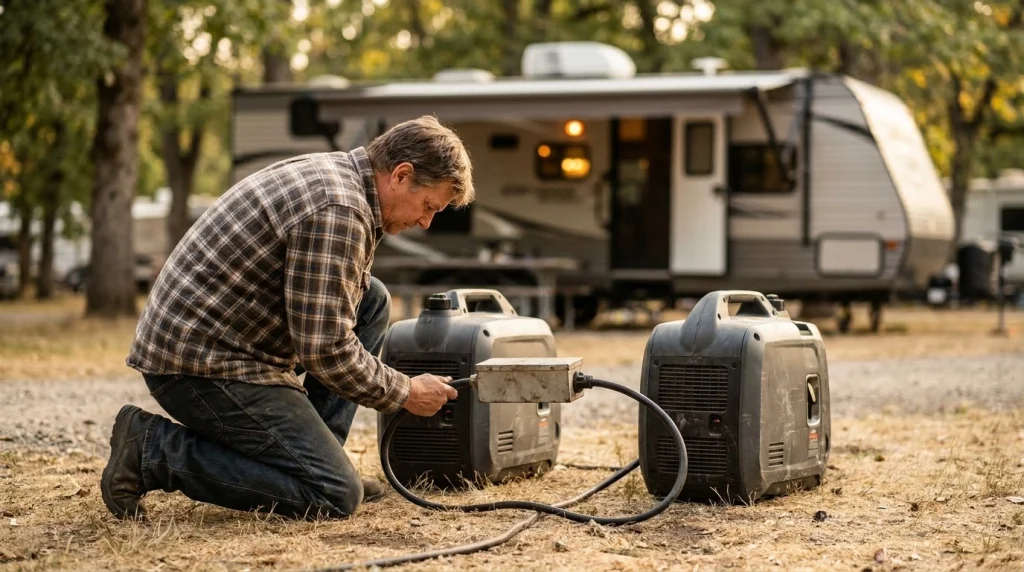
You get close to the combined running watts of both units, minus a small loss through the kit. Starting watts also combine, which helps with motor loads.
Use the running watts on the kit outlet as your real limit. That number is printed on the kit, not just on the generators.
| Pairing example | Combined starting watts* | Usable running watts* | Typical use |
|---|---|---|---|
| 2 x 2,000W running | About 4,400W | About 3,600W via kit | RV AC plus fridge and lights |
| 2 x 2,500W running | About 5,500W | About 4,500W via kit | RV AC, microwave in short bursts |
| 2,000W + 1,600W running | About 4,000W | Often limited by smaller unit / kit rating | Check kit manual for exact cap |
*General examples only. Check your owner’s manual and the kit’s rated outlet for the exact limit for your models.
That starting surge is why paralleling works so well for RV air conditioning. If you are sizing for that load alone, see what size inverter generator can run an RV air conditioner before you buy a second unit.
For everyday loads, add up the running watts first. Then leave 20% headroom so neither engine screams at full throttle all day.
- RV AC 13,500 BTU: About 1,200-1,500 running watts, with a much higher start surge.
- Residential fridge: About 150-200 running watts, higher on compressor start.
- Microwave: About 900-1,200 watts while cooking.
- LED lights and chargers: Usually under 200 watts combined.
What do you need to parallel two inverter generators?
You need two parallel-capable units, the correct parallel kit, fuel for both, and a heavy-duty cord rated for the kit outlet. Nothing else substitutes for the kit.
Never use a male-to-male cord, sometimes called a suicide cord. It energizes exposed prongs and bypasses all sync protection.
Kit types you will see
- Parallel cord set: Two plugs that join into one outlet box, common on small suitcase models.
- Parallel box: A separate box with a TT-30 or twist-lock outlet and its own breaker.
- Built-in link: Some larger inverters link with a single cable and share a panel outlet.
Check what outlet the kit actually gives you. A 30-amp kit outlet is the reason many RV owners parallel in the first place.
If your load list is still fuzzy, work through what appliances a 3,000-watt inverter generator can run as a baseline. A paralleled pair of 2,200-watt units sits just above that class.
Safety note: Keep both generators outdoors, at least 20 feet from doors and windows, with exhaust pointing away. Carbon monoxide rules do not change when you run two units instead of one.
How to connect two inverter generators in parallel, step by step
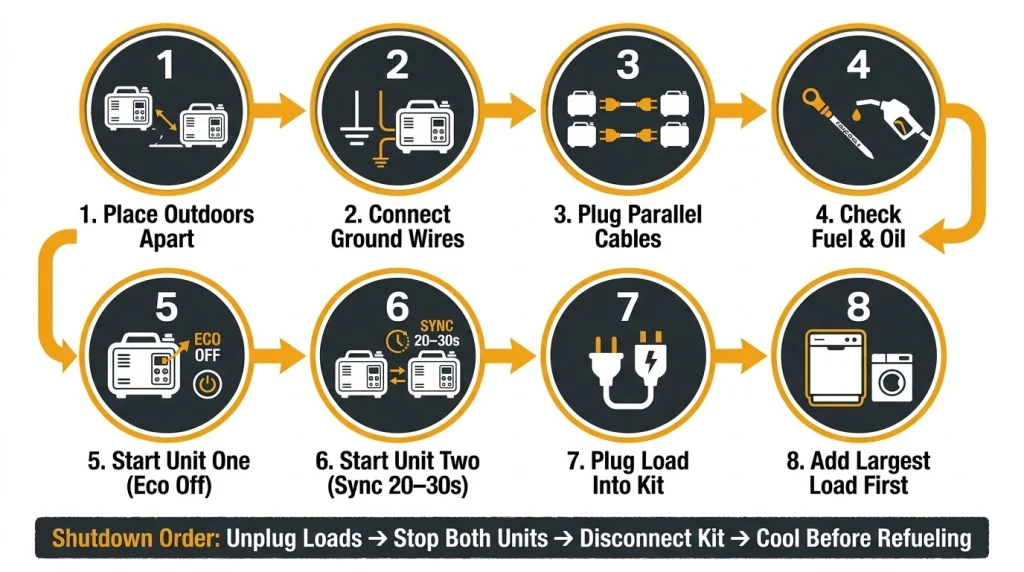
Connect the kit while both generators are off, start them one at a time, then plug in your load last. That order protects the inverter boards every time.
I follow the same routine at home and at camp. It takes under five minutes once you have done it twice.
- Set both units down: Place them on flat, dry ground outdoors, a few feet apart for airflow.
- Connect ground wires: Attach the kit ground leads to each unit’s ground terminal if your kit requires it.
- Plug in the parallel cables: Push each kit plug into the matching parallel ports until seated.
- Check fuel and oil: Top up both units so one does not die under load first.
- Start generator one: Let it settle to a steady idle with Eco mode off for starting.
- Start generator two: Let it sync for 20-30 seconds before adding any load.
- Plug into the kit: Connect your RV cord or extension cord to the kit outlet only.
- Add loads one by one: Start the largest motor load first, then add smaller items.
Shutting down correctly
Turn loads off first and unplug from the kit. Then shut down one generator, then the other, and disconnect the kit last.
Let both units cool before refueling. Hot refueling is a fire risk I never take, even when the outage is frustrating.
For house use, the connection rules are stricter than a campsite plug-in. Review how to safely connect an inverter generator to a house and use a transfer switch or interlock where required.
Section Takeaway: Kit on while off, engines on one by one, load on last. Reverse that order when you shut down.
Can you parallel different brands or different sizes?
Sometimes, but only when the manufacturers say their units and kits are compatible. Mixing brands without that written approval is the most common way people damage a good generator.
Different sizes from the same brand family are more often allowed. The combined output is usually capped by the kit rating and the smaller unit’s limits.
- Same brand, same model: Best case, full combined rating, simplest kit choice.
- Same brand, different size: Often allowed, check the chart in the kit manual for the real cap.
- Different brands: Only if both makers list cross-compatibility, which is uncommon.
- Gas plus dual-fuel: Follow the fuel-specific output rating, propane usually gives fewer watts.
When in doubt, call the maker’s support line with both model numbers in hand. That five-minute call has saved me from buying the wrong kit before.
The EPA emissions certification also applies per engine. Running two smaller engines can change your total fuel use versus one larger engine, so compare runtime at half load, not just peak watts.
Parallel pair vs one bigger generator: which is better?
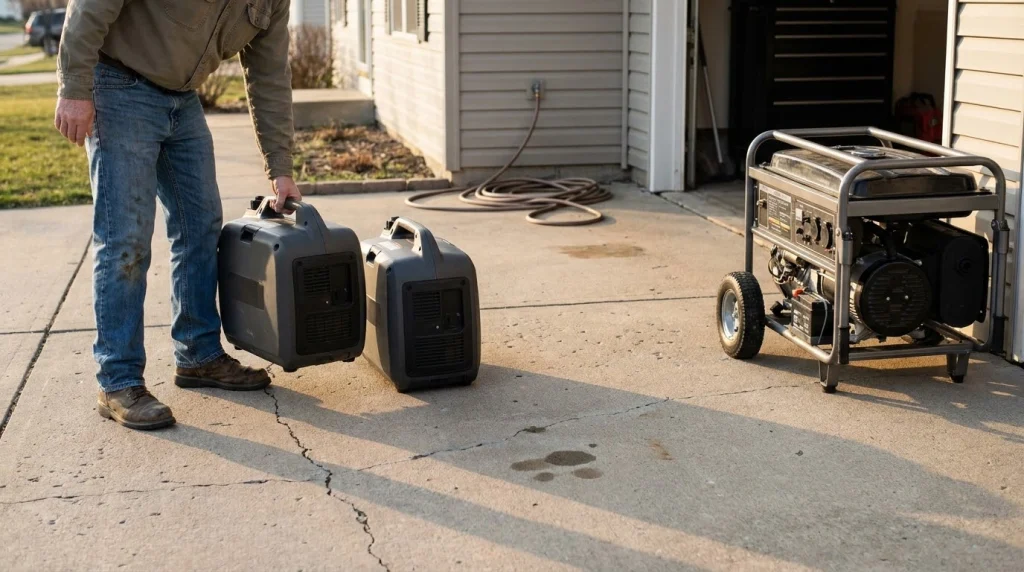
A parallel pair wins on weight, flexibility, and redundancy. One bigger generator wins on simplicity, fuel capacity, and often on 240V access.
I keep a pair for RV trips because I can lift each unit alone. For a long home outage, I prefer one larger unit with a bigger tank.
| Factor | Two in parallel | One bigger generator |
|---|---|---|
| Weight to move | Two light lifts, about 45-55 lb each for small units | One heavy lift, often 100 lb or more |
| Flexibility | Run one for small loads, both for big loads | Always run the full unit |
| Maintenance | Two oil changes, two air filters | One engine to maintain |
| 240V output | Usually no, still 120V only | Available on select larger inverters |
| If one fails | You still have half power | You have no power until repaired |
If your main goal is campground comfort, start with the shortlist of best portable generators for RV camping and pick a parallel-capable model from day one. Adding a twin later is cheaper than replacing a non-parallel unit.
Consumer Reports testing is a useful cross-check on noise and runtime claims. Manufactured ratings alone rarely tell the whole story at real loads.
Section Takeaway: Choose a pair for portability and backup, choose one big unit for simple long runs and any true 240V need.
Is paralleling safe, and can it give you 240V?
Paralleling is safe when you use the approved kit and follow placement, grounding, and load rules. It does not give you 240V on most consumer inverter pairs.
That 240V point surprises a lot of people. Two 120V sources in parallel share the same hot leg, so voltage stays at 120V while amps add up.
If you need 240V for a well pump, dryer, or split household circuits, read whether an inverter generator can provide 240V power before you plan around a parallel kit. A few specialty systems differ, and the manual is the final word.
- Outdoors only: Run both units outside, never in a garage, even with the door open.
- Dry connections: Keep the kit and cords off wet ground and out of puddles.
- No backfeeding: Never plug a generator into a house outlet to power circuits.
- CO alarms: Keep working carbon monoxide alarms inside any nearby living space.
Safety note: Disconnect loads and let engines cool before refueling or moving either unit. Follow grounding instructions in your manual, as RV, home, and job-site setups differ.
Common parallel mistakes and troubleshooting
Most parallel problems come from the wrong kit, loose plugs, or overloading the kit outlet. Work through the basics before you assume a unit has failed.
The first time my pair tripped at camp, the kit plug had backed out a quarter inch. Pushing it fully home fixed what looked like a major fault.
- Kit breaker trips: Reduce load, start motor loads one at a time, and check the kit rating.
- One unit races, one idles: Turn Eco off on both while starting large loads, then re-enable it for steady loads if the manual allows.
- No output from kit: Reseat both parallel plugs, confirm both units are running, and reset the kit breaker.
- Frequent overload light: Recalculate running watts and leave 20% headroom below the kit limit.
- One unit runs out of fuel: Shut the pair down properly instead of refueling one hot engine under load.
Do not keep resetting a breaker that trips instantly. That is a sign of a short, a wrong connection, or a load far above the rating.
Section Takeaway: Reseat the plugs, recheck the watt math, and respect the kit breaker. Most parallel faults are connection or overload issues, not dead generators.
Frequently asked questions
Can you run two inverter generators in parallel all day?
Yes, within the oil, fuel, and service intervals in both manuals. Check oil more often on long runs, refuel only after a cool shutdown, and give both units airflow. Runtime is limited by the smaller tank if you want them to stop together.
Do both generators have to be the same size to parallel?
Not always, but they must be approved to pair together. Same-brand, same-family models of different sizes are sometimes allowed, with output capped by the kit. Identical models remain the simplest and most predictable choice.
Can you parallel an inverter generator with a regular generator?
No, not with a standard parallel kit. A conventional generator lacks the inverter sync electronics and parallel ports the kit needs. Pairing them can damage both units and create an unsafe backfeed risk.
Will paralleling make my generators louder?
Two engines make more total noise than one, but each often runs at a lower load than a single strained unit. At camp, total noise is usually similar to one larger generator. Keep both units as far from sleeping areas as cords safely allow.
Can I plug loads into both generators and the kit at the same time?
Follow your kit manual, which usually directs all shared loads to the kit outlet only. Using individual panel outlets while paralleled can unbalance the load on some models. When the manual is silent, use the kit outlet alone.
Does paralleling give me a 50-amp RV outlet?
No, most parallel kits give you a 30-amp TT-30 outlet, not 50 amps. Amps add at 120V, but that is not the same as a 50-amp, 240V RV service. Use an adapter only within its rating and expect reduced capacity.
What happens if one generator stops while paralleled?
The remaining unit will usually overload and trip if the load exceeds its solo rating. Turn off large loads right away, shut the pair down in order, and fix the stopped unit’s fuel, oil, or overload cause before restarting.
Paralleling two inverter generators is one of the smartest power upgrades I recommend. You keep the easy lifting of small units and gain the starting power that actually runs an RV AC.
Start with two parallel-capable models and the factory kit. Follow the start-up order, respect the kit rating, and you will get clean, flexible power as of 2026 and for years after.

Hi, I’m Michael Turner. I own a generator workshop in the United States and founded HomeGeneratorBlog to share practical, hands-on guidance about generator installation, maintenance, troubleshooting, safety, and backup power solutions. My goal is to help homeowners make smarter, more confident decisions through clear and reliable information