How Many Inverter Generators Can You Connect in Parallel? The Real 2-Unit Limit, 3-4 Unit Workarounds & When to Go Bigger
Quick Answer
For almost every homeowner and RVer, the answer is two. How many inverter generators can you connect in parallel? Two with a standard factory kit — and that limit is set by the kit, the outlets, and the manual, not by your imagination. A few commercial systems allow three or four, but stacking consumer units beyond two is not supported, and you will get more reliable power from running multiple appliances at once on one correctly sized setup.
The Short Answer by Setup
- Standard consumer limit: 2 units with one brand-approved parallel kit.
- Three or four units: Only on specific models with a manufacturer multi-unit system — rare in 2026.
- Different brands: Do not parallel them, even if the plugs look the same.
- Different wattages: Sometimes allowed within the same brand family — output is limited by the smaller unit.
- 240V output: Paralleling two 120V units does not create true 240V split-phase power.
- Better alternative: One larger inverter often beats three small ones on cost, fuel, and noise.
What to Do Instead
- Add your running and starting watts first, then decide if two units actually cover the load with 20% headroom.
I’ve had this exact conversation at a campground and in my own driveway. Someone owns one quiet 2,200-watt unit, buys a second for the RV air conditioner, then asks if a third will let them run everything at once.
It sounds logical. In practice, the parallel kit is the ceiling — and this guide explains why two is the real limit for most people, when three or four is genuinely possible, and when you should stop stacking and buy bigger.
In This Guide
- What Is the Standard Limit for Parallel Inverter Generators?
- Why Do Most Parallel Kits Only Connect Two?
- Can You Connect Three or Four Inverter Generators?
- How Many Watts Do You Actually Get From Paralleling?
- Can You Parallel Different Wattages or Different Brands?
- When Is Two Not Enough — And What Should You Do?
- What Safety Rules Apply No Matter How Many You Connect?
- Frequently Asked Questions
What Is the Standard Limit for Parallel Inverter Generators?
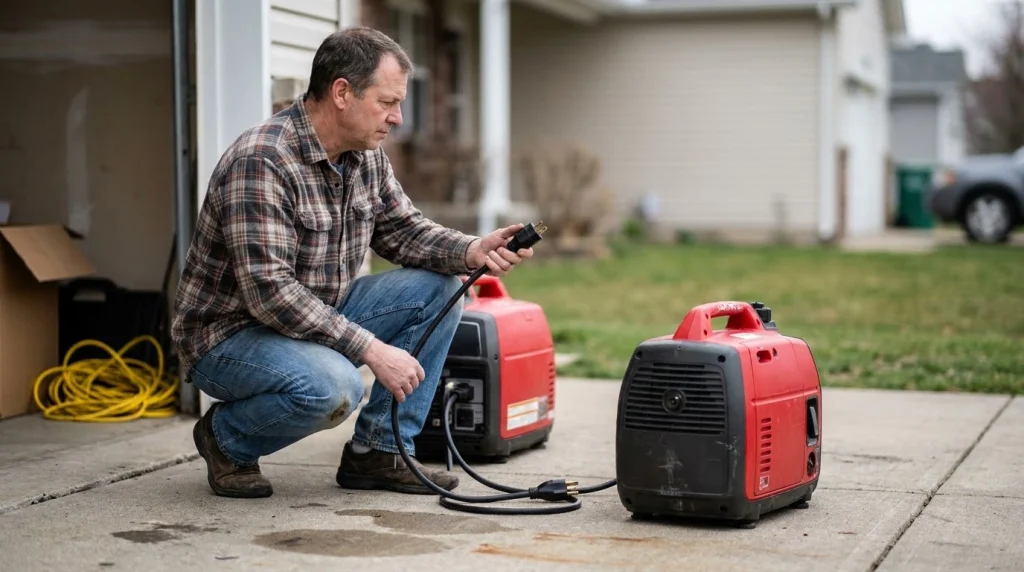
The standard limit is two units. That applies to Honda, Yamaha, Champion, WEN, Predator, Generac, and most other consumer brands as of 2026.
A parallel-capable inverter generator is a generator with special parallel ports that let its control board sync voltage and frequency with one other matching unit. The kit joins them into one output.
- One unit: Use it alone, no kit needed.
- Two units: Use one factory parallel kit — this is the supported setup.
- Three-plus units: No standard consumer kit supports this.
I learned this the hard way helping a neighbor. He had bought two kits hoping to daisy-chain three 2,000-watt units, and there was simply nowhere for the third kit to plug in correctly.
The outlets on the kit also matter. Most kits top out at a 30-amp RV or L5-30 outlet, which caps usable output long before a third unit would help.
Section Takeaway: For 99% of buyers, plan for a maximum of two paralleled units. If your load needs more, size up instead of stacking up.
Why Do Most Parallel Kits Only Connect Two?
The kit is designed for two because syncing, load sharing, and outlet capacity all get harder with each added unit. Two is manageable and safe for a consumer product.
The inverter boards must match frequency and phase perfectly. With two units, one follows the other cleanly.
The three limits you hit first
- Kit design: Two parallel ports in, one combined outlet out — no input for a third.
- Outlet rating: A 30-amp, 120V outlet maxes at 3,600 watts, regardless of generator total.
- Load sharing: Boards are tuned to split load 50/50 between two units, not three ways.
Trying to work around the kit with custom cables is where damage happens. Backfeeding, out-of-phase power, and overloaded neutrals can fry control boards in seconds.
Manufacturers also void the warranty for unsupported setups. That alone should stop most experiments.
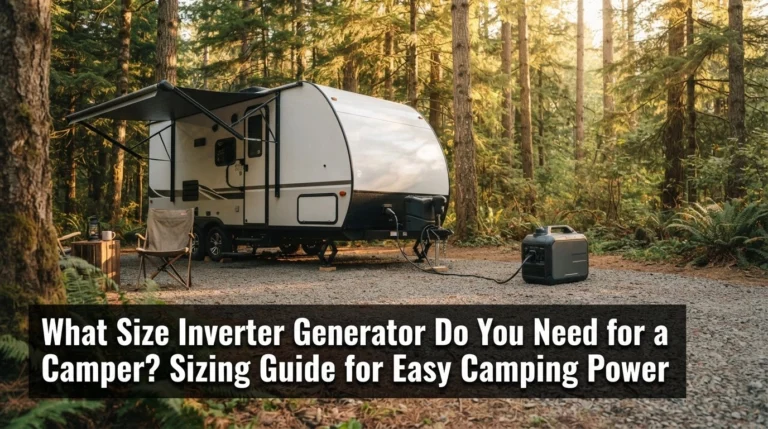
If you need enough power to run an RV air conditioner, two mid-size units usually clear the starting surge comfortably. A third rarely solves the real problem, which is outlet or starting watts.
Can You Connect Three or Four Inverter Generators?
Yes, but only in narrow cases. A small number of larger or commercial-oriented systems offer a manufacturer-designed multi-unit link for three or four units.
Those systems use a central combiner box, not a simple Y-kit. They cost more, require identical models, and are sold for job sites or events — not typical RV or home backup use.
- Identical models required: Same model, same firmware family, same fuel.
- Factory combiner required: No homemade or third-party daisy chains.
- Manual must say so: If your manual only shows two, the limit is two.
I have seen event crews run multi-unit arrays successfully. Every one used a matched set bought for that purpose, not a mix of garage units collected over years.
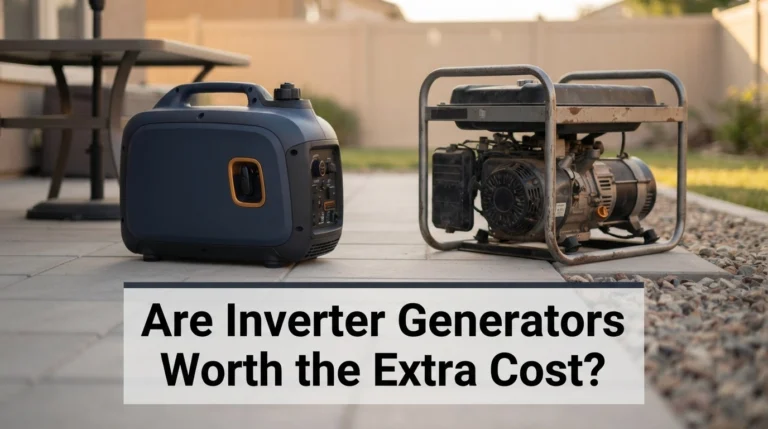
For home backup in 2026, three small inverters almost never beat one 7,000 to 9,500-watt inverter on price. You also get three engines to fuel, maintain, and listen to.
Section Takeaway: Three or four is a specialty, factory-supported exception — not a DIY upgrade. Check the manual for your exact model before assuming it is possible.
How Many Watts Do You Actually Get From Paralleling?
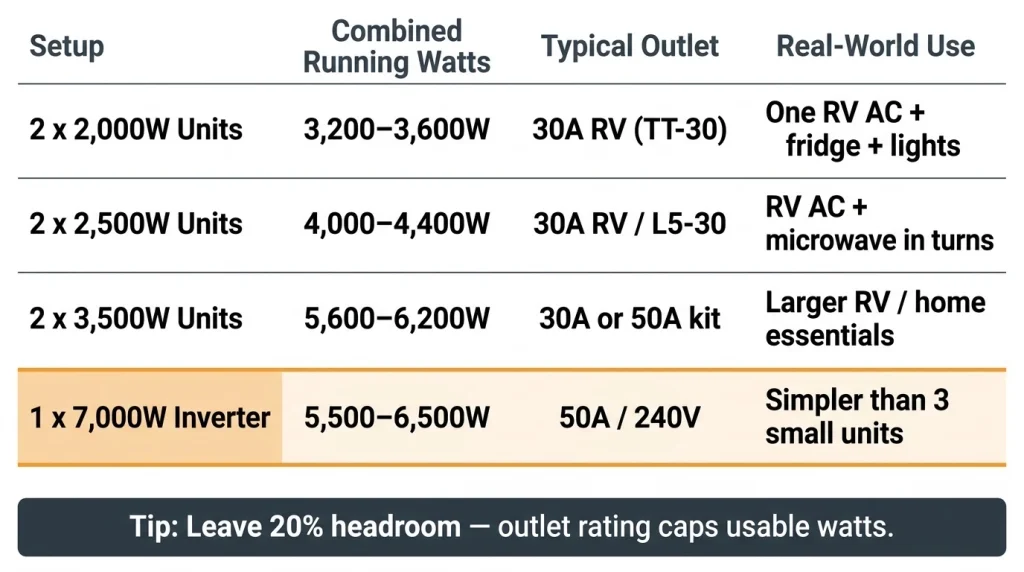
You get close to the combined running watts of both units, minus a small loss, but you are still capped by the kit outlet. Add the running watts, not just the peak watts, for your real budget.
Peak watts help start motors. Running watts keep everything on.
| Setup | Combined Running Watts* | Typical Kit Outlet | Real-World Use |
|---|---|---|---|
| 2 x 2,000W units | ~3,200-3,600W | 30A RV (TT-30) | One RV AC + fridge + lights |
| 2 x 2,500W units | ~4,000-4,400W | 30A RV / L5-30 | RV AC + microwave in turns |
| 2 x 3,500W units | ~5,600-6,200W usable via 50A kit if offered | 30A or 50A depending on kit | Larger RV / home essentials |
| 1 x 7,000W large inverter | ~5,500-6,500W from one unit | 50A / 240V on select models | Simpler, often cheaper than 3 small units |
*Check your spec sheet — running watts vary by model and fuel. Propane usually lowers output versus gasoline.
Notice the outlet cap in the first two rows. Two strong units can make more watts than a 30-amp outlet can deliver, so choosing the right kit matters for the best portable generators for RV camping setups.
Always leave headroom. Running at 100% all day shortens engine life and trips overloads when a fridge or AC cycles on.
Can You Parallel Different Wattages or Different Brands?
Different wattages within the same brand family are sometimes allowed. Different brands are not, even if a seller claims a universal kit works.
When mismatched sizes are allowed, the pair is limited by the smaller unit. A 2,000-watt and a 3,000-watt unit will not share load evenly like two equal units.
What does that mean in practice?
- Same brand, same family: Check the compatibility chart — many pairs work.
- Same brand, different family: Often not approved, even with the same plug shape.
- Different brands: Do not connect them — sync logic and grounding differ.
- Conventional + inverter: Never parallel these together.
Grounding is another hidden issue. Some units are neutral-bonded and some are floating, and mixing them through a kit can create a safety fault.
The NHTSA and manufacturer manuals are not being cautious for fun here. Bad parallel setups are a fire and shock risk, not just a performance problem.
Section Takeaway: Match brand and family first, wattage second. If the compatibility chart does not list your exact pair, treat it as not compatible.
When Is Two Not Enough — And What Should You Do?
Two is not enough when you need 240V, more than about 6,000 running watts, or a 50-amp feed. At that point, a larger single inverter is the cleaner answer.
Paralleling two 120V units does not create split-phase 240V. For well pumps, dryers, or a house panel that needs 240V, read up on whether an inverter generator can provide 240V power before you buy a second unit.
- Need 240V: Buy a 240V-capable inverter, do not parallel for it.
- Need 50 amps: Look for a 50-amp outlet model or approved 50-amp parallel kit.
- Need quiet + power: Two small units at half load can be quieter than one large unit at full load — the one real advantage of paralleling.
- Need redundancy: Two units let you run one for light loads and save fuel.
That last point is why I still like a pair for RV use. At night I run one unit for the fridge and a CPAP, and I fire the second only for the AC in the afternoon.
For a house, the math flips. One larger unit with a proper inlet is simpler and safer than juggling two engines during an outage, especially if you follow guidance on how to safely connect an inverter generator to a house.
Compare total cost honestly. Two units plus a kit, two oil changes, and two fuel tanks often cost more than stepping up to one of the best inverter generators in the next size class.
What Safety Rules Apply No Matter How Many You Connect?

The safety rules do not change with the count. More units mean more exhaust, more fuel, and more cords to manage.
Safety note: Run all generators outdoors, at least 20 feet from doors and windows, with exhaust pointed away. Never run them in a garage, and use working carbon monoxide alarms inside — guidance echoed by the AAA and Consumer Reports generator safety advice.
- Connect the kit first: Join units with engines off, then start them in the order your manual specifies.
- Ground as directed: Follow the kit and manual grounding instructions for your exact models.
- Refuel cold: Shut down and cool before adding fuel to either unit.
- Never backfeed: Use a transfer switch or interlock for a house — never a male-to-male cord.
Keep cords dry and rated for the load. A cheap household extension cord will overheat long before a parallel pair reaches its limit.
Store fuel safely away from the running units. With two or three engines running, heat and spill risk both rise.
Section Takeaway: If you would not do it with one generator, do not do it with two. Parallel power is still generator power, with the same carbon monoxide and electrical risks.
Frequently Asked Questions
How many inverter generators can you connect in parallel with a standard kit?
Two. Every standard consumer parallel kit in 2026 is built for exactly two compatible units and one combined outlet. There is no supported way to add a third unit to that same kit.
Can you connect 3 inverter generators together?
Only with a manufacturer multi-unit system designed for three identical models. Most brands do not offer one for consumer models, so for Honda, Champion, WEN, Predator, and similar RV and home units, the answer is no.
Does paralleling double your watts?
Almost, for running watts, if both units are the same size. You still lose a little to the kit, and a 30-amp outlet caps delivery at 3,600 watts even if the pair can make more on paper.
Can you parallel two generators of different sizes?
Sometimes, within the same brand and family, if the compatibility chart lists that pair. Output and load sharing are limited by the smaller unit, so equal sizes usually run smoother and are easier to manage.
Will paralleling give me 240 volts?
No, not from two standard 120V inverter generators. Their parallel kit combines them into a larger 120V output. For true 240V split-phase power, you need a generator built with a 240V outlet.
Is it cheaper to parallel two or buy one bigger generator?
It depends on what you own already. If you have one unit, adding a second plus a kit is often cheaper. Buying from scratch, one larger inverter is frequently cheaper, quieter to maintain, and simpler to connect.
Can you run just one of a paralleled pair?
Yes, and you should for light loads. Disconnect the kit or use the single unit’s own outlets as the manual directs, run one engine, and save fuel and wear until you need the second unit’s power.
The Bottom Line on Paralleling More Than Two
Plan for two, and you will be right almost every time. That pair will start an RV AC, back up home essentials, and still let you run one quiet unit at night.
If your load list outgrows two, do not chase a third kit. Size up to a larger inverter, check for the outlet and voltage you actually need, and keep the setup simple enough to run safely in bad weather.

Hi, I’m Michael Turner. I own a generator workshop in the United States and founded HomeGeneratorBlog to share practical, hands-on guidance about generator installation, maintenance, troubleshooting, safety, and backup power solutions. My goal is to help homeowners make smarter, more confident decisions through clear and reliable information