How Much Power Does a 9000-Watt Inverter Generator Provide? What It Can Run, What It Cannot, and How to Use It Right
Quick Answer
A 9000-watt inverter generator provides about 9,000 starting watts and 7,000 to 7,500 running watts. That is enough for a fridge, lights, phones, a furnace blower, and a small window AC together, but it is not whole-house power for every home. Check what size inverter generator you need before you buy, because your real load decides the answer.
The short version
- Starting watts: About 9,000 watts for a few seconds when motors start.
- Running watts: About 7,000 to 7,500 watts for steady, continuous use.
- Best fit: Large home backup, a big RV, or a job site with several tools.
- Not a fit: A central AC, an electric water heater, and an electric range at the same time.
- Power quality: Clean sine wave power suits laptops, phones, and sensitive electronics.
Do this first
- Add the running watts of everything you want on at once, then add the largest starting watts on top.
- Keep the total under the running watts on the spec sheet, not the 9,000-watt headline.
I’ve run big inverter generators through long outages, and the 9,000-watt class feels like a real step up. It covers the essentials with room to breathe, yet it still has firm limits.
This guide goes deeper than the box label. You’ll get real wattage math, what it can run, how long it lasts, and how to hook it up safely in 2026.
In This Guide
- What Does 9,000 Watts Actually Mean?
- How Much Power Does a 9000-Watt Inverter Generator Provide in Real Use?
- What Can a 9000-Watt Inverter Generator Run?
- Can a 9000-Watt Inverter Generator Run a Whole House?
- How Long Will a 9000-Watt Inverter Generator Run?
- Is a 9000-Watt Inverter Generator Better Than a 7000-Watt or 5000-Watt Model?
- How Do You Connect a 9000-Watt Inverter Generator Safely?
- What Should You Check Before You Buy a 9000-Watt Inverter Generator?
- Frequently Asked Questions
- The Bottom Line
What Does 9,000 Watts Actually Mean?
An inverter generator is a portable generator that makes clean, stable power for sensitive electronics. It creates raw AC power, turns it into DC, then inverts it back into smooth AC power with low total harmonic distortion, or THD.
That clean sine wave matters for laptops, phones, CPAP machines, and modern fridge controls. A rough, spiky waveform can stress those devices over time.
What is the difference between starting watts and running watts?
Starting watts, also called surge watts, are the short burst a motor needs to start. Running watts are the steady watts it needs to keep going.
A fridge may run on 150 to 200 watts, yet need 1,200 watts for a second to start its compressor. That gap is why the headline number can mislead you.
- 9,000 watts: The starting, or peak, rating on most models in this class.
- 7,000 to 7,500 watts: The running rating you should plan around.
- About 58 to 62 amps at 120 volts: The rough current behind that running power, split across outlets.
- About 29 to 31 amps at 240 volts: The rough current on the 240-volt outlet, when fitted.
Check the spec sheet before you buy. Some brands rate the same class at 7,000 running watts, while others rate it at 7,600.
That small gap can decide whether your window AC and fridge start together. I learned that the hard way during a summer outage, when my AC compressor kicked in just as the fridge cycled on.
Section Takeaway: Plan around 7,000 to 7,500 running watts, not the 9,000-watt headline, and treat the extra surge power as a short safety margin.
How Much Power Does a 9000-Watt Inverter Generator Provide in Real Use?
In real use, a 9000-watt inverter generator provides strong, usable power for a large set of essentials. It does not provide unlimited power, and load, altitude, fuel, and eco mode all change the result.
Eco-throttle, or economy mode, slows the engine at light loads. It saves fuel and cuts noise, yet it can react a fraction slower when a big motor starts.
How do you do the wattage math?
List each load you want on at the same time. Add their running watts, then add the largest single starting watts in the group.
Here is a simple home-backup example that fits this class well.
- Fridge: 200 running watts, plus about 1,200 starting watts.
- Freezer: 150 running watts, plus about 1,000 starting watts.
- Furnace blower: 800 running watts, plus about 1,500 starting watts.
- Lights and phones: 300 running watts, with no big surge.
- Window AC, 10,000 BTU: 1,000 running watts, plus about 2,200 starting watts.
That set totals about 2,450 running watts. Add the largest surge, about 2,200 watts for the AC, and you land near 4,650 watts at the worst moment.
You still have headroom for a microwave or a coffee maker in short bursts. That headroom is the real value of this size.
What reduces the power you actually get?
Altitude cuts engine power, often by a few percent per 1,000 feet above sea level. Heat, old fuel, and a dirty air filter can also pull output down.
Propane gives slightly less power than gasoline on most dual fuel models. Check the propane rating on the spec sheet, because it may sit 500 to 1,000 watts below the gasoline rating.
For a full step-by-step method, use our guide on how to calculate the generator wattage you need. It walks through the same math with more appliance examples.
Section Takeaway: A 9000-watt inverter generator gives you about 7,000 to 7,500 watts to use, so add your running loads first and leave room for the biggest motor surge.
What Can a 9000-Watt Inverter Generator Run?

A 9000-watt inverter generator can run a fridge, a freezer, lights, a furnace blower, a sump pump, a CPAP, laptops, and a small window AC at the same time. It can also run a 13,500 BTU RV air conditioner, a microwave, and a coffee maker with careful timing.
It cannot run everything at once. Stagger big motors, and do not start two compressors in the same second.
| Appliance or load | Running watts (typical) | Starting watts (typical) | Fits with a 9000-watt model? |
|---|---|---|---|
| Fridge | 150-200 | 1,000-1,200 | Yes, easily |
| Chest freezer | 100-150 | 800-1,000 | Yes, easily |
| Furnace blower | 600-900 | 1,200-1,800 | Yes |
| Sump pump, 1/2 HP | 800-1,000 | 1,800-2,200 | Yes |
| Window AC, 10,000 BTU | 900-1,200 | 2,000-2,500 | Yes, with care |
| RV AC, 13,500 BTU | 1,200-1,500 | 2,800-3,500 | Yes, often with a soft start |
| Microwave, 1,000 watts | 1,000-1,200 | 1,000-1,200 | Yes, one at a time |
| Electric water heater | 4,000-4,500 | 4,000-4,500 | No, not with a full house load |
| Central AC, 3-ton | 3,000-3,500 | 6,000-9,000 | Usually no, without a soft start |
These are typical ranges, not spec-sheet promises. Check your own appliance labels, because age and size change the numbers.
For fridge sizing in detail, see our guide to the best portable generator for a refrigerator. It covers the same start-up surge problem from the fridge side.
What can it run in an RV?
In an RV, it can run a 13,500 BTU or 15,000 BTU air conditioner, the converter, lights, and a microwave in turn. It can also run a coffee maker, a TV, and device chargers without strain.
Start the AC first, let it settle, then add the next load. That one habit prevents most overload trips I have seen at campgrounds.
What can it run on a job site?
On a job site, it can run a circular saw, a drill charger, work lights, and a small compressor in rotation. It can also run a miter saw, though a large table saw may push it hard at start-up.
Check each tool’s starting watts before you plug it in. A saw that surges past 3,000 watts will still work, but not while the AC and fridge are also running.
Section Takeaway: This size covers a fridge, freezer, furnace blower, lights, and a small AC together, but stagger big motors and keep heavy heating loads out of the mix.
Can a 9000-Watt Inverter Generator Run a Whole House?
A 9000-watt inverter generator can run a whole house only if that house uses gas heat, gas hot water, and no central AC. It can power the essentials in most homes, yet it cannot power every circuit at full load.
Most homes need 10,000 to 20,000 watts or more to run everything at once. A 9,000-watt portable unit is a strong partial-home solution, not a whole-home standby replacement.
What does it cover well during an outage?
- Food and water: Fridge, freezer, well pump in short runs, and a sump pump.
- Heat and air: Furnace blower, a small window AC, fans, and a gas water heater’s controls.
- Comfort and work: Lights, phones, laptops, a CPAP, and a TV.
- Kitchen in turns: Microwave, coffee maker, or toaster, one at a time.
Pick your must-run circuits first. That list is your real whole-house plan.
For outage sizing by home size, read choosing the right generator size for a power outage. It helps you match circuits to watts before the next storm.
What will overload it fast?
Electric ranges, electric dryers, electric water heaters, and central AC units are the usual overload culprits. Each one can draw 3,000 to 5,500 watts on its own.
Two of those together will trip the overload protection. One alone may work, yet it leaves little room for anything else.
Safety note: Never plug a generator into a wall outlet to backfeed your home. Use a transfer switch, an interlock kit, or a generator inlet installed by a licensed electrician, and follow the guidance from Energy.gov on safe home backup power.
Section Takeaway: A 9000-watt inverter generator can run a well-chosen set of home circuits, but it cannot run a full electric home with central AC and electric heat at the same time.
How Long Will a 9000-Watt Inverter Generator Run?
Most 9000-watt inverter generators run about 12 to 18 hours at 25% load on a full tank. At 50% load, that often drops to about 8 to 12 hours, depending on tank size and engine design.
Tank size matters as much as efficiency. A 5-gallon tank at light load lasts far longer than a 3-gallon tank at the same load.
How does load change runtime?
- 25% load: Longest runtime, quietest sound, and best fuel use per hour.
- 50% load: A good balance for home backup, with steady power and fair fuel use.
- 75% to 100% load: Shortest runtime, loudest sound, and fastest fuel burn.
Eco mode helps at light loads, because the engine slows when demand drops. Turn eco mode off when you start a big motor, then turn it back on once the load settles.
I keep a simple fuel log during outages. It stops the guesswork, and it tells me at a glance when I need to refuel before night.
How much fuel should you store?
Store enough gasoline for at least 24 hours at your expected load, plus a safe margin. Rotate it every few months, because stale fuel clogs carburetors and makes hard starts more likely.
Use fuel stabilizer if you store gas for more than a month. Keep fuel in approved containers, outdoors, away from the generator and any ignition source.
Safety note: Let the generator cool before you refuel, and never refuel indoors or near an open flame. Check your owner’s manual for the exact fuel and oil guidance for your model.
Section Takeaway: Expect roughly 12 to 18 hours at light load and 8 to 12 hours at half load, and store fresh, stabilized fuel for at least a full day of use.
Is a 9000-Watt Inverter Generator Better Than a 7000-Watt or 5000-Watt Model?
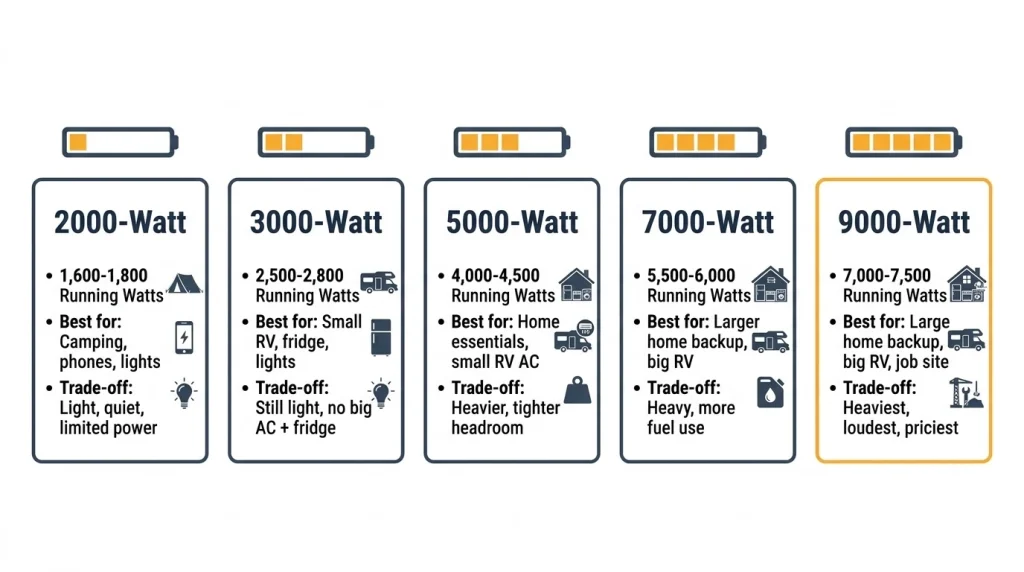
A 9000-watt inverter generator is better than a 7000-watt or 5000-watt model when you need more headroom for motors and heating loads. It is not better when weight, fuel use, noise, and price matter more than that extra power.
The right size is the smallest size that still covers your real load with margin. Bigger is not always smarter.
| Generator size | Running watts (typical) | Best for | Trade-off |
|---|---|---|---|
| 2000-watt | 1,600-1,800 | Camping, phones, lights | Light, quiet, limited power |
| 3000-watt | 2,500-2,800 | Small RV, fridge, lights | Still light, no big AC plus fridge |
| 5000-watt | 4,000-4,500 | Home essentials, small RV AC | Heavier, tighter headroom |
| 7000-watt | 5,500-6,000 | Larger home backup, big RV | Heavy, more fuel use |
| 9000-watt | 7,000-7,500 | Large home backup, big RV, job site | Heaviest, loudest, priciest |
When should you choose 9,000 watts?
Choose 9,000 watts when your load math lands above 5,500 running watts. That often means a fridge, freezer, furnace blower, sump pump, and a window AC together.
Choose it too when you run a large RV AC and want to use a microwave without shutting the AC off. The extra margin keeps the overload light off.
When is a smaller model smarter?
A smaller model is smarter when you camp often, carry the unit alone, or run light loads for days. A 9,000-watt unit can weigh 200 pounds or more, and that weight changes how you move it.
Two smaller parallel-capable units can also beat one big unit for some users. They are easier to carry, and you can run just one when the load is light.
For the inverter versus conventional trade-off, see our comparison of an inverter generator vs a regular generator. It covers noise, fuel use, THD, and power quality in one place.
Section Takeaway: Buy the 9000-watt class when your real load needs the headroom, and buy smaller when weight, fuel, and noise matter more than extra watts.
How Do You Connect a 9000-Watt Inverter Generator Safely?
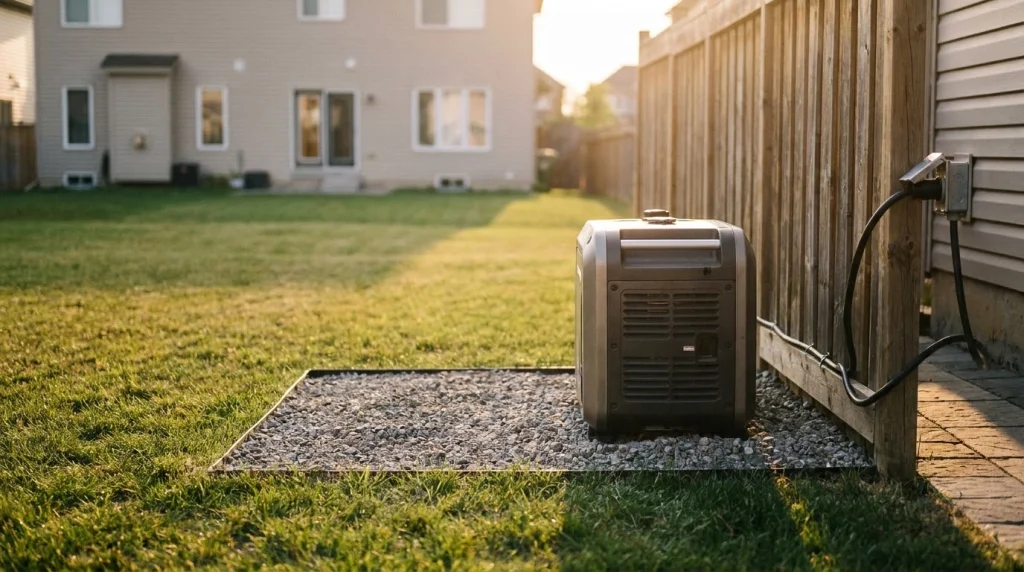
Connect a 9000-watt inverter generator with heavy-duty extension cords for single appliances, or with a transfer switch, interlock kit, or inlet box for home circuits. Never backfeed through a wall outlet.
Backfeeding can energize lines outside your home and put utility workers at risk. It can also damage your generator when power returns.
What outlets will you use most?
- 120-volt duplex outlets: For lights, chargers, fans, and small appliances.
- 30-amp RV outlet: For a large RV or a transfer-switch feed.
- 240-volt twist-lock outlet: For a well pump or a 240-volt home feed, when fitted.
- USB ports: For phones and small devices, when fitted.
Match the cord to the load and the distance. A long, thin cord drops voltage and heats up, so use a short, heavy-gauge cord for high-watt loads.
Keep cords dry, clear of walkways, and away from hot exhaust. I route mine along a fence line, not across the driveway, so no one trips in the dark.
Where should you place the generator?
Place the generator outdoors, at least 20 feet from your home, with the exhaust pointed away from windows, doors, and vents. Carbon monoxide is colorless and odorless, and it can build up fast in a garage or near an open window.
Use battery CO alarms inside your home during an outage. The CDC and the CPSC both stress outdoor placement and working CO alarms as core generator safety steps.
Safety note: Run generators outdoors and well away from windows, doors, and vents. Use a transfer switch or interlock installed by a licensed electrician, and check your owner’s manual before use.
Section Takeaway: Use proper cords or a licensed transfer-switch setup, keep the unit at least 20 feet from the house, and never backfeed through a wall outlet.
What Should You Check Before You Buy a 9000-Watt Inverter Generator?
Check running watts, starting watts, fuel type, tank size, noise, weight, outlets, and warranty before you buy. A good spec sheet tells you more than a big headline number ever will.
Price matters, yet total cost matters more. Fuel, oil, a transfer switch, cords, and a cover add up fast.
Which specs matter most?
- Running and starting watts: Confirm both, on gasoline and on propane if dual fuel.
- THD: Look for under 3% for sensitive electronics.
- Noise: Compare dB ratings at the same load and distance, not across different test setups.
- Runtime: Compare hours at 25% and 50% load, with tank size noted.
- Weight and wheels: Check dry weight, wheel size, and handle design.
- Outlets: Confirm a 30-amp RV outlet and a 240-volt outlet if you need them.
For price ranges by size and brand, read our guide on how much an inverter generator costs. It sets a fair budget before you shop.
What about fuel type, noise, and maintenance?
Gasoline is easy to find, yet it goes stale fast. Propane stores longer and burns cleaner, yet it gives slightly less power on most dual fuel models.
Noise rises with load, so a quiet rating at 25% load will not match the sound at full load. Place the unit farther away, point the exhaust away, and respect quiet hours at campgrounds.
Follow the break-in steps in your manual, change oil on schedule, and run the unit every month or two. The EPA notes that proper maintenance also helps control emissions and keeps small engines running well.
Popular brands in this class include Honda, Yamaha, Champion, Westinghouse, DuroMax, Generac, and Predator. Compare warranty length, parts support, and local service before you pick a brand.
Section Takeaway: Compare running watts, THD, runtime, noise, weight, and warranty on the spec sheet, and budget for fuel, cords, and a safe home hookup too.
Frequently Asked Questions
How much power does a 9000-watt inverter generator provide?
It provides about 9,000 starting watts and 7,000 to 7,500 running watts. Plan your loads around the running watts, and use the surge rating only for short motor starts.
Can a 9000-watt inverter generator run a refrigerator and freezer?
Yes, it can run both at once with room to spare. A fridge and freezer together use about 250 to 350 running watts, though their starting surges can reach 2,000 watts combined.
Can a 9000-watt inverter generator run an air conditioner?
Yes, it can run a window AC or a 13,500 BTU RV AC in most cases. A 3-ton central AC is harder, and it may need a soft start kit and a very light house load.
How long will a 9000-watt inverter generator run on a full tank?
Expect about 12 to 18 hours at 25% load and about 8 to 12 hours at 50% load. Tank size, fuel type, eco mode, and load all change the result, so check the spec sheet.
Is a 9000-watt inverter generator quiet?
It is quieter than a conventional open-frame generator, yet it is louder than a small 2,000-watt inverter at full load. Noise rises with load, so place it far from living and sleeping areas.
Can you parallel two 9000-watt inverter generators?
Some models support parallel operation, but many large units do not. Check the manual for a parallel kit and matching outlets before you buy a second unit.
What should you not plug into a 9000-watt inverter generator?
Do not plug in loads that exceed its running watts, or several large heating loads at once. Avoid backfeeding your home, and avoid running it indoors, in a garage, or near open windows.
The Bottom Line
A 9000-watt inverter generator gives you about 7,000 to 7,500 watts of steady power, with a 9,000-watt surge for motor starts. That is a strong fit for large home backup, a big RV, and a busy job site.
Do your wattage math first, stagger big motors, and hook it up safely outdoors. That simple plan turns a big headline number into power you can trust in 2026.

Hi, I’m Michael Turner. I own a generator workshop in the United States and founded HomeGeneratorBlog to share practical, hands-on guidance about generator installation, maintenance, troubleshooting, safety, and backup power solutions. My goal is to help homeowners make smarter, more confident decisions through clear and reliable information