What Size Inverter Generator Do You Need for a 30-Amp RV? 3,000–4,000 Watts for Most Campers
Quick Answer
For most 30-amp RVs, a 3,000 to 4,000-watt inverter generator is the sweet spot. It can start a 13,500 BTU air conditioner and still run lights, the fridge, and chargers. Check the best portable generators for RV camping before you buy, then match the running watts to your real load.
The short sizing rule
- 3,000 watts: Works for a 13,500 BTU AC plus light loads if you manage the microwave.
- 3,500 watts: Gives you more headroom for a 15,000 BTU AC on a hot day.
- 4,000 watts: Best for families who run the AC, fridge, and TV together.
- 2,000 watts: Too small for most rooftop ACs, but fine for charging and lights.
- 30 amps x 120 volts: Equals 3,600 watts, which is your RV’s hard ceiling.
Start here
- Find your AC size first, then add 500 to 1,000 watts for the rest of your RV.
- Buy for running watts, not the bigger starting-watts number on the box.
I’ve sized generators for friends at campgrounds, in driveways, and on hot afternoons when the AC kept tripping.
The mistake is almost always the same. People buy the smallest quiet unit, then wonder why the air conditioner stalls on startup.
This guide fixes that. You’ll learn what 30-amp really means, how much power your AC and other gear draw, and how to pick a size you won’t outgrow next summer.
In This Guide
- What Does 30-Amp Actually Mean for Your RV?
- What Size Inverter Generator Do You Need for a 30-Amp RV?
- How Many Watts Does a 30-Amp RV Air Conditioner Really Need?
- Can a 2,000-Watt Inverter Generator Run a 30-Amp RV?
- 3,000 vs 3,500 vs 4,000 Watts: Which Size Fits Your Camping Style?
- How to Calculate Your RV Load in 5 Minutes
- Do You Need a 30-Amp Outlet, Adapter, or Parallel Kit?
- What to Look for When You Buy: Noise, Runtime, Weight, and Fuel
- Common Sizing Mistakes That Trip Breakers and Stall ACs
- Frequently Asked Questions
What Does 30-Amp Actually Mean for Your RV?
A 30-amp RV service is a 120-volt, single-phase hookup with one hot wire. It gives you 30 amps at 120 volts, which works out to 3,600 watts at most.
That number is a ceiling, not a target. Your RV breaker will trip if you try to pull more than 30 amps for long.
Think of it like a garden hose. The plug size sets the widest flow you can get, but your generator sets how much water is actually in the tank.
How is 30-amp different from 50-amp?
A 50-amp RV service is 240 volts split into two 120-volt legs. It can deliver up to 12,000 watts, which is why large fifth wheels and Class A coaches use it.
A 30-amp RV is simpler and lighter. Most travel trailers, smaller fifth wheels, and Class C motorhomes use it.
You don’t need a 50-amp generator for a 30-amp RV. You need a generator that can feed that 30-amp plug without running flat out all day.
What is an inverter generator?
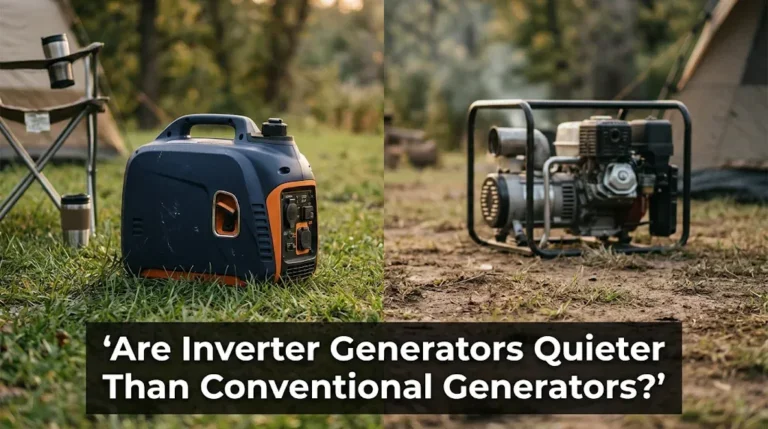
An inverter generator makes clean, stable power that is safe for phones, laptops, TVs, and RV control boards. It changes engine speed to match the load, so it runs quieter and uses less fuel than a conventional open-frame unit.
That clean power matters in an RV. Your converter, fridge board, and AC thermostat all prefer steady voltage and frequency.
Section Takeaway: A 30-amp RV can use at most 3,600 watts, so a generator in the 3,000 to 4,000-watt range matches the plug without wasting fuel or weight.
What Size Inverter Generator Do You Need for a 30-Amp RV?
For most 30-amp RVs, you need a 3,000 to 4,000-watt inverter generator. That range covers a rooftop AC plus the normal background loads in a camper.
Your exact size depends on your AC. A 13,500 BTU unit is the common case, while a 15,000 BTU unit pushes you toward the top of the range.
I learned this on a 98-degree trip in Texas. My 2,200-watt unit ran the lights and fan fine, but the AC compressor would grunt, dim the lights, and shut down.
A 3,500-watt inverter solved it the next trip. The AC started clean, the fridge stayed cold, and the generator wasn’t screaming at full throttle.
The quick pick by AC size
- No AC, or fan only: 2,000 to 2,200 watts is enough for lights, charging, and a small fridge.
- 13,500 BTU AC: 3,000 to 3,500 watts is the safe pick for most campers.
- 15,000 BTU AC: 3,500 to 4,000 watts gives you startup headroom on hot days.
- AC plus microwave or coffee maker: 4,000 watts, or learn to stagger those big loads.
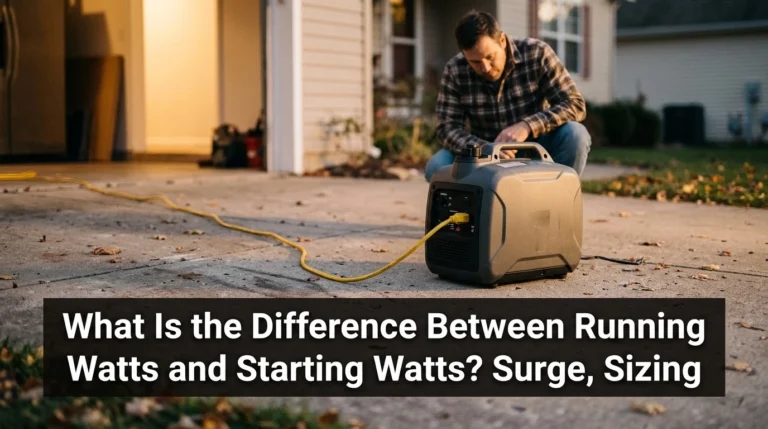
Running watts matter more than starting watts. A box may shout 4,000 starting watts, but only deliver 3,200 watts for continuous use.
Check the spec sheet for both numbers. Size your RV on the running-watts figure, then confirm the starting watts can handle the AC surge.
Section Takeaway: Pick 3,000 watts for a 13,500 BTU AC and light use, 3,500 watts for mixed use, and 4,000 watts if you want the AC plus another big appliance at the same time.
How Many Watts Does a 30-Amp RV Air Conditioner Really Need?
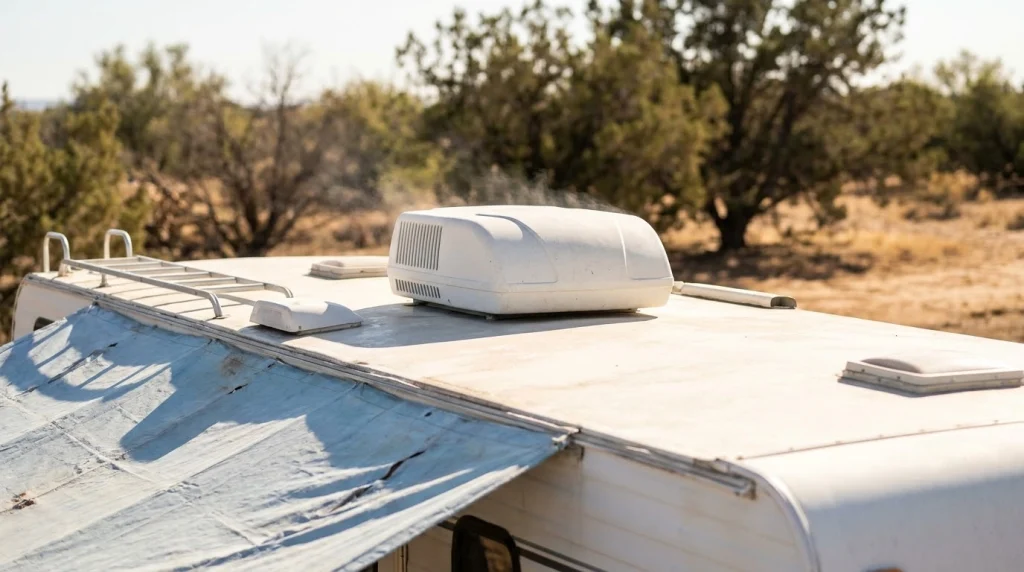
A 13,500 BTU RV air conditioner typically draws 1,200 to 1,500 running watts. It can need 2,800 to 3,000 starting watts for a brief second when the compressor kicks on.
A 15,000 BTU unit is heavier. It often draws 1,500 to 1,800 running watts and can need 3,000 to 3,500 starting watts.
Heat, altitude, and a dirty filter all raise that draw. A hot rooftop unit in direct sun works harder than the same unit on a mild morning.
Why does startup wattage trip small generators?
Motors need a surge to start. The compressor, the fan motor, and the converter can all pull at once when the thermostat calls for cool air.
A small generator sees that surge as an overload. It may drop voltage, trip its breaker, or stall the AC before it gets going.
That is why a 2,000-watt unit can run the AC fan but not the compressor. The fan is easy, the compressor start is not.
Can a soft start kit help?
A soft start kit lowers the AC startup surge. It can cut that spike by half or more on many rooftop units, according to RV owners and installers I talk to.
It does not change running watts. It just makes the start gentler, so a 3,000-watt generator has a better chance.
Check your AC manual and have a qualified tech fit the kit if you’re unsure. It is a useful upgrade, but it is not a fix for a generator that is far too small.
Safety note: Turn the generator off and let it cool before you touch AC wiring or install accessories. Follow your RV and AC manuals, and get a qualified tech if the wiring is unfamiliar.
Section Takeaway: Budget 1,500 running watts and 3,000 starting watts for a 13,500 BTU AC, and more for a 15,000 BTU unit, before you add anything else.
Can a 2,000-Watt Inverter Generator Run a 30-Amp RV?
A 2,000-watt inverter generator can run a 30-amp RV, but only without the air conditioner. It will handle lights, phone charging, the TV, and a 12-volt converter with ease.
It will not reliably start a rooftop AC. Most 13,500 BTU units need more starting watts than a 2,000-watt unit can give.
That limit surprises a lot of new owners. The plug fits, the lights come on, and everything feels fine until the thermostat clicks.
What can a 2,000-watt unit actually run?
It can run the items below at the same time in most cases. Check your own labels, because brands vary.
- LED lights and chargers: 100 to 300 watts combined.
- RV fridge on propane: 300 to 600 watts for the control board and fan.
- TV and laptop: 150 to 300 watts combined.
- Small fan: 50 to 100 watts.
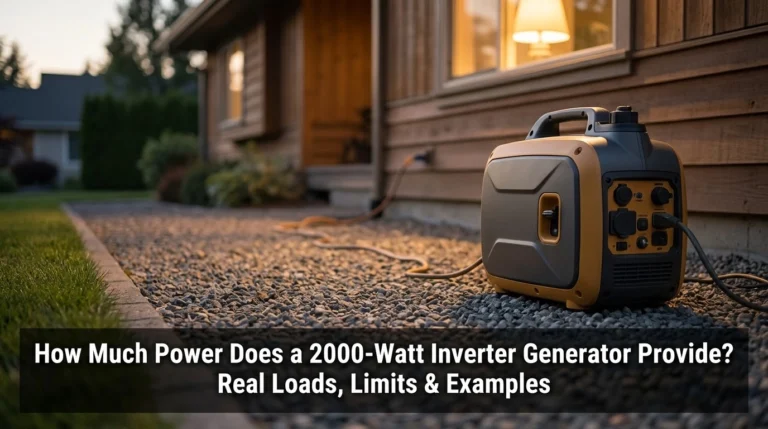
Learn more about what a 2,000-watt inverter generator can run if you camp mostly in mild weather. It is a good fit for shoulder-season trips and overnight stops.
A microwave will push it over the edge. A 1,000-watt microwave can draw 1,500 watts or more from the wall, so it needs to run alone.
When does 2,000 watts make sense?
It makes sense if you camp without AC, travel light, and value quiet and low weight. A 2,000-watt inverter is easy to lift, easy to store, and sips fuel.
It also makes sense as a second unit. Two 2,000-watt inverters in parallel can give you 4,000 watts when you need AC, and one unit alone when you don’t.
That flexibility is why many RVers start small and add a parallel kit later. It costs more than one bigger unit, but it gives you two ways to camp.
Section Takeaway: A 2,000-watt inverter is fine for a 30-amp RV without AC, but it is not a reliable AC solution on its own.
3,000 vs 3,500 vs 4,000 Watts: Which Size Fits Your Camping Style?
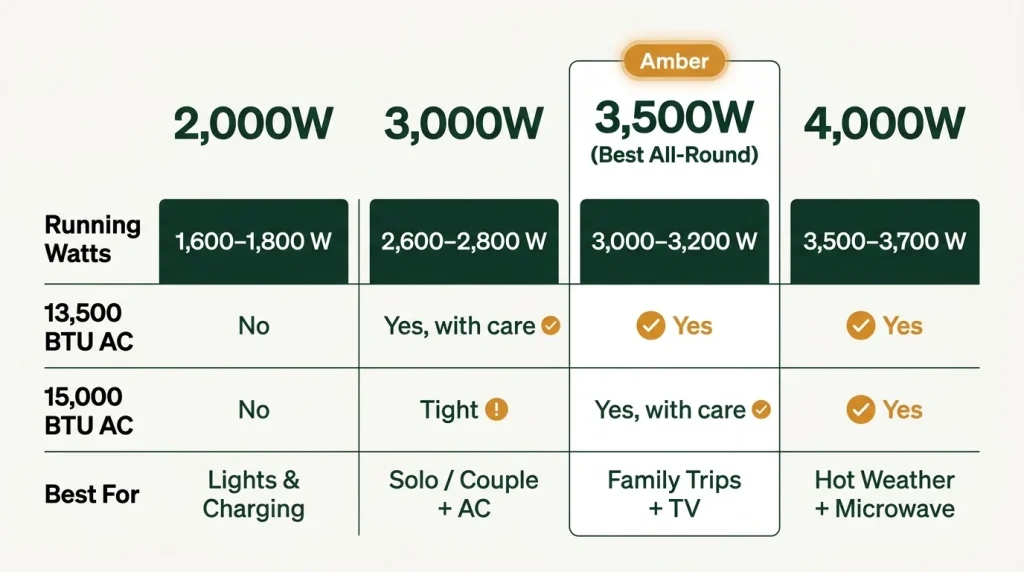
These three sizes look close on paper, but they feel different at a campsite. The gap is headroom, noise, weight, and how much you can run at once.
A 3,000-watt unit is the lightest AC-capable choice. A 4,000-watt unit is the most relaxed, but it is heavier and thirstier.
Use the table below to match your camping style to the size, then check the real running watts on the model you like.
| Generator size | Typical running watts | 13,500 BTU AC | 15,000 BTU AC | Best for |
|---|---|---|---|---|
| 2,000 watts | 1,600–1,800 | No | No | Lights, charging, no AC |
| 3,000 watts | 2,600–2,800 | Yes, with care | Tight | Solo or couple, AC + lights |
| 3,500 watts | 3,000–3,200 | Yes | Yes, with care | Family trips, AC + fridge + TV |
| 4,000 watts | 3,500–3,700 | Yes | Yes | Hot weather, AC + microwave in turns |
| 4,500 watts | 3,700–4,000 | Yes | Yes | Full 30-amp use, more weight |
See what a 3,000-watt inverter generator can run to compare real load lists. The difference between 3,000 and 3,500 watts is often one extra appliance at a time.
If you want more room for a bigger AC and a coffee maker, see what a 5,000-watt inverter generator can run. It is more than a 30-amp RV needs, but it shows how load stacking works.
Which size would I buy first?
If I camped mostly in summer with a 13,500 BTU AC, I would buy 3,500 watts. It is the best balance of weight, noise, and headroom for most 30-amp rigs.
If I had a 15,000 BTU AC and two kids who want the TV on, I would go 4,000 watts. The extra weight is worth it on a 95-degree afternoon.
If I boondocked in spring and fall without AC, I would stay at 2,200 watts and save the weight. You can always parallel later.
Section Takeaway: 3,500 watts is the best all-round pick for a 30-amp RV, with 3,000 watts for light use and 4,000 watts for hot-weather comfort.
How to Calculate Your RV Load in 5 Minutes
You don’t need a spreadsheet to size an RV generator. You need your AC size and a short list of the other things you run at the same time.
Start with running watts, then add the biggest starting watts on top. That total is your real need.
Use the formula watts = volts x amps when a label only lists amps. A 10-amp device at 120 volts draws about 1,200 watts.
Step-by-step load check
- List the must-runs: Write down AC, fridge, lights, converter, and chargers.
- Add running watts: Use the labels on each device or your RV manual.
- Add the AC start surge: Add 1,200 to 1,500 watts above running watts for startup.
- Add a 20% buffer: Multiply your running total by 1.2 for heat, altitude, and age.
- Compare to running watts: Pick a generator whose running watts cover that buffered total.
A worked example for a typical 30-amp trailer
- 13,500 BTU AC: 1,400 running watts.
- Fridge on electric: 400 watts.
- Converter and lights: 300 watts.
- TV and chargers: 200 watts.
- Total running load: 2,300 watts, plus AC startup.
That example needs about 3,000 running watts with buffer. A 3,500-watt inverter fits it well.
Learn how to run multiple appliances at once without tripping the breaker. Stagger the microwave and coffee maker, and let the AC settle first.
Section Takeaway: Add your running watts, add the AC startup surge, add 20% buffer, and buy on running watts — not the headline starting watts.
Do You Need a 30-Amp Outlet, Adapter, or Parallel Kit?
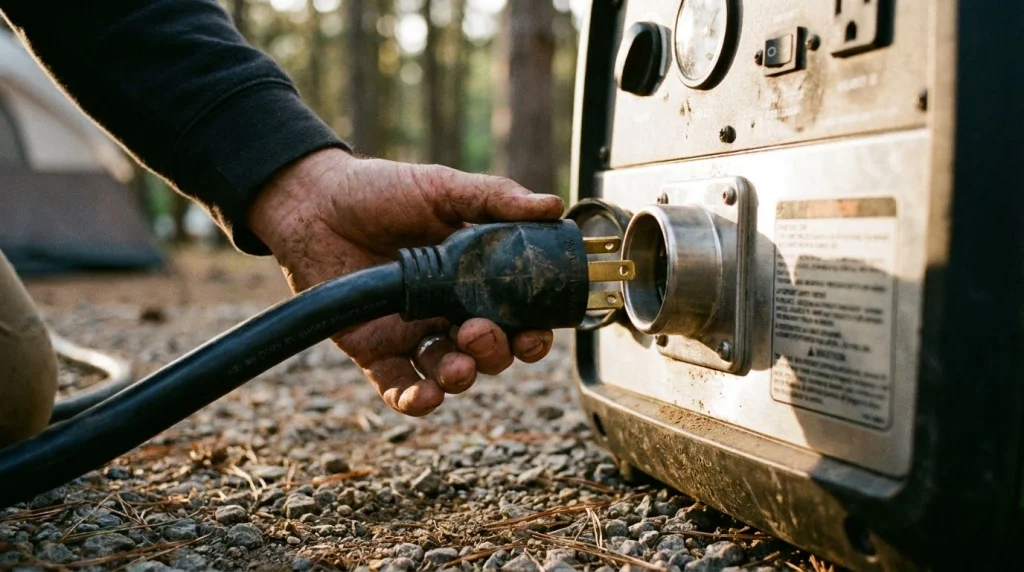
A 30-amp outlet makes hookup simple. You plug your RV shore cord straight in, with no dogbone adapter in the middle.
Many 3,000 to 4,000-watt inverters now include a TT-30R outlet. That is the 30-amp, 120-volt RV outlet you want.
If your generator only has 20-amp household outlets, you can still use an adapter. You just need to respect the lower limit of that outlet.
When is an adapter safe?
An adapter is safe when it is rated for the load and the cord is in good shape. A 15-amp to 30-amp dogbone will work, but it caps you near 1,800 watts.
That cap is fine for charging and lights. It is not fine for an AC start, so don’t expect full RV power through a small adapter.
Use a short, heavy-gauge RV cord. Long, thin extension cords drop voltage and make motors work harder.
Should you parallel two smaller inverters?
Paralleling lets two inverter generators share the load. Two 2,000-watt units can give you about 3,600 to 4,000 watts combined, depending on the kit.
It is a good option if you already own one small unit. It also gives you a light single unit for quiet nights.
Check that both units are parallel-ready and use the maker’s kit. Mixed brands and DIY cables are a bad idea for RV power.
If you ever move to a larger rig, compare a portable generator with a 50-amp outlet. A 30-amp RV does not need it, but it shows the step up in size and weight.
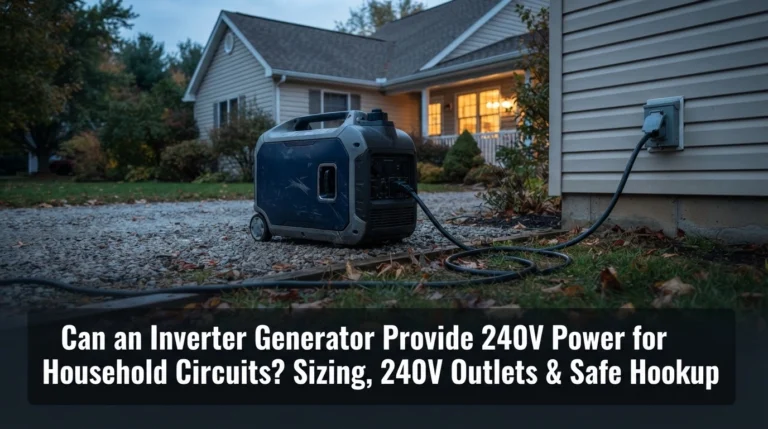
Safety note: Never backfeed your RV or house through a household outlet, and never run a generator inside or near an open window. Place it outdoors, downwind, and at least 20 feet from your RV when you can.
Section Takeaway: A built-in TT-30R outlet is the cleanest hookup for a 30-amp RV, and a parallel kit is the best way to grow from a small inverter you already own.
What to Look for When You Buy: Noise, Runtime, Weight, and Fuel
Watts get you started, but noise and weight decide whether you enjoy the generator. A loud unit will annoy you and your neighbors, even if it powers the AC.
Look for a noise rating at 25% load. Most good RV inverters sit near 52 to 60 decibels at that load, which is about normal conversation level.
Runtime matters on long nights. A larger fuel tank and eco mode can stretch a tank to 8 to 12 hours at light load, so check the runtime at 25% load.
Weight and portability
A 3,000-watt inverter often weighs 50 to 70 pounds. A 4,000-watt unit can weigh 90 to 110 pounds, which is a two-person lift for many campers.
Check the handles, wheels, and storage spot in your RV. A generator that lives in the truck bed is easier than one you must lift into a bay every time.
I keep a small ramp and a strap in my truck for the bigger unit. It saves my back and keeps the generator from sliding.
Fuel type and clean power
Gasoline is the most common RV fuel. Dual-fuel models add propane, which stores longer and burns cleaner, but gives you slightly less power on propane.
Check the total harmonic distortion, or THD. Look for under 3% THD for sensitive electronics, and check the maker’s spec sheet for the exact figure.
Compare models in our guide to the best inverter generators before you choose. Noise, runtime, and outlet layout vary more than watts do.
For independent safety and consumer context, see Consumer Reports and EPA guidance on generator use. Both are useful checks before a big purchase.
Section Takeaway: Buy the quietest, lightest unit in your watt range with a TT-30R outlet, good runtime, and clean power under 3% THD.
Common Sizing Mistakes That Trip Breakers and Stall ACs
Most sizing failures are not about bad generators. They are about small math errors and habits that stack loads at the worst moment.
I have made most of them. The fix is simple once you see the pattern.
- Buying on starting watts: A 4,000 starting-watt unit may only run 3,200 watts all day.
- Running everything at once: AC plus microwave plus water heater on electric will trip a 30-amp breaker.
- Forgetting altitude: Generators lose power at altitude, so add headroom for mountain trips.
- Ignoring the water heater: An electric water heater can draw 1,400 watts on its own.
- Using a long thin cord: Voltage drop makes the AC work harder and start worse.
- Skipping the break-in: A new generator needs its first oil change early, per the manual.
Switch the water heater and fridge to propane when you run the AC on generator power. That one change frees up 1,000 watts or more.
Let the AC run for a few minutes before you start the microwave. Staggering big loads is the cheapest upgrade you can make.
Check AAA car care and travel guidance for road-trip prep, and keep your RV manual close. Your manual lists the exact AC size and breaker layout for your rig.
Section Takeaway: Size on running watts, run the water heater on propane, stagger big loads, and add headroom for altitude and heat.
Frequently Asked Questions
What size inverter generator do you need for a 30-amp RV with a 13,500 BTU AC?
A 3,000 to 3,500-watt inverter generator is the best fit for a 13,500 BTU AC in a 30-amp RV. It covers the AC startup surge and leaves room for lights, fridge, and chargers.
Will a 3,500-watt generator run a 15,000 BTU AC?
Yes, in most cases, a 3,500-watt inverter can run a 15,000 BTU AC if you manage other loads. It is tight on very hot days, so a soft start kit or a 4,000-watt unit gives more margin.
Can I run my 30-amp RV on a 2,000-watt generator?
You can run lights, charging, TV, and a propane fridge on a 2,000-watt generator. You cannot reliably run a rooftop AC, microwave, or electric water heater on it.
Is a 4,000-watt generator too big for a 30-amp RV?
No, a 4,000-watt generator is not too big for a 30-amp RV. Your RV breaker still caps use at 3,600 watts, and the extra headroom means quieter, less strained running.
Do I need a 30-amp outlet on my generator?
A built-in TT-30R outlet is the cleanest option, but it is not required. You can use a rated adapter, but a 15-amp adapter will limit you to about 1,800 watts.
How long will a 3,500-watt inverter run my RV AC?
Runtime depends on tank size, load, and eco mode. Many 3,500-watt inverters run 7 to 11 hours at 25% load, and less at full AC load, so check the maker’s runtime chart.
For most 30-amp RVs in 2026, start with 3,500 watts, confirm your AC size, and pick a quiet inverter with a TT-30R outlet. Size it once, test it at home before your first hot trip, and you’ll spend your weekends camping, not troubleshooting breakers.

Hi, I’m Michael Turner. I own a generator workshop in the United States and founded HomeGeneratorBlog to share practical, hands-on guidance about generator installation, maintenance, troubleshooting, safety, and backup power solutions. My goal is to help homeowners make smarter, more confident decisions through clear and reliable information