What Size Inverter Generator Do You Need for a 50-Amp RV: Full Power, Two ACs & Easy Sizing
Quick Answer
Most 50-amp RV owners need a 5,500 to 7,500 running-watt inverter generator for comfortable use with two air conditioners. A 3,500 to 4,500 running-watt unit can work for one air conditioner plus lights, fridge, and charging, but it leaves little headroom. Always size by running watts, not starting watts, and check your air conditioner labels before you buy a generator with a 50-amp outlet.
Pick your size in seconds
- Two ACs, full comfort: Choose 5,500 to 7,500 running watts with a 240-volt, 50-amp outlet.
- One AC, light loads: Choose 3,500 to 4,500 running watts and manage the microwave and water heater.
- One AC, plus extras: Choose 4,500 to 5,500 running watts if you run a microwave, coffee maker, or hair dryer often.
- Soft starts help: A soft-start kit can cut air conditioner starting watts by a large amount, so check your owner’s manual first.
- Parallel option: Two 3,000 to 3,500 running-watt inverter generators in parallel can match one large unit.
Before you plug in
- Add up running watts for everything you want on at the same time, then add the largest starting load once.
- Use the correct 50-amp RV cord and adapter, and keep the generator outside, away from windows and doors.
I’ve sized generators for big fifth wheels on hot July afternoons, and I’ve watched a too-small unit trip the second the second air conditioner kicked in.
That moment is frustrating, loud, and easy to avoid. This guide walks you through the real math, the 50-amp plug, 240-volt power, and the choices that actually work in 2026.
You’ll learn what size inverter generator do you need for a 50-amp RV, how to add up your loads, and when a parallel pair beats one heavy generator.
In This Guide
- What Does 50-Amp Actually Mean for an RV?
- How Many Watts Does a 50-Amp RV Need?
- What Size Inverter Generator for One AC vs. Two ACs?
- How Do You Calculate Your RV Load Step by Step?
- Do You Need 240V, or Will 120V Work?
- Parallel Generators vs. One Large Generator: Which Is Better?
- How Do You Connect a Generator to a 50-Amp RV Safely?
- What Mistakes Trip Breakers and Damage Air Conditioners?
- How Do You Choose the Right Inverter Generator for a 50-Amp RV?
- Frequently Asked Questions
- Final Takeaway: Size for Your Hottest Day, Not Your Easiest One
What Does 50-Amp Actually Mean for an RV?
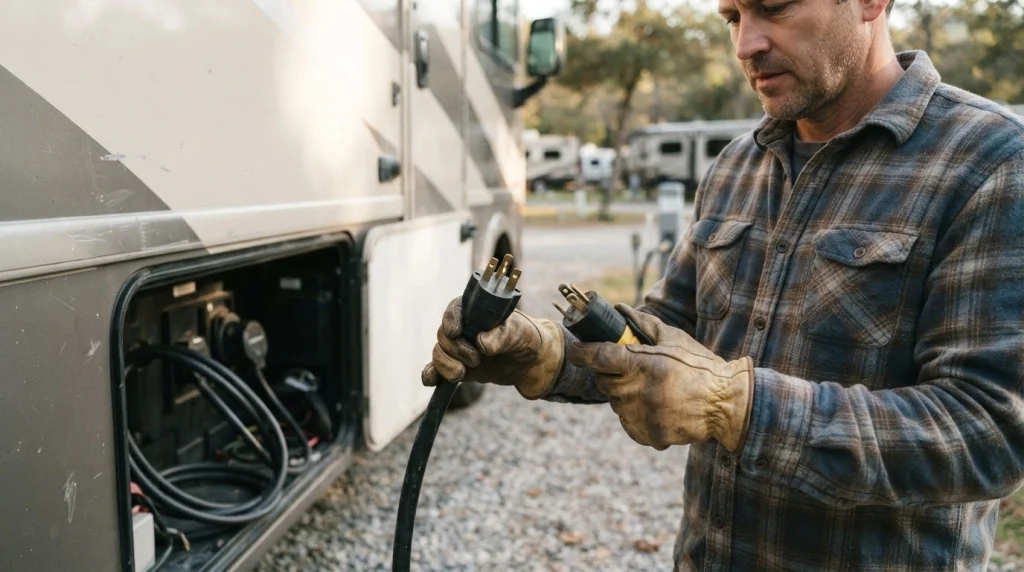
A 50-amp RV service is a 120/240-volt service with two separate 120-volt legs. Each leg can supply 50 amps, so the full service can supply up to 12,000 watts in theory.
That number surprises a lot of owners. It does not mean your RV uses 12,000 watts all the time.
Most RVs use far less power in normal use. The 50-amp plug simply gives you more headroom for two air conditioners, a microwave, a water heater, and other loads at once.
How is 50-amp different from 30-amp?
A 30-amp RV service is 120 volts only, with one 30-amp leg. That gives you about 3,600 watts of total power.
A 50-amp service gives you two legs, so it can feed more circuits at once. That is why large fifth wheels and Class A motorhomes use it.
- 30-amp RV: One 120-volt leg, about 3,600 watts, usually one main air conditioner.
- 50-amp RV: Two 120-volt legs, up to 12,000 watts, often two air conditioners.
- Plug shape: A 50-amp RV plug has four prongs, while a 30-amp plug has three.
I once helped a neighbor who kept tripping a 30-amp adapter on a 50-amp coach. The RV was fine, but the adapter limited the whole rig to one leg.
He thought the generator was weak, but the cord was the bottleneck. Always match the plug, adapter, and generator outlet to the service you want to use.
What is a 50-amp RV service, in plain terms?
An RV 50-amp service is a four-wire shore-power connection that splits power across two 120-volt circuits. It lets a large RV run two air conditioners and several other appliances at the same time.
Think of it as two power lanes instead of one. Each lane feeds part of your breaker panel, and together they give you much more usable power.
Section Takeaway: A 50-amp RV can use up to 12,000 watts in theory, but most owners need 5,500 to 7,500 running watts for real-world comfort.
How Many Watts Does a 50-Amp RV Need?
A 50-amp RV needs about 3,500 to 7,500 running watts from a generator, depending on how many air conditioners you run. Light use with one air conditioner sits near the low end, while two air conditioners plus cooking loads sit near the high end.
Your exact number depends on your air conditioner size, your fridge type, and your habits. A 13,500 BTU air conditioner uses less power than a 15,000 BTU unit.
Start with running watts, then add starting watts for the biggest motor. Running watts are what a device uses while it runs, and starting watts are the short surge it needs to start.
What are typical RV running watts?
Use the table below as a starting point, then check the labels on your own appliances. Labels beat guesses every time.
- 13,500 BTU AC: About 1,200 to 1,500 running watts, with a much higher starting surge.
- 15,000 BTU AC: About 1,500 to 2,000 running watts, with a higher starting surge.
- Microwave: About 1,000 to 1,500 running watts.
- Electric water heater: About 1,200 to 1,500 running watts.
- Residential fridge: About 150 to 300 running watts, with a short starting surge.
- Converter and charger: About 300 to 800 running watts, depending on battery state.
- TV, lights, and charging: About 200 to 500 running watts combined.
Those numbers add up fast. Two air conditioners alone can use 3,000 to 4,000 running watts.
Add a microwave and a water heater, and you can pass 6,000 running watts in seconds. That is why load management matters more than the plug size.
Why do starting watts matter so much?
Air conditioner compressors need a short surge to start, often two to three times their running watts. A 15,000 BTU unit may need 3,000 to 3,500 starting watts for a second or two.
If your generator cannot supply that surge, the compressor may stall, hum, or trip the overload. That is the most common sizing mistake I see at campgrounds.
A soft-start kit can reduce that surge a lot, but it does not remove the need for enough running watts. Check your air conditioner manual and the soft-start instructions before you rely on one.
Section Takeaway: Add running watts first, then add the largest starting surge once — that total is your true generator size.
What Size Inverter Generator for One AC vs. Two ACs?
For one 13,500 or 15,000 BTU air conditioner, choose 3,500 to 4,500 running watts. For two air conditioners, choose 5,500 to 7,500 running watts.
That range covers most 50-amp RVs in 2026, but your fridge, water heater, and cooking habits can push you up a size. If you want to run both ACs and a microwave at once, aim for the top of the range.
| Generator size (running watts) | What it can run | Best for |
|---|---|---|
| 3,500 to 4,000 | One AC, fridge, lights, charging, TV | Solo travelers, mild weather, careful load use |
| 4,500 to 5,000 | One AC plus microwave or water heater, with care | Couples, one AC, occasional cooking loads |
| 5,500 to 6,500 | Two ACs, fridge, lights, charging, light cooking | Families, hot climates, two-AC rigs |
| 7,000 to 7,500 | Two ACs plus microwave, water heater, or coffee maker | Large fifth wheels, full comfort, less load juggling |
The table is a guide, not a promise. Your air conditioner size and your other loads decide the final number.
If you have two 15,000 BTU units, do not buy a 4,500-watt generator and hope for the best. You will spend the trip turning things off.
Can a 3,500-watt generator run a 50-amp RV?
Yes, a 3,500 running-watt generator can run a 50-amp RV with one air conditioner and light loads. It cannot run two air conditioners, a microwave, and a water heater at the same time.
It can work well if you manage loads and use propane for heat and hot water. It will feel tight on a hot afternoon with guests inside.
Learn what a mid-size unit can handle in our guide to what a 5000-watt inverter generator can run. It shows how fast common loads add up.
Can a 5,000-watt generator run two ACs?
Sometimes, but only with soft starts, careful timing, and smaller air conditioners. Two 13,500 BTU units may start and run on a 5,000 running-watt generator if you stagger them.
Two 15,000 BTU units are a harder test, especially at high altitude or in extreme heat. I would not count on it for all-day comfort.
Section Takeaway: One AC needs 3,500 to 4,500 running watts, while two ACs need 5,500 to 7,500 running watts for comfortable use.
How Do You Calculate Your RV Load Step by Step?
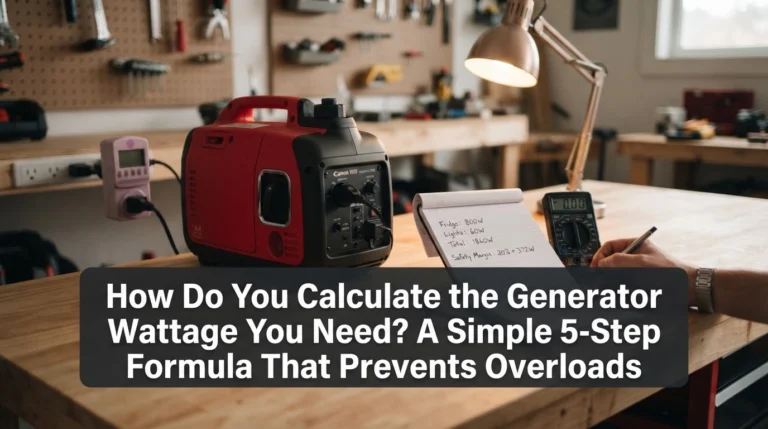
Write down every load you want on at the same time, add the running watts, then add the largest starting watts once. That total is the minimum running watts your generator should supply, with some headroom.
Use labels, not memory, for the big loads. The label on your air conditioner, microwave, and water heater will give you the most useful numbers.
- List your must-run loads: Include each air conditioner, fridge, converter, lights, and charging.
- Add running watts: Add the running watts for everything on that list.
- Add one starting surge: Add the starting watts for the largest motor, usually an air conditioner.
- Add occasional loads: Add the microwave or water heater only if you want to run it with the ACs.
- Add 10 to 20% headroom: This covers heat, altitude, and fuel type, so the generator does not run flat out.
What does a two-AC example look like?
Two 15,000 BTU air conditioners may use about 3,600 running watts together. Add a fridge, converter, lights, and charging, and you may reach about 4,400 running watts.
Add one starting surge of about 3,000 watts, and your short-term need may reach about 7,400 watts. That is why a 7,500 running-watt generator, or a parallel pair, makes sense for two large ACs.
With soft starts, that surge can fall a lot, but the running watts stay the same. Size for running watts first, then check starting watts.
How do altitude and propane change the math?
Generators lose power at high altitude, and many lose power on propane compared with gasoline. Check the generator manual for the exact derating, because it varies by model.
As a rule, plan for less power in the mountains and on propane. If you camp at 5,000 feet often, buy a size up.
See how loads stack when you run multiple appliances at once on an inverter generator. It helps you spot the combos that trip an overload.
Section Takeaway: List real loads, add running watts, add one starting surge, then add headroom for heat, altitude, and propane.
Do You Need 240V, or Will 120V Work?
You need a 240-volt generator outlet if you want full 50-amp RV power. A 120-volt-only generator can still feed a 50-amp RV through an adapter, but it will only power one leg.
That means half your breaker panel may stay dead, or you may need to move loads. Some RVs split the two air conditioners across the two legs, so a 120-volt feed may leave one AC off.
Check your RV wiring before you buy. Your owner’s manual or breaker panel will show which circuits sit on each leg.
What is the difference between 120V and 240V for an RV?
A 120-volt generator supplies one hot leg, while a 240-volt generator supplies two hot legs. A 50-amp RV plug needs both legs for full power.
Many large inverter generators offer a 120/240-volt switch or a dedicated 50-amp outlet. Smaller inverter generators often offer 120 volts only.
Learn the basics in our guide to whether an inverter generator can provide 240V power. It explains which models offer it and how the outlet works.
Can I use a 30-amp adapter on a 50-amp RV?
Yes, you can use a 50-to-30-amp adapter, but it limits you to about 3,600 watts. It is a useful backup, not a full-power solution.
Use it when you only need one air conditioner and light loads. Do not expect it to run two air conditioners and a microwave at once.
Section Takeaway: For full 50-amp use, choose a generator with a true 120/240-volt, 50-amp outlet — 120V-only power will leave part of your RV unpowered.
Parallel Generators vs. One Large Generator: Which Is Better?
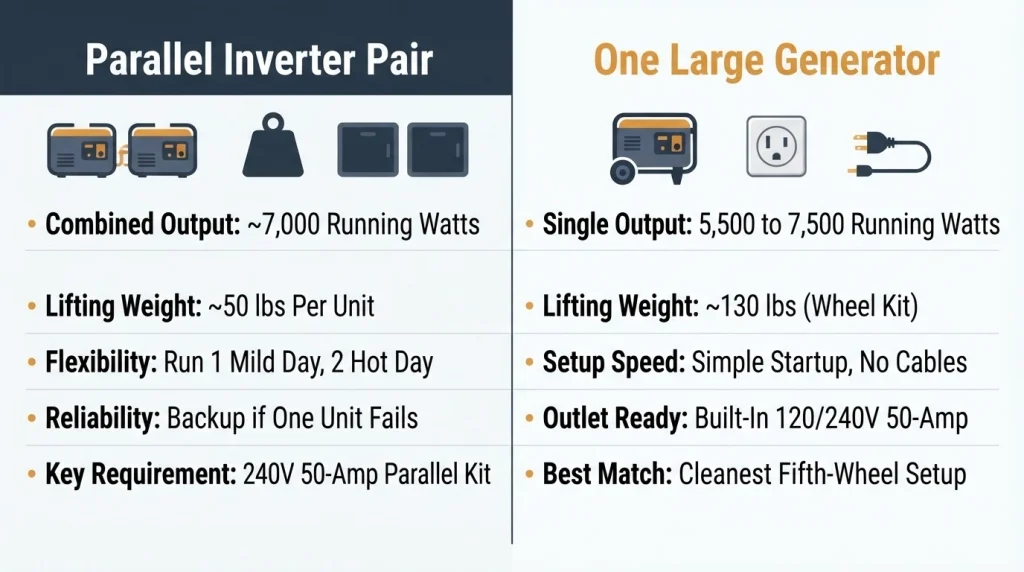
A parallel pair is better if you want lighter lifting, easier storage, and backup power. One large generator is better if you want simple setup, a true 50-amp outlet, and fewer cords.
Two 3,500 running-watt inverter generators in parallel can supply about 7,000 running watts. That can run two air conditioners, but only if the parallel kit supports 240 volts and a 50-amp outlet.
Many parallel kits are 120 volts only, so check the kit specs carefully. A 120-volt parallel pair will not give you full 50-amp power.
When does a parallel pair win?
A parallel pair wins when you camp alone, move the generator often, or want a smaller unit for light trips. You can run one generator for a single air conditioner, then add the second for hot days.
It also gives you a backup if one unit fails. That peace of mind matters on a long trip far from a dealer.
- Weight: Two 50-pound units are easier to lift than one 130-pound unit.
- Fuel use: One small unit can sip fuel on a mild day.
- Storage: Two small units can fit in separate compartments.
When does one large generator win?
One large generator wins when you want a single 50-amp outlet, simple startup, and no parallel cables. It is the cleanest setup for a large fifth wheel.
It also avoids the 240-volt parallel-kit problem. Many large inverter generators are built for 50-amp RVs from the start.
Our roundup of the best portable generators for RV camping can help you compare single units and parallel-friendly models side by side.
Section Takeaway: Parallel pairs offer flexibility and lighter lifting, but only a 240-volt-capable parallel kit or a large single unit gives you true 50-amp power.
How Do You Connect a Generator to a 50-Amp RV Safely?
Use a heavy-duty 50-amp RV cord, plug it into the generator’s 50-amp outlet, and keep the generator outside on level ground. Start the generator, let it stabilize, then connect the RV cord and turn on loads one at a time.
Never run a generator inside a garage, under an awning, or near open windows. Carbon monoxide is colorless and odorless, and it can build up fast.
Safety note: Keep the generator at least 20 feet from your RV and other occupied spaces when possible, follow your owner’s manual, and never backfeed your RV or a house panel. If you are unsure about wiring, have a qualified electrician check it.
What cord and adapter do you need?
Use a 50-amp RV extension cord rated for outdoor use, with the correct four-prong plug. A cheap, thin cord can heat up and drop voltage.
Keep the cord as short as practical, and check it for damage before each trip. Replace a cord with cracked insulation or loose prongs.
- 50-amp cord: Use a 6-gauge, four-wire RV cord for full 50-amp use.
- Adapter: Use a 50-to-30-amp adapter only when you accept the lower power limit.
- Surge protection: Use an RV surge protector or EMS to guard against low voltage and wiring faults.
How do you start loads in the right order?
Start the largest load first, then add smaller loads one at a time. Start one air conditioner, wait for it to settle, then start the second.
That stagger reduces the chance of two compressors starting at the same moment. It is a simple habit that saves a lot of tripped breakers.
The U.S. Consumer Product Safety Commission offers generator safety guidance, and the U.S. Department of Energy explains safe generator use and power basics. Both are worth a quick read before your first trip.
Section Takeaway: Use the right 50-amp cord, keep the generator outside, and start big loads one at a time.
What Mistakes Trip Breakers and Damage Air Conditioners?
The most common mistake is sizing by starting watts instead of running watts. A generator that can start one air conditioner may still fail when you add a microwave, water heater, and fridge.
Low voltage is another silent problem. A generator that is overloaded can drop voltage, and low voltage can stress air conditioner compressors.
Watch for dimming lights, slow fan starts, and frequent overload trips. Those are signs you need to shed a load or size up.
What are the top sizing mistakes?
- Buying by peak watts: Peak watts last only seconds, while running watts decide what you can use all day.
- Ignoring propane derating: Propane often supplies less power than gasoline, so check the manual.
- Forgetting the converter: A converter charging low batteries can draw several hundred watts.
- Running everything at once: Two ACs, a microwave, and a water heater can exceed even a large generator.
- Using a long, thin cord: Voltage drop can make a good generator look weak.
I learned the converter lesson the hard way after a long drive with low batteries. The charger pulled power I had not counted, and the second AC would not start.
Now I charge batteries first, then start the second AC. It is a small change that makes a big difference.
How do you protect your ACs from low voltage?
Use an EMS or surge protector that cuts power on low voltage. It can save a compressor from a brownout.
Also, turn off the electric water heater when both ACs are running. Use propane for hot water when you need full cooling.
Section Takeaway: Size by running watts, manage big loads, and use propane for heat and hot water when both ACs are running.
How Do You Choose the Right Inverter Generator for a 50-Amp RV?
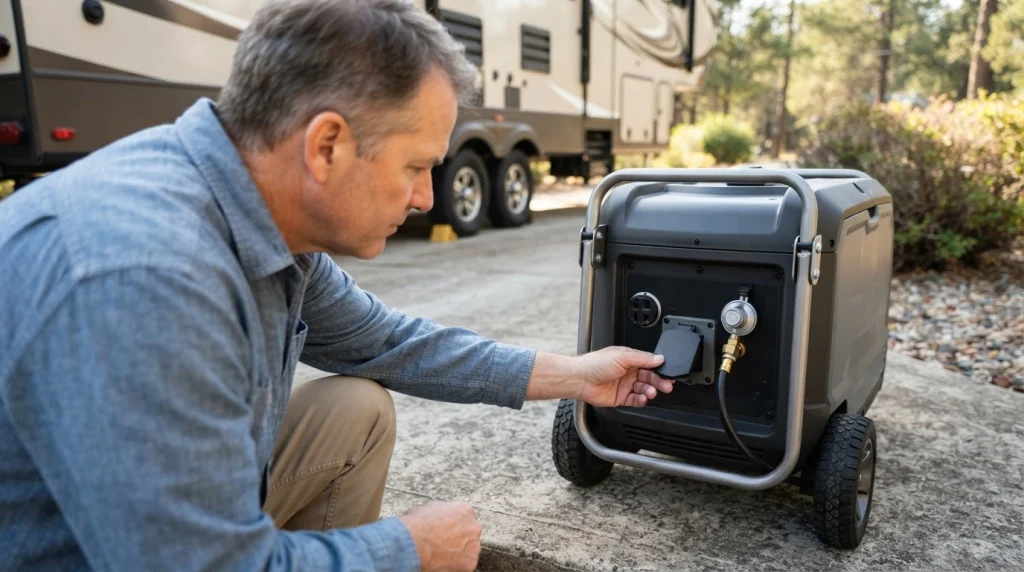
Choose by running watts, outlet type, weight, noise, fuel type, and runtime. A 50-amp RV needs a generator that can supply enough running watts through a true 50-amp outlet.
Check the spec sheet for running watts, not just the headline number. Many listings lead with starting watts, which can mislead buyers.
Also check the noise level at quarter load and the fuel tank size. A quiet, long-running unit is easier to live with at a campground.
What features matter most for a 50-amp RV?
- 50-amp outlet: Look for a 120/240-volt, 50-amp RV outlet, not just a 30-amp twist-lock.
- Running watts: Match the running watts to your two-AC or one-AC plan.
- Clean power: Look for low total harmonic distortion for sensitive electronics.
- Fuel choice: Dual-fuel models offer gasoline and propane, which helps when one fuel is hard to find.
- Remote start: Remote start is handy on cold mornings and hot afternoons.
- Weight and wheels: Check the dry weight and wheel kit, because a 7,500-watt unit is heavy.
Read independent reviews before you buy, and compare the spec sheets side by side. Consumer Reports and the National Fire Protection Association are useful starting points for safety and buying research.
Should you buy a soft-start kit too?
Yes, if you have a borderline generator or two large air conditioners. A soft-start kit can cut the starting surge and make a smaller generator workable.
It does not add running watts, so it will not fix a generator that is far too small. It is best used with a generator that is already close to the right size.
Have a qualified RV technician install it if you are not comfortable with AC wiring. Follow the kit manual and your air conditioner manual.
Section Takeaway: Match running watts and outlet type first, then choose fuel, noise, weight, and remote start to fit your camping style.
Frequently Asked Questions
What size inverter generator do you need for a 50-amp RV with two ACs?
You need 5,500 to 7,500 running watts for two air conditioners in most 50-amp RVs. Two 15,000 BTU units need the higher end, while two 13,500 BTU units can work near the lower end with soft starts.
Can a 4500-watt inverter generator run a 50-amp RV?
Yes, a 4,500 running-watt generator can run a 50-amp RV with one air conditioner and light loads. It cannot run two air conditioners plus a microwave and water heater at the same time.
Can two 3500-watt generators run a 50-amp RV?
Two 3,500 running-watt generators in parallel can supply about 7,000 running watts. They can run a 50-amp RV only if the parallel kit supports 240 volts and a 50-amp outlet.
Do I need a 240V generator for a 50-amp RV?
Yes, you need a 240-volt generator for full 50-amp power. A 120-volt-only generator can feed one leg through an adapter, but it will not power both legs at full capacity.
What size generator do I need for a 50-amp fifth wheel?
Most 50-amp fifth wheels need 5,500 to 7,500 running watts for two air conditioners. Check your air conditioner sizes, fridge type, and water heater fuel before you choose.
Will a 7500-watt inverter generator run everything in my RV?
A 7,500 running-watt generator can run two air conditioners, a fridge, lights, and charging in most RVs. It may still trip if you add a microwave, electric water heater, and hair dryer at the same time.
Final Takeaway: Size for Your Hottest Day, Not Your Easiest One
Buy for the hottest afternoon, not the mild morning. That is the day your air conditioners, fridge, and cooking loads will all want power at once.
For most 50-amp RV owners, that means 5,500 to 7,500 running watts with a true 50-amp outlet. For one-AC use, 3,500 to 4,500 running watts can work with careful load management.
Check your labels, add your loads, and leave headroom for heat and altitude. Your future self, sitting cool inside on a 95-degree day, will thank you.

Hi, I’m Michael Turner. I own a generator workshop in the United States and founded HomeGeneratorBlog to share practical, hands-on guidance about generator installation, maintenance, troubleshooting, safety, and backup power solutions. My goal is to help homeowners make smarter, more confident decisions through clear and reliable information