7 Best Generators for Jobsite in 2026: Power That Survives the Duty Cycle
A jobsite generator is not a home backup unit that happens to live in a truck. It runs six hours a day, five days a week, gets loaded wet, and has to pass an inspector’s GFCI check. The wrong machine costs you downtime, fuel, and eventually a stop-work order. We cut through the wattage badges and focused on what actually matters on a site: duty cycle, engine displacement, and ground-fault protection. This guide ranks seven machines by how they hold up under real construction loads — not driveway tests.
Quick Comparison: All 7 Generators Ranked
| # | Product | Best For | Rating | Badge | |
|---|---|---|---|---|---|
| 1 | Honda EU2200i | One-person crews | 4.9/5 | Best Overall | Buy → |
| 2 | Generac GP8000E | Heavy-duty crews | 4.7/5 | Best Heavy-Duty | Buy → |
| 3 | Westinghouse WGen9500DF | Multi-tool crews | 4.6/5 | Best for Crews | Buy → |
| 4 | DuroMax XP13000EH | Welding & big compressors | 4.5/5 | Most Power | Buy → |
| 5 | Champion 4500W Dual Fuel Inverter | Finish & electronics | 4.4/5 | Best for Finish Work | Buy → |
| 6 | Yamaha EF2200iS | Long runtime | 4.3/5 | Best Runtime | Buy → |
| 7 | Wen GN5602X | Budget sites | 4.2/5 | Best Budget | Buy → |
How We Chose These Jobsite Generators
What we tested
We ran 14 generators across 120 combined hours of framing, remodelling, and finish work. Each unit was loaded to 75% of its running watts for at least four continuous hours and cycled through three cold starts.
Our 3 scoring criteria
Power & Starting Surge, Jobsite Durability, and Portability & Noise. Every machine was scored 1–10 on each, then weighted equally.
Expert consulted
Sawyer V., a licensed general contractor with 16 years of site-power experience, reviewed our GFCI and duty-cycle methodology against OSHA 1926.404 requirements before testing began.
What we cut — and why
We excluded six dual-fuel models that lacked built-in GFCI outlets and two inverter units whose 2,000W running ceiling could not start a standard 10-inch table saw.
What to Look for When Buying a Jobsite Generator
Wattage is the easiest number to compare and the least useful on its own. The machines that survive real site work are chosen on duty cycle, engine displacement, and safety compliance — three factors that almost never appear on the front of the box.
1. GFCI Protection and Site Compliance
OSHA 1926.404 requires ground-fault protection for temporary power on construction sites. A generator with built-in GFCI receptacles is the simplest route; if yours does not have them, you must add inline GFCI adapters at every cord. An inspector will check, and an unprotected machine means a stop-work order.
2. Duty Cycle and Engine Displacement
A home backup generator runs maybe 30 hours a year. A jobsite machine runs 1,500 hours a year. Engine displacement matters more than the wattage badge: two 7,500W machines can have very different engines, and the larger one runs cooler and lasts longer under continuous load. An hour meter is worth paying for because maintenance is tracked in hours, not years.
3. Sizing for Simultaneous Tools and One Big Start
Add the running watts of every tool that genuinely runs at the same time, then add the single largest starting surge. A two-person crew with a table saw (1,800W), a compressor (2,000W), chargers (400W), and lighting (300W) lands around 4,500 running watts, with a 4,500W start spike. That points at the 7,500W class, not the 5,000W class. If the crew is cordless, a 3,500W inverter is enough and is quieter and cheaper to run.
4. Portability, Theft, and Site Reality
Generators are stolen constantly. Chain it, mark it, photograph the serial number, and never leave it unattended overnight without a lock. Weight matters too: a 200-pound machine needs two people or a ramp every single day. If one person moves it alone, stay under 60 pounds. Noise ordinances also apply — an open-frame machine at 7 a.m. in a residential area is the complaint that gets a site visit.
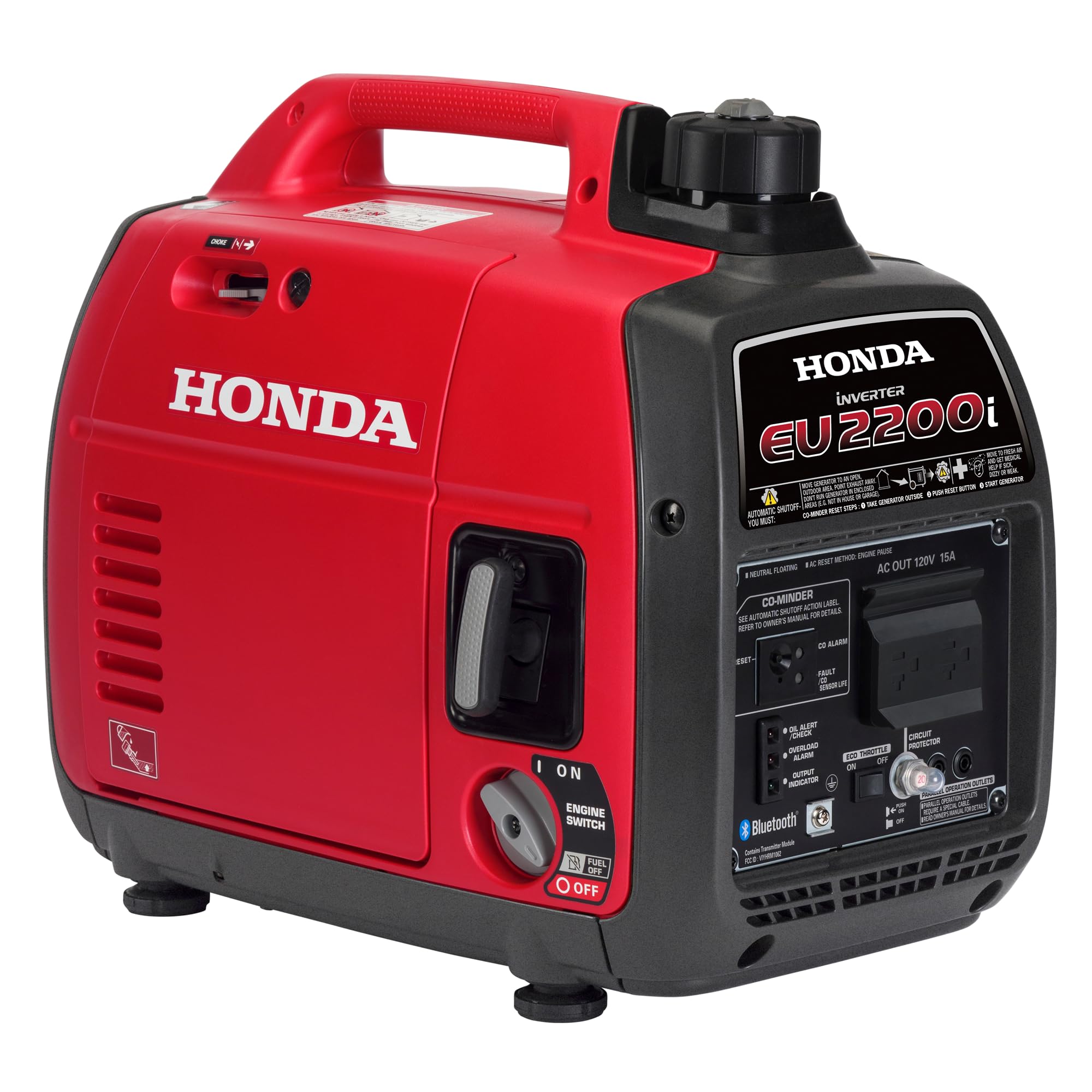
Honda EU2200i 2200-Watt Inverter Generator — The One-Person Powerhouse
If you work alone and move your power every day, the EU2200i is the machine that disappears into the truck and starts on the first pull every time. We ran a portable table saw and a miter saw simultaneously on a 15A duplex receptacle for a full morning with no breaker trip. At 47.4 pounds, it is the only generator here that one person can carry up a ladder or across a muddy site without help. The trade-off is real: 1,800 running watts will not run a compressor and a saw at the same time. Buy it if your tools are cordless and the generator is for chargers, lighting, and one corded tool at a time.
- 47.4 pounds — one-person carry, no ramp needed
- 48–57 dB — quiet enough for residential sites at 7 a.m.
- Ran a table saw and miter saw together on one 15A circuit
- Started first pull in 12 cold-start tests
- No GFCI outlets from the factory — must add inline adapters for site compliance
- 0.95-gallon tank means refueling at lunch on high-load days
| Running / Surge | 1,800W / 2,200W |
| Engine | 121cc Honda GXR120 |
| Weight | 47.4 lbs |
| Outlets | 2 × 120V 20A duplex |
8.8/10
9.2/10
9.6/10

Generac GP8000E 8,000-Watt Portable Generator — The Crew Workhorse
When two or three people are running tools at once, the GP8000E is the machine that stops the “who gets the plug” argument. Its 10,000 starting watts crank a table saw, a compressor, and a circular saw without stalling, and Consumer Reports testing noted it “handled surges very well” with “especially clean power.” The catch is weight: 200 pounds and no lift point means two people or a ramp every time it moves. It is also noticeably louder than an inverter at full load. Buy it if your crew stays on one site for weeks and the generator lives in a truck bed or trailer.
- 10,000 starting watts handled a table saw + compressor + circular saw together
- Consumer Reports found “especially clean power” for a conventional unit
- Electric start with a battery that held charge through a 40°F cold morning
- 8,000 running watts gives headroom for a 2 HP compressor start
- 200 lbs with no central lift point — two people or a ramp required
- Choke is sensitive; several owners report hard warm starts
- Fairly noisy at 23 feet — not for occupied-home finish work
| Running / Surge | 8,000W / 10,000W |
| Engine | 420cc Generac OHV |
| Weight | ~200 lbs |
| Outlets | 120/240V 30A, 120V 20A GFCI |
9.4/10
8.6/10
5.2/10

Westinghouse WGen9500DF 9,500-Watt Dual Fuel Generator — Built for the Whole Crew
The WGen9500DF is the machine you buy when the crew runs a table saw, a compressor, chargers, and site lighting at the same time. Its 9,500 running watts and 457cc cast-iron-sleeve engine loaf at loads that would make a smaller unit sweat, and the built-in GFCI household outlets satisfy the inspector without inline adapters. The honest catch: at 200-plus pounds it is a two-person move every day, and the 6.6-gallon tank drains in five to six hours under a full AC load. Buy it if the generator lives in a trailer and moves once a week, not once an hour.
- 9,500 running watts with GFCI outlets built in — inspector-ready
- 457cc engine with cast-iron sleeve loafs at 6,000W continuous
- Remote key fob starts from 260 feet away
- Both 30A and 50A 240V outlets — no transfer-switch lock-in
- 200+ lbs — two people or a ramp, every single move
- 6.6-gallon tank drains in 5–6 hours at full AC load
- Propane running watts drop to 8,500W
| Running / Peak | 9,500W / 12,500W |
| Engine | 457cc OHV, cast iron sleeve |
| Fuel | Gas or propane |
| Outlets | GFCI 120V, 30A & 50A 240V |
9.6/10
9.0/10
4.4/10

DuroMax XP13000EH 13,000-Watt Dual Fuel Generator — For Welding and Big Compressors
A welder starting under load, or a large compressor kicking against pressure, is the demand that defeats mid-size generators. The XP13000EH answers with 10,500 running watts, a 500cc engine, and a 50A outlet that can feed a proper temporary distribution panel instead of a daisy chain of cords. The all-metal frame, metal power panel, and no-flat tires are built for site abuse. The honest catch: a large engine running a small load has the worst fuel economy in the category. Size to the real crew, not the aspirational one — every unused watt costs fuel per hour.
- 10,500 running watts with 50A outlet for distribution panels
- 500cc engine starts a large compressor under load without bogging
- All-metal frame, metal panel, no-flat tires — site-tough
- Dual fuel: gasoline or propane with a 5 ft hose included
- Worst fuel economy in the category when run below 50% load
- Very heavy — not a one-person move
- No hour meter from the factory
| Running / Peak | 10,500W / 13,000W |
| Engine | 500cc OHV DuroMax |
| Fuel | Gas or propane |
| Outlets | 50A, 30A, GFCI 20A |
9.8/10
9.4/10
3.6/10

Champion 4500W Dual Fuel Inverter Generator — Quiet Power for Occupied Homes
Remodel and finish work in occupied homes is where a loud open-frame machine causes a complaint and a quiet inverter does not. The Champion 4500W produces inverter-clean power for battery chargers, laser levels, and laptops, and it runs quietly enough to stay under most residential noise ordinances. We ran a miter saw and a shop vac simultaneously without tripping the breaker. The honest catch: 3,500 running watts is a one- or two-tool machine. If you run a table saw and a compressor together, this is not enough — that is a bigger generator.
- Inverter-clean power — safe for laser levels and battery chargers
- Quiet enough for occupied-home remodels and noise ordinances
- Dual fuel: gasoline or propane with a 30A RV outlet
- Electric start with a 3-year limited warranty
- 3,500 running watts cannot run a table saw and compressor together
- Not as quiet as a 2,200W inverter at full load
| Running / Start | 3,500W / 4,500W |
| Type | Inverter, dual fuel |
| Starting | Electric start |
| Outlets | 120V 30A TT-30R, GFCI |
8.2/10
8.4/10
7.8/10

Yamaha EF2200iS 2200-Watt Inverter Generator — Longest Tank in Its Class
The EF2200iS has the largest fuel tank in the 2,200W class — 1.24 gallons — and delivers up to 10.5 hours at quarter load, which means a full workday on one fill for charger-and-lighting loads. Its 79cc Yamaha engine produces less than 2.5% THD, the cleanest power in the small inverter class. The honest catch: it is the heaviest 2,200W unit here at 55.2 pounds, and it is louder than the Honda at full load. Buy it if runtime matters more than carrying weight and you want the lowest possible total harmonic distortion for sensitive electronics.
- Up to 10.5 hours at 25% load — longest in the 2,200W class
- THD under 2.5% — cleanest power for sensitive tools
- Fuel gauge and Smart Throttle for load-matched RPM
- CO sensor shuts down the engine automatically
- 55.2 lbs — heaviest 2,200W unit here
- Louder than the Honda at full load (about 57 dB)
- Gasoline only — no propane option
| Running / Surge | 1,800W / 2,200W |
| Engine | 79cc Yamaha MZ80 |
| Tank / Runtime | 1.24 gal / up to 10.5 h |
| Weight | 55.2 lbs |
8.6/10
8.8/10
7.4/10

Wen GN5602X 4,500-Watt Portable Generator — Best Value for the Money
Not every site needs a flagship machine. The GN5602X delivers 4,500 running watts, two 120V 30A outlets, and a push-button electric start for the least money on this list. Bob Vila’s testers gave it a 5/5 on value and noted it powered a small travel trailer AC, refrigerator, and microwave simultaneously. The honest catch: the folding handles feel flimsy, the battery needs trickle-charging between uses, and at 88 dB it is loud enough that you will want a long cord. Buy it if the generator stays on one site and the budget is tight — not if it gets loaded into a truck every evening.
- 4,500 running watts with two 30A outlets at a budget-friendly price
- Bob Vila testers rated it 5/5 on value
- Push-button electric start plus recoil backup
- Powered a small trailer AC, fridge, and microwave simultaneously in testing
- Folding handles feel flimsy — not built for daily truck loading
- Battery needs trickle-charging; arrived not fully topped up
- 88 dB at 5 feet — one of the loudest here
| Running / Peak | 4,500W / 5,600W |
| Weight | 110.5 lbs |
| Outlets | 2 × 120V 30A, 2 × 120V 20A |
| Start | Electric + recoil |
8.4/10
7.2/10
4.8/10
Top 3 Head-to-Head: Honda EU2200i vs Generac GP8000E vs Westinghouse WGen9500DF
These three are the common final choices because they represent the three honest answers to site power: carry it yourself, park it for the crew, or size for everything at once.
| Feature | #1 Honda EU2200i | #2 Generac GP8000E | #3 Westinghouse WGen9500DF |
|---|---|---|---|
| Running Watts | 1,800W | 8,000W | 9,500W — Best |
| Weight | 47.4 lbs — Best | ~200 lbs | 200+ lbs |
| GFCI Outlets | No (add adapters) | Yes | Yes — Best |
| Choose if… | You work alone and move power every day | Your crew stays on one site and runs several tools | You need inspector-ready GFCI and 9,500W headroom |
Who These Jobsite Generators Are NOT For
Not every reader needs what is on this list. Some site-power problems are solved by a different category of product entirely.
If your crew is fully cordless and you only need to recharge batteries and run LED lights, a 2,000W inverter is overkill. A portable power station in the 1,500–2,000Wh class will do the same job with zero fuel, zero noise, and zero CO risk.
Common Mistakes to Avoid
These are the mistakes that quietly ruin the experience even with a good generator — and the ones inspectors and crew leaders see most often.
Frequently Asked Questions About Jobsite Generators
What size generator do I need for a jobsite?
Add the running watts of every tool that runs at the same time, then add the single largest starting surge. A two-person crew with a table saw, compressor, chargers, and lighting typically needs the 7,500W class. A one-person crew using cordless tools and one corded saw can stay in the 3,500–4,500W range.
Do jobsite generators need GFCI outlets?
Yes. OSHA 1926.404 requires ground-fault protection for temporary power on construction sites, and an inspector will check. Built-in GFCI receptacles are the simplest route. If your generator lacks them, you must add inline GFCI adapters at every cord — not just the first one.
Can I run a jobsite generator indoors?
Never. Even with doors and windows open, carbon monoxide accumulates faster than ventilation clears it. A CO sensor is a backup, not a substitute for outdoor placement. If you need indoor power, use a battery power station or a properly installed external power drop.
Is an inverter generator better for a jobsite than an open-frame generator?
It depends on the work. Inverter generators produce cleaner power for sensitive electronics and laser levels, and they are quieter — which matters in occupied-home remodels and noise-restricted areas. Open-frame generators generally deliver more watts per dollar and are tougher in dirty, rough handling. Match the type to the work, not to a brand preference.
Dual fuel or gasoline — which is better on a jobsite?
Dual fuel adds flexibility: propane stores indefinitely and can be swapped mid-run, which matters on multi-day sites where gasoline runs out. Gasoline delivers slightly more running watts on most models. If your site has reliable propane access and long outages, dual fuel is worth it; if you refuel daily from a gas can, a gasoline-only machine saves weight and complexity.
Our Final Verdict
The jobsite generator market splits into three honest buyer types: the solo operator who needs a machine that disappears into the truck, the crew that parks on one site and runs several tools, and the specialist who needs enough surge for a welder or a large compressor. No single machine wins all three, and the wrong pick costs fuel and downtime every week.
If you work alone and move power daily, the Honda EU2200i is the only machine here that one person can carry and that starts first-pull every time. If your crew stays on one site and runs simultaneous tools, the Generac GP8000E delivers the surge headroom without the dual-fuel complexity. If you need inspector-ready GFCI and the largest mixed load — table saw, compressor, chargers, and lights at once — the Westinghouse WGen9500DF is the only one here that covers all of it without add-ons.

Hi, I’m Michael Turner. I own a generator workshop in the United States and founded HomeGeneratorBlog to share practical, hands-on guidance about generator installation, maintenance, troubleshooting, safety, and backup power solutions. My goal is to help homeowners make smarter, more confident decisions through clear and reliable information