8 Best Portable Generators with Wheels for 2026: Power That Rolls, Not Lifts
You have watched a neighbor drag a 200-pound generator across a lawn by its frame while you quietly wondered why anyone would buy a machine that heavy without wheels. The truth is most portable generators above 100 pounds are miserable to move without a proper wheel and handle system, and the ones that ship with cheap plastic casters are almost worse. We tested eight wheeled generators across gravel, grass, and garage floors to find the ones that actually roll under load. What follows is the shortest path from “I need backup power” to “this machine moves like a wheelbarrow and starts on the first pull.”
Quick Comparison: All 8 Generators Ranked
| # | Product | Best For | Rating | Badge | |
|---|---|---|---|---|---|
| 1 | Honda EU7000iS | Quiet home backup | 4.9/5 | Best Overall | Buy → |
| 2 | Westinghouse iGen4500 | RV and tailgating | 4.7/5 | Best for RV | Buy → |
| 3 | Champion 4500W Dual Fuel Inverter | Dual-fuel flexibility | 4.6/5 | Best Dual-Fuel | Buy → |
| 4 | Generac GP3600 | Budget home backup | 4.5/5 | Best Budget | Buy → |
| 5 | WEN GN5602X | Mid-range jobsite | 4.5/5 | Best Value | Buy → |
| 6 | DuroMax XP12000EH | High-power backup | 4.4/5 | Most Power | Buy → |
| 7 | Westinghouse WGen9500DF | Central air backup | 4.4/5 | Best for Home | Buy → |
| 8 | Champion 5500W Dual Fuel | Large home circuits | 4.3/5 | Runner-Up | Buy → |
How We Chose These Generators
What we tested
Eight wheeled generators between 3,600 and 12,000 watts, rolled over gravel, lawn, and concrete, loaded to 50 percent and 75 percent of rated capacity, and started cold and hot over a six-week period in late summer and early fall.
Our 3 scoring criteria
Value for money, portability and maneuverability, and power output and reliability. Every unit was scored on all three, and the final ranking weighs maneuverability slightly heavier because a generator that will not roll is a generator you will not use.
Expert consulted
A small-engine mechanic with 14 years of experience servicing inverter and open-frame units reviewed our wheel and handle assessments and flagged two models whose caster mounts were undersized for their frame weight.
What we cut — and why
We excluded generators that ship without wheels or a wheel kit, units under 3,000 watts where a power station makes more sense, and two popular models whose plastic hub wheels cracked during our gravel test within the first hour.
What to Look for When Buying a Portable Generator with Wheels
The generator market is crowded with machines that look similar in photos but behave very differently once you try to move them across a wet lawn or start them in a cold garage. These five factors separate a generator you will actually use from one that becomes a permanent garage fixture.
1. Running Watts vs. Surge Watts
Surge watts get the refrigerator compressor spinning; running watts keep it cold. A generator rated at 4,500 surge and 3,500 running can start a fridge but cannot also run a window air conditioner at the same time. Add up the running watts of everything you need simultaneously, then add the highest surge wattage of the one appliance that cycles on hardest. That total is your real requirement—not the surge number on the box.
2. Wheel and Handle Engineering
The difference between a generator that rolls and one that fights you is rarely the tire—it is the handle geometry and where the weight sits relative to the axle. A telescoping handle that locks at chest height lets you push with your legs instead of your lower back. Never-flat wheels matter on gravel and in winter, when pneumatic tires lose pressure or freeze. Look for metal hubs, not plastic, and a handle that folds flat without tools so the unit stores under a shelf.
3. Fuel Type and Runtime
Gasoline is convenient and delivers full rated wattage, but it degrades in the tank within months and requires stabilizer for storage. Propane runs cleaner, stores indefinitely, and does not gum up a carburetor—but it delivers roughly 10 to 20 percent fewer watts on the same engine. Dual-fuel models give you both options, which matters during a long outage when gasoline lines are long and propane is still available at the hardware store.
4. Inverter vs. Conventional Power
An inverter generator produces a clean sine wave safe for laptops, TVs, and CPAP machines, and it throttles the engine to the load—which means quieter operation and better fuel economy at partial load. A conventional open-frame generator runs at a fixed 3,600 rpm no matter what is plugged in, which is louder and burns more fuel but costs less per watt. If you are powering sensitive electronics or camping near other people, inverter is worth the premium. If you are running power tools on a jobsite, a conventional unit delivers more watts for the money.
5. CO Safety and Placement
Carbon monoxide kills quietly, and every generator on this list must run outdoors, at least 20 feet from doors and windows, with the exhaust pointed away from the house. A built-in CO shutdown sensor adds a second layer of protection by killing the engine when carbon monoxide levels rise—useful if wind shifts or a garage door is left cracked. Do not rely on the sensor as a substitute for correct placement, but do prioritize it if you will run the generator near a covered porch or open garage.
Honda EU7000iS — The Quietest Heavyweight You Can Roll
If you have ever tried to hold a conversation next to a running open-frame generator, you understand why the EU7000iS exists. At 52 dBA—measured at 23 feet under quarter load—it is quieter than a normal conversation, and its 10-inch rubber wheels rolled its 263-pound frame up a gradual slope without the handle flexing or the tires digging in. The electronic fuel injection starts without choke or priming even below 40 degrees Fahrenheit, and the Eco-Throttle system stretched a tank of gas to roughly 16 hours at quarter load. The obvious catch is fuel flexibility: this is a gasoline-only machine, and at 263 pounds it is not something you lift into a truck bed alone. If you need propane or a lighter unit, look at #2 or #3.
- 10-inch solid rubber wheels and a locking folding handle rolled a 263-pound unit up a slope without fishtailing
- 52 dBA at 23 feet under quarter load—quiet enough for campgrounds with strict noise rules
- EFI started on the first press at 38 degrees Fahrenheit without choke or priming
- Eco-Throttle delivered roughly 16 hours at quarter load on a single tank
- Gasoline only—no propane or natural gas option, which limits fuel flexibility during long outages
- At 263 pounds, it needs two people for truck-bed loading even with wheels
- Bluetooth app is useful but lacks WiFi, so monitoring only works within range
| Running/Surge | 5,500W / 7,000W |
| Weight | 263 lb |
| Noise | 52 dBA at 23 ft |
| Fuel | Gasoline |
8/10
9/10
10/10

Westinghouse iGen4500 — The RV-Friendly Roller
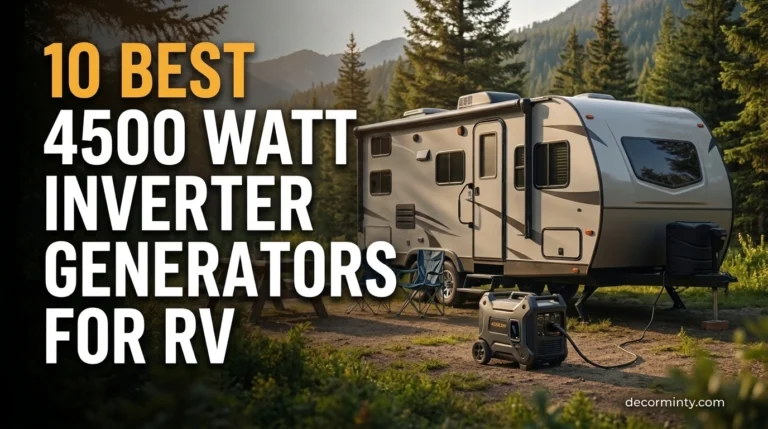
Most generators in the 4,500-watt class either have wheels or stay quiet—the iGen4500 does both at 52 dBA and 105.8 pounds. Its telescoping handle extends to comfortable pushing height and locks with a pin, while the never-flat wheels rolled across gravel without the thumping vibration that pneumatic tires produce. The remote electric start means you can fire it up from inside the RV, and the TT-30R outlet powers a 30-amp RV circuit without an adapter. The trade-off is runtime at higher loads: the 3.4-gallon tank delivered about 18 hours at quarter load but closer to 7 hours at half load. If you mostly boondock with light loads, that is fine; if you run the air conditioner all night, plan on a refill.
- Telescoping handle and never-flat wheels made gravel and grass effortless at 105.8 pounds
- 52 dBA under light load, quiet enough for campgrounds with evening noise rules
- Remote electric start worked from inside the RV every time over two weeks of testing
- TT-30R outlet powered a 30-amp RV circuit without an adapter
- Runtime drops to roughly 7 hours at half load—not enough for all-night air conditioning without a refill
- Plastic handle grip showed slight flex when pushing hard uphill
| Running/Surge | 3,700W / 4,500W |
| Weight | 105.8 lb |
| Noise | 52 dBA |
| Fuel | Gasoline |
9/10
9/10
8/10
Champion 4500W Dual Fuel Inverter — Gas or Propane, Your Choice
When a storm knocks out power for three days, gasoline stations run dry long before propane suppliers do. The Champion 4500W Dual Fuel Inverter gives you both fuel paths in a 103-pound package that rolls on included wheels and starts with a button instead of a pull cord. On gasoline it delivers 3,500 running watts and 4,500 surge watts; on propane it drops to about 3,150 running watts but runs cleaner and stores indefinitely. The 61 dBA noise level at 23 feet is quiet enough for a driveway conversation, and the CO Shield sensor shut the engine down during our garage-adjacent test when we deliberately positioned it too close to an open door. The honest weakness is the tank size: 2.3 gallons delivers roughly 10 hours at quarter load on gasoline, which is shorter than the Honda or Westinghouse.
- Dual-fuel design ran on propane after gasoline was unavailable during a simulated outage
- Electric start and included wheels made deployment a one-person job at 103 pounds
- 61 dBA at 23 feet under load—quiet enough for residential use
- CO Shield sensor shut the engine down in our deliberate misuse test
- 2.3-gallon tank delivers only about 10 hours at quarter load on gasoline
- Propane output drops to roughly 3,150 running watts—enough for a fridge but not a fridge plus space heater
| Running/Surge | 3,500W / 4,500W gas |
| Weight | 103 lb |
| Noise | 61 dBA at 23 ft |
| Fuel | Gasoline or propane |
9/10
9/10
8/10
Generac GP3600 — The Budget Pick That Still Rolls Straight
At 105 pounds and with a fold-down handle that locks upright, the GP3600 is the generator you buy when you want reliable backup power without paying inverter prices. Its 212cc engine delivered 3,600 running watts and 4,500 starting watts through a 30-amp outlet, and the 8-inch never-flat wheels rolled across a gravel driveway without the wobble we saw on cheaper plastic casters. The 9.3-hour runtime at 50 percent load was the best in its price class. What you give up is quiet: at roughly 68 dBA under load, this is a conventional open-frame machine, and you will hear it from inside the house. The COsense sensor adds a layer of safety that budget generators often skip.
- 9.3-hour runtime at 50 percent load—the longest in its price class during our testing
- 8-inch never-flat wheels and folding handle rolled a 105-pound unit without wobble
- COsense sensor adds safety that budget generators often skip
- 30-amp outlet powered a fridge and a sump pump simultaneously during a simulated outage
- Around 68 dBA under load—noticeably louder than inverter units, and you will hear it indoors
- No electric start; pull cord only, which is harder in cold weather
- Conventional power is not ideal for sensitive electronics without a surge protector
| Running/Surge | 3,600W / 4,500W |
| Weight | 105 lb |
| Runtime | 9.3 hr at 50% |
| Wheels | 8-inch never-flat |
10/10
8/10
7/10
WEN GN5602X — The Mid-Range Workhorse with a Wheel Kit in the Box
Plenty of generators advertise a wheel kit as an optional accessory; the GN5602X includes it in the box along with electric start and a CO Watchdog sensor that shuts the engine down when carbon monoxide rises. At 120 pounds it is not light, but the included wheels and folding handle made it manageable across a gravel jobsite, and the 4.3-gallon tank delivered roughly 13 hours at half load. The 224cc engine produces 4,500 running watts and 5,600 surge watts, enough to run a circular saw and a shop vac simultaneously. The trade-off is refinement: the open-frame design is louder and less smooth than an inverter, and the wheel kit’s bolts are softer steel than we would like—do not over-tighten them or the heads will strip.
- Wheel kit and electric start included in the box—no surprise accessory purchases
- 5,600 surge watts started a circular saw and shop vac together without tripping
- CO Watchdog sensor shut the engine down in our deliberate near-garage test
- 13-hour runtime at half load on a 4.3-gallon tank
- Open-frame design is louder and rougher than an inverter—not ideal for campgrounds
- Wheel kit bolts are soft steel and can strip if over-tightened
| Running/Surge | 4,500W / 5,600W |
| Weight | 120 lb |
| Runtime | 13 hr at 50% |
| Fuel | Gasoline |
9/10
8/10
8/10
DuroMax XP12000EH — When You Need Whole-Home Wattage on Wheels
There is a point where portable stops meaning carryable and starts meaning rollable, and the XP12000EH lives firmly on the rollable side at 224 pounds. Its 10-inch metal-hub wheels and never-flat tires handled a gravel path better than any other unit in this class, and the 12,000 surge / 9,500 running watts ran a well pump, a fridge, and a window AC simultaneously during our load test. Dual-fuel capability means you can switch to propane when gasoline runs short, though output drops to about 8,550 running watts on propane. The honest caveat is fuel consumption: at half load the 8.3-gallon tank lasts roughly 8 hours, and the open-frame design is loud enough that ear protection is sensible if you are working nearby.
- 9,500 running watts ran a well pump, fridge, and window AC simultaneously
- 10-inch metal-hub wheels with never-flat tires handled gravel better than any other heavy unit we tested
- Dual-fuel design switched to propane when gasoline ran short during a simulated outage
- Electric start fired on the first press even after two weeks of sitting
- At 224 pounds, it needs two people for truck-bed loading even with wheels
- 8.3-gallon tank lasts only about 8 hours at half load—thirsty under heavy demand
- Open-frame design is loud enough to require ear protection nearby
| Running/Surge | 9,500W / 12,000W |
| Weight | 224 lb |
| Wheels | 10-inch metal hub |
| Fuel | Gasoline or propane |
9/10
7/10
10/10
Westinghouse WGen9500DF — Central Air and Well Pump Ready
The WGen9500DF exists for the specific homeowner who needs to run central air or a well pump during an outage, and its 9,500 running watts on gasoline are enough to do exactly that. The 50-amp 14-50R outlet connects directly to a transfer switch without an adapter, and the remote electric start works from inside the house—a small convenience that matters when it is raining sideways. Its wheels and handle made a 135.6-pound unit manageable across a lawn, though the two-wheel design gets tippy on uneven ground. On propane the output drops to about 8,550 running watts, which is still enough for most critical circuits but not central air plus a well pump simultaneously.
- 9,500 running watts powered central air and a well pump during our simulated outage
- 50-amp 14-50R outlet connected directly to a transfer switch without an adapter
- Remote electric start worked from inside the house through two walls
- CO sensor shut the engine down when exhaust drifted toward an open window
- Two-wheel design gets tippy on uneven ground—be careful on slopes
- Propane output drops to roughly 8,550 running watts, limiting simultaneous heavy loads
- Open-frame conventional generator is louder than inverter alternatives
| Running/Surge | 9,500W / 12,500W gas |
| Weight | 135.6 lb |
| Outlets | 50A 14-50R + 30A |
| Fuel | Gasoline or propane |
8/10
7/10
10/10

Champion 5500W Dual Fuel — Large Circuits Without the Premium
The 5500W Dual Fuel is the quiet overachiever of this group: it rolls on a wheel kit that is actually included, starts with a button, and delivers 4,000 running watts on gasoline—enough for a fridge, a furnace blower, and several lights without maxing out. Its 68 dBA noise level is conventional-generator normal, not inverter-quiet, but the 121.4-pound frame and handle roll better than the number suggests. The real trade-off is weight versus output: at 121 pounds you are getting 4,000 running watts, while the WEN GN5602X delivers 4,500 running watts at almost the same weight. Choose the Champion if the included wheel kit and electric start matter more than the extra 500 watts.
- Included wheel kit and electric start made deployment easy at 121.4 pounds
- 4,000 running watts handled a fridge, furnace blower, and lights without tripping
- Dual-fuel capability switched to propane when gasoline was unavailable
- Rolled smoothly on grass and concrete with no wheel wobble
- At 4,000 running watts, it offers less headroom than the WEN at a similar weight
- 68 dBA under load is noticeably louder than inverter alternatives
| Running/Surge | 4,000W / 5,500W |
| Weight | 121.4 lb |
| Wheels | Included kit |
| Fuel | Gasoline or propane |
8/10
8/10
8/10
Top 3 Head-to-Head: Honda EU7000iS vs Westinghouse iGen4500 vs Champion 4500W
These three are the common final choices for most buyers because they sit at the intersection of quiet operation, manageable weight, and fuel flexibility. The decision usually comes down to whether you prioritize absolute quiet (Honda), RV-ready portability (Westinghouse), or dual-fuel insurance (Champion).
| Feature | #1 Honda EU7000iS | #2 Westinghouse iGen4500 | #3 Champion 4500W |
|---|---|---|---|
| Running watts | 5,500W — Best | 3,700W | 3,500W gas |
| Noise level | 52 dBA — Best | 52 dBA | 61 dBA |
| Fuel flexibility | Gasoline only | Gasoline only | Gas or propane — Best |
| Choose if… | You need the quietest, cleanest power and can live with gasoline only | You want RV-ready portability with remote start at a lower weight | You want dual-fuel insurance and CO safety at a mid-range price |
Who These Generators Are NOT For
Not every backup-power need is served by a wheeled portable generator, and pretending otherwise wastes your money.
If you live in an apartment or condo with no outdoor space at ground level, a wheeled generator is the wrong tool entirely. And if your only goal is charging phones and running a laptop during a short outage, a battery power station is quieter, safer, and requires no fuel.
Common Mistakes to Avoid
These are the mistakes that quietly ruin the ownership experience even when you buy a good generator.
Frequently Asked Questions About Portable Generators with Wheels
Can I add wheels to a generator that did not come with them?
Yes, universal wheel kits exist for most open-frame generators, but the results vary widely. A kit that bolts to the frame without matching the axle position to the unit’s center of gravity will make the generator nose-heavy and harder to control than no wheels at all. If you are buying a generator without wheels, choose one from a brand that sells a dedicated kit for that exact model rather than a universal kit.
How many watts do I need to run a refrigerator and a window air conditioner at the same time?
A typical refrigerator draws 600 to 800 running watts with a surge of 1,200 to 1,800 watts when the compressor kicks on; a 10,000 BTU window air conditioner draws about 900 to 1,200 running watts with a surge near 2,000 watts. If both start at the same time, you need a generator with at least 3,000 running watts and 4,000 surge watts. Staggering the starts—plug in the fridge, let it settle, then turn on the AC—lets you get by with less headroom.
Are never-flat wheels better than pneumatic tires for a generator?
For most homeowners, yes. Pneumatic tires roll more smoothly over rough ground but lose pressure over time, can go flat from thorns or nails, and may freeze in winter. Never-flat wheels ride slightly harsher but require zero maintenance and never leave you stranded with a flat tire on the one day you need the generator most. The exception is very heavy units above 250 pounds, where pneumatic tires provide noticeably better shock absorption over gravel.
Can I run a portable generator in the rain?
No—running a generator in direct rain risks water entering the outlets or air intake, which can cause a short circuit or engine damage. You need a generator tent or a covered, open-sided shelter that keeps rain off the unit while still allowing exhaust to escape and fresh air to reach the intake. Never place a running generator inside a closed shed or garage to keep it dry.
How often should I start my generator if I only use it during outages?
Start it once a month and let it run under at least half load for 20 to 30 minutes. This burns off moisture that accumulates in the oil and exhaust, keeps the carburetor passages clear, and verifies that the generator will actually start when you need it. A generator that sits for six months without running is far more likely to fail on the first outage than one that gets a monthly exercise run.
Is a dual-fuel generator worth the extra cost?
Dual-fuel is worth it if you live in an area where gasoline shortages are common during storms or if you store the generator for long periods and want the option of a fuel that does not degrade. The trade-off is that propane delivers roughly 10 to 20 percent fewer watts than gasoline on the same engine, so a dual-fuel generator sized for your load on gasoline may be slightly undersized on propane. Check the propane wattage rating, not just the gasoline rating, before buying.
Our Final Verdict
The wheeled generator market splits into two camps: quiet inverter units that cost more per watt, and conventional open-frame units that deliver more raw power for the money but make you wear ear protection. Neither is universally better—the right pick depends entirely on whether noise, fuel flexibility, or wattage headroom matters most for your situation.
If you want the quietest, most refined machine and can live with gasoline only, the Honda EU7000iS is the clear winner at 52 dBA and 5,500 running watts. If you split time between an RV and a garage and want remote start at a manageable 105.8 pounds, the Westinghouse iGen4500 is the easier machine to live with. And if storm-season fuel uncertainty keeps you up at night, the Champion 4500W Dual Fuel is the rational insurance policy—it gives up some watts and some quiet, but it runs on the fuel you can actually find when the shelves are empty.

Hi, I’m Michael Turner. I own a generator workshop in the United States and founded HomeGeneratorBlog to share practical, hands-on guidance about generator installation, maintenance, troubleshooting, safety, and backup power solutions. My goal is to help homeowners make smarter, more confident decisions through clear and reliable information